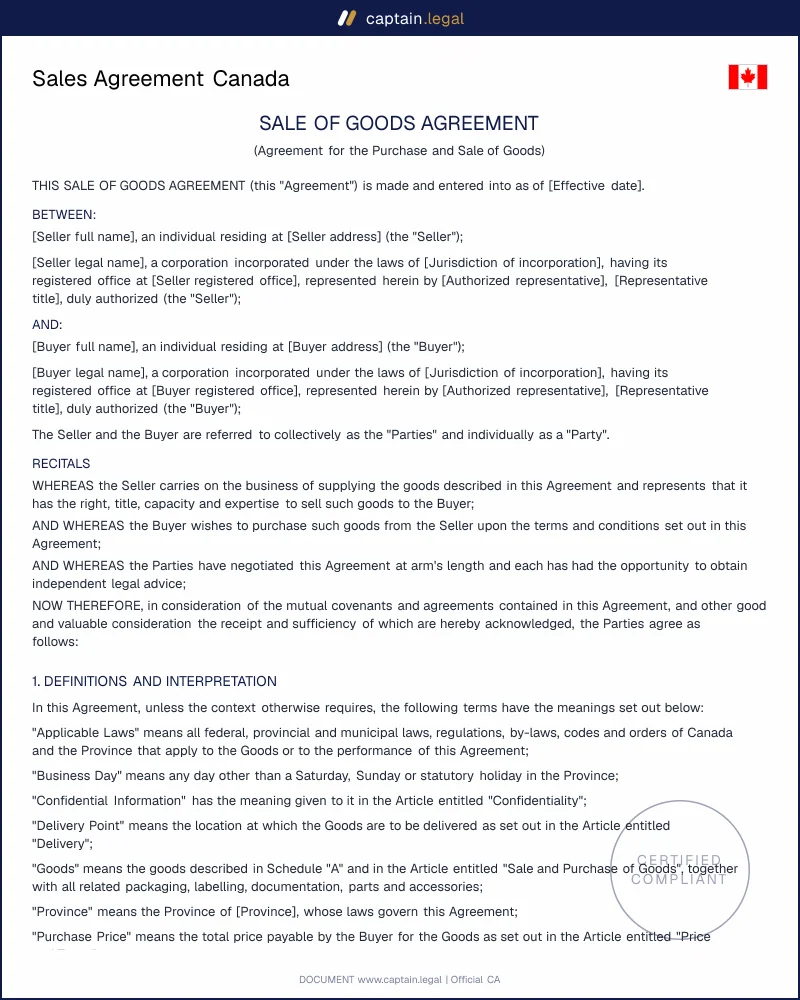
Contracts for the sale of goods in Canada's common-law provinces are governed by two layers working together: the general common law of contract, and each province's Sale of Goods Act. Ontario applies the Sale of Goods Act, R.S.O. 1990, c. S.1; British Columbia applies the Sale of Goods Act, R.S.B.C. 1996, c. 410; Alberta applies the Sale of Goods Act, R.S.A. 2000, c. S-2; and Nova Scotia, Manitoba, Saskatchewan and the others have their own substantially similar versions, all descended from the original English Sale of Goods Act 1893. Quebec stands apart, governed instead by the Civil Code of Québec, so the analysis below applies to the common-law provinces. Where a sale crosses borders between businesses in different countries, the United Nations Convention on Contracts for the International Sale of Goods, brought into Canadian law by the federal International Sale of Goods Contracts Convention Act, may apply by default unless the parties exclude it.
The statute matters most for what it inserts silently. Each Sale of Goods Act implies a condition that the seller has the right to sell, that goods sold by description match that description, and that goods bought from a seller who deals in them are of merchantable quality and reasonably fit for purpose. These implied terms bind even when the written contract says nothing about quality, which is why a buyer who receives defective goods can repudiate the contract or claim damages without proving negligence. On price, section 9 of the Ontario Act lets the parties fix the amount, leave it to be set by an agreed mechanism, or rely on the course of dealing, and if none of that is done the buyer must pay a reasonable price, a question of fact in each case. Businesses can contract out of most of these default rules, but only with clear language; a vague clause will not displace a statutory implied condition. Consumer sales are a separate matter, since provincial consumer protection statutes prohibit waiving certain warranties altogether.
On form, there is no general requirement that a sale of goods be in writing. Section 4 of Ontario's Act confirms a contract of sale may be made in writing, by word of mouth, or partly by each. A written agreement is still strongly advisable for evidence and certainty. For a plain-language overview of how these statutes operate, the Government of Ontario's consolidated Sale of Goods Act is the authoritative provincial source, available through the Ontario e-Laws consolidation of the Sale of Goods Act. For the wider commercial paperwork around a transaction, the employment contract templates for Canadian businesses handle the staff who fulfil the orders.