Create my document
Login

Choose country

CanadaCanadaChoose country
Business

Partnership Agreement Template Canada | Partnerships Act

Override the Partnerships Act default rules with a lawyer-grade partnership agreement covering contributions, profit sharing and dissolution. Word and PDF.
4.7/528 reviews50 000+ downloadsInstant download
Share

A handshake and a shared bank account feel like enough to launch a business with someone you trust. They are not. A partnership agreement is the contract that turns an informal arrangement into a governed business relationship, fixing how partners contribute capital, split profits and losses, make decisions and unwind the venture if it ends. In Canada a general partnership can arise the moment two people carry on business together for profit, even with nothing in writing, which is why the written agreement matters so much. Without one, the default rules of your provincial partnership statute decide questions you may never have discussed, and rarely in the way you would have chosen.

Compliant

2026 Legislation

50,000+ clients

trust us

Affordable

From $4.90 / doc

Secure payment

Instant download

Partnership Agreement Template Canada | Partnerships Act

Secure payment · No subscription

Fill in the template

What is a partnership agreement?

A partnership agreement is a private contract among two or more persons who carry on business in common with a view to profit. It is the foundational governance document for a general partnership, and it sits on top of the relationship the law already recognizes once partners begin operating together. The agreement does not create the partnership the way articles of incorporation create a corporation. Instead, it organizes a relationship that provincial partnership law treats as existing by conduct, and it replaces the statutory default rules with terms the partners have actually negotiated.

People often confuse a partnership agreement with a shareholder agreement or a corporation's governing documents, but they rest on different legal foundations. A corporation is a separate legal person that shields its owners from most business debts. A general partnership is not separate from its partners, who remain jointly and severally liable for the debts and obligations of the firm. That single difference drives most of what a careful agreement addresses: liability allocation, indemnities, capital accounts and exit terms. A well-drafted agreement also distinguishes a general partnership from a limited partnership, where limited partners contribute capital but stay out of management to keep their liability limited.

2

When do you need this document?

The clearest trigger is the start of any business owned by two or more people who are not incorporating. Two consultants joining forces, three siblings running a family restaurant, a group of tradespeople pooling tools and clients: each is a partnership in law from day one, and the agreement is what stops the Partnerships Act defaults from filling the silence with equal splits nobody intended. You also need a fresh or amended agreement whenever a partner joins or leaves, because the admission of a new partner and the retirement or death of an existing one are exactly the events the statute handles crudely if the partners have not addressed them.

Unequal contributions are another common reason to put terms in writing. When one partner invests the working capital and another brings only labour, the statutory presumption of equal profit sharing can produce a result that feels deeply unfair once the business succeeds. The agreement lets you tie distributions to capital accounts, to fixed percentages, or to a formula that rewards both money and effort. A useful edge case worth flagging is the implied partnership that forms without anyone meaning to create one. Sharing profits is strong evidence of partnership, so two people who split the net revenue of a side venture may already be partners exposed to joint liability. If you are sharing profits with someone, you may already be in a partnership whether you signed anything or not. Anyone weighing a partnership against incorporation should review the broader Canadian business and incorporation documents before settling on a structure.

3

Key clauses included in our template

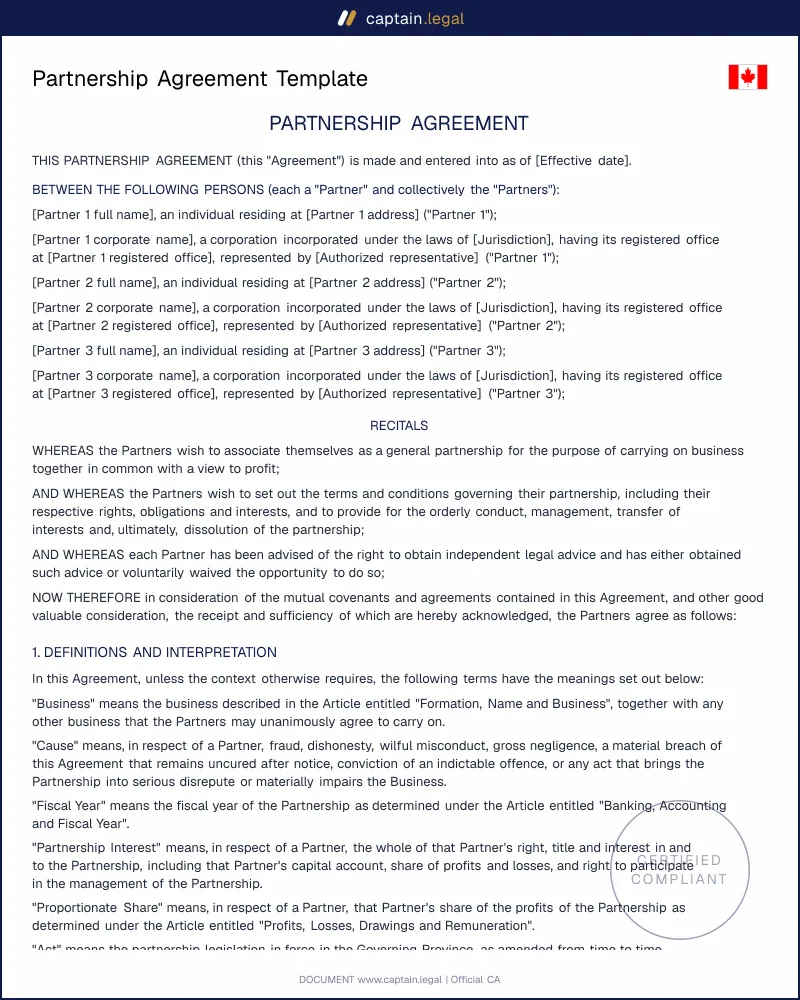
  • The identification of the partners and the firm records every partner's full legal name, the partnership's business name and the province whose law governs the agreement. This anchors the contract to a specific statute, which matters because the Partnerships Act of the chosen province supplies the background rules and determines where the firm registers its name.
  • The capital contributions clause sets out exactly what each partner contributes, whether cash, property, equipment or services, and the value attributed to each. It establishes the opening capital accounts that later govern distributions and the return of capital on dissolution, displacing the statutory presumption that everyone contributed equally.
  • The profit and loss allocation clause fixes how income and losses are divided, by fixed percentage, in proportion to capital, or under a formula that blends both. Because section 24 of the Ontario Act otherwise imposes equal sharing, this is often the single most important reason partners draft an agreement at all.
  • The management and decision-making clause defines who runs the business day to day, which decisions need a majority and which need unanimous consent, and how deadlocks are broken. It can reserve major matters such as taking on debt, admitting partners or selling assets for unanimous approval while leaving ordinary operations to designated managing partners.
  • The admission, retirement and dissolution clause governs the life cycle events the statute handles bluntly, setting out how a new partner is admitted, how a departing partner's interest is valued and paid out, and what triggers a winding up. For partners who also expect to hire staff, pairing it with a proper Canadian employment agreement keeps the workforce on equally solid footing.
4

Regional considerations

Ontario partnerships run on the Partnerships Act, R.S.O. 1990, c. P.5, whose section 24 default rules impose equal profit sharing and equal management rights unless the agreement says otherwise. The province also enforces the Business Names Act, and a general partnership using a business name must register it; an unregistered firm can be blocked from maintaining a court proceeding on its business until it registers. Treat name registration as a precondition to enforcing contracts, not an afterthought.

British Columbia applies the Partnership Act, R.S.B.C. 1996, c. 348, which mirrors Ontario's default scheme of equal sharing and joint liability. Registration of the partnership and its business name runs through BC Registries, and the framework for limited partnerships and limited liability partnerships sits in the same statute, so a BC agreement should state plainly which form the partners intend.

Alberta governs partnerships under the Partnership Act, R.S.A. 2000, c. P-3, following the common pattern of presumed equality and unlimited liability for general partners. Alberta requires registration of trade names and partnership declarations with the Corporate Registry, and partners carrying on business there should confirm the filing is current before relying on the firm name in contracts.

Quebec is the outlier. Partnerships are governed by the Civil Code of Québec rather than a partnership act, and the province recognizes general, limited and undeclared partnerships with their own registration rules through the enterprise register. An agreement drafted for a common-law province will not map cleanly onto Quebec law, so a Quebec venture needs terms and citations built for the Civil Code. Partners operating across provincial lines should also watch for extra-provincial registration, since carrying on business in a second province usually requires a separate filing there.

5

How to fill out this partnership agreement

You begin by selecting the province whose law will govern the partnership, since that single choice determines which statute supplies the default rules and where the business name must be registered. From there the template asks for each partner's full legal name and the firm's operating name, then moves to the financial core of the agreement. You enter what every partner is contributing, in cash, property or services, and the value assigned to each contribution, which the document uses to set up the opening capital accounts.

Next you choose how profits and losses are shared, whether equally, by fixed percentages or in proportion to capital, and the form adjusts the language accordingly. You then set the management terms, deciding which decisions a majority can make and which require every partner to agree, and you specify how a partner can be admitted or bought out. The final stage covers dissolution and dispute resolution, after which the agreement is ready to download in Word and PDF for signature. Partners who expect to share confidential information often pair it with a Canadian non-disclosure agreement at the same time.

6

Common mistakes to avoid

The most frequent and most expensive mistake is having no agreement at all and assuming goodwill will cover the gaps. The moment a dispute arises, the Partnerships Act steps in with equal profit sharing and equal management rights, and partners who contributed unequal money or effort discover the law does not care. A close second is drafting an agreement that says nothing about exit, so the death, insolvency or simple departure of one partner dissolves the entire firm by operation of statute and forces a fire-sale winding up nobody wanted. Partners also routinely forget to register the business name, which in Ontario can stop the firm from enforcing its own contracts until the registration is fixed.

Other errors are subtler but just as damaging. Vague profit clauses that refer to "fair shares" without a formula invite litigation, because a court asked to interpret them will often fall back on the statutory equal split. Partners frequently overlook the joint and several liability that attaches to a general partnership, signing personal guarantees or large supply contracts without realizing each of them is fully exposed for the whole debt. Many agreements are also silent on dispute resolution, leaving partners to fight in court when a simple arbitration or buy-sell clause would have settled the matter privately. Founders who own property together should also keep their personal affairs in order with the right Canadian wills and powers of attorney.

Key takeaways

Default rules

The statute decides if you do not

A general partnership can exist the moment two people carry on business together for profit, even without a signed document. If you do not have a written partnership agreement, the default rules in your provincial Partnerships Act will fill the gaps, often in ways you did not discuss. The whole point of the agreement is to replace those defaults with terms you actually negotiated.

Liability

Partners are jointly and severally liable

Unlike a corporation formed under the CBCA or a provincial Business Corporations Act, a general partnership is not a separate legal person that shields owners from most business debts. Partners remain jointly and severally liable for the firm’s obligations. That reality drives the need for clear provisions on liability allocation, indemnities, capital accounts, and what happens when a partner exits or the venture winds down.

Profit split

Equal sharing is the legal default

Under section 24 of Ontario’s Partnerships Act (and similar provisions in other common-law provinces), partners share capital and profits equally and contribute equally to losses unless they agree otherwise. Management rights are also equal by default: ordinary decisions are by majority, but a change in the nature of the business requires unanimous consent. If one partner invests more money or labour, spell out a different split in writing.

Frequently Asked Questions

Yes. A partnership agreement is a contract, and once the partners sign it intending to be bound, it is enforceable like any other commercial agreement under the common law of contract in the common-law provinces. It does not require notarization or witnesses to be valid, and an electronic signature carries the same weight as ink under provincial electronic commerce legislation. What makes it binding is genuine agreement among the partners on its terms, supported by the consideration each provides through capital, services or mutual promises. The agreement also displaces the default rules of the Partnerships Act, so wherever its terms conflict with the statute, the contract generally prevails between the partners.

No, and that is exactly the trap. A general partnership forms automatically once two or more people carry on business in common with a view to profit, with no document required. The risk is that the absence of an agreement leaves your provincial partnership statute to govern by default, imposing equal profit sharing, equal management rights and automatic dissolution on a partner's death or departure. A written agreement is not a legal precondition to partnership, but it is the only practical way to set terms that reflect what the partners actually intended rather than what the statute assumes.

Equally, in most provinces, no matter what each partner actually contributed. Under section 24 of the Ontario Partnerships Act and the equivalent provisions elsewhere, partners share capital and profits equally and contribute equally toward losses unless they have agreed otherwise. This default frequently produces unfair outcomes, because a partner who invested most of the money or did most of the work receives the same share as one who did neither. The agreement exists precisely to override this presumption, letting partners tie distributions to capital accounts, fixed percentages or a negotiated formula that matches their real bargain.

In a general partnership, yes. Partners are jointly and severally liable for the debts and obligations of the firm, which means a creditor can pursue any single partner for the entire amount owed, not merely that partner's share. This unlimited personal liability is the defining risk of the general partnership form and the main reason some founders choose to incorporate instead. A partnership agreement can set out indemnities among the partners so that one who pays more than a fair share can recover from the others, but it cannot limit liability toward outside creditors.

The completed partnership agreement downloads in both Microsoft Word and PDF. The Word file lets you make further edits, add schedules or adjust clauses as the partnership grows, while the PDF gives you a clean, fixed version ready for signature and record-keeping. Many partners keep the signed PDF in the firm's permanent records and retain the Word version for future amendments when partners are admitted or terms change. Both formats reproduce the same governed terms, so you can sign either one and treat it as the binding agreement.

The agreement itself is not filed, but the partnership's business name usually must be registered under provincial business names legislation. In Ontario, a general partnership operating under a business name registers that name, and failure to do so can prevent the firm from maintaining a court proceeding on its business until the registration is corrected. Registration timelines and authorities differ by province, so partners should confirm the requirement in their own jurisdiction. The private agreement stays among the partners; only the name and, for limited partnerships, a declaration, become part of the public record.

Through the terms you set in the agreement itself. A well-drafted document specifies how a new partner is admitted, how a departing partner's interest is valued and paid, and what events trigger a winding up, so that one partner's exit does not automatically collapse the firm. Without those terms, the Partnerships Act default can dissolve the partnership on a partner's death, insolvency or notice, forcing an unplanned liquidation. Amending the agreement generally requires the consent the document specifies, often unanimous, and a clean amendment signed by all partners keeps the governance current as the business evolves.

4.7/5

28 verified reviews · 50 000+ downloads

Partnership Agreement Template Canada | Partnerships Act
  • Immediate access to the document
  • PDF + Word download
  • Compliant with 2026 legislation
  • Reviewed by lawyers
Fill in the template
Secure payment · No subscription
Updated on June 20, 2026

You might also like

Consulting Agreement Canada
Service Agreement Template Canada