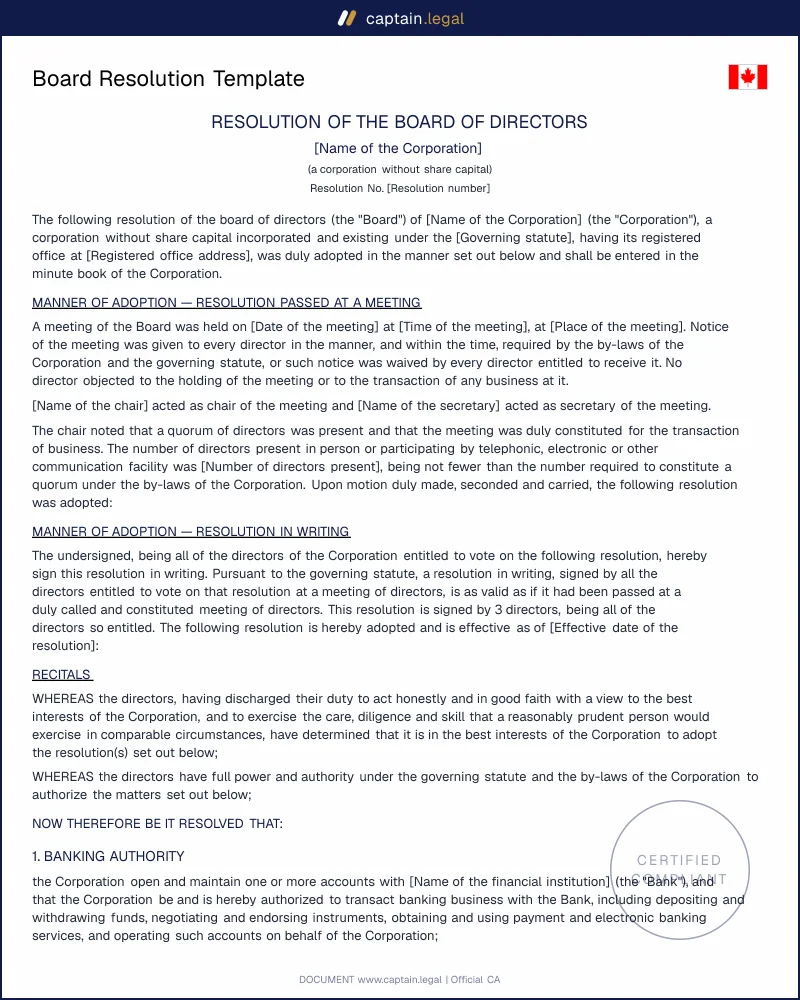
The most frequent trigger by a wide margin is banking. When you open the organisation's account, change financial institutions, add or remove signing officers, or apply for a credit facility, the bank will refuse to act on anyone's say-so and will demand a board resolution naming exactly who is authorized to sign. Treasurers learn this fast: the cheque book stays locked until the resolution lands on the branch manager's desk. The same applies when you set up online banking or a payment processor for donation and sponsorship arrangements.
Appointing or removing officers is the next common scenario. After incorporation, and at the first meeting following each annual members' meeting, the board passes resolutions confirming the president, treasurer, secretary and any other officers, fixing their terms and their authority. Approving the financial statements before they go to members, authorizing a lease or major contract, adopting a conflict-of-interest or governance policy for the organisation, and authorizing a grant application or a significant expenditure all run through board resolutions too.
Two edge cases deserve attention. First, a charity contemplating a transaction with a connected person (a director's company, for instance) needs a resolution that records the conflict disclosure and the abstention from voting, because section 141 of the NFP Act bars an interested director from voting on it. Second, where the by-laws permit consensus decision-making, the secretary still has to produce a written resolution capturing the consensus, since a bank or auditor will not accept "we reached consensus" as documentary proof. No resolution, no authority you can prove.