Create my document
Login

Choose country

CanadaCanadaChoose country
Personal & Family

Gift Deed Canada | Pecore v Pecore SCC Compliant

Gift deed drafted to Canadian common law and Pecore v. Pecore, 2007 SCC 17. Donative intent, delivery and witness clauses built in. Word and PDF download.
4.7/521 reviews50 000+ downloadsInstant download
Share

A gift deed (also called a deed of gift) records the voluntary transfer of money or personal property from one person to another without any payment or consideration in return. Canadian courts treat gifts with more suspicion than most donors expect: a transfer that is not properly documented can be reclassified years later as a loan, a trust, or unreported income. This gift deed template is drafted for the common-law provinces and territories of Canada, with an irrevocability clause, a declaration of donative intent, and the witness attestation that gives the document weight in front of a judge or the Canada Revenue Agency. It suits parents advancing money to adult children, transfers of vehicles or valuables within a family, and any donor who wants the gift to stay a gift.

Compliant

2026 Legislation

50,000+ clients

trust us

Affordable

From $4.90 / doc

Secure payment

Instant download

Gift Deed Canada | Pecore v Pecore SCC Compliant

Secure payment

Fill in the template

What is a gift deed in Canada?

A gift deed is a written instrument in which a donor declares the immediate, unconditional and irrevocable transfer of identified property to a donee, who accepts it. The document exists because Canadian common law imposes three strict conditions on any inter vivos gift: the donor must genuinely intend to give, the property (or the deed itself) must be delivered, and the recipient must accept. Miss one of the three and the law says no gift was ever made. The deed captures all three elements on paper, signed and witnessed, which is why practitioners reach for it whenever the property is valuable or the family situation could turn contentious.

The distinction with neighbouring documents matters. A promissory note or loan agreement creates a debt that must be repaid; a gift deed extinguishes any claim to repayment forever. A will only speaks at death and can be rewritten at any time, whereas a gift deed operates immediately and permanently during the donor's lifetime. A donatio mortis causa, the deathbed gift, is conditional on the donor actually dying and reverts if they recover. The gift deed is the cleanest of the four: one signature, one witnessed document, and ownership changes hands with no strings attached.

2

When do you need this document?

The classic scenario is the family advance that must never look like a loan. Parents helping an adult child with a down payment sign a gift deed so the child's mortgage lender, and later any separating spouse or sibling contesting the estate, can see the money was given outright. The same logic protects a child receiving a vehicle, jewellery, artwork or a collection: without a deed, the transfer of a car worth five figures rests on memory and goodwill. Donors planning their succession use gift deeds to move specific assets out of the estate during their lifetime, which keeps those items away from probate fees and out of any will challenge, a strategy that pairs naturally with a last will and testament for the common-law provinces.

Two edge cases justify extra care. First, a gift from a parent to an adult child who also acts under a continuing power of attorney for property draws intense scrutiny for undue influence; the deed, ideally signed before independent witnesses, is the donor's best protection. Second, recipients of large transfers from abroad or between accounts increasingly face CRA questions about the source of funds. An undocumented gift can be re-assessed as unreported income, and a contemporaneous deed is the answer auditors accept.

3

Key clauses included in our template

  • The identification of donor and donee records full legal names, addresses and the relationship between the parties. The relationship line is not cosmetic: it tells a court which presumption applies under Pecore, and it frames the CRA's analysis of the attribution rules.
  • The description of the gifted property identifies the money or item with precision, including amounts, serial numbers, VINs for vehicles or account references for cash transfers. Vague wording like "some funds" is the single most litigated defect in homemade deeds.
  • The declaration of donative intent states in the donor's own voice that the transfer is voluntary, absolute and made without consideration, expectation of repayment or reservation of any interest. This paragraph is what rebuts the resulting trust presumption.
  • The irrevocability clause confirms that once the deed is delivered and the gift accepted, the donor cannot revoke, cancel or reclaim the property under any circumstances, including a later falling-out between the parties.
  • The delivery and acceptance provisions record how and when possession passes and contain the donee's signed acceptance, closing the third leg of the common-law test.
  • The execution block with witness attestation provides signature lines for the donor, the donee and an independent adult witness, with space for signing under seal where the province gives sealed instruments their traditional effect.
4

Provincial considerations

Ontario practice leans heavily on documentation because its estate bar generates the country's largest volume of resulting trust litigation. Transfers from elderly parents to the child who manages their finances are routinely attacked after death, and Ontario judges applying Pecore look for a contemporaneous written record of intent. Executing the deed under seal engages the province's long-standing common-law rule that a sealed instrument needs no consideration, and an independent witness who is not a family member strengthens the document further. For gifts of vehicles, the deed supports the family transfer process at ServiceOntario, where a sworn statement can exempt qualifying family transfers from retail sales tax.

British Columbia donors should think about the estate consequences. Under the Wills, Estates and Succession Act, s. 60 allows a spouse or child to ask the court to vary a will, and lifetime gifts made by deed are one of the few planning tools that move assets beyond the reach of a variation claim, provided the gift is complete and genuine. BC courts scrutinize deathbed transfers closely, so a deed signed while the donor is healthy and independent carries far more weight than one signed in hospital.

Alberta law gives sealed instruments full traditional effect, and the Wills and Succession Act context makes lifetime gifting a common probate-avoidance strategy. Albertans gifting vehicles should pair the deed with the registry transfer, since insurance and registration follow the registered owner rather than the deed.

Quebec is excluded from this template: articles 1806 and following of the Civil Code of Québec impose their own regime, including notarial execution en minute for gifts not accompanied by immediate delivery.

5

How to fill out this gift deed

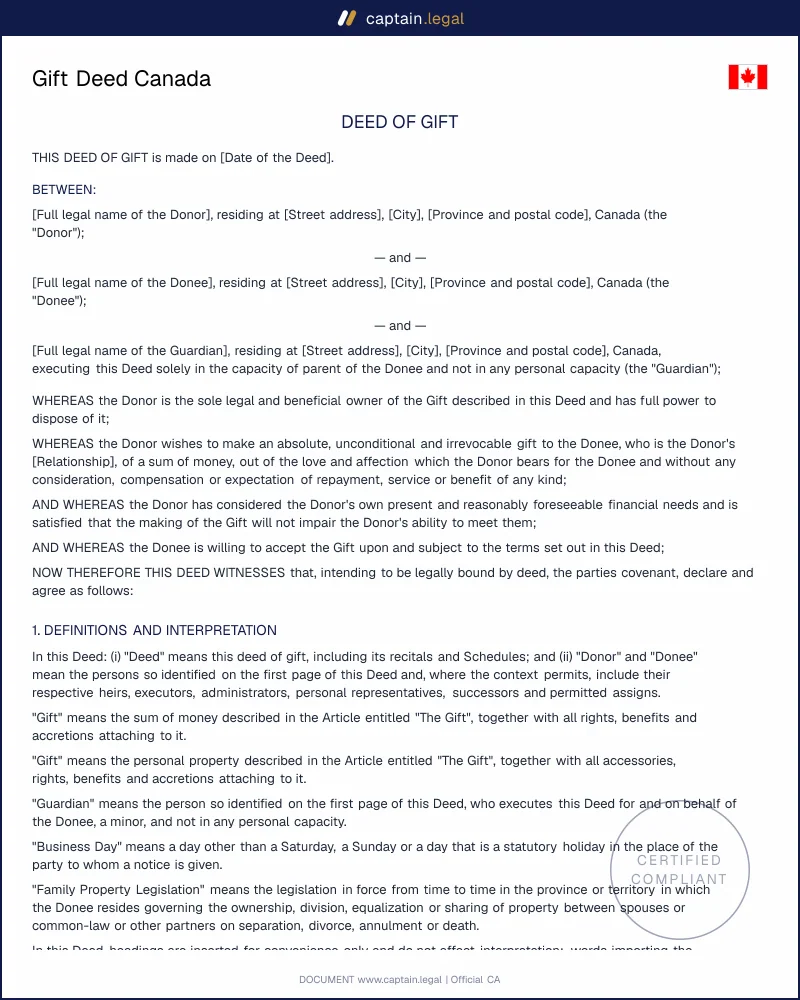
You start by identifying the donor and the donee, then stating their relationship, which drives the legal presumptions discussed above. From there, the form asks you to describe the gift: a cash amount, a vehicle with its VIN, or any item of personal property with enough detail that a stranger could identify it. You then confirm the date of delivery and whether possession passes immediately or on a stated date. The questionnaire adds the declaration of intent and the irrevocability clause automatically, adapted to the wording courts in the common-law provinces expect. The final step generates the execution page with lines for the donor, the donee and an independent witness. Print the document, sign in wet ink in front of the witness, have the donee sign the acceptance, and give each party an original. Browse the personal and family document library for Canada if the situation also calls for a will, a power of attorney or a statutory declaration to sit alongside the deed.

6

Common mistakes to avoid

The most damaging error is signing the deed but never delivering anything. A deed that sits in the donor's drawer while the "gifted" funds stay in the donor's account persuades nobody; courts want to see the transfer actually happen, and the deed dated the same day as the e-transfer or registry change is the gold standard. Close behind comes the family-member witness. A spouse or the donee's sibling can technically witness a deed, but an independent adult removes the argument that the whole family orchestrated the transfer. Donors also sabotage themselves by keeping strings attached: telling the donee "it's yours, but pay me back when you can" converts the gift into a loan and invites exactly the dispute the deed was meant to prevent.

On the tax side, donors of appreciated property routinely forget the deemed disposition under subsection 69(1) and discover a capital gain on their next return; cash gifts avoid this problem entirely, but a gifted cottage or share portfolio does not. Finally, do not use a personal gift deed where a charitable receipt is expected. Gifts to registered charities follow CRA receipting rules and belong in a donation agreement built for Canadian charities, not in a family gift deed.

Key takeaways

Gift basics

A gift needs intent, delivery, acceptance

Canadian common law treats an inter vivos gift as valid only if three elements are proven: the donor meant to give (donative intent), the property or the deed was delivered, and the donee accepted. If one element is missing, the transfer can fail in law and be reframed later as a loan or something held for someone else. A signed, witnessed gift deed is designed to capture all three.

Case law

Pecore shifts the burden for family gifts

Under Pecore v Pecore, 2007 SCC 17, a gratuitous transfer to an adult child or other non-dependant is presumed to be a resulting trust, meaning the recipient may be treated as holding the property for the donor or the donor’s estate. Clear evidence of donative intent is what rebuts that presumption. A properly executed, witnessed gift deed is the type of evidence courts and estate litigators look for.

Tax impact

No gift tax, but gains can arise

Canada does not impose a stand-alone gift tax, but the Income Tax Act can still make a gift expensive. Subsection 69(1) can deem the donor to dispose of capital property at fair market value, triggering capital gains tax even when no money changes hands. For gifts to a spouse or minor, sections 74.1 and 74.2 can attribute future income back to the donor, affecting annual reporting.

Frequently Asked Questions

Yes, provided the three common-law conditions are met: genuine donative intent, delivery of the property or of the deed itself, and acceptance by the donee. A written deed signed by the donor, accepted by the donee and attested by an independent witness satisfies the evidentiary burden the Supreme Court set out in Pecore v. Pecore, 2007 SCC 17, and a deed executed under seal is binding even though no consideration passes. Once complete, the gift is irrevocable: the donor cannot change their mind, and the property no longer forms part of the donor's estate. Courts have enforced properly executed gift deeds against later claims by estates, trustees in bankruptcy and separating spouses.

Canada has no gift tax, so the donee receives money or property tax-free in almost all cases. The donor is a different story. Under subsection 69(1) of the Income Tax Act, gifting capital property such as shares, a cottage or artwork triggers a deemed disposition at fair market value, and any accrued gain is taxable to the donor in the year of the gift. Gifts of cash create no capital gain. Attribution rules also apply: income earned on property gifted to a spouse or to a minor child is generally taxed back in the donor's hands under sections 74.1 and 74.2. When large sums are involved, a conversation with an accountant before signing is money well spent.

No, and that is the point of the document. Once the deed is delivered and the donee has accepted the gift, the transfer is final; the irrevocability clause simply states what the common law already provides. A donor who later regrets the gift cannot rely on ingratitude, family conflict or a change in financial circumstances. The narrow exceptions come from contract-adjacent doctrines: a deed procured by fraud, duress or undue influence can be set aside by a court, and a deed signed by a donor lacking mental capacity is void. If you want the option to change your mind, do not sign a gift deed; use a will, which remains revocable until death.

Timing and permanence. A gift deed transfers ownership immediately, during the donor's lifetime, and cannot be undone. A will transfers nothing until death and can be rewritten at any time while the testator has capacity. Property gifted by deed leaves the estate entirely: it escapes probate fees, cannot be redirected by a later will and, in provinces like British Columbia, sits beyond the reach of wills variation claims. The two documents work as a pair in most estate plans, with the deed handling specific lifetime transfers and the will distributing everything that remains. Separating spouses should also review how lifetime gifts interact with property division under the applicable family and divorce documents.

Notarization is not a legal requirement for a gift of money or personal property in the common-law provinces. What the law expects is a signed document, delivery, acceptance and ideally an independent witness; signing under seal adds the traditional force of a deed. That said, notarization is inexpensive insurance for high-value gifts, transfers likely to be contested or documents that will be shown to foreign banks or authorities, because a notarial attestation makes the signature nearly impossible to challenge. Gifts of real property are different altogether: land transfers must go through the provincial land titles system and usually involve a lawyer or notary regardless.

The completed deed is delivered instantly in both Word (.docx) and PDF formats. The PDF is ready to print and sign as-is, while the Word version lets you adjust names, add a second donee or refine the property description before printing. Both files are yours to keep and reuse. Because gift deeds must be signed in wet ink before a witness to carry full evidentiary weight, print at least two originals so the donor and the donee each retain one, and store a scan with your other estate records alongside your will and powers of attorney.

The gift is complete when the last of the three elements falls into place, which in practice means the moment the signed deed is delivered and the donee accepts. If the deed states that possession passes on signing, ownership changes that day even if the physical item is picked up later; a properly executed deed can perfect the gift without separate physical delivery. If the deed sets a future delivery date, the donor is bound from signing but the transfer completes on that date. Date every signature, match the deed date to the actual money transfer where cash is involved, and the timeline will withstand scrutiny from any court, lender or the CRA. Other supporting documents are available in the full Canadian template catalogue.

4.7/5

21 verified reviews · 50 000+ downloads

Gift Deed Canada | Pecore v Pecore SCC Compliant
  • Immediate access to the document
  • PDF + Word download
  • Compliant with 2026 legislation
  • Reviewed by lawyers
Fill in the template
Secure payment
Updated on July 28, 2026

You might also like

Personal Loan Repayment Agreement
Vehicle Bill of Sale Canada