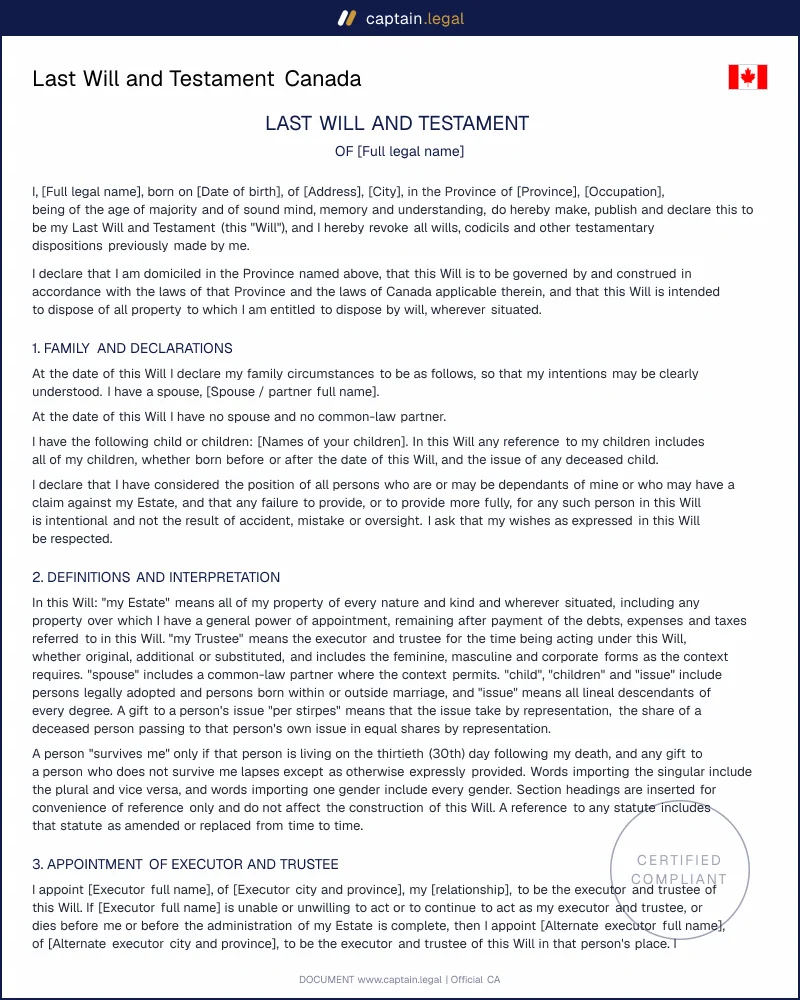
Wills and succession are matters of provincial jurisdiction in Canada, so the governing statute changes with the province. Ontario relies on the Succession Law Reform Act, British Columbia on the Wills, Estates and Succession Act (commonly cited as WESA), Alberta on the Wills and Succession Act, and the other common-law provinces on their own wills or succession legislation. Despite the different names, the core execution rule is remarkably consistent across the country. A formal will must be in writing, signed by the testator at its end, and that signature must be made or acknowledged in the presence of two witnesses present at the same time, who then sign in the testator's presence. A will signed before only one witness is, in most provinces, not validly executed and exposes the estate to a court application or to intestacy.
The single rule that catches the most people is the beneficiary-witness prohibition. A gift to a person who witnesses the will, or to that witness's spouse, is void, even though the rest of the will stands. In British Columbia this is section 43 of WESA; Ontario has an equivalent provision. The practical lesson is to choose two disinterested adults as witnesses and to keep beneficiaries well away from the signing.
Several provinces have softened the old strict-compliance regime. British Columbia introduced substantial compliance through sections 58 and 59 of WESA in 2014, letting a court cure a defective document if it represents the deceased's true intentions, and Ontario followed with section 21.1 of the Succession Law Reform Act, in force since 2022. These curative powers are a safety net, not a plan: each requires a contested court application with no guaranteed outcome. A handful of provinces also recognise the holograph will, a document written entirely in the testator's own hand and signed, valid without any witnesses at all. For the authoritative provincial text, the consolidated statutes published by the Province of Ontario on the Government of Ontario e-Laws record of the Succession Law Reform Act set out the formal execution requirements in full.