Create my document
Login

Choose country

CanadaCanadaChoose country
Non-Profit

Fundraising Event Agreement | Gaming & CRA Compliant

Fundraising event agreement drafted for Canadian law: Criminal Code raffle rules, CRA split receipting, liability and force majeure. Available in Word and PDF.
4.7/522 reviews50 000+ downloadsInstant download
Share

A fundraising event agreement is the contract a charity or non-profit signs with the vendors, sponsors, suppliers and venue operators who make a gala, auction, charity run or community festival happen. It fixes in writing who pays what, who carries the liability if someone is injured, who supplies the food, sound or marquee, and what happens if the event has to be cancelled. For Canadian organisations, this is the document that turns a verbal handshake with a sponsor or caterer into an enforceable arrangement, and it sits at the centre of any well-run charity fundraising event alongside the by-laws and governance policies that hold the organisation together. Whether you are an incorporated charity, a community club or an unincorporated association, a properly drafted agreement protects the directors and reassures the people writing the cheques.

Compliant

2026 Legislation

50,000+ clients

trust us

Affordable

From $4.90 / doc

Secure payment

Instant download

Fundraising Event Agreement | Gaming & CRA Compliant

Secure payment · No subscription

Fill in the template

What is a fundraising event agreement?

A fundraising event agreement is a commercial contract governing the relationship between an event organiser, usually a non-profit or registered charity, and the third parties contributing to the event. The most common counterparties are sponsors who provide cash or in-kind support in exchange for recognition, vendors who sell goods or services on site, and suppliers such as caterers, audiovisual companies and venue operators. A single event often needs several of these agreements running in parallel.

It is worth separating this document from two cousins it is frequently confused with. A pure sponsorship agreement deals only with the sponsor relationship, the branding rights granted and the sponsorship fee, while a vendor or exhibitor agreement covers a stallholder's pitch, fees and conduct on the day. A fundraising event agreement is the broader instrument that can cover any of these arrangements, and it is built to flex around the specific commercial deal the parties strike. In practice most organisers run a master template and adapt the payment, liability and cancellation terms to each counterparty, which is exactly how a working contract should behave. Because Canada is a common-law country outside Quebec, the parties enjoy wide freedom to set their own terms, so the quality of the drafting is what determines whether the agreement holds up when something goes wrong.

2

When do you need this document?

The clearest trigger is a paid sponsor. The moment a company agrees to put money or product behind your gala in exchange for logo placement, naming rights or a speaking slot, you need written terms covering the sponsorship fee, the recognition delivered, exclusivity in the sponsor's industry, and what happens if the event shrinks or moves. A verbal promise of a title sponsorship is worth very little when the cheque is late and the banner has already been printed.

You also need the document whenever a vendor or supplier carries risk onto your site. A caterer serving four hundred guests, a marquee company erecting a structure, a pyrotechnics or amusement operator: each introduces liability that a written agreement allocates through indemnity and insurance clauses. Organisers often require a counterparty to name the charity as an additional insured on its commercial general liability policy, and the contract is where that obligation lives. A third common scenario is the venue rental itself, where access times, set-up windows, damage deposits and noise restrictions all need recording. The edge cases are where experience shows. Events that include a 50/50 draw or raffle need the gaming-licence responsibility pinned to one party in writing, and multi-year or recurring festivals benefit from a renewal and right-of-first-refusal mechanism so a departing sponsor cannot leave a hole at the last minute. Charities issuing tax receipts at the door should also confirm contractually how benefit values will be calculated, because an error there can disqualify every receipt issued that night. Many organisers pair the event agreement with broader Canadian business and commercial contract templates for the supplier side of the relationship.

3

Key clauses included in our template

  • The parties and recitals identify the organiser, the sponsor or vendor and the event itself with precision, including the legal status of the charity and its CRA registration number where relevant. Vague party descriptions are a frequent source of disputes, so the template names each entity in full and states the event date, location and purpose up front.
  • The financial terms set out the sponsorship fee or vendor fee, the payment schedule, whether contributions are cash or in-kind, and any milestones that release funds in tranches. Where a sponsor funds a specific purchase, the clause can require payment direct to the supplier so the money is demonstrably used as agreed.
  • The rights and deliverables clause records exactly what the sponsor or vendor receives: logo placement, booth size, signage, social-media mentions, tickets, hospitality and any exclusivity preventing a competitor from sponsoring the same category. Defining these deliverables tightly is what prevents the "I thought we were the headline sponsor" argument.
  • The liability and indemnity clause allocates responsibility for injury, property damage and third-party claims arising at the event, and is paired with an insurance requirement obliging the counterparty to maintain commercial general liability cover and, often, to add the charity as an additional insured.
  • The cancellation and force majeure clause is the one organisers rely on most. It addresses postponement, no-fault termination, refund or pro-rating of fees, and the force majeure events, severe weather, government restrictions or venue loss, that excuse performance. Pandemic-era cancellations made this clause non-negotiable for serious organisers.
  • The governing law and dispute resolution clause fixes the province whose law applies and how disagreements are resolved, which matters when a sponsor is headquartered in another province or country.
4

Regional considerations

Ontario. Charitable gaming at events is governed by the Gaming Control Act, 1992 and administered by the Alcohol and Gaming Commission of Ontario. Municipalities issue raffle licences for prizes up to fifty thousand dollars, while the AGCO licenses larger draws, all electronic raffles and bingo events above the prescribed prize board. An organisation must typically have carried out charitable programs benefiting residents for at least a year before it qualifies, and the agreement should state plainly which party secures and holds the licence. Online 50/50 draws now run through an iGaming Ontario framework, adding a further compliance layer for digital fundraisers.

British Columbia. Charitable gaming is regulated by the Gaming Policy and Enforcement Branch under the Gaming Control Act, and licences are required for raffles, independent of prize size in many cases. BC organisers should confirm the licence class before printing tickets, and the event agreement should reflect that the licensed charity, not a sponsor or vendor, retains conduct and management of any draw.

Alberta. Gaming licences are issued by Alberta Gaming, Liquor and Cannabis, and casino-style or raffle fundraising follows detailed terms and conditions on prize handling and proceeds. Because proceeds must be used for the approved charitable purpose, the agreement's financial clauses should align with how the licence requires funds to be applied.

Quebec. As a civil-law jurisdiction, Quebec is the outlier. Contracts are governed by the Civil Code of Québec rather than common law, and gaming is regulated separately under provincial rules administered by the relevant board. Organisers running events in Quebec should have the agreement reviewed against civil-law contract principles, since drafting assumptions that hold in the common-law provinces do not transfer cleanly. Across every province, the safest approach is to name the licensing authority in the contract and assign the compliance duty expressly.

5

How to fill out this fundraising event agreement

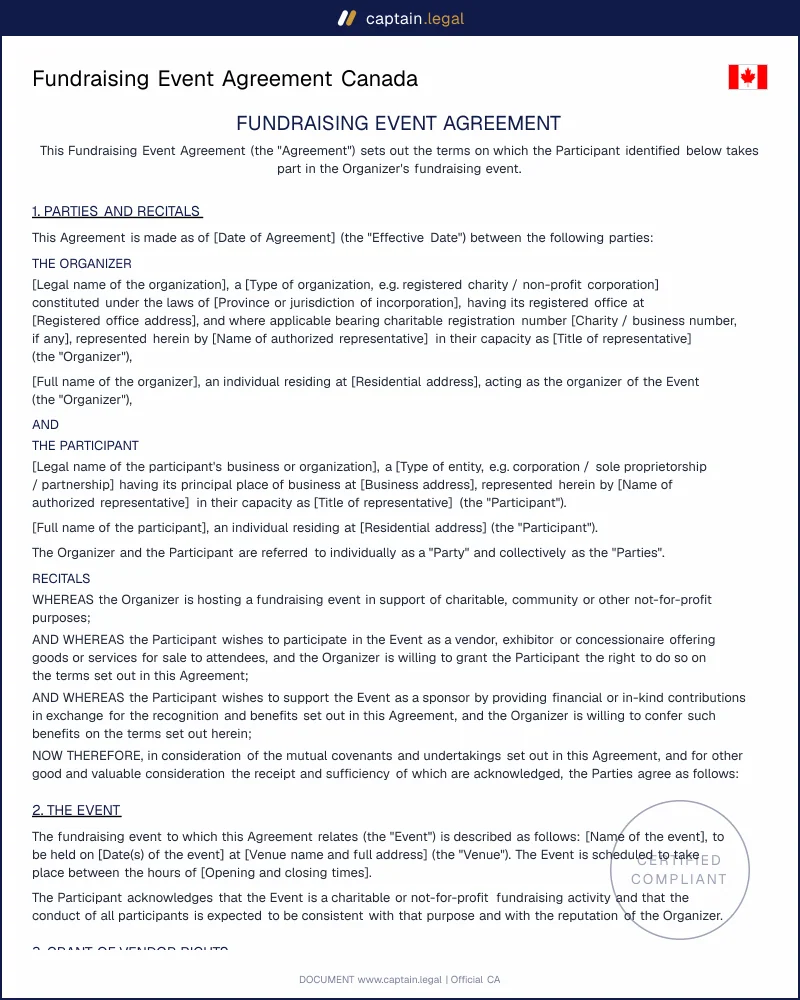
You start by identifying the type of arrangement, because the template adapts depending on whether your counterparty is a sponsor, a vendor or a supplier. From there you enter the full legal names of both parties, the charity's registration details where relevant, and the core event facts: date, venue, purpose and expected attendance. The form then walks you through the financial terms, prompting you to set the fee, the payment schedule and whether the contribution is cash or in-kind, and it lets you record any tranche conditions tied to milestones.

Next you define the deliverables, selecting the recognition, branding, booth or hospitality rights the counterparty receives and adding any exclusivity that protects them within their industry. The liability section guides you through the indemnity and insurance requirements, including the option to require the charity be named as an additional insured. You then complete the cancellation and force majeure terms, choosing how fees are treated on postponement or termination, before selecting the governing province. A short Canadian personal and family document set is available if individual signatories need supporting declarations. Once every field is complete, you generate the agreement in PDF and Word, ready to sign or hand to your lawyer for a final review.

6

Common mistakes to avoid

The error that causes the most damage is treating a sponsor's promise as binding without a signed contract. Organisers print banners, commit to deliverables and build budgets around a commitment that, left verbal, evaporates the moment priorities shift at the sponsor's head office. A close second is ignoring the gaming-licence requirement: charities routinely run a 50/50 draw or raffle assuming their CRA registration is enough, when in fact an unlicensed draw is a Criminal Code offence regardless of how charitable the cause. The agreement should always pin licence responsibility to a named party. A third recurring mistake is a weak or missing cancellation clause, which leaves the charity exposed when weather, illness or a venue failure forces a postponement and a sponsor demands its money back.

Organisers also mishandle tax receipting. Issuing a full receipt for a ticket that includes a dinner and entertainment ignores the CRA's eighty-percent benefit threshold and can disqualify the receipt entirely, so benefit values must be calculated and recorded before the event. Finally, many templates omit insurance and additional-insured language, leaving the charity to absorb a liability that belonged to the caterer or amusement operator all along. Confirming the counterparty's coverage in writing, rather than assuming it exists, is the difference between a manageable incident and a lawsuit. Organisations building out their wider governance can draw on Canadian employment and staffing agreements for paid event staff and the full catalogue of Canadian legal document templates for everything else an event touches.

Key takeaways

GAMING LAW

Unlicensed raffles can make the event illegal

Raffles, 50/50 draws, bingo and other chance-based fundraising are lottery schemes under section 207 of the Criminal Code and generally require a provincial licence. Even a registered charity cannot run an unlicensed draw. Your agreement should state which party is responsible for obtaining and maintaining the licence and for following the gaming authority rules tied to the event.

TAX RECEIPTS

Ticket benefits change what you can receipt

If attendees pay for tickets and receive something back, like a meal or entertainment, CRA split receipting comes into play. That affects what portion (if any) can be treated as a charitable donation and what must be treated as a purchase. The contract should align with your receipting plan, including how benefits are described and who controls messaging to donors.

RISK ALLOCATION

Put liability and cancellation terms in writing

A fundraising event agreement turns handshakes with sponsors, vendors, suppliers and venues into enforceable terms, and it is often the main tool for allocating risk in common-law provinces. The liability, indemnity and cancellation or force majeure clauses decide who pays if someone is injured, property is damaged, or the event is called off. Tight drafting can protect directors and reassure major donors.

Frequently Asked Questions

Yes. In the common-law provinces a fundraising event agreement is enforceable once both parties sign and consideration passes between them, meaning each side gives something of value such as a fee in exchange for sponsorship rights or services. Our template is drafted to common-law contract principles and includes the parties, deliverables, payment, liability and governing-law terms a court expects to see. It becomes binding on signature without any need for notarisation. For events held in Quebec, the agreement should be reviewed against the Civil Code of Québec, since civil-law contract rules differ from the rest of the country and some common-law drafting conventions do not carry over.

Almost always, yes. Raffles, 50/50 draws and similar games of chance are lottery schemes under section 207 of the Criminal Code and are lawful only under a licence from your provincial gaming authority, such as the Alcohol and Gaming Commission of Ontario. Municipalities typically license smaller raffles while the provincial regulator handles larger or electronic draws. Federal charitable registration with the CRA does not grant gaming rights on its own. Running an unlicensed draw is illegal even for a registered charity, so the agreement should name which party secures the licence and assumes conduct and management of the draw.

The agreement is available in both Word and PDF. The Word version lets you adjust party names, fees, deliverables and cancellation terms to fit each sponsor or vendor, which matters because most organisers run several agreements from one master template across a single event. The PDF version is the clean, ready-to-sign copy you circulate for signature. Having both means you can negotiate in Word, finalise in PDF, and keep a tidy executed record for your files and for any tax or audit purposes that arise later.

Earlier than most organisers think. Sponsors plan their marketing budgets quarters ahead, so a signed agreement three to six months before a major event protects your deliverables and gives the sponsor confidence to commit funds. Vendor and supplier agreements should be locked in once the headcount and venue are confirmed, because caterers, marquee firms and audiovisual companies book out fast in peak season. Leaving agreements unsigned until the final weeks is how organisers end up accepting unfavourable terms under time pressure or, worse, proceeding on a handshake that offers no protection if the counterparty walks.

That depends entirely on the cancellation and force majeure clause you agree. A well-drafted agreement distinguishes between no-fault cancellation, where fees may be refunded or pro-rated, and cancellation caused by events beyond your control such as severe weather or a government restriction, where force majeure can excuse performance on both sides. Without a clear clause you fall back on common-law principles, which rarely favour the cancelling party. This is why the cancellation terms are among the most negotiated in the document, and why you should set them deliberately rather than accept a counterparty's boilerplate.

It can, which is why the distinction matters. A genuine sponsorship, where a business pays for advertising and recognition, is not a gift and generates no charitable receipt; it is a commercial transaction. Where an attendee buys a ticket and receives a benefit such as a meal, the CRA's split-receipting rules apply, and if the fair market value of the benefits exceeds eighty percent of the payment, no receipt may be issued for any part of it. The agreement should record how benefit values are calculated so your receipting stays compliant and your donors keep the deductions they expect.

The agreement decides this through its liability, indemnity and insurance clauses, rather than leaving it to chance. Organisers typically require each vendor and supplier to carry commercial general liability insurance and to indemnify the charity against claims arising from that party's own activities, often adding the charity as an additional insured. The organiser usually retains responsibility for the general conduct of the event itself. Confirming a counterparty's insurance in writing before the event is essential, because assuming coverage exists is how charities end up personally exposed to a claim that should have sat with the caterer, the amusement operator or the venue.

4.7/5

22 verified reviews · 50 000+ downloads

Fundraising Event Agreement | Gaming & CRA Compliant
  • Immediate access to the document
  • PDF + Word download
  • Compliant with 2026 legislation
  • Reviewed by lawyers
Fill in the template
Secure payment · No subscription
Updated on June 18, 2026

You might also like

Donation Agreement Template
Membership Application Form Canada