Create my document
Login

Choose country

CanadaCanadaChoose country
Personal & Family

Guardianship Consent Form Canada | Family Law Act

Delegate parental authority under provincial Family Law Act rules. Medical, school and travel consent, mature-minor safe. Notary-ready Word and PDF download.
4.7/522 reviews50 000+ downloadsInstant download
Share

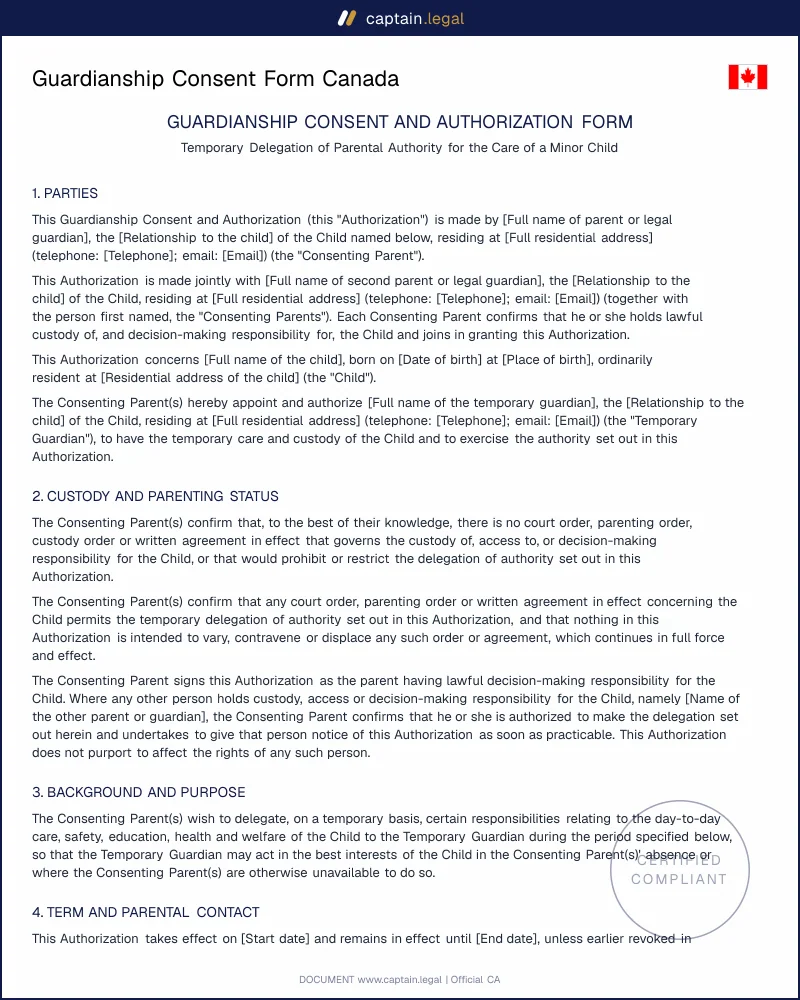
A guardianship consent form for Canada is a written authorization by which a parent or legal guardian temporarily delegates day-to-day decision-making authority over a minor child to a trusted adult, covering medical, educational and travel matters while the parent is unavailable. It is the practical instrument families reach for when a child stays with grandparents for a summer, travels abroad with a relative, or lives with a caregiver during a parent's hospitalization or work posting. This temporary guardianship consent form is not a court order and does not transfer legal guardianship; it records the parent's permission so that doctors, schools and border officers will accept the caregiver's authority. Drafted for the common-law provinces, it puts your consent in clear, verifiable terms.

Compliant

2026 Legislation

50,000+ clients

trust us

Affordable

From $4.90 / doc

Secure payment

Instant download

Guardianship Consent Form Canada | Family Law Act

Secure payment

Fill in the template
2

When do you need this document?

The most common trigger is a planned absence of the parent. A work posting, a hospital stay, military deployment or an extended trip leaves a child in the care of a grandparent, aunt or family friend, and someone has to be able to sign a permission slip, authorize a filling at the dentist or speak to a teacher. Without a written consent, the caregiver's authority is invisible to the institutions that matter. A school registrar or a walk-in clinic has no way to know that Grandma is acting with the parent's blessing, and the safe default for those institutions is to refuse.

The second scenario is international or cross-border travel. When a child flies to visit relatives with only one parent, or joins a school group or a sports team abroad, airlines and foreign border officers frequently ask for proof that the non-travelling parent consents. Even a day trip into the United States can prompt the request. A relative who takes a niece to Florida for March break should carry a signed letter from both of the child's parents, ideally notarized.

Longer-term care arrangements form the third category. Where a child lives with a caregiver for a school year, or during a family crisis short of formal guardianship, a consent form bridges the gap until either the situation resolves or a court order becomes necessary. A private consent form cannot substitute for a court order where a province requires one, such as to enrol certain benefits or to make major irreversible decisions. One edge case worth flagging: separated parents. If a court order or separation agreement built to the Divorce Act allocates decision-making, the parent delegating authority must actually hold the authority they purport to delegate, or the consent is worth little.

3

Key clauses included in our template

  • The identification of the parties and the child names each consenting parent or guardian, the caregiver receiving authority, and the child by full legal name and date of birth. This section also asks you to confirm that you hold the decision-making authority you are delegating, which is the point most often overlooked when parents are separated.
  • The scope of delegated authority is drafted as a checklist of decision categories rather than a vague grant. You specify whether the caregiver may consent to medical and dental treatment, communicate with and make decisions for the child's school, authorize activities and travel, and handle emergencies, so an institution reading the form sees precisely what the caregiver may do.
  • The medical consent clause authorizes the caregiver to consent to routine and emergency healthcare, names the child's physician and health-card details, and records allergies and existing conditions. It is drafted to work with, not override, the mature minor rules that let an older child consent for themselves.
  • The duration and revocation clause fixes a start and end date and states that the parent may revoke the consent in writing at any time. A consent with no end date invites questions; a bounded one reassures the reader that authority is temporary and controlled.
  • The execution and witnessing block provides for signature before a witness of the age of majority or, where the document will be used for travel or presented to strict institutions, before a notary public or commissioner for oaths. The affidavit template built to provincial evidence rules uses the same execution discipline and shows why the jurat matters.
4

Regional considerations

Ontario frames a caregiver's authority through the Children's Law Reform Act, which recognizes that a parent can consent to another person having care of the child. There is no single government consent form, so a clearly drafted private authorization is the accepted route, and schools will generally accept it as proof of a caregiver's standing. For medical treatment, Ontario's Health Care Consent Act governs who may consent, and a caregiver acting on a parent's written authority is on solid ground for routine and urgent care.

British Columbia is the most explicit province. Section 21 of the Family Law Act directly permits a guardian to authorize another person to exercise parental responsibilities, and section 21(6) contemplates appointment during a temporary absence. BC's Infants Act also anchors the mature-minor doctrine, so a caregiver's authority over an older teen's healthcare is qualified by the child's own capacity to consent.

Alberta uses the Family Law Act language of guardianship and decision-making, amended in March 2021 to speak of parenting and contact. A parent-signed consent lets a non-guardian caregiver exercise day-to-day authority, but Alberta draws a firm line: only a guardian makes major decisions, so a consent form should stay within the delegable everyday matters and not attempt to grant guardian-only powers.

Quebec sits outside this template entirely. The province operates under the Civil Code of Québec with its own regime of parental authority and tutelle, and the terminology and formalities differ substantially from the common-law provinces. A family in Quebec should use a Civil Code instrument rather than this form.

6

Common mistakes to avoid

The mistake that undoes the most forms is delegating authority the signer does not hold. A separated parent whose court order gives the other parent sole decision-making cannot validly authorize a caregiver over the other parent's objection, and a form that ignores an existing parenting arrangement is not just weak, it can breach the order. Before signing, check what any custody or parenting plan compliant with the Divorce Act actually says. The second frequent error is treating this consent as though it created legal guardianship. It does not. It delegates day-to-day authority temporarily, and where a province genuinely requires a court-appointed guardian, no private form will serve.

Families also leave the scope vague, writing a blanket "authority over my child" that institutions distrust and often reject, when a specific checklist of medical, school and travel powers would have been accepted at once. Open-ended duration is a related trap: a consent with no end date reads as a permanent transfer and draws exactly the scrutiny families want to avoid. For travel, the recurring failure is skipping notarization; the letter is legally valid when witnessed by any adult, but a border officer at a strict destination is far more likely to wave through a notarized one. Finally, parents forget that an older teenager may consent to their own medical care under the mature-minor doctrine, so the form governs the caregiver, not the child's independent capacity.

Key takeaways

Scope

Consent delegates care, not guardianship

This form lets a parent or legal guardian temporarily authorize a named adult to handle day-to-day decisions for a child, such as medical appointments, school issues, and travel logistics. It is not a court order and it does not transfer legal guardianship. The parent keeps legal authority throughout, and the caregiver is acting only under the parent’s permission for the limited period described.

Legal basis

Provincial statutes set the rules

The legal footing comes from provincial and territorial family law, not a single federal code. The excerpt highlights delegation provisions such as British Columbia’s Family Law Act, section 21, including section 21(6) for temporary absence or emergencies. Similar structures exist in other common-law provinces. That is why the document is drafted as a clear written authorization: it aligns with how provincial law treats delegated parental responsibilities.

Limits

Medical decisions have key exceptions

A signed consent helps doctors and other professionals accept the caregiver’s authority, but it does not override medical consent rules. An older child who understands the treatment may be able to consent on their own under the mature minor doctrine (including the Supreme Court’s reasoning in A.C. v. Manitoba (2009) and BC’s Infants Act). In emergencies, providers may treat without waiting for written consent if delay would endanger the child.

Frequently Asked Questions

The form is a legally valid expression of a parent's consent, and institutions rely on it as proof that a caregiver is authorized to act. What it does not do is create legal guardianship or override a court order. Its force comes from the parent's own authority under provincial law, such as section 21 of British Columbia's Family Law Act or the delegation recognized in Ontario's Children's Law Reform Act. So long as the signing parent actually holds the decision-making authority being delegated, and the document is properly signed and witnessed, doctors, schools and border officers will treat it as authoritative for the day-to-day and travel matters it covers.

Yes. The template includes a medical consent clause that lets the caregiver authorize routine and emergency healthcare, and it records the child's physician, health-card number, allergies and conditions so a clinic has what it needs. Two limits apply. For genuine emergencies, a provider may treat the child without any signed consent where delay would cause harm. And under the mature minor doctrine, recognized across Canada and codified in BC's Infants Act, an older child who understands the proposed treatment may consent for themselves regardless of your form. Within those bounds, a clear written consent is precisely what turns a caregiver's authority from doubtful to accepted.

A consent letter is not legally required to leave Canada, but Global Affairs Canada strongly recommends that any child travelling abroad without both parents carry one signed by every non-accompanying parent or guardian. Foreign immigration authorities and airlines may request it, and failure to produce one can mean delays or a refusal to enter or exit. The recommendation covers all cross-border travel, even a day trip into the United States. Signing before a notary is advised so that officials are less likely to question the letter, though a witness of the age of majority is technically sufficient.

Formal guardianship is a legal status granted by a court or by statute, giving a person full authority to make major decisions for a child, and it is the route when a parent cannot care for the child on a lasting basis. This consent form does something narrower and temporary: the parent keeps guardianship and simply delegates specified day-to-day authority to a caregiver for a defined period, revocable at any time. Think of it as a permission slip with teeth rather than a transfer of status. Where a province requires a court-appointed guardian for a particular decision, this form cannot substitute.

The document is available in both Word and PDF. The Word version lets you complete every field on your computer and adjust wording to your family's arrangement before printing, which is useful when you need to tailor the scope of authority or add specific medical details. The PDF is ready to print and sign as-is. Because travel use and strict institutions often call for notarization, most families print the finished document, then sign it in front of a witness or a notary public rather than relying on a digital signature, since border officers may prefer to see an original signed letter.

You set the duration yourself. The template asks for a start and end date, and the consent runs only for that window, which is deliberate: a bounded consent reassures schools and clinics that the arrangement is temporary and controlled. You can align it with a specific trip, a hospital stay or a school term. You may also revoke it in writing at any time before the end date, and the template includes wording to that effect. An open-ended consent is discouraged because it reads like a permanent transfer of authority and invites the very scrutiny families are trying to avoid.

Where both parents hold decision-making authority, both should sign. This is the norm for two-parent families and for separated parents who share decision-making, and it is what a border officer expects to see for travel. If a court order or agreement gives one parent sole decision-making, that parent may sign alone, but the safest practice is to keep a copy of the order with the consent so a reader can see the authority is properly held. A caregiver presenting a form signed by only one of two decision-making parents may face questions that a jointly signed document would have avoided.

You can, but with care. The form must match whatever custody or decision-making arrangement is already in place. If your child support and parenting arrangement under the federal guidelines or a court order allocates authority, you can only delegate the authority you actually hold, and you should not purport to grant powers the order reserves to the other parent. When both parents share decision-making, the cleanest approach is for both to sign the consent together. Attempting to delegate around an existing order, rather than in step with it, is the fastest way to render the document ineffective and to create conflict.

4.7/5

22 verified reviews · 50 000+ downloads

Guardianship Consent Form Canada | Family Law Act
  • Immediate access to the document
  • PDF + Word download
  • Compliant with 2026 legislation
  • Reviewed by lawyers
Fill in the template
Secure payment
Updated on July 13, 2026

You might also like

Personal Loan Repayment Agreement
Codicil to a Will Canada