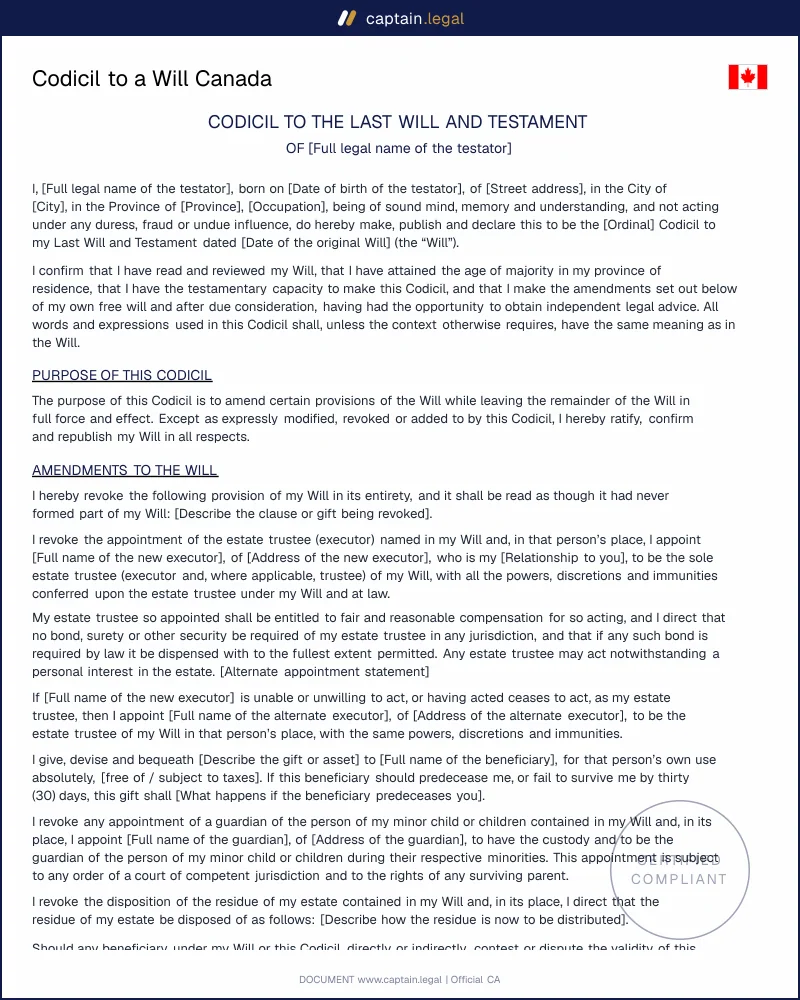
Ontario applies the Succession Law Reform Act, and its courts historically demanded strict compliance with the two-witness formalities. That changed with section 21.1, which since January 1, 2022 lets the Superior Court validate a document that reflects testamentary intention even when execution was imperfect, though electronic wills are excluded. Ontario also permits remote witnessing by audio-visual link under O. Reg. 431/20, provided at least one witness is a licensed Ontario lawyer. Even with these reliefs available, the safe route in Ontario remains two independent witnesses signing in person, with an affidavit of execution completed the same day.
British Columbia governs codicils through sections 37 and 54 of the Wills, Estates and Succession Act. The province is notable for its generous curative power in section 58, which allows the BC Supreme Court to give effect to a record that represents the will-maker's testamentary intentions despite formal defects. That power has rescued informal documents, but the case law also shows courts refusing to save undated or unsigned notes that fail to prove a fixed and final intention. British Columbia further recognises electronic wills, a feature most other provinces have not adopted, so a BC codicil has planning options that an Ontario one does not.
Alberta relies on the Wills and Succession Act, S.A. 2010, c. W-12.2, which likewise requires two witnesses for a formal codicil and grants the Court of King's Bench a dispensing power to validate documents evidencing testamentary intent. Manitoba, Saskatchewan and the Atlantic provinces follow the same common-law model, each with its own statute but the same core rule: a codicil signed and witnessed like a will is valid, and one that is not depends on a court's discretion. Quebec sits outside this framework entirely, since it operates under the Civil Code with notarial and holograph will regimes, so this template is built for the common-law provinces only.