Create my document
Login

Choose country

CanadaCanadaChoose country
Personal & Family

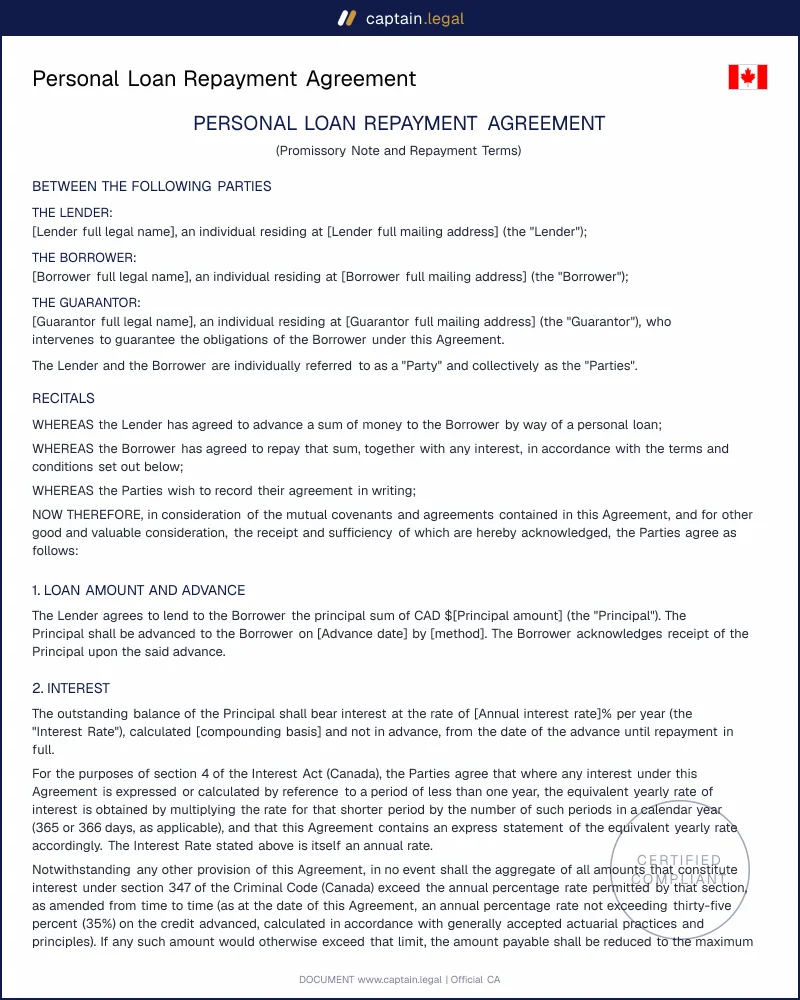
Personal Loan Repayment Agreement | Criminal Code s.347

Loan repayment agreement drafted to the Interest Act s.4 and the 35% APR cap under Criminal Code s.347 (2025). Instalment schedule and default clause. Word/PDF.
4.7/519 reviews50 000+ downloadsInstant download
Share

A personal loan repayment agreement records the terms on which one person lends money to another and sets out exactly how the borrower will pay it back. It fixes the principal, the interest rate if any, the instalment schedule and what happens on default, turning a private arrangement between family, friends or acquaintances into a written contract a court will enforce. In Canada this document sits at the intersection of federal money law and provincial contract and limitation rules, which is why a casual IOU rarely survives a dispute. A properly drafted personal loan repayment agreement protects the lender's capital and gives the borrower a clear, predictable path out of the debt.

Whether you are lending a relative money for a car, formalising an advance to a business partner or documenting a loan you made years ago on a handshake, the written terms are what let you recover the money without a fight over what was agreed.

Compliant

2026 Legislation

50,000+ clients

trust us

Affordable

From $4.90 / doc

Secure payment

Instant download

Personal Loan Repayment Agreement | Criminal Code s.347

Secure payment

Fill in the template

What is a personal loan repayment agreement?

A personal loan repayment agreement is a contract between a lender and a borrower that acknowledges a debt and commits the borrower to repay it on defined terms. It is the fuller cousin of the promissory note, which is a one-sided promise to pay governed by the Bills of Exchange Act. Where a promissory note simply says "I owe you and I will pay," a repayment agreement carries the full architecture of the deal: the amount advanced, the interest treatment, the instalment schedule, prepayment rights, security if any, and the consequences of missing a payment. Many lenders sign both, using the note as a negotiable record of the debt and the agreement as the governing contract.

The distinction that trips people up is between a repayment agreement and a plain loan agreement. In practice the terms overlap, but a repayment agreement puts the schedule of payments at its centre. It is the document you reach for when the loan is being paid down over time rather than in a single lump sum, and when both sides want certainty about dates, amounts and the running balance. Without a written schedule, a lender who later claims a fixed monthly instalment was agreed has almost nothing to stand on. The agreement also settles which province's law applies, a detail that decides everything from the limitation period to the enforceability of a default clause.

2

When do you need this document?

The most common trigger is a family or friend loan large enough that a verbal promise feels inadequate. Money advanced to a sibling for a down payment, to an adult child for a vehicle, or to a friend starting out cries out for a schedule everyone can point to later, because these are precisely the loans that curdle relationships when memory diverges. A written agreement lets the lender treat the money as a genuine debt rather than a disputed gift, which matters both for repayment and, occasionally, for tax and estate reasons.

The next scenario is formalising an old informal loan. People often lend on trust, then years later want the arrangement on paper once repayment stalls or circumstances change. Reducing the existing debt to a signed agreement with a fresh schedule restarts the clock in a way that protects the lender, and it converts a shaky oral claim into an enforceable contract. A related case is the structured repayment of a settled dispute, where two parties agree that one owes the other a sum and want an orderly, dated payment plan instead of litigation.

Lenders also use this document when they want security or a guarantor. If a parent guarantees a loan to a young borrower, or the borrower pledges an asset, those terms belong in a proper agreement rather than a bare note. One edge case worth flagging: a loan of more than $500,000 to an individual is not exempt from the section 347 cap the way an equivalent commercial loan to a company would be, so high-value private lending needs care. Another is cross-border lending within a family, where choosing the governing province becomes decisive. For business-context lending between shareholders, our shareholder agreement template under CBCA section 146 addresses adjacent needs.

3

Key clauses included in our template

  • The identification of the parties and the advance names the lender and borrower in full and states the exact principal advanced, the date of the advance and the currency. This anchors the debt and prevents the later argument that the money was a gift or an investment rather than a loan repayable on demand or schedule.
  • The interest clause states any rate as an annual percentage, satisfying section 4 of the Interest Act, and confirms the total cost of borrowing stays below the 35% APR criminal ceiling. Where the loan is interest-free, the clause says so expressly, which removes any implied-interest argument and keeps the arrangement clean.
  • The repayment schedule is the heart of the document: it fixes instalment amounts, frequency, the first and final payment dates and the running balance, and specifies how each payment is applied between interest and principal. A clear schedule is what lets a lender prove precisely what was missed.
  • The prepayment clause confirms whether the borrower may repay early without penalty, a point borrowers often assume in their favour and lenders sometimes wish to limit. Stating it removes doubt.
  • The default and acceleration clause defines what counts as default, the cure period allowed, and the lender's right to demand the whole outstanding balance at once. Vague default language is the single most common reason a repayment clause fails in practice.
  • The governing law and dispute clause selects the province whose law applies and sets out how disputes are resolved, which in turn fixes the limitation period and the forum. For informal lending inside a household, our Canadian gift versus loan guidance in the last wishes letter template helps distinguish the two.
4

Regional considerations

Because the Interest Act and Criminal Code are federal, the interest and criminal-rate rules described above apply identically in every common-law province. What changes province to province is the contract and limitations layer, and that layer decides whether a lender can still sue.

Ontario applies a basic two-year limitation period under the Limitations Act, 2002, running from the day the claim was discovered, which for a missed instalment is usually the day payment was due. A demand loan with no fixed schedule can start the clock on the day the loan is made under Ontario's rules, so lenders relying on "payable on demand" language should understand the clock may already be running. A written acknowledgement of the debt or a part payment can reset that period, which is one reason formalising an old loan is worthwhile.

British Columbia also uses a two-year basic limitation under its Limitation Act, with a fifteen-year ultimate long-stop. BC's treatment of demand obligations was deliberately reformed so that the limitation period for a demand debt generally runs from the first day after demand is made, which gives lenders more room than the Ontario position. The province's consumer and contract rules otherwise track common-law principles.

Alberta sets a two-year discovery period alongside a ten-year ultimate limitation under its Limitations Act, and courts there give real weight to written acknowledgements as a means of restarting time. A signed repayment agreement with a dated schedule creates exactly the paper trail Alberta courts look for when a lender needs to show the debt is live and quantified.

The one province this template does not serve is Quebec, where lending between individuals is governed by the Civil Code of Québec rather than the common law, with its own rules on interest, prescription and proof. A borrower or lender in Quebec needs a document drafted to the civil-law regime. For employment-linked advances documented alongside a job, our employment agreement template for Canada covers the related paperwork.

5

How to fill out this personal loan repayment agreement

You start by identifying the parties and confirming which province's law will govern, since that choice drives the limitation period and the enforceability of your default terms. From there you enter the principal advanced and the date of the advance, then decide the interest treatment. If the loan carries interest, you state it as an annual percentage so the document satisfies section 4 of the Interest Act automatically, and the running total stays visibly below the 35% APR criminal ceiling. If it is interest-free, you record that plainly.

Next you build the repayment schedule, setting the instalment amount, the frequency and the first and last payment dates; the template calculates the balance so both sides can see the debt shrink. You then choose whether early repayment is allowed without penalty and define what triggers default, including any grace period before the lender may accelerate the balance. Finally you address security or a guarantor if the deal calls for it, and both parties sign and date. Keeping a witnessed copy each strengthens the record. For a lighter one-page acknowledgement, the affidavit template for Canada can support a sworn statement of the outstanding balance.

6

Common mistakes to avoid

The error that does the most damage is stating interest as a short-period rate and stopping there. A lender who writes "1.5% per month" without the equivalent annual figure invites the section 4 remedy, and the recoverable interest can drop to five percent regardless of what both sides intended. Close behind is ignoring the section 347 ceiling: because the Criminal Code now measures against a 35% APR and counts every fee, penalty and commission as interest, a stated rate that looks fine can breach the cap once late charges pile on, and the interest can be struck out entirely. Both mistakes come from treating interest as a number to fill in rather than a regulated term.

The other frequent failures are structural. Lenders leave the default clause vague, so when payment stops they cannot cleanly prove breach or accelerate the balance, and they omit a written schedule, which leaves the exact instalment open to dispute. Many forget the limitation clock: an old loan left undocumented can quietly become unenforceable once the provincial period expires, and no agreement can revive a claim that is already statute-barred. A few try to reuse a template built for Quebec or drafted to foreign law, which imports the wrong rules on interest and prescription. Finally, some skip witnessing or keep no counter-signed copy, then struggle to prove the borrower ever agreed. Each of these is avoidable with a document built to the correct provincial and federal frame.

Key takeaways

INTEREST DISCLOSURE

State the annual rate or lose it

If you charge interest using a monthly or weekly rate, section 4 of the federal Interest Act can cut what you can actually recover. A term like 2% per month is not enough on its own; without an express equivalent yearly rate, recoverable interest above 5% per annum may be unrecoverable. Put the annual percentage clearly in the agreement so the rate survives a dispute.

CRIMINAL CAP

Stay under the 35% APR ceiling

Section 347 of the Criminal Code sets a hard limit on the cost of borrowing. As of 1 January 2025, the cap is 35% APR, replacing the old 60% effective annual rate approach. This is not just about stated interest; the definition of interest is broad and can capture fees and penalties. If the overall pricing crosses the line, you are in criminal-interest territory.

PAYMENT TERMS

A written instalment schedule is enforcement

A repayment agreement is designed around the payment schedule: dates, amounts, and how the balance declines over time. Without a written schedule, a lender who later claims a fixed monthly instalment was agreed has very little to point to, and arguments turn into a credibility fight. The agreement should also set out what counts as default and what happens if a payment is missed.

Frequently Asked Questions

Yes, a written and signed personal loan repayment agreement is a binding contract in the common-law provinces, provided it has the usual elements of offer, acceptance and consideration, which the advance of money supplies. Its enforceability rests on being consistent with federal money law, chiefly section 4 of the Interest Act and the 35% APR ceiling in section 347 of the Criminal Code, and with the contract and limitation rules of the governing province. A clear agreement with defined parties, a stated principal, an annualised interest rate and a dated schedule is exactly the kind of document a Canadian court will uphold and enforce.

For an ordinary loan between individuals, the hard ceiling is an annual percentage rate of 35% under section 347 of the Criminal Code, a limit that took effect on 1 January 2025 and replaced the older 60% effective-rate cap. That APR counts not just the headline rate but fees, penalties and similar charges, so watch the total. Separately, section 4 of the Interest Act means any rate you quote for a period under a year must be paired with its yearly equivalent, or recoverable interest can fall to five percent. Stating the rate as a plain annual percentage keeps you inside both rules.

Not strictly, but many lenders use both. A promissory note is a concise, negotiable promise to pay governed by the Bills of Exchange Act, while the repayment agreement is the fuller contract carrying the schedule, default terms and governing law. The note is easy to enforce and can be transferred; the agreement gives you the detail. Using them together gives a lender a clean record of the debt plus the enforceable machinery around it, which is why our combined document pairs the two.

The personal loan repayment agreement is available in both Word and PDF. The Word version lets you adjust names, amounts, the schedule and any optional clauses before you print, which is useful when the deal has a guarantor or security to add. The PDF is the ready-to-sign version, formatted for printing and signature. Most people edit the Word file to match their exact terms, then sign the PDF, keeping a counter-signed copy for each party as the executed record of the loan.

In most common-law provinces, including Ontario, British Columbia and Alberta, the basic limitation period is two years from the day you discover the claim, which for a missed instalment is generally the day that payment was due. Provinces also impose an ultimate long-stop, often ten or fifteen years. A part payment or a signed written acknowledgement of the debt can reset the two-year clock, which is one practical reason to put an old informal loan into a fresh signed agreement rather than relying on memory.

Yes. An interest-free loan is entirely lawful, and the agreement simply records that no interest applies. Stating it expressly is worth doing, because it forecloses any later argument that interest was implied and it keeps the arrangement clean for tax and family purposes. Interest-free lending is common between relatives, and the document still earns its place by fixing the repayment schedule, the default terms and the governing province, which are the parts that actually determine whether you get your money back.

No. This template is drafted for Canada's common-law provinces and does not cover Quebec, where private lending is governed by the Civil Code of Québec with its own rules on interest, prescription and proof of the debt. A lender or borrower in Quebec needs a document built to the civil-law regime rather than one that selects a common-law province's law. If your loan touches more than one province, choosing the governing law carefully in the agreement is what determines which limitation period and which contract rules will apply.

4.7/5

19 verified reviews · 50 000+ downloads

Personal Loan Repayment Agreement | Criminal Code s.347
  • Immediate access to the document
  • PDF + Word download
  • Compliant with 2026 legislation
  • Reviewed by lawyers
Fill in the template
Secure payment
Updated on July 13, 2026

You might also like

Power of Attorney Personal Care
Guardianship Consent Form Canada