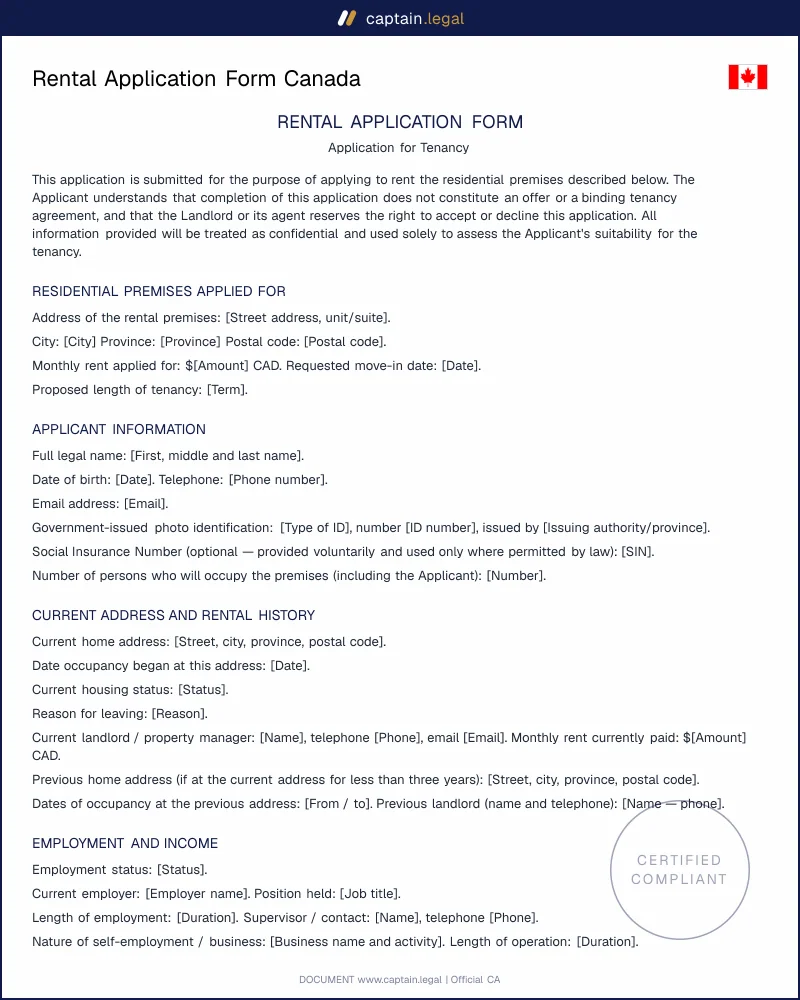
Canada has no single rental application; each common-law province layers its own privacy and human rights rules on top of the federal baseline, and a careful landlord adjusts the form accordingly.
Ontario runs its tenancy regime under the Residential Tenancies Act, 2006 and screening conduct under the Ontario Human Rights Code. There is no government-mandated application form, so a landlord may use any form provided it complies with both. Two Ontario quirks catch newcomers out. First, application fees are generally not permitted, so a form that charges to "process" an application is a red flag. Second, only a rent deposit (typically last month's rent) is lawful; security or damage deposits are not, so the form should never reference them.
British Columbia operates under the Residential Tenancy Act, with the Residential Tenancy Branch overseeing disputes and privacy governed by provincial PIPA. Charging any fee to accept, process or investigate an application is expressly illegal in BC, even if the landlord intends to refund or credit it later. After approval, the binding contract is the prescribed Form RTB-1. As in every province, written consent is required before a credit check, and the applicant cannot be compelled to provide a Social Insurance Number.
Alberta combines the Residential Tenancies Act (Alberta) with the Alberta Human Rights Act and provincial PIPA. The provincial privacy commissioner has been explicit that a SIN has no bearing on tenant suitability and should not be collected, and that consent is required before ordering a credit report under both PIPA and consumer protection law. A landlord who outsources screening to a third party remains responsible for that party's PIPA compliance, so the consent clause must extend to the service used.
Across all common-law provinces the same constants hold: written consent before any credit or background check, no compelled SIN, collection limited to what is reasonably necessary, and no questions touching a protected ground. Our Canadian property and rental document collection reflects these shared baselines while leaving room for the provincial variations above.