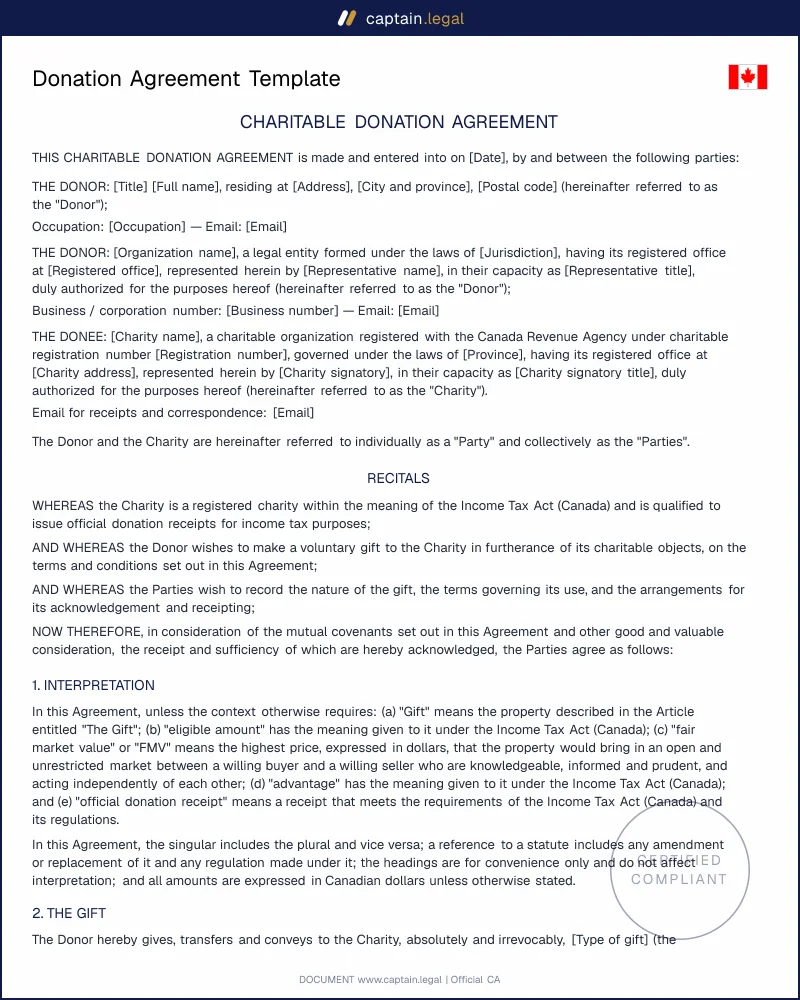
Federal and CRA rules apply everywhere. The receipting regime under the Income Tax Act and the definition of a charitable gift do not change from province to province, so the receipt requirements in Regulation 3501, the split-receipting rule, and the appraisal threshold for gifts over $1,000 are constant across Canada. What does change is the provincial law that governs charitable property and trusts, and that is where the agreement should be tailored.
Ontario has the most active regime. The Charities Accounting Act gives the Office of the Public Guardian and Trustee broad oversight of how charitable assets are used, and the courts have shown they will enforce donor restrictions strictly, with directors exposed to personal consequences for breach of trust. A donation agreement governing an Ontario charity should be drafted knowing it may be read by a regulator, not just by the parties. Charities incorporated under Ontario's Not-for-Profit Corporations Act, 2010 (ONCA) should also confirm that accepting a restricted gift sits within their stated objects.
British Columbia non-profits organized under the Societies Act face less centralized oversight of restricted funds than Ontario, but the trust analysis is identical, so a poorly drafted restriction is just as likely to bind the society indefinitely. Alberta charities under its Societies Act are in a comparable position. Quebec stands apart because it is a civil-law jurisdiction: gifts there are governed by the rules on donations in the Civil Code of Québec rather than common-law trust principles, so an agreement intended for a Quebec organization needs civil-law drafting and should not simply borrow common-law language. For organizations operating in more than one province, our Canadian non-profit constitution and by-law templates help align the gift terms with the charity's governing documents.