Create my document
Login

Choose country

CanadaCanadaChoose country
Non-Profit

Volunteer Agreement: Protect Your Non-Profit in Canada

Volunteer agreement drafted for the Employment Standards Act, PIPEDA and occupiers' liability. Lawyer-grade non-employment and waiver clauses, Word and PDF.
4.7/516 reviews50 000+ downloadsInstant download
Share

A volunteer agreement is the written record that defines what a volunteer will do for a non-profit, what the organization owes in return, and where the boundaries of confidentiality, conduct and liability sit. It is not an employment contract and is drafted precisely so it never reads like one. A well-drafted volunteer agreement protects the organization from a misclassification claim, sets clear expectations on both sides, and documents the volunteer's informed acceptance of the risks attached to the role. For any Canadian charity, society or unincorporated association that relies on unpaid help, it is the single most useful governance document after the by-laws.

This page explains how the agreement works under Canadian law, when you need one, the clauses our template includes, and the provincial points that decide whether it holds up.

Compliant

2026 Legislation

50,000+ clients

trust us

Affordable

From $4.90 / doc

Secure payment

Instant download

Volunteer Agreement: Protect Your Non-Profit in Canada

Secure payment · No subscription

Fill in the template

What is a volunteer agreement?

A volunteer agreement is a written understanding between a non-profit organization and an individual who donates time without expectation of pay. It records the volunteer's role and reporting line, the hours expected, the policies they agree to follow, and the organization's commitments on training, supervision and reimbursement of out-of-pocket expenses. Most Canadian agreements also fold in three protective layers: a confidentiality undertaking covering donor and beneficiary information, a release and waiver of liability for the ordinary risks of the activity, and an express statement that the relationship is not employment.

People often confuse three documents that do different jobs. A volunteer agreement sets out expectations and the working relationship. A liability waiver is narrower, focused only on the volunteer giving up the right to sue for injury arising from the activity. A position description is the operational sketch of duties that usually sits as a schedule to the agreement. Our template combines the agreement and the waiver in one instrument because Canadian non-profits almost always need both, while keeping the position description as an editable appendix so you can reuse the same core terms across cleanup crews, fundraising volunteers, board committee members and event staff. The label on the document does not control its legal effect: a court reads the substance of the relationship, not the title you give it, which is exactly why the wording matters more than the heading.

2

When do you need this agreement?

The clearest trigger is bringing on a volunteer in any ongoing or significant role. A weekend helper at a single bake sale rarely needs paperwork, but a volunteer who attends regularly, handles money, drives, works with children or vulnerable adults, or has access to confidential records should sign before the first shift. The agreement is what lets the organization set conduct expectations and document that the volunteer accepted the role's risks knowingly. Charities applying their limited budgets toward programs rather than staff lean heavily on these documents, and the same template that governs a non-profit's volunteers and governance documents scales from a two-person committee to a roster of hundreds.

The second common situation is any activity carrying a physical risk: warehouse and food-bank work, construction-style builds, outdoor cleanups, sporting events, transport of people or goods. Here the release and assumption-of-risk language earns its place, because the foreseeable injury is real and the organization wants documented informed consent. A third scenario is access to sensitive information. Volunteers who see donor lists, client files or medical details need a binding confidentiality undertaking that survives the end of their service. One edge case worth flagging is the volunteer driver: if a volunteer uses their own vehicle for organization business, the agreement should address insurance and scope expressly, since an accident on a personal errand falls outside vicarious liability while one on an approved delivery run does not. A second edge case is the volunteer who signs contracts or speaks for the organization: ostensible authority can bind the non-profit even where the volunteer exceeded their mandate, so the agreement should state plainly what the volunteer may and may not commit the organization to.

3

Key clauses included in our template

  • The identification of the parties and the non-employment statement opens the agreement and does the heaviest legal lifting. It names the organization and the volunteer, then states expressly that the arrangement creates no contract of employment, no entitlement to wages, vacation or notice, and no expectation of future paid work. This is the language that holds back a misclassification claim under provincial employment standards law.
  • The role description and reporting line sets out duties, expected hours and the supervisor the volunteer answers to. Defining scope tightly is what keeps the organization's vicarious liability exposure predictable, because acts within the defined scope are the organization's responsibility and acts outside it generally are not.
  • The confidentiality and privacy undertaking binds the volunteer to protect donor, beneficiary and organizational information, and to handle personal data consistently with PIPEDA or the applicable provincial privacy statute. It is drafted to survive the end of the volunteer relationship rather than expiring with it.
  • The release, waiver and assumption of risk records that the volunteer understands the risks of the activity and agrees not to sue the organization for ordinary harm arising from it. It stops short of excusing gross negligence, because a Canadian court will strike a waiver that reaches that far.
  • The code of conduct and termination provisions let the organization set behavioural standards and end the relationship cleanly, on notice or immediately for cause, without the language reading as a dismissal that could imply employment.
  • The emergency contact, insurance and indemnity terms capture practical details that matter when something goes wrong, including whether the volunteer is covered under the organization's policy and how out-of-pocket expenses are reimbursed.
4

Regional considerations

Ontario. The Employment Standards Act, 2000 governs the employee/volunteer line, and the ESA Policy and Interpretation Manual treats genuine volunteers as outside the Act. Two Ontario points deserve attention. First, the Human Rights Code has been applied by the Human Rights Tribunal of Ontario to "volunteer employment", so anti-discrimination obligations can attach even though employment standards do not. Second, the Occupiers' Liability Act sets the organization's duty of care to anyone on its premises, which directly shapes how far the waiver can go. An Ontario non-profit incorporated under the Not-for-Profit Corporations Act, 2010 (ONCA) should keep its volunteer documents consistent with the governance terms in its Ontario non-profit by-laws and governance documents.

British Columbia. BC's Employment Standards Act similarly excludes true volunteers, and the Occupiers Liability Act frames premises duties in much the same way as Ontario. Societies in BC are incorporated under the Societies Act, and many run substantial volunteer programs, so the agreement should align with the society's bylaws and any conduct policies the directors have adopted. BC also applies its own Personal Information Protection Act rather than relying solely on PIPEDA for private-sector data handling, a distinction worth reflecting in the confidentiality clause.

Alberta. Volunteers fall outside the Employment Standards Code, and non-profits commonly incorporate under the Societies Act or the Companies Act Part 9. Alberta's Occupiers' Liability Act governs premises duties, and its Personal Information Protection Act applies to private-sector personal data. The classification analysis is the same in substance across these provinces: courts and tribunals look past the label to the reality of the arrangement, so the non-employment wording carries the same weight wherever the organization operates.

Quebec sits apart, since the Civil Code of Québec governs civil obligations there rather than the common-law framework above, and an organization operating in Quebec should have its agreement reviewed against the Code and the provincial privacy regime before use.

5

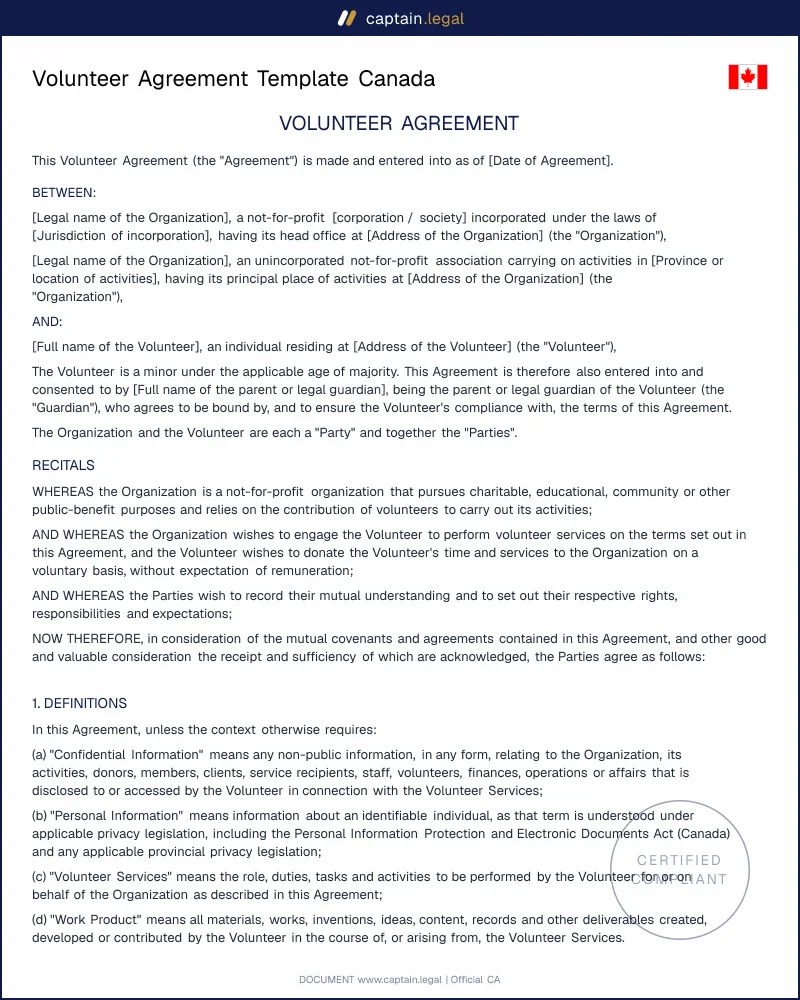
How to fill out this volunteer agreement

You begin by entering the organization's legal name and the province where the volunteer will serve, and the template adjusts the statutory references and privacy language to that jurisdiction. From there you set out the volunteer's role, the supervisor they report to, and the expected schedule, which becomes the position description appendix. The form then walks you through the optional layers: whether to include a full release and assumption-of-risk clause for higher-risk activities, how the confidentiality undertaking should be scoped, and whether the volunteer will use a personal vehicle or handle funds. You add emergency contact fields and confirm whether the volunteer is covered under the organization's insurance, then review the non-employment and termination wording before generating the final document. The output is ready to sign in Word and PDF, so you can either use it as is or hand it to your insurer or counsel for a quick review. If you are setting up a broader governance file at the same time, our Canadian business and corporate document templates cover the resolutions and policies that sit alongside the volunteer program.

6

Common mistakes to avoid

The most damaging mistake is treating a volunteer like an employee in everything but name. Setting fixed shifts, imposing discipline, demanding exclusivity or dangling future paid work are exactly the factors a tribunal weighs, and an agreement that calls someone a volunteer while the day-to-day reality looks like a job will not save the organization from reclassification. The second frequent error is over-reaching on the waiver. A release that tries to excuse the organization's gross negligence or to strip away rights that cannot be contracted out of is liable to be struck in whole or in part, so the clause should be specific to the activity's real risks and written in plain language the volunteer can actually understand.

A third mistake is ignoring privacy obligations. Volunteers who handle donor and beneficiary data without a confidentiality undertaking expose the organization under PIPEDA or provincial law, and bolting the obligation on after a breach is too late. Closely related is the failure to address volunteer drivers and signing authority, the two situations where vicarious liability and ostensible authority most often catch organizations off guard. Finally, many groups sign once and forget. Roles change, programs evolve, and a stale agreement covering duties the volunteer no longer performs is weak evidence of informed consent, so the document should be refreshed when the role does. For volunteers whose work touches staff supervision, it helps to keep the file aligned with your Canadian employment contracts and HR templates.

Key takeaways

Classification

A label will not prevent employee status

A volunteer agreement is drafted to avoid reading like an employment contract, but the heading does not control the legal result. Under provincial Employment Standards Acts, genuine volunteers are not employees, yet tribunals look at the substance: how much the organization benefits, the degree of control, and whether the person is pursuing a livelihood. Misclassification can lead to reclassification and liability, as seen in the S-Trip settlement.

Scope of role

Set duties, hours, and boundaries in writing

Use the agreement to spell out the volunteer’s role, reporting line, expected hours, and the policies they must follow. It should also record what the organization will provide, such as training, supervision, and reimbursement of out-of-pocket expenses. Pair it with a position description as an editable appendix so you can reuse core terms across different volunteer roles without rewriting the whole document.

Liability & privacy

Combine waiver, confidentiality, and supervision duties

Most Canadian non-profits need more than task lists: they need protection for risk and information. A good template folds in a release and waiver for ordinary activity risks, plus a confidentiality undertaking that covers donor and beneficiary information, aligning with privacy obligations like PIPEDA where applicable. It should also reflect that the organization may still face vicarious liability for volunteer conduct when acting under its direction and control.

Frequently Asked Questions

Yes, when it is properly drafted and signed it is an enforceable contract. The non-employment statement, the confidentiality undertaking and the conduct terms all bind the volunteer, and the release and waiver is generally enforceable for the ordinary risks of the activity as long as it is clear, brought to the volunteer's attention before they sign, and not unconscionable. What a Canadian court will not enforce is a waiver that purports to excuse the organization's own gross negligence or that tries to contract out of rights protected by statute. The agreement is strongest when its wording matches the real working relationship, because a tribunal reads the substance over the label every time.

No, and the document is specifically drafted to prevent that. The opening clause states there is no contract of employment, no wages, and no entitlement to notice or vacation under provincial employment standards legislation such as the Employment Standards Act, 2000 in Ontario. That said, the signature alone does not settle the question. A tribunal looks at how much the organization benefits from the work and whether the individual is pursuing a livelihood, so the protection only holds if the day-to-day arrangement genuinely looks like volunteering. Avoid imposing employee-style controls and you keep the classification safe.

A volunteer agreement is the broad document that defines the role, expectations, confidentiality, conduct and the non-employment relationship. A liability waiver is narrower and does one job: it records the volunteer giving up the right to sue for injury arising from the activity. Most Canadian non-profits need both, which is why our template combines them, putting the expectations and policy terms in the body and the release and assumption-of-risk language in a dedicated section. For low-risk roles you can rely mainly on the agreement, while higher-risk activities such as warehouse work or outdoor events call for the full waiver layer.

The agreement is delivered in both Word and PDF. The Word file lets you edit the organization's name, the role description and any clause you want to tailor before circulating it, while the PDF gives you a clean, ready-to-sign version for volunteers who simply need to read and sign. Many organizations keep the Word version as their master template, updating the position-description appendix for each new program, and issue the PDF for signature. Both formats carry the same legal content, so you can move between them freely depending on whether you are drafting or signing.

Yes, and ideally before the first shift. The release and assumption-of-risk clause only does its job if the volunteer signs before being exposed to the activity's risks, because the whole point is documented informed consent ahead of time. Signing after an incident is far weaker evidence and may not protect the organization at all. For roles involving access to confidential data, money or vulnerable people, the confidentiality and conduct terms should also be in place from day one. Build the signing step into your intake process so no volunteer begins work on an unsigned agreement.

It can, and it should where driving is part of the role. A volunteer driver raises two issues the agreement addresses directly: insurance coverage and the scope of authorized activity. The organization may be vicariously liable for an accident that happens during an approved delivery or transport run, but not for one that occurs while the volunteer is on a personal errand, so defining the scope tightly matters. The template lets you state whether the volunteer is covered under the organization's policy or must carry their own, and confirms that personal use falls outside the volunteer role.

The agreement includes termination provisions that let either side end the relationship cleanly, either on reasonable notice or immediately for cause such as a breach of the code of conduct or confidentiality. Because the document states there is no employment, ending it does not trigger notice or severance entitlements under provincial employment standards law, provided the relationship was genuinely a volunteer one throughout. Keep a brief written record of the reason where you end for cause, and remind the departing volunteer that the confidentiality undertaking survives the end of their service and continues to bind them afterward.

4.7/5

16 verified reviews · 50 000+ downloads

Volunteer Agreement: Protect Your Non-Profit in Canada
  • Immediate access to the document
  • PDF + Word download
  • Compliant with 2026 legislation
  • Reviewed by lawyers
Fill in the template
Secure payment · No subscription
Updated on June 18, 2026

You might also like

Conflict of Interest Policy Canada
Non-Profit Bylaws Template Canada