Create my document
Login

Choose country

CanadaCanadaChoose country
Business

Non-Disclosure Agreement Canada | Common-Law NDA Template

Canadian NDA built on common-law contract principles and CCQ, with trade-secret carve-outs and PEI compliance. Reviewed, ready to sign. Word and PDF.
4.8/532 reviews50 000+ downloadsInstant download
Share

A non-disclosure agreement (NDA) is a binding contract that obliges one or more parties to keep specified information secret and to use it only for an agreed purpose. Canadian businesses reach for it the moment sensitive information leaves the building: before a financing round, during due diligence on an acquisition, when onboarding a contractor, or while exploring a joint venture. Also called a confidentiality agreement, a confidential disclosure agreement, or simply a confidentiality contract, it is the primary legal tool for protecting trade secrets, client lists, pricing models, source code, and unfiled intellectual property. A well-drafted NDA does not just deter a leak. It creates a documented obligation a court can enforce, and it preserves the secrecy that gives information like a client database or a proprietary algorithm its commercial value in the first place.

Most Canadian businesses underestimate how much of their worth sits in information that no patent or trademark protects. A confidentiality agreement is what keeps that information defensible.

Compliant

2026 Legislation

50,000+ clients

trust us

Affordable

From $4.90 / doc

Secure payment

Instant download

Non-Disclosure Agreement Canada | Common-Law NDA Template

Secure payment · No subscription

Fill in the template

What is a non-disclosure agreement?

A non-disclosure agreement is a contract under which a disclosing party shares confidential information with a receiving party, who promises not to reveal it to outsiders and not to use it beyond the stated purpose. The structure comes in two forms. A unilateral NDA runs one way, typically when an employer or owner discloses to an employee, contractor, or prospective buyer. A mutual NDA runs both ways, used when two businesses trade information during merger talks, a partnership, or a technology integration. The choice is not cosmetic. It dictates who carries the obligations and who can sue on a breach.

People often blur the NDA with two neighbouring instruments, and the distinction matters in practice. A non-disclosure agreement restrains the use and disclosure of information; a non-compete restrains where someone can work, and a non-solicitation clause restrains who they can approach. Canadian courts treat these very differently. Confidentiality covenants are enforced readily, while restrictive covenants that limit a person's livelihood face heavy scrutiny and are frequently struck down. Lumping all three into one loosely worded paragraph is a drafting error that can sink the confidentiality protection along with the rest. The companion to an NDA is the non-compete and non-solicitation agreement, and the two are best kept as distinct, carefully scoped documents rather than one overbroad clause. For the relationship between confidentiality and competitive restraints, see our non-compete and non-solicitation agreement for Canadian employers.

2

When do you need this document?

The classic trigger is the early-stage conversation that has to happen before trust is established. A founder pitching an investor, a manufacturer sharing specifications with a supplier, or a software company demonstrating an unreleased product all need confidentiality locked down before the information leaves the room. Sign first, disclose second. Information shared before the NDA is signed usually falls outside its protection, which is why the order of operations is not a formality.

Hiring and contracting form the next cluster. When you bring on an employee, an implied duty of fidelity already obliges them to protect your confidential information, but that implied duty is thin and hard to prove, so a written NDA inside or alongside the employment contract makes the obligation explicit. Contractors are the sharper risk: a freelancer, consultant, or outsourced developer carries no implied duty at all, meaning that without a signed contractor NDA, the person building your product has no legal obligation to keep it secret. Our Canadian independent contractor agreement pairs naturally with confidentiality terms for exactly this reason.

Transactions and partnerships round out the picture. Due diligence in a sale or merger forces both sides to open their books, so a mutual NDA frames what each party may see and what they must return if the deal collapses. Joint ventures, licensing talks, and board-level strategy sessions raise the same need. One edge case deserves a flag: information that is already public, independently developed, or lawfully received from a third party is not protectable no matter what the NDA says, so a contract that pretends otherwise invites a court to question the whole instrument.

3

Key clauses included in our template

  • The definition of confidential information is the engine of the entire agreement. Our template describes the protected categories with precision, such as financial data, client lists, source code, formulas, and business strategy, rather than relying on a sweeping phrase like "all information related to the business," which Canadian courts routinely read down as overbroad.
  • The permitted purpose confines the receiving party to using the information for the deal at hand, nothing more. A consultant given access to evaluate a project cannot quietly repurpose what they learned for a competing client, because the clause ties every permitted use back to the stated objective.
  • The standard exclusions carve out information that is already public, was known before disclosure, was independently developed, or is lawfully obtained elsewhere. It also preserves the right to disclose where the law compels it, including court orders, regulatory investigations, and protected whistleblowing, which keeps the agreement on the right side of recent reform.
  • The duration and survival provision sets how long obligations last and confirms they continue after the relationship ends. The template supports a fixed term for ordinary confidential information and indefinite protection for genuine trade secrets, the two-tier structure Canadian practice favours.
  • The return or destruction of materials clause requires the receiving party to hand back or securely delete everything on request or at the end of the engagement, with written confirmation, closing the gap that lets stale copies leak years later.
  • The remedies and governing law clause acknowledges that money rarely undoes a leak, so it expressly preserves the right to seek an injunction and names the province whose law governs and whose courts decide disputes.
4

Regional considerations

Confidentiality law is mostly consistent across Canada because it rests on common law contract principles, but the province you name as governing law still shapes enforcement, and a few jurisdictions carry distinctive rules.

Ontario follows common law and enforces well-drafted NDAs reliably, but its courts are quick to read down or sever a clause that defines confidential information too loosely. The practical lesson from Ontario litigation is precision: name the categories, scope the duration, and include the statutory carve-outs, because a vague agreement can leave a business with less protection than a tight one. Fresh consideration for NDAs presented to existing employees is strictly required.

Quebec stands apart. The Civil Code of Québec governs rather than common law, and obligations of good faith run through the analysis differently. Drafting should reflect civil-law concepts and, in practice, French-language requirements under the Charter of the French Language apply to many commercial documents used in the province, so a Quebec-facing NDA often needs a French version.

Prince Edward Island is the jurisdiction to watch on misconduct. Its Non-Disclosure Agreements Act restricts NDAs that would conceal harassment or discrimination, permitting them only where the complainant genuinely wishes it and has had independent legal advice. A standard commercial NDA protecting trade secrets is unaffected, but any agreement touching a workplace complaint must respect the statute.

Alberta, British Columbia, and the other common-law provinces apply the same reasonableness framework, and the leading authority on indefinite confidentiality terms, Evans v. The Sports Corp., comes from Alberta. Across all of them, the recurring theme is that courts enforce confidentiality covenants willingly while scrutinising anything that drifts into restraint of trade.

5

How to fill out this non-disclosure agreement

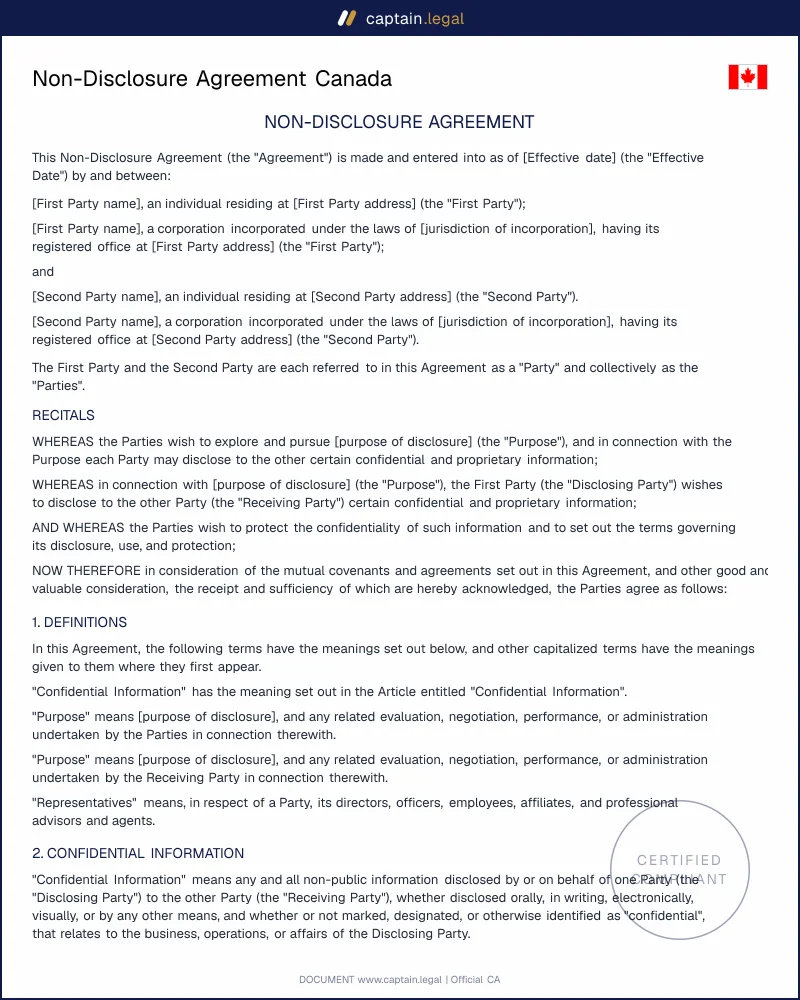
You begin by choosing whether the agreement runs one way or both ways, because that single decision shapes every obligation that follows. From there the form asks you to identify the parties with their full legal names and addresses, then to describe the permitted purpose in plain terms, the financing discussion, the supplier relationship, or the contractor engagement that the disclosure serves. The heart of the process is defining the confidential information, where the template prompts you to select the categories that actually apply rather than leaving a blanket phrase that a court might reject.

Next you set the duration, with the option to apply indefinite protection to genuine trade secrets and a fixed term to ordinary business information. You then confirm the standard exclusions and the legally required disclosure carve-outs, which the template includes by default so you do not accidentally create an unenforceable gag clause. Finally you select the governing province, which fixes the law and the forum for any dispute, and the document is ready to download as Word or PDF for signature. If you need related corporate paperwork once the deal proceeds, our Canadian business and incorporation documents sit in the same category.

6

Common mistakes to avoid

The single most damaging error is the overbroad definition. A business that protects "all information" protects nothing reliably, because a Canadian court faced with a sweeping clause will read it down or strike it, and the disclosing party discovers its weakness only at the moment it tries to enforce. The cure is specificity: list the real categories of sensitive information and resist the temptation to draft a catch-all. Closely related is the failure to include exclusions and legally required disclosure carve-outs, which not only weakens enforceability but, after the recent provincial reforms, can render an agreement unenforceable where it touches misconduct.

Two procedural mistakes recur just as often. The first is presenting an NDA to an existing employee without fresh consideration, a step that quietly voids the covenant because the original job offer was already spent. The second is disclosing information before the agreement is signed, which leaves the early, often most sensitive exchange outside the contract's protection entirely. A fourth trap is treating confidentiality and non-competition as interchangeable and bundling them into one clause, which risks dragging the enforceable confidentiality terms down with the harder-to-enforce restraint on competition. For employment-specific paperwork that keeps these obligations clean, our Canadian employment agreement template and the dedicated Canada NDA template within the employment category handle the relationship from both angles.

Key takeaways

Purpose

An NDA controls use and disclosure

An NDA is a binding contract that limits how the receiving party can use and share defined confidential information, and ties it to a stated purpose (for example, due diligence, a financing round, or a contractor onboarding). It protects assets that are hard to register, like client lists, pricing models, source code, and unfiled IP, by creating an obligation a court can enforce.

Legal test

Contract basics decide enforceability in Canada

In common-law provinces, an NDA stands or falls on ordinary contract rules: offer, acceptance, consideration, and intent to create legal relations (Quebec follows the Civil Code of Québec). Consideration is the common weak spot. If you ask an existing employee to sign later, the original job offer is not enough; you generally need fresh value like a raise, bonus, or promotion.

Drafting risk

Keep NDAs separate from non-competes

Do not mash confidentiality, non-compete, and non-solicitation terms into one loose clause. NDAs restrain information, while non-competes restrict where someone can work, and courts scrutinize those heavily. A poorly bundled paragraph can drag the confidentiality promise down with it. Draft the NDA narrowly: define confidential information precisely and keep the scope reasonable so it targets a legitimate business interest.

Frequently Asked Questions

Yes. An NDA is a contract, and Canadian courts have consistently upheld properly drafted ones as enforceable in every province. To bind, it must meet the ordinary contract tests of offer, acceptance, consideration, and intention to create legal relations, and it must protect a legitimate business interest while staying reasonable in scope. Quebec applies the Civil Code of Québec rather than common law, but the result is the same. The agreements that fail tend to be those drafted too broadly or those that try to conceal illegal conduct or harassment, which courts will not enforce. Define the confidential information precisely and the agreement will stand.

It depends on what you are protecting. For ordinary confidential business information, a fixed term of two to five years after the relationship ends is common practice. For genuine trade secrets, the obligation can run indefinitely, because in Evans v. The Sports Corp. the Alberta court confirmed that confidential information needs no fixed expiry date, the duty simply ends when the information stops being secret. Many businesses adopt a two-tier structure, applying a fixed term to general information and indefinite protection to trade secrets. The key is that the period must be reasonable for the type of information involved.

They protect against different things. A non-disclosure agreement stops a party from revealing or misusing your confidential information, while a non-compete stops a person from working in a competing role for a period after they leave. Canadian courts enforce confidentiality covenants readily but scrutinise non-competes heavily, often striking them down as an unreasonable restraint of trade. A non-solicitation clause sits between the two, restricting who a former employee may approach. Keeping these as separate, well-scoped documents protects each one, which is why pairing an NDA with our non-compete and non-solicitation agreement works better than one blended clause.

Yes, and you usually should. A mutual NDA is the right instrument whenever both parties will exchange confidential information, which is exactly what happens during merger due diligence, a joint venture, or a technology partnership. It places identical obligations on both sides and lets either party enforce on a breach. A unilateral NDA, by contrast, suits situations where only one party discloses, such as an employer to an employee or an owner to a prospective buyer who is not sharing anything in return. Choosing the wrong direction leaves one party's information unprotected.

Yes. Under PIPEDA and provincial electronic commerce legislation, electronic signatures are valid for the vast majority of commercial documents, and NDAs fall squarely within that category. A signed PDF or an e-signature platform record binds as firmly as a handwritten signature, provided the signing process reliably identifies the signer and links them to the document. The narrow exceptions in those statutes, such as wills and certain land transfers, do not touch confidentiality agreements. This is what lets you complete and sign an NDA entirely online without the delay of printing and couriering paper.

The template is delivered in both Microsoft Word and PDF. The Word version lets you adjust party details, the permitted purpose, and the confidentiality term before signing, while the PDF gives you a clean, ready-to-sign copy for parties who do not need to make further edits. Because the document is built on Canadian common law principles and includes the standard exclusions and governing-law options, you can complete it without a lawyer for routine business confidentiality, then keep the signed copies on file for each party. For other corporate paperwork, the full Canadian legal document catalogue lists what is available.

A written NDA is still worth having. Employees do carry an implied duty of fidelity that obliges them to protect their employer's confidential information, but that implied duty is vague, varies with the role, and is difficult to prove in court. A written agreement defines exactly what is protected, how long the obligation lasts, and what happens on a breach, which removes the uncertainty. The contrast is sharpest with contractors, who carry no implied duty at all, so for any freelancer or consultant a signed NDA is not optional but essential to creating any confidentiality obligation in the first place.

4.8/5

32 verified reviews · 50 000+ downloads

Non-Disclosure Agreement Canada | Common-Law NDA Template
  • Immediate access to the document
  • PDF + Word download
  • Compliant with 2026 legislation
  • Reviewed by lawyers
Fill in the template
Secure payment · No subscription
Updated on June 20, 2026

You might also like

Sales Agreement Canada
Business Purchase Agreement