Create my document
Login

Choose country

CanadaCanadaChoose country
Family & Divorce

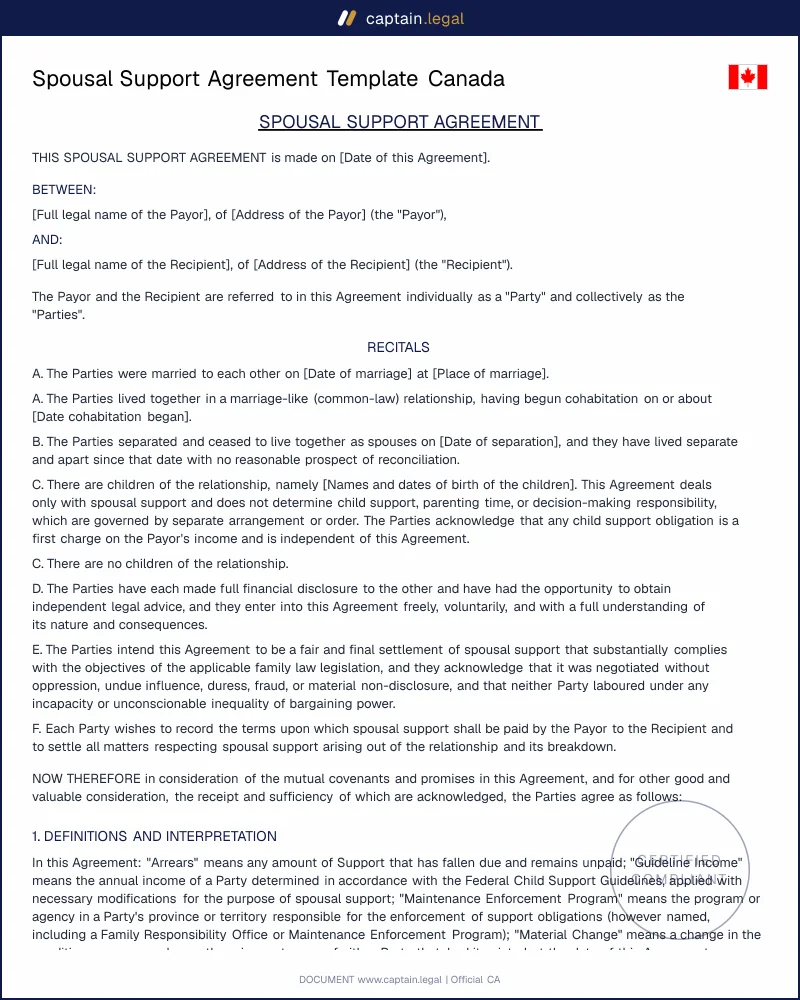
Spousal Support Agreement Canada | Divorce Act s.15.2

Draft a binding spousal support agreement under the Divorce Act and Advisory Guidelines. Entitlement, amount, duration. Word and PDF download.
4.8/518 reviews50 000+ downloadsInstant download
Share

A spousal support agreement is the contract two former partners use to fix the amount, duration, and review conditions of support payments after a separation or divorce, without leaving the question to a judge. It is the document that turns "we'll work it out" into something a court will actually recognize. Whether you are married or separating as common-law partners, a properly drafted spousal support agreement records who pays, how much, for how long, and on what terms it can change. Done right, it protects both the payor and the recipient, keeps the Canada Revenue Agency satisfied on the tax treatment, and keeps you out of a courtroom. Done carelessly, it gets set aside and you negotiate the whole thing twice.

Most people sign one of these at the worst possible moment, when emotions are high and money is tight. That is exactly why the wording matters more than the handshake behind it. A clear agreement built on full financial disclosure holds up. A vague one drafted on a kitchen table rarely does.

Compliant

2026 Legislation

50,000+ clients

trust us

Affordable

From $4.90 / doc

Secure payment

Instant download

Spousal Support Agreement Canada | Divorce Act s.15.2

Secure payment · No subscription

Fill in the template

What is a spousal support agreement?

A spousal support agreement is a written, signed contract in which one former spouse or partner agrees to pay the other an amount of support for a defined period, on stated conditions. It is distinct from a separation agreement, which is the broader document covering parenting, property, and debt; spousal support is one component that can either live inside a separation agreement or stand on its own as a focused contract. It is also separate from child support, which is governed by its own mandatory guidelines and is never a bargaining chip in the same way.

The agreement does two things at once. It records the parties' decision on entitlement, meaning whether support is owed at all, and it sets the amount and duration, the two numbers that drive everything else. Entitlement in Canadian law rests on three recognized grounds: compensatory (one partner gave up career progress for the relationship or the children), non-compensatory or needs-based (one partner simply cannot meet reasonable expenses), and contractual (the parties agreed to it). A good agreement names the basis it relies on, because that single choice shapes how a court later reviews or varies the deal. If you are still mapping out the full picture of your separation, our Canadian separation agreement templates sit alongside this one in the same category and are often signed together.

2

When do you need this document?

The clearest trigger is a negotiated separation where both people can still talk and want to settle support privately rather than litigate it. This is the everyday case: one partner earned less or stepped back from work, the relationship is ending, and the two of you would rather agree on a number than pay lawyers to argue about it. A written agreement converts that goodwill into binding dates and amounts before anyone changes their mind. You will often pair it with a parenting plan and a property settlement in the same sitting.

A second scenario is the lump-sum buyout. Instead of monthly payments stretching years into the future, one spouse pays a single capital amount to extinguish the obligation entirely, common when the payor wants a clean break or the recipient needs money now for a down payment. The tax consequences differ sharply from periodic support, so the agreement has to be drafted with that distinction in mind. A third common use is documenting a waiver, where both parties agree no support is payable; courts scrutinize waivers closely, especially in long relationships, so the reasoning needs to be on the page.

Then there are the edge cases that legitimize careful drafting. One partner is on parental leave with income that will rebound, so the agreement needs a built-in review date rather than a fixed number. Or the recipient has a health condition unrelated to the marriage but which prevents self-sufficiency, a fact pattern that can support indefinite needs-based support even where compensatory grounds are thin. Watch for the spouse who pushes a one-page document that "waives support forever", because that wording can collapse under judicial review and leave both parties worse off than a properly structured deal. If your situation involves a future relationship rather than a current breakup, our Canadian marriage contract and prenuptial templates handle support intentions before the fact.

3

Key clauses included in our template

  • The identification of the parties and relationship status opens the agreement and is not boilerplate. It states plainly whether you are married spouses under the Divorce Act or common-law partners under provincial law, because that single line determines which legal regime governs and which review powers a court holds. The clause also records the separation date, a fact that anchors limitation periods and the calculation of relationship length.
  • The statement of entitlement and its basis records why support is being paid: compensatory, non-compensatory, contractual, or a combination. Naming the ground is what allows a future court to assess whether a change in circumstances justifies variation, and it protects the recipient from a later argument that support was a gift rather than an obligation.
  • The amount and payment mechanics set the figure, the frequency, the start date, and the method of payment. Our template prompts you to specify periodic monthly payments or a single lump sum, and it records the Guidelines range used so the number is defensible. It also reminds you to pay by traceable means, since CRA will only respect deductions backed by a record.
  • The duration and review triggers clause is where most future conflict is prevented or created. It can set a fixed end date, an indefinite term, or a review tied to specific events such as the recipient reaching a stated income, a new cohabiting relationship, the payor's retirement, or the end of a parental leave. Vague triggers invite litigation; precise ones close it down.
  • The tax treatment and disclosure acknowledgements confirm that both parties exchanged financial information and understood the tax outcome. This is the clause that keeps the agreement enforceable, because it documents the disclosure that courts look for first.
4

Regional considerations

Spousal support is federal in name only once you leave the divorce itself, so the province you live in shapes the practical analysis far more than most people expect.

Ontario governs unmarried partners through its Family Law Act, which extends support eligibility to common-law partners who cohabited continuously for at least three years or who have a child together and lived in a relationship of some permanence. The same Act drives spousal support for married spouses outside the divorce context, and Ontario courts lean heavily on the Spousal Support Advisory Guidelines when fixing amounts. The Family Responsibility Office enforces support orders and registered agreements, which is why filing your agreement with the right body matters as much as signing it.

British Columbia sets a lower threshold under its Family Law Act, treating partners as spouses for support purposes after two years of a marriage-like relationship, or immediately if they have a child together. BC was an early adopter of treating common-law and married spouses almost identically for support, so the married-versus-common-law gap narrows considerably here compared with other provinces.

Alberta applies its Family Property Act and, for support, recognizes adult interdependent partners, a defined status that captures many unmarried couples after three years of cohabitation or sooner with a child. The terminology differs from other provinces, so an agreement drafted for an Ontario couple should never be copied wholesale for an Alberta one without adjusting the status language.

Quebec stands apart entirely. The province does not recognize a support obligation between common-law partners (de facto spouses) the way the rest of Canada does, a position the Supreme Court upheld in the Eric v Lola litigation. Married spouses in Quebec are covered by the Divorce Act on divorce, but unmarried couples generally cannot claim spousal support, which makes a privately negotiated contract the only route to any obligation. If your matter touches property as well as support, our Canadian real estate and property agreement templates cover the home transfer side of a separation.

5

How to fill out this spousal support agreement

You start by selecting your relationship status, married or common-law, because the template adjusts the governing-law language and the available review triggers based on that answer. From there you enter the identities of both parties and the separation date, then move to the entitlement section where you choose the basis for support and the agreement records it in the correct statutory framing. The form then asks for income figures from both parties, which is the point where the disclosure that makes the agreement enforceable gets captured rather than skipped.

Next you set the amount and the payment structure, choosing between periodic monthly support and a lump sum, with the template flagging the different tax consequences of each so you do not stumble into a non-deductible payment by accident. You then define duration and any review triggers, picking concrete events rather than vague language. The final step generates a clean signing version with proper execution blocks for both parties and, where you want it, space for independent legal advice certificates. The whole flow is built so a non-lawyer can produce a document that reads like a lawyer drafted it. For couples who also need to set decision-making and parenting terms, our Canadian family and divorce document collection keeps the related agreements in one place.

6

Common mistakes to avoid

The most expensive mistake is signing without full financial disclosure. People treat it as a formality and trade it away to speed things up, then discover that the missing income statement is exactly what the other side uses to reopen the deal two years later. Courts set aside agreements built on incomplete disclosure with little hesitation, so the time you save by skipping it is borrowed against a much larger future cost. Closely related is confusing child support with spousal support; child support comes first, is calculated under mandatory guidelines, and cannot be reduced to make room for a more generous spousal number. Mixing the two into a single undifferentiated "family support" figure creates a tax mess, because spousal support is deductible to the payor and taxable to the recipient only when it is clearly identified and paid periodically.

Vague duration language is the next trap. An agreement that says support continues "until circumstances change" hands a judge an open invitation to rewrite it, while precise triggers tied to income levels, retirement, or a new cohabiting relationship give both parties certainty. Paying in cash is another quiet disaster, since CRA will deny the deduction without a traceable record, so e-transfer or cheque is the only sensible method. Finally, copying a template drafted for another province without adjusting the status and statutory references produces a document that looks right and fails at the worst moment. The cheaper a corner looks to cut, the more it tends to cost later. Our Canadian personal and family legal documents round out the paperwork many separating couples need alongside support.

Key takeaways

Purpose

Turn a promise into an enforceable deal

A spousal support agreement is a written, signed contract that fixes whether support is owed, how much will be paid, for how long, and when it can be reviewed or changed. It can stand alone or be part of a broader separation agreement. When drafted clearly and backed by full financial disclosure, it is far more likely to be recognized by a court than an informal handshake arrangement.

Framework

Married and common-law follow different rules

Which law governs depends on your relationship status. If you are married and divorcing, spousal support is anchored in the federal Divorce Act, with s. 15.2 setting out the factors and objectives a court must consider, including the weight given to any existing agreement. If you are common-law or unmarried, entitlement comes from provincial family legislation (for example, Ontario or British Columbia), with eligibility tied to cohabitation length or having a child together.

Review risk

Name entitlement and set amount and duration

The agreement needs to address entitlement and then lock in the two numbers that drive everything else: amount and duration. Canadian law recognizes compensatory, needs-based (non-compensatory), and contractual bases for entitlement, and choosing the basis affects how a court later reviews or varies the deal. Under Divorce Act s. 15.2, self-sufficiency is only one objective and does not automatically trump hardship or compensatory claims.

Frequently Asked Questions

Yes, a written and signed spousal support agreement is a binding contract, and courts give significant weight to agreements the parties negotiated themselves. That said, binding is not bulletproof. A court can set the agreement aside if it finds there was inadequate financial disclosure, if one party signed under pressure, or if the terms are unconscionable. The Divorce Act treats an existing agreement as a factor under section 15.2(4)(c) rather than an absolute bar. The way to make yours hold up is full disclosure of income and assets, plain terms both parties understood, and ideally independent legal advice for each side. An agreement built that way is very hard to dislodge.

Yes. Every spousal support agreement created on Captain.Legal is available in both Microsoft Word and PDF formats. The Word version lets you make further edits if your circumstances shift before signing, adjust a clause, or add a schedule, while the PDF gives you a clean, locked copy ready to print and sign. Most people keep both: the editable file for their records and the PDF as the executed original. Having a properly formatted document in the right format also matters if you later need to register it with a provincial enforcement office, which expects a legible signed agreement rather than a marked-up draft.

Duration depends on the length of the relationship and which formula applies. Under the without child support formula in the Spousal Support Advisory Guidelines, the rough range is half a year to one full year of support for each year of cohabitation, so a ten-year relationship might generate support somewhere between five and ten years. For long relationships, often twenty years or more, or where the marriage length plus the recipient's age reaches sixty-five, support is frequently indefinite, meaning no end date is specified rather than literally forever. Your agreement can fix a term, leave it open with review triggers, or restructure a long periodic obligation into a shorter higher-amount arrangement.

For periodic payments made under a written agreement or court order, yes: spousal support is taxable income to the recipient and deductible for the payor. This is the opposite of child support, which is neither taxable nor deductible. The deduction only applies to amounts actually paid on a periodic basis, so a single lump-sum buyout is generally not deductible and not taxed as income. To claim the deduction the payor needs a clear written agreement and traceable payments, which is why paying by cheque or e-transfer rather than cash matters so much. If you are behind on child support, the CRA will deny the spousal deduction until those arrears are cleared.

It depends on the province, and this is where the married-versus-common-law distinction bites hardest. Most provinces extend support obligations to common-law partners once they meet a cohabitation threshold, typically two to three years, or sooner if they have a child together, under provincial family legislation rather than the federal Divorce Act. Quebec is the major exception, where de facto spouses generally have no statutory support claim, a position upheld by the Supreme Court. Because the rules differ so widely, your agreement should state your status and the governing provincial law explicitly. A privately negotiated contract can create a support obligation even where the statute would not impose one.

Yes, if it is drafted to allow it or if circumstances change materially. Under section 17 of the Divorce Act, a court can vary support where there has been a change in the condition, means, needs, or other circumstances of either party since the agreement was made. A payor losing a job, a recipient becoming self-sufficient, or a payor's retirement can all qualify. The smarter approach is to build review triggers into the agreement itself, naming the specific events that prompt a recalculation, so neither party has to run to court to adjust the number. An agreement with no variation mechanism is harder to change but not immune from a court's power to vary.

Independent legal advice is not strictly mandatory in most provinces, but it is strongly advisable and it materially strengthens the agreement. When each party has had separate legal advice before signing, it becomes far harder for either to later claim they did not understand the terms or were pressured into them, which removes two of the most common grounds for setting an agreement aside. Many couples use a thorough template to settle the substance, then have a lawyer review the final document, a sequence that controls cost while preserving enforceability. At minimum, both parties should exchange full financial disclosure and read every clause before signing.

4.8/5

18 verified reviews · 50 000+ downloads

Spousal Support Agreement Canada | Divorce Act s.15.2
  • Immediate access to the document
  • PDF + Word download
  • Compliant with 2026 legislation
  • Reviewed by lawyers
Fill in the template
Secure payment · No subscription
Updated on June 19, 2026

You might also like

Postnuptial Agreement Template Canada
Child Support Agreement Template