Create my document
Login

Choose country

CanadaCanadaChoose country
Non-Profit

Non-Profit Bylaws Canada | NFP Act Section 152 Rules

Non-profit bylaws drafted to the Canada Not-for-profit Corporations Act and ONCA, covering Section 152 confirmation, quorum and charity governance.
4.8/524 reviews50 000+ downloadsInstant download
Share

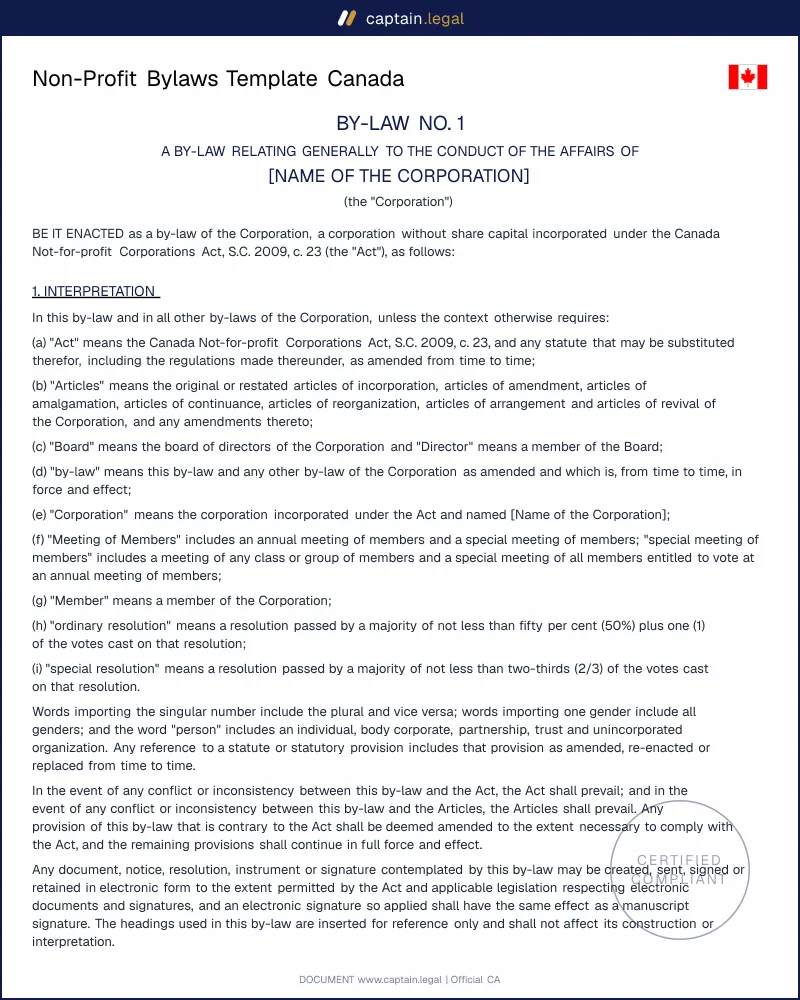
A non-profit by-law is the internal governing document that tells a Canadian not-for-profit corporation how it will actually be run: who its members are, how directors are elected, what officers do, when meetings are held, how votes are counted and how the rules can later be changed. Where the articles of incorporation create the corporation and fix its broad structure, the by-laws fill in the day-to-day machinery of governance. Federal corporations operate under the Canada Not-for-profit Corporations Act (NFP Act), and most provinces have a close equivalent, so a well-drafted set of non-profit by-laws has to track the statute that governs your particular organisation. This template gives founders, boards and charities a complete, lawyer-grade framework covering membership, board structure, officer roles, meetings, voting and amendment procedures.

Compliant

2026 Legislation

50,000+ clients

trust us

Affordable

From $4.90 / doc

Secure payment

Instant download

Non-Profit Bylaws Canada | NFP Act Section 152 Rules

Secure payment · No subscription

Fill in the template

What is a non-profit by-law in Canada?

A by-law is a binding internal rule adopted by a non-profit corporation to regulate its own activities and affairs. It is not the same thing as the articles of incorporation, and the distinction trips up a surprising number of founders. The articles are filed publicly with the regulator and set the corporation's name, registered province, statement of purpose, number of directors and classes of members. The by-laws are the operating manual that sits beneath the articles: they govern how those members are admitted, how directors are nominated and removed, what a quorum looks like and how a meeting is called. Under the NFP Act, the by-laws and the articles together form the corporation's governing documents, and a corporation must keep both at its registered office along with its minutes and member resolutions.

People also confuse a by-law with a constitution. In federal and most modern provincial regimes there is no separate "constitution": the purpose and structural elements live in the articles, and everything procedural lives in the by-laws. Older unincorporated clubs still use a constitution-and-by-law pairing, but an incorporated entity does not. If your group is incorporated, you need articles and by-laws, not a constitution. A by-law that contradicts either the articles or the governing statute is void to the extent of the conflict, which is why the drafting has to be done against the right Act from the outset.

2

When do you need this document?

The most common trigger is incorporation itself. Once Corporations Canada or a provincial registry issues the certificate, the directors hold an organisational meeting and adopt the founding by-law, and without it the corporation has no rules for electing officers, calling meetings or admitting members. A federal corporation that drifts past its first members' meeting without a confirmed by-law is operating on borrowed time, because the section 152 confirmation deadline is unforgiving. The second frequent scenario is the conversion or continuance of an older entity, where a club incorporated under a repealed statute, or an unincorporated association that has outgrown its handshake governance, needs a modern by-law that matches its current Act.

A third situation is charity registration. The CRA reviews an applicant's governing documents closely, and by-laws with vague objects, a missing dissolution clause or weak conflict-of-interest rules routinely draw questions that delay approval for months. Founders preparing for this step often pair their by-laws with our Canadian non-profit incorporation and governance documents so the whole package reads consistently.

Finally, growth itself forces the issue. A board that adds membership classes, creates committees, moves to electronic meetings or wants to indemnify its directors has to amend the by-laws to do any of it properly. An action the by-laws do not authorise can be challenged by any member after the fact, so the document needs to anticipate where the organisation is going, not just where it is today.

3

Key clauses included in our template

  • The membership provisions define who may join, the classes of members and the rights attached to each class, including which classes vote. They also set out admission, resignation, the discipline and termination of members, and the notice a member is owed before any disciplinary decision, which both the NFP Act and ONCA treat as a substantive right rather than a formality.
  • The board and director clauses fix the number of directors, their term (which under the NFP Act cannot exceed four years), the qualifications, and the rules for election, removal and filling vacancies. For a soliciting corporation under the federal Act, the template carries the requirement that at least two directors not be officers or employees, a point easily overlooked by charities that solicit public donations.
  • The officer roles describe the chair, president, secretary and treasurer, their appointment by the board and their authority to bind the corporation, so that day-to-day signing authority is never left ambiguous.
  • The meeting and quorum rules govern annual and special meetings of members, notice periods, the use of electronic participation, proxies where permitted, and the quorum for both board and member meetings. Getting the notice window right matters because a meeting called on short notice can have its resolutions set aside.
  • The voting and resolution mechanics distinguish ordinary resolutions from special resolutions and set the thresholds for each, which is what makes amendments and fundamental changes enforceable.
  • The financial, conflict-of-interest and dissolution clauses require directors to disclose material interests in writing under the statute, set the financial year and audit or review-engagement approach, and direct charitable assets to a qualified donee on dissolution, a clause the CRA expects to see.
4

Regional considerations

Federal (NFP Act). A federally incorporated non-profit is governed nationwide by the Canada Not-for-profit Corporations Act, but it must register extra-provincially in any province where it actually carries on activities. The federal scheme draws a sharp line between a soliciting corporation, which receives meaningful income from public or government sources, and a non-soliciting one, with the soliciting category carrying a higher minimum of three directors and a public-accountant requirement above set revenue thresholds. The by-laws should state plainly which category applies and adjust the board composition and financial review provisions accordingly. Our Canadian business incorporation and corporate templates explain how the federal and provincial registration layers interact.

Ontario (ONCA). Ontario non-profits incorporate through ServiceOntario and no longer need Office of the Public Guardian and Trustee approval for charitable purposes. ONCA introduces the concept of a public benefit corporation, limits the proportion of directors who may be employees, and imposes the sixty-day organisational by-law deadline noted above. The by-laws must dovetail with the articles, because where the two conflict the Act deems the articles amended to match the statute.

British Columbia (Societies Act). BC societies file by-laws directly with the BC Registry, and the by-laws are part of the public record from the outset rather than an internal-only document. The Societies Act distinguishes member-funded societies from ordinary ones, with different reporting expectations, so a BC by-law has to declare the society's type. Founders here often also need our Canadian charity and association governance documents to round out the filing.

5

How to fill out this non-profit by-law

You start by selecting the governing statute, because the template branches between the federal NFP Act and the provincial regimes, and the wording of the amendment and confirmation clauses changes with that choice. From there you enter the corporation's legal name exactly as it appears on the certificate of incorporation, its registered province and its statement of purpose, so the by-laws sit consistently beneath the articles. The form then walks through the membership classes, asking which classes vote and what rights attach to each, before moving to the board, where you set the number of directors, their term and any qualification requirements. Next come the officer roles and signing authority, then the meeting mechanics, where you choose notice periods, quorum and whether electronic meetings are permitted. The final stage covers the financial year, the conflict-of-interest rules and the dissolution clause directing assets to a qualified donee. Once the fields are complete you download the by-law as a ready-to-edit Word file or a print-ready PDF, sign at the organisational meeting and keep the original with your corporate records, alongside any director resolutions you generate from our Canadian personal and family legal documents where individual signing roles overlap.

6

Common mistakes to avoid

The error that causes the most trouble at the federal level is treating a director-adopted by-law as permanently effective. Under section 152 of the NFP Act the directors' resolution is only provisional until the members confirm it at the next meeting, and a board that forgets this step can find a year of governance resting on a by-law that has quietly ceased to have effect. A close second is borrowing a by-law written for the wrong statute, because a template drafted for Ontario's ONCA carries defaults that simply do not exist federally, and vice versa, so the clauses on quorum, removal and amendment end up describing rules the corporation is not actually subject to. Founders also tend to copy purpose language without checking it against CRA expectations, which is the fastest way to stall a charity application.

The other recurring problems are quieter but just as damaging. Boards leave the dissolution clause blank or send assets to the wrong recipient, when charitable assets must flow to another qualified donee. They set notice periods shorter than the regulations allow, exposing every resolution passed at the meeting to challenge. They omit the conflict-of-interest disclosure the statute requires in writing, and they fail to name the soliciting-corporation status that drives the minimum number of directors and the audit obligation. Each of these is fixable before adoption and expensive to fix afterward.

Key takeaways

Governing documents

By-laws run the day-to-day rules

The articles of incorporation set the public, structural basics (name, purposes, director number, member classes). The by-laws sit underneath as the operating manual: how members are admitted, how directors are elected or removed, what quorum is, how meetings are called, and how votes are counted. Keep both at the registered office with minutes and member resolutions.

NFP Act s. 152

Director changes need member confirmation

For federal corporations under the Canada Not-for-profit Corporations Act, section 152 allows directors to make, amend or repeal a by-law by board resolution, but the change must go to members at the next meeting. Members can confirm, reject, or amend it by ordinary resolution. If directors never submit it, the by-law stops having effect.

Ontario ONCA

Miss the organisational by-law deadline

Your statute depends on where you incorporated, and the defaults can be unforgiving. In Ontario under the Not-for-Profit Corporations Act, 2010, if directors do not pass an organisational by-law within sixty days after incorporation, the corporation is deemed to have adopted the Director’s standard by-laws. Those generic rules often misfit real membership, quorum, and meeting practices.

Frequently Asked Questions

Yes. A by-law adopted in accordance with your governing statute is binding on the corporation, its directors and its members from the moment it takes effect. For a federal corporation under the NFP Act, the directors' resolution makes the by-law effective immediately, but it stays effective only if the members confirm it by ordinary resolution at the next meeting under section 152. Provincial regimes such as ONCA and the BC Societies Act have their own adoption mechanics, which the template follows. The document is drafted to the statute you select, so once you complete the fields, sign at the organisational meeting and record it in your minute book, it carries full internal legal force.

Not in most cases. Canadian non-profit statutes let the directors and members adopt by-laws themselves, and a well-structured template that tracks the NFP Act or the relevant provincial Act lets a board do this without retaining counsel for routine governance. Where legal review genuinely helps is with novel charitable purposes, unusual membership structures or a planned amalgamation, since the CRA and the registries scrutinise those closely. For a straightforward incorporation, completing the by-law and pairing it with the Canadian non-profit and association document library is generally enough to get the corporation properly organised.

The articles create the corporation and are filed publicly with Corporations Canada or the provincial registry; they set the name, registered province, purpose, number of directors and member classes. The by-laws are the internal rulebook that govern how those elements operate day to day, including elections, meetings, quorum and voting. Under the NFP Act a requirement to set something out in the by-laws can be satisfied by putting it in the articles instead, but in practice the two documents serve different jobs and a corporation keeps both. If they ever conflict, the statute generally treats the articles, and the Act itself, as prevailing.

Amendment follows the same path as adoption. Federally, the directors pass a resolution to make, amend or repeal a by-law, then submit it to the members at the next meeting for confirmation by ordinary resolution; if they do not submit it, the change ceases to have effect. Some matters listed in the Act require a special resolution of the members rather than the directors acting alone. Provincial statutes set comparable thresholds, and the template's amendment article is written to match whichever Act you select, so your board always knows which vote is required for which change.

Yes, provided the by-laws authorise it and you follow the notice and participation rules. Both the federal NFP Act and modern provincial statutes permit members and directors to meet by telephone or electronic means and to vote electronically where the by-laws so provide. The template includes optional electronic-meeting and electronic-voting clauses, the registered-office record-keeping that the statute requires, and the notice periods that keep those meetings valid. If your by-laws are silent on electronic meetings, a court may treat a virtual meeting as improperly held, so the authorising clause matters.

You receive the completed by-laws in both Microsoft Word and PDF. The Word file lets you adjust clause numbering, add committee provisions or tailor officer titles before the organisational meeting, while the PDF gives you a clean, print-ready version to sign and file in the corporate records. Because Canadian non-profit governance evolves and boards routinely amend their rules, keeping the editable Word version is practical for future amendments, and you can combine it with related Canadian employment contracts and HR documents once the organisation starts hiring staff.

As soon as practicable, and for some provinces there is a hard deadline. The directors normally adopt the founding by-law at the organisational meeting held shortly after the certificate of incorporation issues. Under Ontario's ONCA the timing is strict: if the directors do not pass an organisational by-law within sixty days of incorporation, the corporation is deemed to have adopted the Director's standard by-laws, which seldom suit a real organisation. Federally there is no fixed deadline, but the section 152 confirmation requirement means the by-law still has to reach the members at their first meeting to remain in force.

Yes. A registered charity must adopt exclusively charitable purposes, include a dissolution clause directing assets to another qualified donee, and maintain governance records that support its annual T3010 filing with the Canada Revenue Agency. The CRA reviews governing documents at the application stage and can reject purposes it considers non-charitable, so charity by-laws need tighter object and conflict-of-interest language than an ordinary non-profit. The template includes the charity-ready provisions and flags the clauses the CRA expects, helping a board move from incorporation to registration without redrafting.

4.8/5

24 verified reviews · 50 000+ downloads

Non-Profit Bylaws Canada | NFP Act Section 152 Rules
  • Immediate access to the document
  • PDF + Word download
  • Compliant with 2026 legislation
  • Reviewed by lawyers
Fill in the template
Secure payment · No subscription
Updated on June 18, 2026

You might also like

Membership Application Form Canada
Memorandum of Understanding Canada