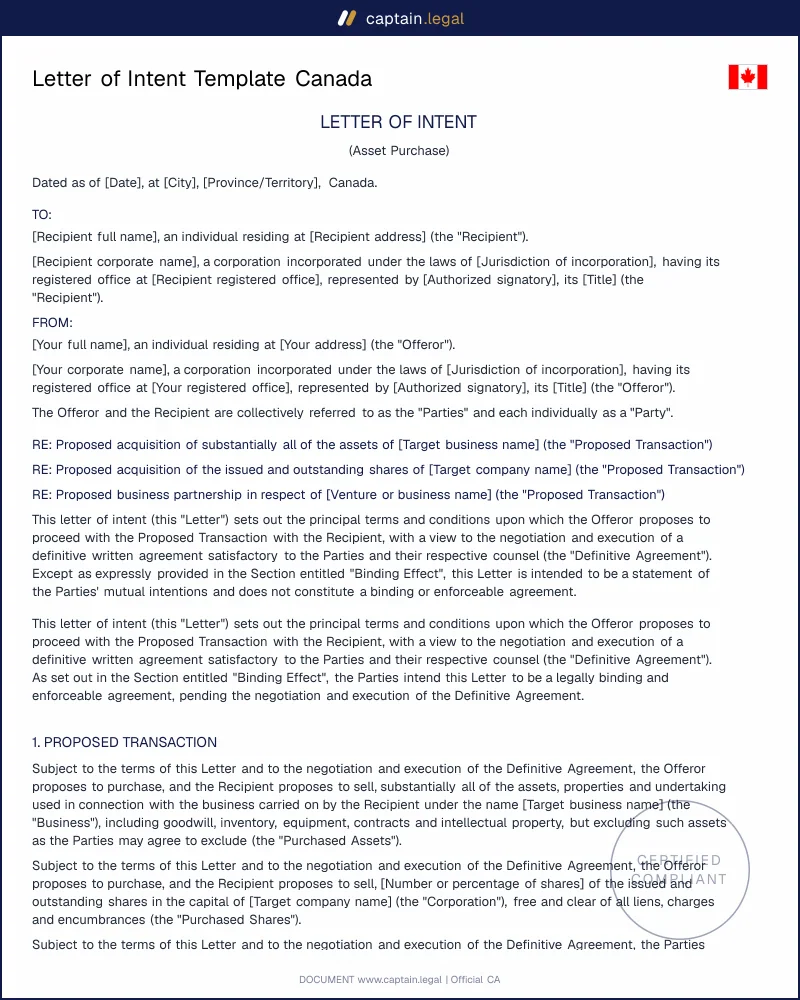
There is no statute in Canada called the "Letter of Intent Act." The enforceability of an LOI is governed by the common law of contract in the common-law provinces and by the Civil Code of Québec in Quebec, and the analysis turns on ordinary contractual principles: offer, acceptance, consideration and, above all, the intention to create legal relations. The leading authority is Wallace v. Allen, 2009 ONCA 36, where the Ontario Court of Appeal held a letter of intent to be fully binding even though it contemplated a later, more formal share purchase agreement. The court read the document as a whole and gave weight to contractual phrasing such as "this agreement" and "it is agreed," and to the conduct of the seller, who announced his retirement and introduced the buyer as the new owner. The lesson practitioners drew from it is blunt: contractual language plus contractual behaviour can bind you regardless of your private intention to stay non-committal. You can read the full reasons in the official report of Wallace v. Allen on CanLII, available through the Canadian Legal Information Institute decision database.
Later cases sharpened the point. In Seelster Farms Inc. v. Ontario, 2020 ONSC 4013, the court confirmed that explicit contractual wording is not strictly necessary so long as the hallmarks of a contract, an offer, an acceptance and consideration, appear in the document and the parties' dealings. Separately, the Supreme Court of Canada in Bhasin v. Hrynew, 2014 SCC 71, established a general organizing principle of good faith and a duty of honest performance that applies to all contracts, and C.M. Callow Inc. v. Zollinger, 2020 SCC 45, extended that duty to cover half-truths and misleading silence during performance. Where an LOI does create binding obligations, even narrow ones such as exclusivity or confidentiality, these duties apply. As for form, the Statute of Frauds still requires a sufficient written memorandum for certain dealings such as transfers of land, and electronic signatures are valid for most commercial LOIs under PIPEDA and the provincial electronic commerce acts.