Create my document
Login

Choose country

CanadaCanadaChoose country
Personal & Family

Power of Attorney Personal Care | SDA 1992

Personal care POA and living will under the Substitute Decisions Act 1992 and Representation Agreement Act, with provincial witnessing built in.
4.7/524 reviews50 000+ downloadsInstant download
Share

A power of attorney for personal care is the document that lets you name a trusted person to make your health and personal care decisions if illness or injury ever takes away your ability to decide for yourself. In most Canadian common-law provinces it sits alongside a living will, the written record of the treatment you would accept or refuse near the end of life. Together they keep two of the hardest questions a family faces out of a courtroom: who speaks for you, and what would you have wanted. This template is drafted for Canadians who want their wishes on record before a crisis, with the witnessing and capacity rules each province imposes already built in.

Most people put this paperwork off because the everyday version of incapacity is invisible until it arrives. A stroke, a serious accident, the later stages of dementia: each can strip decision-making capacity in an afternoon, and without a valid appointment in place your relatives are left guessing or, worse, applying to court. A properly executed personal care document is the single cheapest insurance against that outcome.

Compliant

2026 Legislation

50,000+ clients

trust us

Affordable

From $4.90 / doc

Secure payment

Instant download

Power of Attorney Personal Care | SDA 1992

Secure payment · No subscription

Fill in the template

What is a power of attorney for personal care?

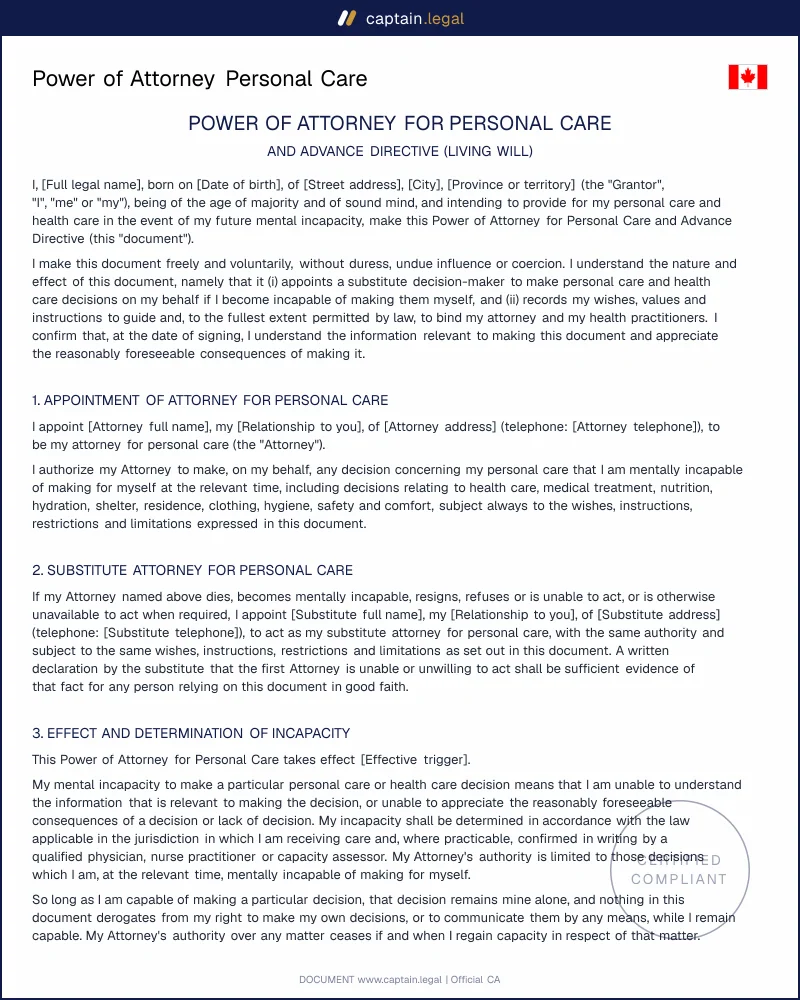
A power of attorney for personal care is a written authority by which you (the grantor) appoint one or more people (your attorney, agent or representative, depending on the province) to make personal and health care decisions on your behalf once you can no longer make them yourself. Personal care is broader than medicine alone. It covers health care, nutrition, shelter, clothing, hygiene and safety, which is why the same document governs both a consent to surgery and a decision about whether you move into long-term care.

The instrument is dormant while you remain capable. It does not hand your autonomy to anyone the day you sign; it activates only when a clinician or assessor finds you incapable of the specific decision at hand, and it lapses for any decision you later regain capacity to make. That distinction matters, because many grantors fear they are signing away control. They are not.

A living will, sometimes called an advance directive or health care directive, is the companion piece. Where the power of attorney names the person, the living will records the instructions: the treatments you want, the interventions you would refuse, and the line past which you would prefer comfort care over aggressive measures. Some provinces fold both functions into one statutory form; others keep them separate. A living will with no one appointed to enforce it, and an appointment with no instructions to guide it, are each only half a plan. Our estate and personal planning templates for Canadian families are built to be used as a matched pair.

2

When do you need this document?

The clearest trigger is a diagnosis that puts future incapacity on the horizon. Anyone told they have early-stage dementia, Parkinson's, ALS or a progressive neurological condition should treat a personal care document as urgent, because the window to sign while still legally capable is closing. Capacity is assessed at the moment of signing, and a document executed after capacity is already in doubt is the one most likely to be set aside.

The second scenario is the one nobody schedules. A serious accident or sudden stroke can remove capacity without warning at any age, which is why estate lawyers routinely advise healthy adults in their thirties and forties to put the appointment in place alongside a will rather than waiting for retirement. Parents of a young adult with a serious disability face a related deadline: the day a child turns eighteen, a parent's automatic authority ends, and without an appointment the family may have to apply for guardianship.

Travel and major surgery sharpen the need too. Someone facing an operation with a meaningful risk of complications wants a named decision-maker in place before they are wheeled in, not a relative scrambling at the hospital. A high-conflict family is its own edge case worth flagging. Where no document exists, provincial law often ranks all adult children equally, so several siblings hold identical authority and a single hold-out can deadlock the most important call of a parent's life. Naming one person, with an alternate, ends that stalemate before it starts. The companion last will and testament tools for Canadian estates address what happens after death; this document governs the period before it.

3

Key clauses included in our template

  • The appointment of the attorney or representative names your primary decision-maker in full and lets you add an alternate who steps in if the first person dies, resigns or becomes unavailable. You choose whether two or more attorneys act jointly, meaning every decision needs agreement, or severally, meaning each can act alone, a choice that quietly determines whether your plan survives a disagreement.
  • The scope of authority sets out exactly which personal care areas your attorney may decide: health treatment, accommodation including a move to a care facility, nutrition, hygiene and safety. You can grant the full range or carve out specific powers, which is how a grantor keeps certain choices for family consensus while delegating the rest.
  • The statement of treatment wishes, the living will element, records the interventions you would accept and those you would refuse, including your position on life support and resuscitation where your province allows it. Specific instructions tied to a known condition carry far more weight than vague language about "no heroic measures", which clinicians struggle to apply.
  • The conditions for the document taking effect confirm that the authority is dormant until a finding of incapacity, and identify who makes that finding. This is the clause that reassures a cautious grantor that signing changes nothing while they remain well.
  • The revocation clause cancels any earlier personal care appointment so two competing documents never circulate at once, a frequent and entirely avoidable source of family conflict.
  • The execution and witnessing block carries the dated signatures and the witness attestations in the form your province requires, the single most litigated part of the whole instrument.
4

Regional considerations

Ontario runs the most widely used regime. Under the Substitute Decisions Act, 1992 the power of attorney for personal care must be signed before two qualifying witnesses, and the Health Care Consent Act, 1996 governs the consent your attorney later gives. Ontario also recognises a specialised Power of Attorney for Personal Care with Special Provisions, sometimes called a Ulysses clause, which can authorise treatment of a resisting patient with a known psychiatric condition; that version requires a capacity assessment by a qualified assessor within thirty days of signing. Where no document exists, the Health Care Consent Act imposes a statutory hierarchy of substitute decision-makers, and equal-ranking relatives must reach consensus.

British Columbia does not use a personal care power of attorney at all. The Representation Agreement Act provides a Section 7 standard agreement for routine and minor health decisions and a Section 9 enhanced agreement for major medical choices and the refusal of life support, with certificates of the representative and any monitor required for the document to take effect. A BC resident who signs an Ontario-style personal care power of attorney has signed the wrong instrument, and the family may be forced into a committeeship application as a result.

Alberta combines appointment and instructions in a single personal directive under the Personal Directives Act, which takes effect on a written declaration of incapacity, usually by a physician. The remaining common-law provinces follow broadly similar models under their own wills, succession and capacity statutes, each with distinct witnessing rules, which is why a document drafted for one province should never be assumed to work in another. Anyone who has recently relocated should review their family and personal status documents for their new province at the same time.

5

How to fill out this power of attorney for personal care

You start by selecting the province where you live, because that single choice sets the correct statutory name, the witnessing rules and the available powers. From there the form asks you to name your attorney or representative and, just as importantly, an alternate, then to choose whether multiple appointees act jointly or severally. The guided fields walk you through the scope of authority next, letting you grant the full range of personal care decisions or limit them to specific areas.

The living will portion follows, where you record your treatment wishes in plain language: your position on life-sustaining measures, artificial nutrition and the point at which you would prefer comfort care. The template prompts you to be concrete rather than general, because precise instructions are the ones clinicians can actually act on. Once the substance is complete the document generates with the correct execution and witnessing block for your province, ready to print, sign and have witnessed. You download it as Word and PDF, so you can adjust wording with a professional if you wish or sign the clean copy as it stands. If you are organising your wider affairs at the same time, our business and commercial agreement templates for Canada and the full catalogue of ready-to-sign Canadian legal documents sit a click away.

6

Common mistakes to avoid

The error that voids more of these documents than any other is botched witnessing. People sign with a spouse, a child or the named attorney standing in as witness, all of whom are disqualified in most provinces, and the appointment collapses at the moment it is needed. Almost as common is signing the wrong provincial instrument, typically because a template found online was drafted for Ontario and used by a resident of British Columbia or Alberta, where the law demands a representation agreement or a personal directive instead. A close cousin of this mistake is failing to refresh the document after moving between provinces.

Grantors also confuse the two halves of the plan. Naming an attorney without recording any treatment wishes leaves your decision-maker guessing at the hardest moments, while writing detailed wishes without appointing anyone leaves nobody with authority to enforce them. Many people leave the document somewhere safe and tell no one, so it never surfaces during the emergency it was made for; your attorney and your usual physician should both know it exists and where to find it. Finally, a surprising number of people sign once and never revisit the choice, even after a divorce, a death or a falling-out has made the named attorney the last person they would now trust. Review the appointment after every major life change, and formally revoke and replace it rather than relying on a loose verbal instruction that no clinician will honour.

Key takeaways

Authority

It only takes effect if you are incapable

A personal care power of attorney does not hand over control the day you sign. It stays dormant while you have capacity, then applies only when a clinician or assessor finds you incapable for the specific decision in front of you, and it stops for any decision you later regain capacity to make. That timing is the whole point: planning ahead without losing autonomy.

Instructions

Pair the appointment with a living will

Naming a decision-maker answers who can speak for you, but it does not automatically answer what you want. A living will (advance directive) records the treatments you would accept or refuse, and when you would choose comfort care over aggressive measures. One without the other is a partial plan: instructions need someone to apply them, and your attorney needs guidance when the stakes are high.

Formalities

Witnessing rules can make or break it

This paperwork is provincial, and execution mistakes are a common way these documents get challenged. In Ontario, under the Substitute Decisions Act, 1992, the grantor must sign and date in front of two witnesses, and certain people cannot witness (including the attorney, the attorney’s spouse, your spouse or child, and anyone under 18). If witnessing is wrong, the appointment can fail entirely.

Frequently Asked Questions

Yes, provided you execute it correctly for your province. The template builds in the Substitute Decisions Act, 1992 witnessing rules for Ontario, the Representation Agreement Act certificate requirements for British Columbia, and the equivalent execution steps for other common-law provinces. What gives the document its legal force is your capacity at signing plus proper witnessing by people the statute permits. A document signed by a capable adult before two qualifying witnesses is as binding as one a lawyer drafts. The substance has to match your province, which is why selecting the correct jurisdiction at the start is the step that matters most.

They answer two different questions and work best together. The power of attorney for personal care appoints the person who will make your health and personal decisions when you cannot, while the living will records the instructions that person should follow: which treatments you want, which you refuse, and your wishes near the end of life. One names the decision-maker; the other guides the decision. Some provinces combine both into a single statutory form, such as Alberta's personal directive, while others keep them separate. Our template lets you complete both elements so your appointed attorney is never left guessing what you would have chosen.

In most common-law provinces you need two witnesses who watch you sign and then sign themselves. Critically, certain people are disqualified: the attorney you are appointing, that attorney's spouse, your own spouse or child, and anyone under eighteen cannot serve as a witness in Ontario. British Columbia uses a certificate process rather than ordinary witnessing for representation agreements. Because the witnessing rule is the single most litigated feature of these documents, the template generates the correct attestation block for the province you select, with a plain note on who may and may not act.

Yes, and many people do, naming a primary attorney plus an alternate who steps in if the first cannot act. If you appoint two or more to serve at the same time, you decide whether they act jointly, meaning they must agree on every decision, or severally, meaning each can act independently. Joint appointments protect against a single person acting rashly but can deadlock if your appointees disagree; several appointments are faster but rely on coordination. For most families a single primary attorney with a named alternate strikes the cleanest balance and avoids the stalemate that equal-ranking relatives often hit.

It stays dormant while you remain capable and activates only when you become incapable of the specific decision at hand. Capacity is assessed decision by decision, so you might be found incapable of a complex medical choice yet still able to decide where you live. The finding is usually made by a treating clinician or, in some cases, a qualified capacity assessor. The document never overrides a decision you are still capable of making yourself. If you recover capacity, authority returns to you automatically for any decision you can once again make.

As long as you remain capable, you can revoke and replace the document at any time. The cleanest approach is to sign a fresh document containing a revocation clause that cancels the earlier one, then destroy the old copies and tell your attorney and physician about the change. A loose verbal statement that you have changed your mind will not reliably override a signed instrument, so always handle a change in writing with the same witnessing the original required. Reviewing the appointment after a divorce, a death or a serious falling-out is strongly advised.

You download the completed document in both Word and PDF. The PDF is ready to print, sign and have witnessed exactly as it stands, while the editable Word version lets you fine-tune wording or hand it to a lawyer or notary for review before signing. There is no obligation to involve a professional, and a correctly witnessed document made by a capable adult is fully effective on its own, but the Word format keeps that option open if your situation is complex or you want a second set of eyes on the treatment wishes.

4.7/5

24 verified reviews · 50 000+ downloads

Power of Attorney Personal Care | SDA 1992
  • Immediate access to the document
  • PDF + Word download
  • Compliant with 2026 legislation
  • Reviewed by lawyers
Fill in the template
Secure payment · No subscription
Updated on June 20, 2026

You might also like

Power of Attorney Canada
Affidavit Template Canada