Create my document
Login

Choose country

CanadaCanadaChoose country
Personal & Family

Last Wishes Letter Canada | Non-Binding Estate Doc

A last wishes letter sits alongside your will, not in place of it. Drafted for the common-law provinces, with the WESA s.58 caution built in. Word and PDF.
4.7/523 reviews50 000+ downloadsInstant download
Share

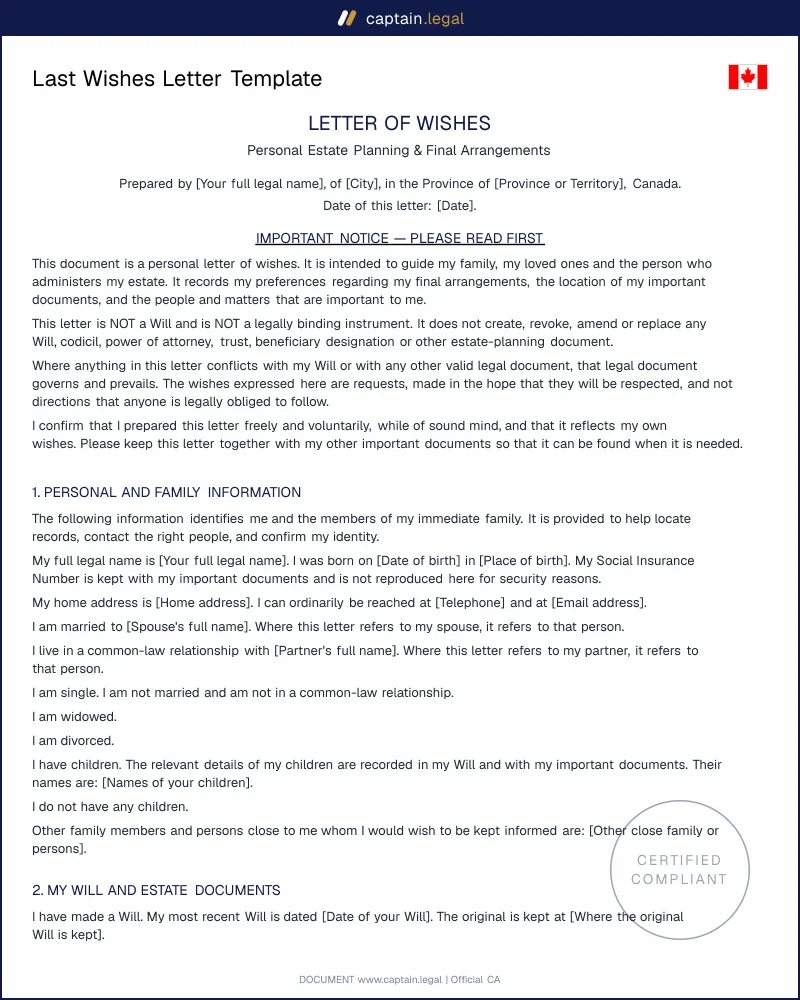
A last wishes letter, also called an estate planning letter or letter of wishes, is a private document that records your funeral preferences, the location of your assets and accounts, and personal instructions meant to guide the people who will settle your affairs. It speaks to your executor, family and loved ones in plain language rather than legalese, and it sits alongside your will without replacing it. In every common-law province this letter is a non-binding record: it carries moral weight and real practical value, yet it lacks the legal force of a will or a power of attorney. Think of it as the human layer of your estate plan, the place where you set out the where, the how and the why a formal will leaves out.

Compliant

2026 Legislation

50,000+ clients

trust us

Affordable

From $4.90 / doc

Secure payment

Instant download

Last Wishes Letter Canada | Non-Binding Estate Doc

Secure payment · No subscription

Fill in the template

What is a last wishes letter?

A last wishes letter is an informal estate-planning document that gathers, in one place, the practical and personal information your loved ones will need after you are gone. It records your funeral and burial or cremation preferences, the location of your original will and other key papers, a list of accounts, investments, insurance policies and digital assets, and any personal messages behind decisions in your will. You write it in your own voice, sign and date it, and store it where your executor can find it quickly.

The distinction that matters most is the one between this letter and a will. A will is the formal legal instrument that appoints your executor (the estate trustee), distributes your property and must satisfy strict execution rules under provincial succession law. A last wishes letter does none of that. It explains, guides and organises, but it transfers ownership of nothing and cannot override a clause in your will. People sometimes confuse it with a holograph will, a handwritten testamentary document several provinces recognise; the difference is intention, because a last wishes letter is deliberately drafted not to dispose of property. Used well, it makes the executor's job markedly easier. For the binding instruments, our Canadian personal and family legal templates cover wills and powers of attorney.

2

When do you need this document?

The most common reason people write one is to spare their family the scramble that follows a death. Executors routinely lose weeks hunting for account numbers, insurance policies, the original will and the name of the deceased's accountant. A last wishes letter that lists where everything lives turns that scramble into an afternoon of administration. The second trigger is funeral planning. Most people hold strong preferences about burial or cremation, the service and who should be told, and a will is the wrong place for them because it is often read only after the funeral has happened.

A third situation is the distribution of personal effects with more sentimental than monetary value. Jewellery, photographs, a collection, the family piano: these are the items that start disputes, and a letter naming who should receive what defuses most of them before they begin. Parents of young children often add guidance for a guardian. One edge case worth flagging: where beneficiaries already have tense relationships, or where an item carries real financial value, the letter is the wrong tool, and those decisions belong in the binding text of the will.

3

Key clauses included in our template

  • The funeral and final arrangements section records your preference for burial or cremation, any religious or cultural rites, the tone of the service, and the people who must be notified. It reads as preference rather than command, since these wishes are honoured by family goodwill, not by court order.
  • The asset and account inventory lists bank accounts, investments, registered plans, real property, insurance policies and pensions, with institution names and reference numbers but never full passwords. Executors say this section saves them the most time.
  • The digital assets and passwords clause addresses email, social media, cloud storage and cryptocurrency, with guidance on access and on which accounts to memorialise or close. Store the access credentials separately from the letter itself to reduce the risk of fraud.
  • The location of key documents points to the original signed will, powers of attorney, property deeds and tax records, because a copy is rarely enough and a missing original can force an estate into added court steps.
  • The personal messages and explanations section lets you record the reasoning behind difficult choices in your will, such as appointing one child as executor or leaving unequal gifts, which is often what prevents a challenge later.
  • The non-binding declaration states that the letter guides but does not bind, that it neither revokes nor amends the will, and that the will prevails in any conflict, the single most important protective clause in the document.
4

Regional considerations

Ontario treats the letter as a purely precatory document sitting outside the Succession Law Reform Act. An executor looks first to the will for binding instructions, and the letter informs discretionary choices such as the division of personal effects. Because Ontario recognises holograph wills under section 6 of the SLRA, a letter written entirely by hand and signed could be mistaken for a testamentary document, so an explicit non-binding statement is especially valuable here.

British Columbia is the province to watch. Under section 58 of the WESA, a court may cure a document that fails the formal will requirements if it captures the deceased's testamentary intention, so a letter using gift-giving language risks being pulled into that curative power. British Columbia also allows electronic wills, so a digital letter needs careful labelling to avoid any suggestion that it is itself a will. Families settling property at the same time often pair it with a residential tenancy or property document for Canada.

Alberta applies its Wills and Succession Act and treats the letter as non-binding guidance, while its substantial-compliance provision under section 37 gives courts a dispensing power like British Columbia's, so the same caution about imperative wording applies. Quebec sits apart, because its Civil Code succession regime and notarial will tradition differ fundamentally from the common-law provinces, and this template serves the common-law provinces only. Across Canada there is no estate or inheritance tax, though a deemed disposition on death can trigger capital gains in the estate, a point your letter can flag for your executor.

5

How to fill out this last wishes letter

You start by entering your full legal name and the date, then a short opening statement that names the document and declares it non-binding, which anchors everything that follows. The template then walks you through funeral preferences in plain prose, capturing burial or cremation, the service you would like and the people to contact. You build the asset inventory section by section, adding each account, policy and property with the institution and a reference number, while the form prompts you to keep passwords in a separate secure location.

Next you record where your original will and other key documents are kept, then the personal messages you want read, including the reasoning behind any sensitive decision. The closing section restates that the letter guides rather than binds and that the will prevails in any conflict. Once complete you download it in Word and PDF, sign and date it, and store it where your executor knows to look. If you also need formal instruments, our Canadian business and corporate templates and employment document library sit in the same catalogue, and you should review the letter whenever your assets, relationships or wishes change.

6

Common mistakes to avoid

The error practitioners see most often is treating the letter as a substitute for a will. A last wishes letter cannot appoint an executor, transfer ownership or override the will, so anyone relying on it to "leave" the house or the savings has left those assets undirected. Closely related is commanding, gift-giving language. A letter that says "I give my watch to my son" in imperative terms can, in British Columbia and Alberta, invite a court to treat it as testamentary, which defeats the purpose. Keep the tone explanatory, and reserve binding gifts for the will.

People also forget to keep the letter current, leaving an executor to follow an account list that is years out of date. Storing it where nobody can find it is just as damaging, since a letter sealed in a safety deposit box that opens only after probate helps no one. The last misstep is bundling full passwords and banking credentials into the same document, which turns a helpful letter into a fraud risk if it is lost. Keep credentials separate, tell your executor where both live, and the letter does its job.

Key takeaways

NON-BINDING

It supports your will, not replaces it

A last wishes letter is a private, plain-language guide for your executor and family. It can set out funeral preferences, where the original will is stored, and a map of accounts, insurance, and digital assets. It does not appoint an estate trustee, transfer property, or change who receives what. If the letter conflicts with the will, the will governs.

EXECUTION RULES

It is not a formal will

Provincial succession laws set strict requirements for a valid will, such as writing, signing, and witnessing. Your last wishes letter is deliberately kept outside those rules, so it does not carry the legal force of a will or a power of attorney. Sign and date it anyway, and store it where your executor can locate it quickly when time-sensitive tasks begin.

B.C. CAUTION

Avoid language that looks like gifts

In British Columbia, WESA section 58 can allow a court to treat a non-compliant record as testamentary if it shows a fixed intention to dispose of property on death. A letter of wishes that reads like directives or gift-giving can invite arguments about whether it was meant to operate as a will. Keep it clearly non-binding and do not distribute valuable assets in it.

Frequently Asked Questions

No, and that is by design. A last wishes letter guides your executor and family but imposes no legal obligation to follow it, and it forms no part of your will or any trust. Its force is moral and practical rather than legal: an executor exercising discretion should take it into account, yet remains bound by the will. The one nuance is British Columbia, where section 58 of the WESA lets a court treat an informal record as testamentary if it shows a fixed intention to dispose of property, which is why the template includes an explicit non-binding declaration.

It does not, and it should never try to. A will is the formal legal instrument that appoints your executor and distributes your estate, executed under strict provincial rules with two witnesses. A last wishes letter has no such power; it organises information and explains your reasoning so the will is easier to carry out. The will carries every binding instruction, the letter supplies context, funeral preferences and the location of your assets. Anything of real value belongs in the will, and our non-profit and governance templates for Canada sit nearby if you are planning charitable gifts.

A useful letter covers four areas. First, your funeral and final arrangements, including burial or cremation and who to notify. Second, a full inventory of assets and accounts, with institutions and reference numbers but not full passwords. Third, the location of your original will, powers of attorney and other key documents. Fourth, personal messages and the reasoning behind sensitive decisions in your will. Many people also add guidance for a guardian of minor children. The aim is to answer the practical questions an executor would otherwise spend weeks chasing.

No. Because a last wishes letter is not a will, it does not need the two witnesses, the notary or the formal execution that provincial succession statutes require for a valid will. You should still sign and date it, because a signature and date show it is genuine and identify the most recent version if you write more than one over time. Some people have a lawyer glance at the draft to confirm it does not accidentally read as a will, sensible in British Columbia and Alberta given their curative provisions, but no witnessing is required.

Yes. The last wishes letter is available in both Microsoft Word and PDF, so you can complete it on screen, adjust any section to your circumstances, and print a clean copy to sign and date. The Word version is handy when you expect to update the letter as your assets or wishes change, since you can edit and reprint without starting over. Review and re-sign it after any major life event such as a marriage, a new child or the sale of a property, and keep only the current version so your executor is never left choosing between two conflicting letters.

Store it with your estate documents, alongside the original will, in a place your executor knows about and can reach without delay. Avoid a bank safety deposit box, which may be sealed on death and opened only after probate, defeating the letter's purpose of guiding the early days. Tell your executor and a trusted family member where it is. Keep any passwords and banking credentials in a separate secure location, and note in the letter where that information can be found.

4.7/5

23 verified reviews · 50 000+ downloads

Last Wishes Letter Canada | Non-Binding Estate Doc
  • Immediate access to the document
  • PDF + Word download
  • Compliant with 2026 legislation
  • Reviewed by lawyers
Fill in the template
Secure payment · No subscription
Updated on June 20, 2026

You might also like

Affidavit Template Canada
Power of Attorney Personal Care