Create my document
Login

Choose country

CanadaCanadaChoose country
Employment

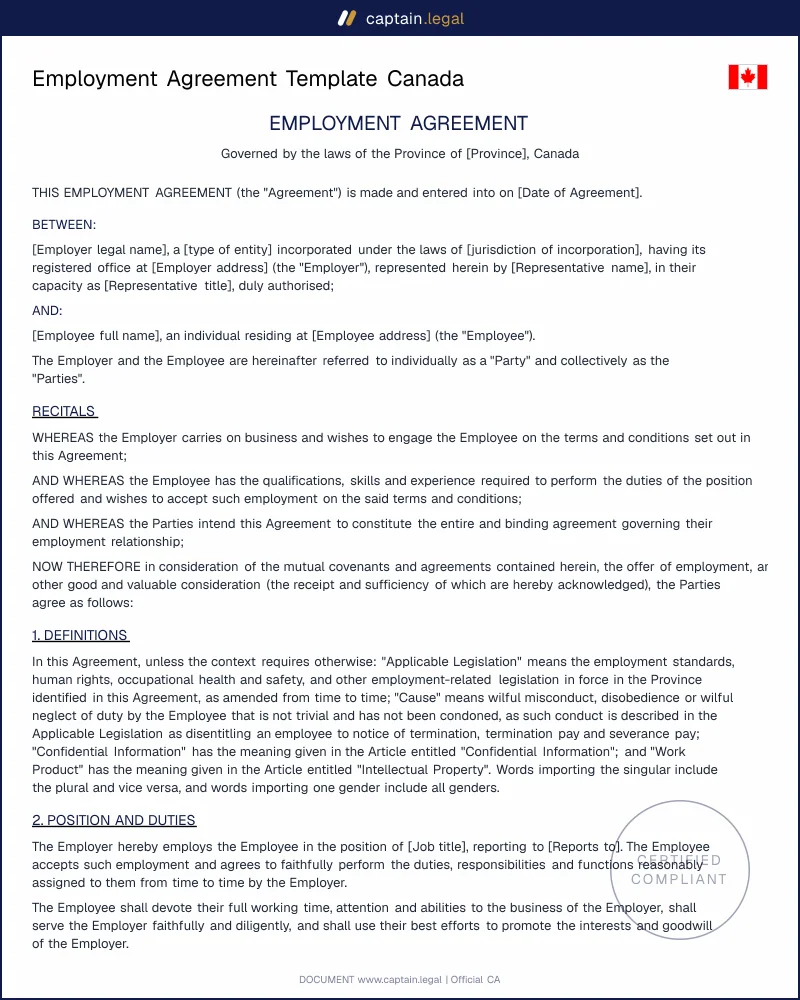
Employment Agreement Canada | ESA & Labour Code

Employment agreement drafted to provincial Employment Standards and the Canada Labour Code, with a Waksdale-proof termination clause. Word and PDF.
4.7/531 reviews50 000+ downloadsInstant download
Share

A Canadian employment agreement is the written contract that defines the working relationship between an employer and an employee: the role, the salary, the hours, the benefits, the probationary period, confidentiality and, above all, how the relationship can end. In Canada it is the termination language that decides most disputes, not the job description. A well-drafted contract anchors the employee's entitlements to the Employment Standards minimums of the right province and keeps the parties out of a costly wrongful dismissal claim. Whether you are hiring your first staff member or standardising offers across a growing team, a clear written employment contract protects both sides and removes the guesswork that fuels litigation.

Hiring on a handshake still happens across Canada, and it remains the single most expensive habit an employer can keep. The moment a dispute reaches a judge, the absence of a signed agreement hands the employee the full benefit of the common law.

Compliant

2026 Legislation

50,000+ clients

trust us

Affordable

From $4.90 / doc

Secure payment

Instant download

Employment Agreement Canada | ESA & Labour Code

Secure payment · No subscription

Fill in the template

What is an employment agreement?

An employment agreement is a legally binding contract under which one party agrees to perform work in exchange for wages and the other agrees to pay and direct that work. It is the document that distinguishes an employee from an independent contractor, a distinction that carries real tax and liability consequences in Canada because misclassification exposes the business to back-remittances for the Canada Pension Plan and Employment Insurance, plus penalties from the Canada Revenue Agency.

People often use "employment agreement," "employment contract" and "offer letter" interchangeably, but they are not the same instrument. An offer letter is a short pre-hire summary of position, pay and start date that a candidate frequently relies on to resign from another job. The full employment contract is the comprehensive document that governs the entire relationship, including probation, vacation, overtime, intellectual property, confidentiality and termination. An offer letter that contradicts a later contract can create ambiguity a court will resolve against the employer, so the two documents must align word for word on compensation and notice. The agreement can be for an indefinite term, which is the Canadian default, or for a fixed term with a defined end date. Fixed-term contracts carry a hidden trap: if there is no enforceable early-termination clause, ending the contract before its date can make the employer liable for the wages owed across the entire remaining term. Our Canadian employment templates aligned with provincial standards are built to keep these definitions tight and enforceable from the first signature.

2

When do you need this document?

The obvious trigger is a new hire, where the agreement fixes the role, compensation, probation, vacation and notice before the first day of work. The less obvious truth is that the contract is most valuable on the day the relationship ends, because a clean, enforceable termination clause is the only thing standing between the employer and an open-ended common-law claim. Employers who skip the written contract at hiring almost always regret it at the exit. A second common scenario is a change in terms: a promotion, a pay restructuring or a move to a new role should be papered with a fresh agreement or a signed variation, since material changes imposed without consideration can amount to constructive dismissal.

The document also earns its place when a business needs to protect itself. Confidentiality, non-solicitation and intellectual-property clauses guard client lists, trade secrets and work product, and they remain enforceable in Canada where a non-compete usually will not. Converting a contractor to an employee is another moment that demands a proper agreement, both to capture the new statutory obligations and to close off the misclassification risk that the Canada Revenue Agency actively audits. One edge case deserves a flag. Asking an existing employee to sign a new contract without offering something fresh in return makes the new terms unenforceable, because under Canadian contract law continued employment alone is not valid consideration. If you are formalising terms for someone already on the payroll, the agreement must be paired with a genuine benefit, a signing bonus, a raise or a promotion, to bind them. For businesses building out their full suite of hiring paperwork, our Canadian business and corporate document templates cover the shareholder and director instruments that often accompany senior hires.

3

Key clauses included in our template

  • The parties and position clause names the legal employer entity and the employee in full, states the job title and reporting line, and confirms the work location, which now matters more than ever for determining which province's Employment Standards legislation applies to a remote or hybrid worker.
  • The compensation and benefits clause sets out salary or hourly rate, pay frequency, eligibility for bonuses or commissions, vacation entitlement and any group benefits, drafted so that discretionary items stay genuinely discretionary and do not harden into contractual entitlements an employer cannot later remove.
  • The probationary period clause defines the trial window and is tied carefully to the statutory notice rules, because terminating during probation does not erase the employer's obligations once the Employment Standards threshold for notice has been crossed.
  • The termination clause is the heart of the agreement, written to limit the employee to Employment Standards notice and severance where lawful, and structured to survive the Waksdale line of cases by ensuring no sub-clause, including the "for cause" wording, can ever fall below the statutory minimum.
  • The confidentiality and non-solicitation clause protects trade secrets and client relationships with a scope tailored to a legitimate business interest, the enforceable alternative to a non-compete in most of the country.
  • The intellectual property clause assigns work product created in the course of employment to the employer, a provision that becomes essential the moment the role touches software, design, written content or any other creative output.
4

Regional considerations

Canada has no single national employment statute for provincially regulated workers, so the same contract must flex to the province of employment. Getting the governing jurisdiction right is the first drafting decision, not an afterthought.

Ontario is the most regulated of the common-law provinces. Minimum notice under the Employment Standards Act, 2000 runs one week per completed year of service to a cap of eight weeks, and employees with five or more years of service at an employer with a payroll of $2.5 million or more are entitled to statutory severance on top, calculated at one week per year up to 26 weeks. Ontario also bans most non-compete clauses under section 67.2 ESA, with narrow exceptions for genuine C-suite executives and the sale of a business, so a non-compete dropped into a standard Ontario contract is void on its face.

British Columbia sets compensating length-of-service notice under its Employment Standards Act from one week after three months of service up to a maximum of eight weeks after eight years. The province has no Ontario-style statutory severance, but common-law reasonable notice applies with full force, and BC courts scrutinise termination clauses closely.

Alberta requires notice under the Employment Standards Code ranging from one week after 90 days of employment to eight weeks after ten years of service. Employees with less than 90 days are within the Code's probationary window and are not entitled to statutory notice, which makes the contractual probation clause especially important for early-stage terminations.

Across all common-law provinces, the constant is common-law reasonable notice layered above whatever the statute provides, which is why every regional version of the agreement leans on a defensible termination clause rather than the bare minimum. A document drawn for the wrong province can understate notice and collapse in court, so the agreement must always state the correct governing law. Where the role sits in a federally regulated industry, the Canada Labour Code displaces the provincial Act entirely, including its distinct notice and severance scheme.

5

How to fill out this employment agreement

You start by selecting the province of employment, because that single choice drives the statutory notice periods, the severance rules and whether a non-compete is even permitted. From there the form asks for the legal name of the employer entity and the employee, the job title, the reporting structure and the work location, then moves to compensation, where you set the salary or hourly rate, pay frequency and any bonus or commission arrangement. The template then guides you through vacation, benefits and the probationary period, applying the right statutory floor for the province you chose so the trial window cannot accidentally undercut the minimum notice the employee is owed once that threshold passes. The termination section is built to limit liability to Employment Standards entitlements where the law allows, with the wording structured to withstand the Waksdale scrutiny that voids carelessly drafted clauses. You then add confidentiality, non-solicitation and intellectual-property terms scaled to the role, review the assembled agreement, and download a ready-to-sign file. If your hire comes with separate covenants or a benefits package, you can pair the contract with our Canadian personal and family legal templates for the supporting declarations that sometimes accompany onboarding.

6

Common mistakes to avoid

The costliest error by far is a defective termination clause. Employers copy old wording, leave a "for cause" provision that strips statutory entitlements, or set notice that could in some scenario dip below the Employment Standards floor, and the entire clause falls under Waksdale, exposing the business to full common-law notice that can dwarf the minimum. A close second is dropping a non-compete into an Ontario contract, where section 67.2 ESA renders it void for almost every employee, when a properly scoped non-solicitation clause would have protected the same interest and survived. Many employers also misclassify a worker as a contractor to avoid CPP, EI and vacation obligations, only to face reassessment and penalties when the Canada Revenue Agency or a tribunal looks at the real substance of the relationship.

The other recurring failure is procedural. Asking a current employee to sign new terms without fresh consideration makes those terms unenforceable, so the change binds no one. Employers forget that an offer letter and a later contract must match, creating an ambiguity courts read against the drafter. And separation is routinely mishandled: failing to issue a Record of Employment on time, or treating Employment Standards notice as the full extent of what is owed when common-law reasonable notice usually sits well above it. Our Canadian non-profit governance templates apply the same drafting discipline for organisations that hire staff under a board structure.

Key takeaways

Termination

Termination wording drives most disputes

In Canada, the termination clause is where employment lawsuits are won or lost. If you do not have a signed agreement with an enforceable termination provision, a court can default to common-law reasonable notice, which is often far more than provincial Employment Standards minimums. Clauses that give less than the applicable minimum standards are void, so drafting has to match the right jurisdiction.

Jurisdiction

Match the right Act to work

Employment rules depend on who regulates the job, not where your head office sits. Most employees are covered by the Employment Standards legislation of the province where they work (for example, Ontario’s Employment Standards Act, 2000 or British Columbia’s Employment Standards Act). Federally regulated sectors like banking and airlines fall under the Canada Labour Code, with different notice and severance rules.

Structure

Offer letters must align with contracts

An offer letter and an employment contract are not interchangeable. The offer letter is a short pre-hire summary that candidates often rely on to resign elsewhere, while the full contract governs probation, overtime, vacation, confidentiality, IP, and termination. If the offer letter conflicts with the later contract, ambiguity is usually read against the employer, so compensation and notice terms should match word for word.

Frequently Asked Questions

Yes. Once both parties sign and there is valid consideration, the agreement is a binding contract enforceable under the law of the province you select. The template is drafted to the Employment Standards legislation of common-law provinces and the Canada Labour Code for federally regulated workplaces, with a termination clause structured to survive the Waksdale standard that voids defective wording. For a new hire, the offer of employment itself is the consideration. For an existing employee, you must add a fresh benefit such as a raise or signing bonus, because continued employment alone will not make new terms enforceable. The signed document then governs the relationship from the start date forward.

It depends on the province and on whether the contract validly limits the employee to the statutory minimum. Under Ontario's Employment Standards Act, 2000, minimum notice is one week per completed year of service to a cap of eight weeks, with possible statutory severance on top for long-serving staff at large employers. British Columbia and Alberta cap statutory notice at eight weeks as well. The critical point is that these are floors, not ceilings: unless a valid termination clause says otherwise, common-law reasonable notice applies and can reach many months or even two years for senior employees. A precise, enforceable clause is the only way to keep liability at the statutory level.

In most cases you should not, and in Ontario you usually cannot. Section 67.2 of the Employment Standards Act, 2000 prohibits non-compete clauses for nearly all Ontario employees, with exceptions only for genuine senior executives and the sale of a business, and a banned clause is void on its face. Elsewhere in Canada a non-compete is presumed unenforceable and survives only if it is reasonable in time, geography and scope, which is a high bar that most clauses fail. The reliable alternative is a non-solicitation clause, which protects your clients and staff and is far more likely to hold. The template defaults to confidentiality and non-solicitation rather than a restraint that courts routinely strike down.

An offer letter is a brief pre-hire document confirming the position, compensation and start date, often the paper a candidate relies on to resign from another role. The employment agreement is the full contract that governs the whole relationship, covering probation, vacation, benefits, confidentiality, intellectual property and termination in enforceable detail. The two must align exactly on pay and notice, because a contradiction between them creates an ambiguity a court will resolve against the employer. Best practice is to issue the offer letter to confirm interest, then have the complete agreement signed before the start date so the binding terms are settled in writing from day one.

You can download the completed agreement in both Word and PDF. The PDF is ready to print and sign as is, suitable for in-person execution or scanning back after wet-ink signature. The Word version lets you adjust wording where your situation calls for it, add schedules such as a bonus plan or benefits summary, or tailor the confidentiality scope to a specific role. Both versions carry the same province-specific clauses you selected during drafting. Many businesses keep the Word file as their master template and reissue it for each new hire, updating only the name, position and compensation while leaving the tested termination and restrictive-covenant language untouched.

For a standard hire on indefinite terms, a well-drafted template gives you an enforceable contract without the cost of bespoke drafting, which is the value of starting from clauses already built to the statutory floors and the Waksdale standard. That said, certain situations warrant a review: a fixed-term contract with a substantial remaining-term exposure, a senior executive whose non-compete might actually be permitted, a misclassification question, or a federally regulated workplace under the Canada Labour Code. The template handles the common cases cleanly and gives you a defensible starting point; the more unusual the arrangement, the more a short legal review pays for itself.

Most employers complete the agreement in a few minutes by stepping through the guided fields for province, parties, compensation, probation and termination. The document assembles with the correct statutory references for the jurisdiction you choose, so you are not researching notice periods or severance rules yourself. Once you download the Word or PDF file, the agreement is ready for signature immediately. You can browse the full library through our complete catalogue of Canadian legal document templates if you need companion paperwork such as variation letters or confidentiality undertakings to go alongside the contract.

4.7/5

31 verified reviews · 50 000+ downloads

Employment Agreement Canada | ESA & Labour Code
  • Immediate access to the document
  • PDF + Word download
  • Compliant with 2026 legislation
  • Reviewed by lawyers
Fill in the template
Secure payment · No subscription
Updated on June 19, 2026

You might also like

Employee Handbook Template Canada
Employee Offer Letter Template Canada