Create my document
Login

Choose country

CanadaCanadaChoose country
Business

Shareholder Agreement Canada | CBCA Section 146

Build a unanimous shareholder agreement under CBCA s.146 and OBCA s.108. Transfer restrictions, shotgun, drag-along and buyout clauses. Word and PDF.
4.8/529 reviews50 000+ downloadsInstant download
Share

A shareholder agreement is the private contract that governs how the owners of a Canadian corporation share control, money and the exit door. It sits beside the articles and by-laws, but it does the work those documents cannot: it tells you who can sell shares and to whom, how big decisions get approved, how dividends are split, and what happens when an owner dies, leaves or falls out with the others. Founders who skip it usually regret it the first time money is on the table. This template gives privately held corporations across the common-law provinces a complete, lawyer-grade agreement covering ownership, share transfers, voting rights, dividends, dispute resolution and exit provisions, ready to download as Word and PDF.

Most disputes between business partners are not caused by bad faith. They are caused by silence: two people who never wrote down what would happen if one of them wanted out, got divorced, or simply stopped pulling their weight. A shareholder agreement is the cure for that silence, and it is far cheaper to draft at the start than to litigate at the end.

Compliant

2026 Legislation

50,000+ clients

trust us

Affordable

From $4.90 / doc

Secure payment

Instant download

Shareholder Agreement Canada | CBCA Section 146

Secure payment · No subscription

Fill in the template

What is a shareholder agreement?

A shareholder agreement is a binding contract among the owners of a corporation, and often the corporation itself, that regulates their relationship as shareholders. It covers the things the Canada Business Corporations Act and the articles leave open: restrictions on transferring shares, how directors are nominated, which decisions need a supermajority or unanimous consent, dividend policy, and the buyout terms triggered by death, disability, retirement or default. It is the operating manual for the ownership of the business.

Canadian practitioners draw a sharp line between two instruments that look alike on the surface. An ordinary shareholder agreement is a private contract that binds only the people who sign it and cannot touch the legal authority of the directors. A unanimous shareholder agreement (USA) is a creature of statute under section 146 of the CBCA: signed by every shareholder, it can strip the directors of some or all of their power to manage the corporation and hand that power to the shareholders themselves. The distinction is not cosmetic. Only a USA can lawfully restrict director powers, and a USA binds future buyers of the shares automatically, while a plain agreement does not. Our template lets you build either version depending on how tightly the owners want to control the company. If you are also setting up the corporation, this works hand in hand with the incorporation and business documents for Canadian corporations.

2

When do you need this document?

The most common moment is incorporation with more than one owner. The day a second shareholder joins is the day you need to write down what happens if the partnership sours, because nobody negotiates fairly once the relationship has broken. The agreement should be signed before the first dollar of profit appears. A close second is bringing in an investor or a key employee through equity, where the newcomer wants assurances about information rights and the founders want to keep control of who sits on the board.

Family businesses are another frequent trigger. When parents fold children into the ownership, a shareholder agreement keeps the family law fallout of a child's divorce from dragging an ex-spouse into the company, an exposure many owners only discover too late. If your circumstances involve a spouse with an interest in the shares, a Canadian marriage contract under the Family Law Act often works alongside the shareholder agreement to wall off corporate value from a matrimonial claim.

Two edge cases legitimately call for extra care. The first is the single-shareholder corporation planning to add owners later: a section 146(2) declaration locks in governance now and converts cleanly into a full USA when the second shareholder arrives. The second is the deadlock-prone 50/50 split, the structure most likely to end in court. Without a tie-breaking mechanism built in advance, two equal owners who disagree can paralyze the company entirely, and a judge's only real remedy may be to wind it up.

3

Key clauses included in our template

  • The share transfer restrictions are the backbone of the agreement. A right of first refusal forces a departing shareholder to offer the shares to the others before any outsider can buy in, on the same terms a third party offered, which keeps strangers and competitors out of the cap table. Our template lets you layer this with a pre-emptive right on new share issuances so existing owners can protect their percentage.
  • The tag-along and drag-along rights govern what happens when a large block changes hands. A tag-along (or piggyback) right lets a minority owner join a majority sale on identical terms and price, so the minority is never stranded with a new controlling stranger. A drag-along right lets the majority compel the minority to sell into a clean 100 percent transaction, which buyers of the whole company almost always demand.
  • The shotgun buy-sell clause is the classic Canadian deadlock breaker. One shareholder names a price; the other must either sell at that price or buy the offeror out on the same terms. The mechanism polices itself because lowballing risks losing your own shares cheaply. It also favours the party with deeper pockets, so the template offers safeguards such as a mandatory independent valuation, a realistic financing window, and a cooling-off period in the early years.
  • The buyout and valuation provisions decide what happens on death, disability, retirement, bankruptcy or termination of an owner-employee. The template sets the trigger, the valuation method (fixed formula, agreed annual value, or independent appraisal), and the funding source, including life insurance proceeds for a buyout on death.
  • The governance and reserved-matters clause lists the decisions that need shareholder approval rather than a simple board vote: selling the company, taking on major debt, issuing new shares, or changing the share structure. In a USA, this is where director powers are formally restricted under section 146.
4

Provincial considerations

Federal (CBCA) corporations rely on section 146 for the unanimous shareholder agreement, and the Supreme Court's decision in Duha Printers confirms that a valid USA is treated as a constating document alongside the articles. Notice of the USA must be referenced on the share certificates, because a purchaser without notice may have a limited right to rescind the acquisition. Federal incorporation also carries a Canadian-residency requirement for a portion of the directors, a point the agreement's board-nomination clauses must respect.

Ontario (OBCA) mirrors the federal scheme at section 108, with its own procedural wrinkles. A sole-shareholder declaration must be executed by the registered shareholder, and a transferee who was not given notice of a USA has a sixty-day rescission window rather than the federal thirty days. Ontario corporations are common vehicles for the businesses that need these agreements most, so matching the clauses to the OBCA text matters.

British Columbia runs under its Business Corporations Act, which does not use the "unanimous shareholder agreement" terminology in the same way and gives shareholders considerable freedom to structure governance through the articles themselves. Practitioners often build restrictions into the articles in BC rather than relying solely on a separate agreement, so the interaction between the two documents needs care.

Alberta follows its own Business Corporations Act with USA provisions closely tracking the federal model, making the federal-style drafting in this template a natural fit. Quebec is the true outlier: governed by the Business Corporations Act (Quebec) and the Civil Code of Québec, with its own civil-law concepts of contract and ownership, so an English common-law agreement should be adapted by a Quebec advisor before signing. If your business also employs staff, the governance terms should be read alongside the rules in our Canadian employment agreement aligned with the ESA and Labour Code, since owner-employees often hold both shares and a job.

5

How to fill out this shareholder agreement

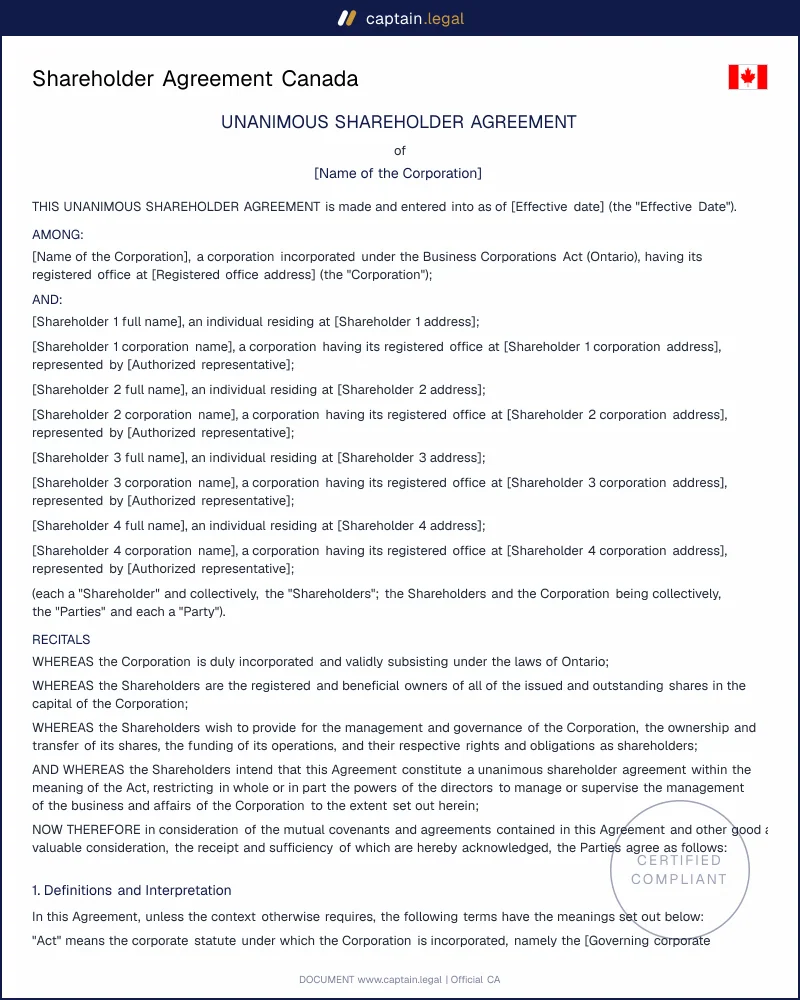
You start by choosing the corporation type and home jurisdiction, because the form adjusts its statutory references depending on whether you are federal, Ontario, BC, Alberta or another province. From there you name every shareholder and enter their shareholdings, since a section 146 unanimous agreement is only valid if all owners are parties to it. The next stage walks you through the governance settings: which decisions are reserved to the shareholders, how directors are nominated, and whether you want to convert the document into a full USA that restricts director powers.

The transfer and exit module is where most of your choices are made. You select which restrictions apply, a right of first refusal, tag-along and drag-along rights, and whether to include a shotgun clause, then set the valuation method and the buyout triggers for death, disability, retirement and default. The form prompts you for the funding mechanism, including whether life insurance backs the death buyout. You finish by reviewing the dividend policy and dispute-resolution path, then download the completed agreement in Word and PDF for signature. If you need supporting corporate paperwork, the full catalogue of Canadian legal document templates keeps everything in one place.

6

Common mistakes to avoid

The error practitioners see most often is treating the agreement as boilerplate that everyone signs unread. A shareholder agreement only protects you to the extent it reflects what the owners actually intended, so a generic document signed without discussion of the deadlock and exit terms is a trap waiting to spring. Closely related is the failure to align the agreement with the articles and by-laws: when the two documents contradict each other on quorum, voting thresholds or transfer rules, the conflict surfaces at the worst possible time and often lands in court. A second recurring problem is calling something a unanimous shareholder agreement when it is not. If a single shareholder has not signed, or the document never restricts director powers in the way section 146 requires, it cannot bind future transferees and cannot fetter the directors, no matter what the title page says.

The financial mistakes are just as damaging. Owners frequently agree on a buyout trigger but never decide how the shares will be valued or how the buyer will pay, which means the clause fires and then stalls for lack of money. A death buyout with no life insurance behind it can force the surviving owners to sell the business to fund the payout. Finally, many agreements are signed and then forgotten as the company grows. Review the agreement whenever ownership changes, a new investor arrives, or the business doubles in size, because a document drafted for two equal founders rarely fits a company with five owners and an outside investor.

Key takeaways

Purpose

It fills the gaps your by-laws cannot

A shareholder agreement is the private contract that sets the rules for control, money, and exits in a Canadian corporation. It can cover who may sell shares and to whom, how directors are nominated, what votes need a supermajority or unanimity, how dividends are handled, and what happens on death, disability, retirement, or default. Without it, disputes often come from silence, not bad faith.

CBCA s.146

Only a USA can shift director powers

Do not confuse a standard shareholder agreement with a unanimous shareholder agreement (USA). Under CBCA section 146, a USA signed by every shareholder can restrict, in whole or in part, the directors power to manage the corporation and move that authority to the shareholders. That distinction changes governance in real life: only a USA can lawfully limit director powers in this way.

Transfers

Exit clauses prevent deadlocks and surprise buyers

The agreement should spell out share transfer restrictions and the exit machinery before anyone wants out. Clauses like a shotgun, drag-along, and buyout triggers set the process when owners fall out, stop contributing, or face life events like divorce or death. A well-drafted USA also binds future purchasers of the shares automatically, while a plain agreement generally binds only signatories.

Frequently Asked Questions

Yes. A shareholder agreement is enforced as an ordinary contract under the common law of your province, or under the Civil Code in Quebec, and needs no filing with any registry to take effect. Once all the named parties sign, the terms bind them. If you build the document as a unanimous shareholder agreement under section 146 of the CBCA or section 108 of the OBCA, it gains statutory force: every shareholder must sign, and it can then lawfully restrict the directors' powers and bind future buyers of the shares. The agreement should be reviewed against your specific articles and, for significant transactions, confirmed with a corporate advisor before signing.

A regular shareholder agreement is a private contract that binds only the people who sign it and cannot touch the legal authority of the directors. A unanimous shareholder agreement is a statutory instrument under section 146 of the CBCA: it must be signed by every shareholder, it can transfer some or all of the directors' management powers to the shareholders, and it automatically binds anyone who later buys the shares. The Supreme Court in Duha Printers confirmed a valid USA ranks alongside the articles as a constating document. Choose the USA when owners want hands-on control of management and certainty that the deal binds future shareholders.

Yes. The completed agreement is available in both Microsoft Word and PDF the moment you finish the guided form. The Word version lets you make further edits, add schedules, or adjust clauses as your circumstances change, while the PDF is the clean, ready-to-sign copy you circulate to the other shareholders. Most corporations keep the signed PDF in the company minute book and retain the Word file for the next amendment. Electronic signatures are valid for shareholder agreements under the provincial electronic commerce acts, so owners in different cities can sign without meeting in person.

For an ordinary shareholder agreement, only the parties who sign are bound, so a partial agreement can still work among those who join it. For a unanimous shareholder agreement, the answer is absolute: every single shareholder must sign, or it cannot qualify as a USA under section 146. If even one owner refuses, the document collapses into an ordinary agreement and loses its power to restrict director authority. This is why the unanimous version is signed at incorporation or when each new shareholder is admitted, with notice of the USA recorded on the share certificates so transferees are deemed parties.

A shotgun clause is a deadlock-breaking mechanism. One shareholder offers to buy the other out at a stated price, and the recipient must either accept that price as a seller or turn around and buy the offeror out on the same terms. Because naming a low price risks losing your own shares cheaply, the clause discourages lowballing. The catch is that it tends to favour the owner with deeper pockets, since the cash-poor shareholder may be forced to sell even when they would rather buy. Many Canadian agreements include one with safeguards: an independent valuation floor, a fair financing window, and a ban on triggering it in the first few years.

The agreement should fix the method in advance, because arguing about value after a trigger event is how disputes start. Common approaches are a fixed formula tied to earnings or book value, an agreed value the shareholders update each year, or an independent appraisal by a chartered business valuator at the time of exit. The template lets you choose and also set the payment terms, whether the buyout is paid in cash, by instalments, or funded by life insurance proceeds on a death. A buyout trigger with no agreed valuation method is a clause that fires and then stalls, so settling this point is one of the most valuable things the agreement does.

It can, and this is one of the strongest reasons family and closely held businesses use one. Transfer restrictions and mandatory buyout triggers let the other owners reclaim shares before they fall into the hands of an ex-spouse, a trustee in bankruptcy or an estate. The agreement cannot override family law entirely, so pairing it with a Canadian cohabitation agreement under provincial Family Law Act rules gives stronger protection where a spouse might claim an interest in the shares. For governance policies that round out a well-run organization, owners often also adopt a conflict of interest policy aligned with Canadian statutory standards as a companion document.

4.8/5

29 verified reviews · 50 000+ downloads

Shareholder Agreement Canada | CBCA Section 146
  • Immediate access to the document
  • PDF + Word download
  • Compliant with 2026 legislation
  • Reviewed by lawyers
Fill in the template
Secure payment · No subscription
Updated on June 20, 2026

You might also like

Non-Disclosure Agreement Canada
Sales Agreement Canada