Create my document
Login

Choose country

CanadaCanadaChoose country
Employment

Workplace Harassment Policy Canada | OHS & CLC Compliant

Employee handbook drafted for provincial Employment Standards Acts and the Canada Labour Code, including the mandatory harassment and violence policy.
4.7/518 reviews50 000+ downloadsInstant download
Share

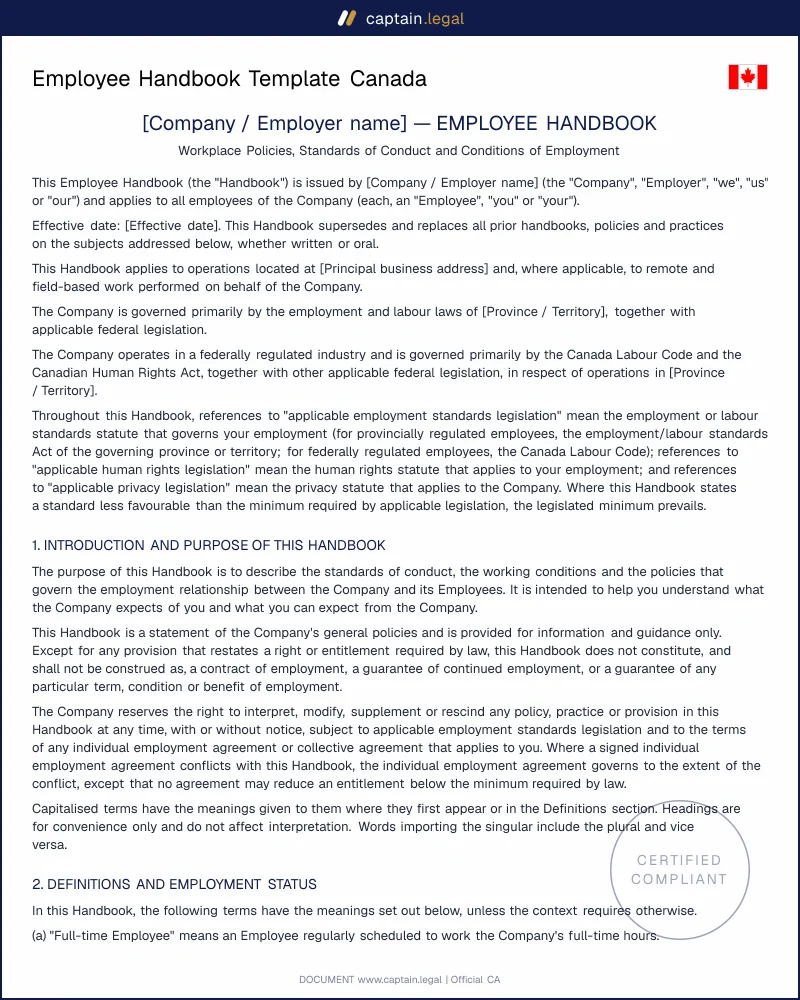
A workplace policy, more often called an employee handbook, is the single document that tells your team how things actually work: what is expected of them, what they can expect from you, and what happens when something goes wrong. A well-built employee handbook brings the scattered rules of an organization, conduct standards, hours, leave, health and safety, and the mandatory harassment and violence policy, into one reference that every employee receives on day one. In Canada it is not just good housekeeping. Several of its components are legally required, and the requirements differ depending on whether you fall under a provincial Employment Standards regime or the federal Canada Labour Code. This template is drafted for Canadian common-law provinces and federally regulated employers alike, and downloads instantly as Word and PDF.

Getting the handbook right protects both sides. For the employee it is a clear statement of rights and recourse. For the employer it is the documentary backbone that makes discipline defensible and demonstrates statutory compliance when a regulator or a tribunal comes asking.

Compliant

2026 Legislation

50,000+ clients

trust us

Affordable

From $4.90 / doc

Secure payment

Instant download

Workplace Harassment Policy Canada | OHS & CLC Compliant

Secure payment · No subscription

Fill in the template

What is a workplace policy or employee handbook in Canada?

A workplace policy is any written rule an employer adopts to govern conduct, while an employee handbook is the consolidated collection of those policies handed to staff as a single document. The two terms are used interchangeably in Canadian HR practice, but the distinction matters in law: certain individual policies, the anti-harassment policy chief among them, are statutorily mandated and prescribed in content, whereas the handbook as a whole is a voluntary but strongly advisable compilation.

A handbook is not an employment contract, and that line is worth holding. The contract sets the binding terms of an individual's engagement, salary, position, notice on termination. The handbook sets the operating rules of the workplace, attendance, dress, internet use, leave procedures, the complaint process. Canadian courts have repeatedly treated handbook provisions as contractually binding when the employee acknowledged them in writing, which cuts both ways: a clear acknowledgment makes a policy enforceable, but a poorly drafted handbook can inadvertently override a favourable contract term. A handbook should never contradict the signed employment agreement or the statutory minimum, because the more generous of the two will usually prevail. If you are still finalizing the underlying contract, our Canadian employment document templates cover that piece before you layer the handbook on top.

2

When do you need this document?

The clearest trigger is reaching the headcount where informal rules stop working. A founder managing three people can hold the rules in their head, but once a team grows past a handful of employees the absence of a written handbook starts producing inconsistent treatment, the exact pattern that fuels human rights and wrongful dismissal complaints. Most Canadian employers adopt a handbook at this growth stage precisely to standardize decisions before a problem arises.

A second trigger is statutory: the moment you employ anyone, you owe a written harassment and violence policy, full stop, regardless of size. This is the one piece of the handbook that does not wait for the business to scale. Onboarding is the third common occasion, because a handbook acknowledged and signed on the first day is the cleanest way to make policies contractually binding and to start the clock on training obligations.

Employers also reach for a handbook when they are tightening up after an incident, a contested termination, a harassment complaint that exposed the lack of a procedure, an insurer or COR auditor asking for documented policies. An after-the-fact policy will not retroactively fix a mishandled complaint, which is why the smart move is to have it in place first. One edge case worth flagging: employers operating in more than one province cannot run a single boilerplate policy, because the harassment definitions and procedural requirements genuinely differ between jurisdictions, and a multi-province handbook needs province-specific schedules. A second edge case is the unionized workplace, where a collective agreement may already govern much of what a handbook would otherwise cover, and the handbook must yield to the agreement.

3

Key clauses included in our template

  • The code of conduct and standards of behaviour sets the baseline expectations for professionalism, attendance, dress, and use of company property and systems. It is drafted to give the employer a defensible foundation for progressive discipline, because a dismissal for cause is far harder to defend when the underlying standard was never written down.
  • The harassment and violence policy is the statutorily prescribed centrepiece, written to satisfy the OHS requirements of the relevant province or the federal Work Place Harassment and Violence Prevention Regulations. It defines harassment in line with the governing statute, names the reporting routes including an alternate when the respondent is a supervisor, and describes the investigation and communication of outcomes.
  • The leave and time-off provisions map the statutory leaves of the applicable jurisdiction, vacation, public holidays, sick leave, parental and other protected leaves, onto the employer's own enhancements, so that staff see one coherent set of entitlements rather than a patchwork. If you are also issuing standalone leave authorizations, the Canadian HR and termination document range sits alongside this.
  • The health and safety section records the employer's general duty under OHS legislation, the right of an employee to refuse unsafe work, and the procedures for reporting hazards and injuries. It is the documentary proof regulators look for during an audit.
  • The confidentiality, technology, and privacy clauses protect business information and set the rules for acceptable use of email, internet, and personal devices, while respecting the limits that privacy law places on employee monitoring.
  • The acknowledgment of receipt is the operative page that turns the handbook from a binder on a shelf into an enforceable set of terms, recording that the employee received, read, and agreed to abide by the policies.
4

Regional considerations

Ontario has the most detailed regime in the country. Under the Occupational Health and Safety Act, as amended by Bill 168 in 2010 and Bill 132 in 2016, every employer must maintain both a workplace harassment policy and a workplace harassment program, the program being the operational machinery that implements the policy. The policy must be posted in a conspicuous place where it is six or more employees, reviewed at least annually, and supported by training. Bill 132 expanded the definition to address workplace sexual harassment specifically, so an Ontario handbook drafted before 2016 is almost certainly out of date.

British Columbia routes its obligations through WorkSafeBC policy under the Workers Compensation Act, which requires a bullying and harassment policy statement, procedures for reporting and investigating, and clear duties for employers, supervisors, and workers. BC also expects documented training and an annual review of the procedures, and WorkSafeBC publishes model wording that an employer's handbook should track.

Alberta updated its violence and harassment prevention requirements under the Occupational Health and Safety Act and its regulations effective 31 March 2025, refreshing the prevention plan obligations. An Alberta handbook should be reviewed against the current code, and employers pursuing COR certification will see an outdated harassment policy flagged in audit. A policy that predates the March 2025 changes is no longer compliant and should be reissued.

Québec sits apart, with the Act respecting labour standards requiring a politique de prévention du harcèlement psychologique, and the 2024 reform on psychological harassment and sexual violence, together with Order in Council 1154-2025 implementing parts of Bill 59, layering on training and complaint-procedure duties that came into force on 1 October 2025. A Québec handbook is drafted in French and against the Québec definitions, which are broader than the common-law provinces.

Federally regulated employers in any province apply the Canada Labour Code and the Work Place Harassment and Violence Prevention Regulations rather than the provincial OHS scheme, which means a joint workplace assessment, a policy developed with the applicable partner, mandatory training, and a defined resolution process with strict timelines.

5

How to fill out this employee handbook

You start by telling the form which regime governs your workplace, the province where your employees are located, or federal regulation if you operate in banking, telecommunications, transport, or another federally regulated sector. That single choice drives the rest of the document, because it determines which Employment Standards entitlements appear, which harassment definition is inserted, and which procedural requirements the policy has to satisfy. From there you enter your organization's identifying details and the name of the person or role designated to receive harassment complaints, with the alternate recipient the statute requires when the complaint involves a supervisor.

Next you confirm your leave entitlements, the form pre-loads the statutory minimums for your jurisdiction and lets you raise them where your organization offers more, so the handbook never accidentally promises less than the law requires. You then select the optional policies that fit your workplace, technology use, remote work, expenses, social media, and the document assembles them into a coherent whole with consistent numbering. The final step generates the acknowledgment page. Once the handbook is complete you download it as Word and PDF, distribute it for signature, and keep the signed acknowledgments on file, which is the evidence that makes the policies enforceable. For the offer and contract documents that precede the handbook, the Canadian business and corporate templates round out your onboarding paperwork.

6

Common mistakes to avoid

The most damaging mistake is treating the harassment policy as boilerplate that can be copied unchanged across provinces. The definitions and procedural requirements genuinely differ, and a single generic policy will fail to meet the prescribed content in at least one jurisdiction. Closely related is the failure to keep the document current: a handbook drafted before Bill 132 in Ontario, before Alberta's March 2025 changes, or before Québec's 2024 and 2025 reforms is non-compliant, and regulators and COR auditors catch stale policies routinely. A policy that states "we take all complaints seriously" without describing the actual investigation procedure is a compliance gap every inspector will flag.

Employers also stumble on training and records. Having an excellent policy is worthless if you cannot prove employees were trained on it and acknowledged it, because the unsigned, untrained handbook sits in a binder while the workforce has no idea it exists. Another frequent error is drafting handbook language that contradicts the signed employment contract or dips below the Employment Standards minimum, in which case the more favourable term to the employee prevails and the employer's intended limit evaporates. Finally, many employers forget the privacy and human rights overlay, writing monitoring or conduct rules that a privacy commissioner or human rights tribunal would not uphold. A handbook is only as strong as its weakest unreviewed clause. If your organization is a registered charity or non-profit, the Canadian non-profit governance policies address the additional conduct and conflict rules that sector expects.

Key takeaways

Scope

Your handbook must match the right regime

Canada has two tracks: most workplaces follow their province’s Employment Standards legislation, while federally regulated employers (for example, banks and interprovincial carriers) fall under the Canada Labour Code. Your handbook has to reflect the correct rules on hours, overtime, vacation, public holidays, and leaves. If you use the wrong framework, the policy may misstate employee rights and invite regulator or tribunal scrutiny.

Harassment policy

Anti-harassment rules are legally required

The one area where the law is most prescriptive is harassment and violence. Every province now requires employers to maintain a written anti-harassment policy under occupational health and safety legislation, and content requirements differ by jurisdiction. Nova Scotia was the last to add this obligation, with its Workplace Harassment Prevention Policy requirement taking effect on September 1, 2025. Treat this as a must-have, not a nice-to-have.

Enforceability

A handbook is not a contract, but can bind

A handbook is meant to set day-to-day operating rules, not replace the signed employment agreement. Still, Canadian courts have treated handbook terms as contractually binding where employees acknowledge them in writing. That makes clarity a double-edged sword: acknowledgments help enforcement, but a sloppy clause can accidentally override a better contractual term. Never let the handbook contradict the employment contract or statutory minimums, since you cannot contract out of those floors.

Frequently Asked Questions

A handbook becomes binding when the employee acknowledges it in writing, which is why the signed acknowledgment page matters so much. Canadian courts have enforced handbook provisions against both employers and employees once receipt and agreement are documented. That said, a handbook cannot override the statutory minimums in your province's Employment Standards legislation or the Canada Labour Code, nor can it contradict a signed employment contract in a way that disadvantages the employee, because the more favourable term prevails. The harassment and violence policy is binding in a different sense: it is mandated by statute, so its absence is itself a breach regardless of any acknowledgment.

Yes. As of 2025 every province imposes a positive obligation on employers to maintain a written anti-harassment policy through its occupational health and safety legislation, and that duty applies regardless of the size of the workplace or the number of workers. There is no small-employer exemption from the policy requirement itself, although some jurisdictions, such as Ontario, attach the posting obligation to workplaces of six or more. A two-person business still owes a compliant written harassment policy, and federally regulated micro-employers owe the full Work Place Harassment and Violence Prevention Regulations obligations.

The dividing line is the nature of the business, not its location. Most employers, retail, manufacturing, professional services, hospitality, fall under the Employment Standards legislation of the province where the employee works. A defined set of industries, banking, telecommunications, broadcasting, air and rail and interprovincial trucking, ports, and a few others, is federally regulated and governed by the Canada Labour Code instead. The two regimes differ on notice, leaves, hours, and, importantly, on the harassment regime: federal employers follow the Work Place Harassment and Violence Prevention Regulations, while provincial employers follow their provincial OHS scheme. A handbook must be built for whichever applies to you.

You receive the completed handbook in both Microsoft Word and PDF. The Word version lets you make further edits, add your logo, adjust optional policies, or update entitlements as the business changes, which matters because your handbook should be reviewed at least annually. The PDF is the clean, distribution-ready version you circulate for signature and store with the signed acknowledgments. Keeping both formats means you can maintain a living master document while issuing a fixed, dated copy to staff.

At minimum once a year, and immediately whenever the governing law changes. Several jurisdictions build an explicit annual review into the harassment policy obligation, Ontario and British Columbia among them. Beyond the calendar, you should refresh the handbook whenever a relevant statute is amended, as happened with Alberta's changes on 31 March 2025 and Québec's reforms taking effect on 1 October 2025, and whenever an internal incident reveals a gap in your procedures. An outdated policy is treated by regulators as no policy at all, so a stale handbook offers little protection.

Not without province-specific adaptation. The core conduct, technology, and confidentiality sections can be shared, but the harassment definitions, the procedural steps, the leave entitlements, and the OHS obligations differ enough between jurisdictions that a single uniform document will be non-compliant somewhere. The standard approach is a common base handbook with province-specific schedules that swap in the correct harassment definition, complaint procedure, and statutory leave table for each location. Employers with federally regulated operations need an entirely separate federal track built on the Canada Labour Code.

It should be, and ideally on the first day of employment. The written acknowledgment is what converts the handbook from internal guidance into enforceable terms and is also your evidence that the employee was informed of the mandatory harassment policy and any required training. Keep the signed acknowledgments on file for the duration of employment and beyond, because in a contested termination or a harassment complaint the signed page is often the single most useful document the employer can produce. Electronic acknowledgment is acceptable in every Canadian jurisdiction provided it reliably identifies the employee.

4.7/5

18 verified reviews · 50 000+ downloads

Workplace Harassment Policy Canada | OHS & CLC Compliant
  • Immediate access to the document
  • PDF + Word download
  • Compliant with 2026 legislation
  • Reviewed by lawyers
Fill in the template
Secure payment · No subscription
Updated on June 19, 2026

You might also like

Independent Contractor Agreement Template
Employee Offer Letter Template Canada