Create my document
Login

Choose country

CanadaCanadaChoose country
Employment

PIP Template Canada | Lowery Just Cause Standard

Performance Improvement Plan built to the Boulet and Lowery just cause tests. Objective goals, warnings, support, review period. Word and PDF for Canada.
4.7/51,200+ reviews50 000+ downloadsInstant download
Share

A Performance Improvement Plan (PIP) is a structured document an employer uses to put performance concerns in writing, set measurable goals, offer concrete support, and fix a timeline for review. In Canada it does double duty: it gives a struggling employee a fair, documented chance to recover, and it builds the evidentiary record an employer will need if the relationship later ends. Used in good faith, a PIP protects both sides. Used as a paper trail to manufacture just cause, it can backfire badly, exposing the employer to wrongful dismissal damages and even a constructive dismissal claim. This template is drafted with that tension in mind, so the plan reads as genuine support rather than a pre-written termination file.

Most Canadian employers reach for a PIP after informal coaching has failed and before any thought of dismissal. Getting the wording right at that stage is what separates a defensible process from an expensive one.

Compliant

2026 Legislation

50,000+ clients

trust us

Affordable

From $4.90 / doc

Secure payment

Instant download

PIP Template Canada | Lowery Just Cause Standard

Secure payment · No subscription

Fill in the template

What is a performance improvement plan?

A performance improvement plan is a formal written agreement between an employer and an employee that identifies specific performance shortfalls, states the standard the employee must reach, lists the support and resources the employer will provide, and sets a defined period (commonly 30, 60, or 90 days) for measurable improvement. It is the documented stage of what employment lawyers call progressive discipline: the sequence of escalating, recorded steps a Canadian employer is expected to follow before performance can ever justify termination.

A PIP is not a warning letter and not a disciplinary suspension. A warning letter flags a single incident; a PIP maps out a recovery path over weeks. It also differs from a routine performance appraisal, which simply scores past work without imposing consequences. The defining feature of a PIP is the explicit link between named goals and a stated outcome if those goals are missed. That link is exactly what makes the document legally sensitive in Canada. A plan that sets unrealistic expectations, strips away duties, or reads as a foregone conclusion stops being a support tool and starts looking like a setup, which is precisely the fact pattern Canadian courts scrutinise. A well-drafted plan keeps the goals objective, measurable, and genuinely attainable, because that is what a judge will look for if the employment later ends in dispute. Employers managing the wider hiring and exit cycle often pair a PIP with a clean Canadian employment contract with an enforceable termination clause so that entitlements are settled before any conflict arises.

2

When do you need this document?

The most common trigger is sustained underperformance that informal coaching has not fixed. A salesperson missing targets quarter after quarter, an analyst whose work needs constant rework, a manager who cannot hit deadlines: each calls for a written plan once verbal feedback has run its course. The PIP marks the moment the employer formalises its concerns and starts the clock on documented improvement. Employers also use a PIP when a previously strong performer slips after a role change or reorganisation, where a structured reset is fairer than jumping straight to discipline.

A second scenario is risk management before any thought of termination. Because Canadian courts demand a clear paper trail before performance can ground just cause, prudent employers run a PIP precisely so that, if improvement does not come, the record will stand up. The plan is the bridge between dissatisfaction and lawful exit. It also surfaces in regulated or unionised-adjacent settings where progressive discipline is effectively expected.

Two edge cases deserve flagging. First, never deploy a PIP against an employee who has just raised a complaint, taken protected leave, or requested accommodation, because the timing invites a reprisal or human-rights claim that can dwarf any performance issue. Second, if the real problem is conduct rather than capability (dishonesty, insubordination, theft), a PIP is the wrong instrument; those grounds follow a different disciplinary route, and you may need a formal employee warning and discipline record instead. Matching the document to the actual problem is the first thing a court will check.

3

Key clauses included in our template

  • The statement of performance concerns sets out, in specific and factual terms, where the employee has fallen short. Vague language like "attitude problems" is replaced with concrete, dated examples tied to the role's actual duties, because Canadian courts weigh objective evidence and discount subjective impressions.
  • The measurable goals and standards translate each concern into a target the employee can actually hit, with numbers, deadlines, and quality benchmarks. This is the clause that satisfies the Boulet requirement of a reasonable objective standard, and it is drafted to be attainable rather than punitive.
  • The support and resources commitment records exactly what the employer will provide: training, mentoring, adjusted workload, or closer feedback. Courts look hard at whether the employer gave a genuine chance to improve, so this clause is not optional window dressing.
  • The review timeline and check-in schedule fixes the plan's duration and the dates of interim meetings, so progress is tracked in writing rather than judged in hindsight. Regular documented check-ins protect both parties.
  • The statement of consequences explains, in measured language, what may follow if the goals are not met, including the possibility of further discipline or termination. It is worded carefully to warn without prejudging the outcome, which keeps the plan on the right side of good faith.
  • The acknowledgement and signature block confirms the employee received and reviewed the plan, with space to note that signing means receipt, not agreement, a distinction Canadian employment lawyers consistently advise employees to preserve.
4

Regional considerations

Ontario governs most non-unionised employees through the Employment Standards Act, 2000, which sets minimum notice and, for larger or longer-tenured workforces, statutory severance. Ontario courts apply a demanding just-cause test for performance, and the province's Working for Workers Act reforms have tightened employer obligations elsewhere in the employment file. An Ontario PIP should align with the warning-and-opportunity sequence the courts expect, and any later termination clause must never dip below the ESA floor or it risks being struck out entirely, pushing the employee into common-law notice.

British Columbia relies on the Employment Standards Act, with the Employment Standards Branch enforcing minimum notice and compensation for length of service. BC's just-cause threshold mirrors the national pattern: poor performance rarely suffices without documented warnings and a real chance to improve. Employers here should keep the PIP's records meticulous, since the Branch and the courts both scrutinise the genuineness of the improvement opportunity.

Alberta operates under the Employment Standards Code, and Alberta courts gave us the influential Lowery four-part test for cumulative incompetence. The province makes for-cause performance dismissals notably difficult, and a poorly run PIP has repeatedly failed to meet the Lowery standard, leaving employers liable for pay in lieu. A clear warning that the job is at risk is non-negotiable in Alberta.

Quebec stands apart. The Civil Code of Québec and the Act respecting labour standards govern, and after two years of uninterrupted service an employee gains strong protection against dismissal without good and sufficient cause. A Quebec PIP must be read against that heightened protection, and the common-law concepts used in the rest of Canada do not transfer directly.

Federally regulated employees sit under the Canada Labour Code, which since February 2024 requires graduated notice on without-cause termination and, after twelve months of service, severance pay. Crucially, non-unionised federal employees can file an unjust dismissal complaint and even seek reinstatement, so a federal PIP carries reinstatement risk that provincial plans do not. Aligning the plan with the Code's standards from the outset is essential.

5

How to fill out this performance improvement plan

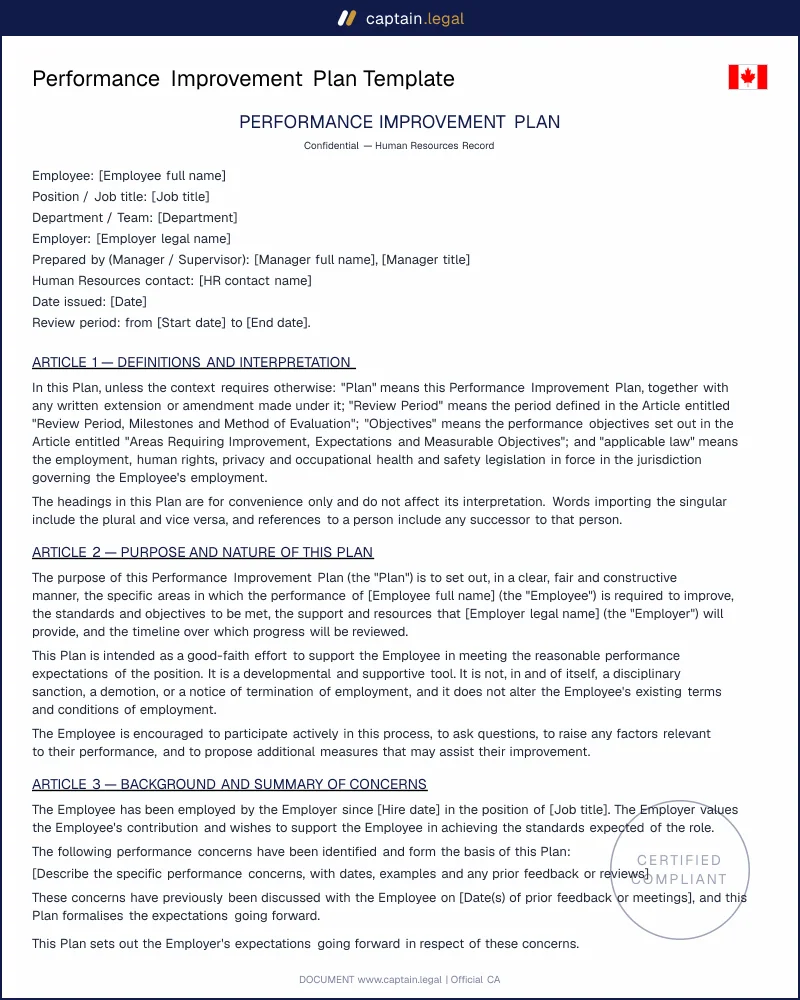
You begin by entering the employer and employee details and the employee's role, so the plan is anchored to the duties that actually apply. From there you describe the performance concerns in plain, factual language, drawing on specific incidents and dates rather than general complaints, because the document's strength rests on concrete evidence. The form then prompts you to convert each concern into a measurable goal with a clear standard and deadline, which is the part that protects you legally if the plan is ever tested.

Next you set out the support the employer commits to provide and the schedule of check-in meetings across the review period, whether that runs 30, 60, or 90 days. You then complete the consequences section in careful, non-prejudicial wording, and finish with the acknowledgement block for signatures. The template adapts its language to a genuine support framing rather than a disciplinary one, and once complete it downloads in both Word and PDF so you can edit internally or issue a clean signed copy. For employers building out a wider people-management file, it sits naturally alongside other Canadian HR and employment templates.

6

Common mistakes to avoid

The most damaging mistake is treating the PIP as a formality on the road to firing someone. Canadian courts read these documents closely, and a plan built on impossible targets, stripped-down duties, or no real support is treated as evidence of bad faith rather than as just cause. Employers who go this route often end up paying common-law reasonable notice plus aggravated damages, the opposite of what they intended. A close cousin of this error is launching a PIP with no prior warnings at all, which breaks the Lowery requirement that the employee knew their job was genuinely at risk before the plan began. Setting vague goals ("improve communication") instead of measurable ones is equally fatal, because a court cannot test compliance against a standard that was never defined.

Employers also stumble on timing and consistency. Issuing a PIP days after an employee requested accommodation, returned from leave, or raised a complaint invites a reprisal or human-rights claim, and the burden then shifts onto the employer to prove the plan was unrelated. Condoning weak performance for years and then suddenly imposing a plan undercuts credibility, since courts dislike employers who tolerated the problem and then weaponised it. Finally, many employers forget that an enforceable termination clause is the real cost-control tool; without one, a properly drafted employment agreement matters far more than any PIP, because the PIP alone almost never defeats common-law notice. Document honestly, support genuinely, and keep the consequences proportionate.

Key takeaways

Purpose

A PIP is support and evidence

A Canadian PIP does double duty: it gives an employee a fair, documented chance to improve, and it creates the record an employer may rely on if the relationship later ends. That only works if the plan is written and used in good faith. If it reads like a pre-made termination file, it can backfire and fuel wrongful dismissal damages or a constructive dismissal claim.

Timeline

Set measurable goals with a clear review period

A defensible PIP is built around specific performance gaps, objective standards, and concrete supports, all tied to a defined review window. The excerpt flags common review periods of 30, 60, or 90 days, which helps show the employee had a real opportunity to improve. Keep goals measurable and attainable; unrealistic targets or stripping duties can look like a setup in court.

Legal test

Poor performance rarely meets just cause

A PIP does not change statutory minimums under a provincial Employment Standards Act or the Canada Labour Code, and it will not, by itself, create just cause. Canadian courts set a high bar for performance-based cause. Under the Boulet and Lowery framework, the employer must set a reasonable objective standard, communicate it, warn that employment is at risk, and allow a reasonable chance to improve, with serious business prejudice.

Frequently Asked Questions

A signed PIP is a binding internal HR document that records the terms of the improvement process, but it does not override statutory or common-law rights. It cannot reduce the notice or severance an employee is owed under provincial Employment Standards legislation or the Canada Labour Code, and it cannot create just cause on its own. What it does is build the documented record courts expect before performance can support a lawful termination. Its legal weight comes from being specific, objective, and implemented in good faith. A vague or punitive plan carries little evidentiary value and may even support a constructive dismissal claim against the employer.

You can download the completed performance improvement plan in both Microsoft Word and PDF. The Word version lets your HR team or manager adjust goals, timelines, and support commitments before the meeting, which matters because every PIP should be tailored to the individual role and the actual concerns. The PDF version produces a clean, professional copy ready to print, sign, and store in the employee file. Many employers keep the Word draft for internal edits and issue the PDF as the final signed record. Both formats reflect the same legally considered structure used throughout the template.

There is no statutory length, but Canadian employers typically run a PIP over 30, 60, or 90 days, with 60 to 90 days being the most defensible for substantive performance issues. The period has to be long enough to give a genuine opportunity to improve, because courts assessing just cause ask whether the employee had a reasonable chance to meet the standard. A plan that demands transformation in a week reads as a setup. The right duration depends on the complexity of the role and the goals; a sales target may need a full quarter, while a process-compliance issue may resolve faster.

Not safely, and not without legal exposure. Failing a PIP does not automatically create just cause. The employer must still show it met the full warning-and-opportunity standard, and even then most performance dismissals are treated as without cause, meaning notice or pay in lieu is owed. Terminating the moment a plan ends, without weighing whether the goals were fair and the support real, is exactly the conduct that draws aggravated damages. The safer path after a failed PIP is usually a without-cause termination with proper notice, governed by an enforceable termination provision in the employment contract.

No. An employee can sign to confirm they received and read the plan without accepting that the criticisms are accurate. Canadian employment lawyers routinely advise employees to note this distinction, often by writing "received, not agreed" beside the signature or sending a short email disputing specific points. The template's acknowledgement clause is drafted to allow this. For employers, that is not a weakness: a signature confirming receipt still proves the employee was warned and given an opportunity to improve, which is the element that matters most if the matter ever reaches a court or adjudicator.

Yes, when it is implemented in bad faith. If a PIP imposes unrealistic or impossible goals, removes core responsibilities, subjects the employee to punitive micromanagement, or creates a poisoned work environment, a court may find the employer effectively forced the resignation. That is constructive dismissal, and it entitles the employee to the same notice and damages as an outright firing. The risk is highest where the plan looks engineered to push someone out rather than help them succeed. Drafting realistic targets, offering genuine support, and documenting honest check-ins are the practical defences against this outcome.

Yes, and the difference is significant. Provincially regulated employees are governed by their province's Employment Standards legislation, which sets minimum notice and, in some provinces, severance. Federally regulated employees fall under the Canada Labour Code, which since February 2024 provides graduated notice on without-cause termination and allows non-unionised employees to file an unjust dismissal complaint, with reinstatement as a possible remedy. That reinstatement power does not exist provincially, so a federal PIP carries an added risk: a poorly run plan can lead not just to damages but to a former employee getting their job back.

4.7/5

1,200+ verified reviews · 50 000+ downloads

PIP Template Canada | Lowery Just Cause Standard
  • Immediate access to the document
  • PDF + Word download
  • Compliant with 2026 legislation
  • Reviewed by lawyers
Fill in the template
Secure payment · No subscription
Updated on June 19, 2026

You might also like

Termination Letter Template Canada
Non-Disclosure Agreement Canada