Create my document
Login

Choose country

CanadaCanadaChoose country
Family & Divorce

Divorce Application Canada | Divorce Act Joint Form

Divorce application built to the federal Divorce Act, s.8 grounds, 2021 parenting rules and guideline support. Joint form in Word and PDF.
4.6/516 reviews50 000+ downloadsInstant download
Share

A divorce application is the court document that formally asks a Canadian court to legally end a marriage, and a joint divorce form is the version both spouses sign together when they agree on everything. It sets out the grounds for the divorce, the essential facts of the marriage, and the proposed arrangements for any children and for property. Married couples across Canada use this paperwork to move from "we have separated" to a binding divorce order. Filed correctly, an uncontested joint application is the fastest, least adversarial route through the system. Filed carelessly, with the wrong province named or a parenting schedule left vague, it becomes the thing that drags a simple separation back into conflict.

Most people reach for this document at the point where the relationship is genuinely over and both spouses want a clean, predictable exit. The hard part is rarely the divorce itself. It is getting the parenting, support, and property details into language a judge will actually approve.

Compliant

2026 Legislation

50,000+ clients

trust us

Affordable

From $4.90 / doc

Secure payment

Instant download

Divorce Application Canada | Divorce Act Joint Form

Secure payment · No subscription

Fill in the template

What is a divorce application in Canada?

A divorce application is a formal court filing under federal law that requests a court order dissolving a marriage. In Canada, divorce is governed entirely by the federal Divorce Act, which applies in every province and territory, so the legal grounds are identical whether you file in Ontario, Alberta, or Nova Scotia. The application names the spouses, states when and where the marriage took place, confirms the ground for divorce, and proposes how children, support, and property will be handled.

The joint divorce application is a specific version of the same document. Instead of one spouse suing the other and serving them with court papers, both spouses sign as joint applicants. There is no respondent, no service step, and no 30-day window for a reply. This only works when you agree on every issue, including parenting time and support. The moment one spouse contests something, the file shifts to a contested track with a separate set of forms.

It helps to separate three things people often blur together. The divorce application ends the marriage. A separation agreement settles the financial and parenting terms between you. A parenting plan details the day-to-day schedule for the children. A joint application can incorporate the terms of a signed separation agreement, but the agreement itself is a different instrument with its own separation and family law templates. Knowing which document does which job is half the battle.

2

When do you need this document?

The textbook scenario is the fully uncontested separation, where both spouses have lived apart for close to a year, agree there is no path back, and want the marriage legally dissolved. If you also agree on parenting, support, and property, the joint application is purpose-built for you. It signals to the court that there is nothing to litigate, which is why joint files move through roughly a third faster than sole applications that require service and a response period.

A second common trigger is the practical need for a divorce order to do something else. You cannot remarry while still legally married, so a pending wedding forces the timeline. Some immigration sponsorships, name changes, and pension or survivor-benefit elections also require proof that the previous marriage has formally ended, and a separation agreement alone will not satisfy them.

The document also matters when one spouse is being pushed to sign something fast. A one-page "agreement" that quietly waives all spousal support or lets a parent relocate the children "as needed" can create consequences that last years. Starting from a structured application and a proper separation agreement and parenting plan forces the right questions before anyone signs.

One edge case worth flagging: spouses who separated but kept living under the same roof for financial reasons. You can still be "separated" within the meaning of the Act while sharing a home, provided you have genuinely ended the marital relationship. You will need to document the separation date and the changed living arrangements carefully, because the court treats that date as the start of the one-year clock and may scrutinize it.

3

Key clauses included in our template

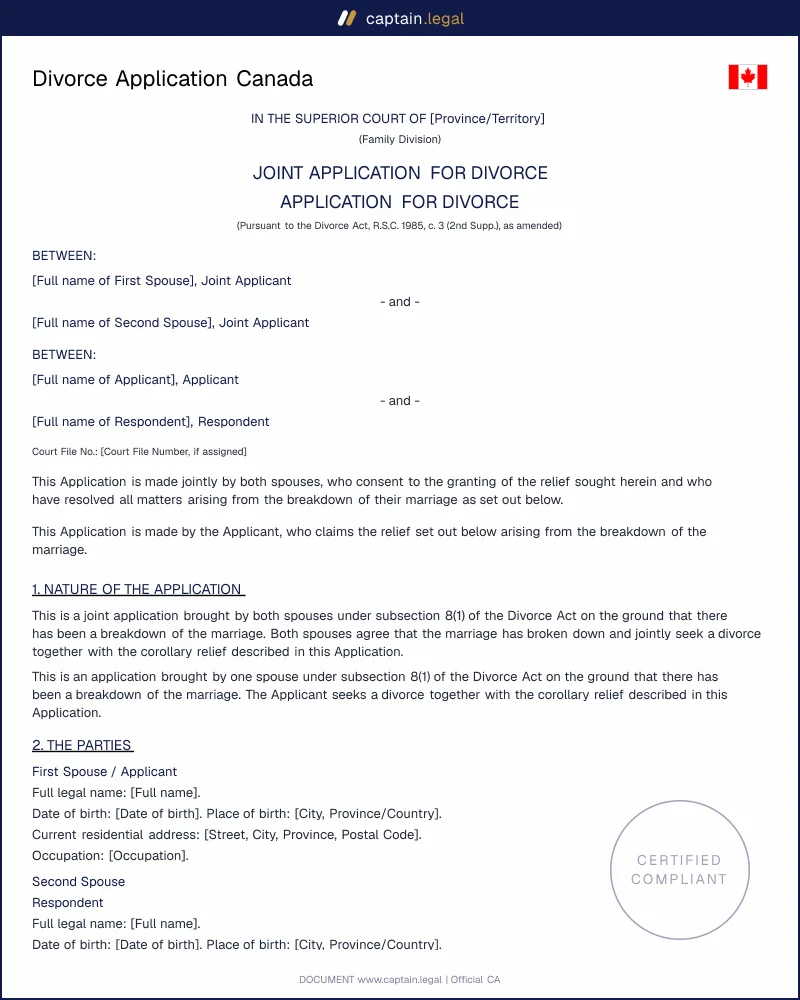
  • The identification of the spouses and the marriage records full legal names, the date and place of the marriage, and current residences. This is where the section 3(1) residency ground is established, so the province and the length of residence must be stated precisely. An application that names the wrong province, or fails to show one full year of residence, can be rejected at filing.
  • The statement of the ground for divorce is drafted to the statutory language of section 8. For the standard route, it confirms the date the spouses began living separate and apart and that they intend the separation to be permanent. Vague phrasing is replaced with the exact separation date, because the court counts twelve months from that point.
  • The parenting arrangements section sets out parenting time and decision-making responsibility in the post-2021 terminology, not the old "custody and access" wording. It covers the regular schedule, holidays, travel consent, and how major decisions about health, education, and religion get made, all framed around the child's best interests.
  • The child and spousal support terms state the amounts, the income figures they were calculated from, and any section 7 special or extraordinary expenses. Tying the numbers to the Federal Child Support Guidelines is what lets a judge approve them without sending the file back.
  • The property and debt provisions confirm how the matrimonial home, accounts, pensions, and debts are divided or whether a separate agreement governs them. Because property law is provincial, this clause flags which provincial regime applies to your situation.
  • The financial disclosure acknowledgement records that both spouses exchanged honest financial information. Skipping this is the single fastest way to have a deal reopened later, so the clause documents that disclosure happened.
4

Regional considerations

Divorce grounds are federal and identical everywhere, but the forms, filing fees, and property rules are provincial, so the province you file in changes the practical experience.

Ontario runs divorces through the Superior Court of Justice using Form 8A for a joint or uncontested divorce and Form 8 for a contested one. Property division for married spouses follows the Family Law Act equalization of net family property model, which is distinct from how unmarried partners are treated. Where parenting claims are made, the court expects a Form 35.1 affidavit on decision-making responsibility and parenting time, sworn before a commissioner. Financial disclosure is required whenever support or property is in issue, and a Canadian affidavit or statutory declaration template is often needed alongside the main application.

British Columbia processes divorces through the Supreme Court, with property division under the provincial Family Law Act on a presumptive equal-division basis that, unusually, also captures many unmarried spouses who meet the cohabitation threshold. The one-year residency and one-year separation rules apply as everywhere, and BC permits same-roof separation where the spouses prove they ended the relationship.

Alberta applies the Family Property Act to married spouses and, in many situations, to adult interdependent partners, which broadens who is caught by the property regime compared with some provinces. Applications proceed through the Court of King's Bench.

Quebec sits inside the federal Divorce Act for the divorce itself but applies its own civil-law system to property through the family patrimony rules, and the forms and terminology differ from the common-law provinces. The province processes the large majority of its files as joint applications.

Across all provinces, the married-versus-common-law distinction reshapes the property analysis entirely, so the document you sign must match your actual legal status.

5

How to fill out this divorce application

You start by confirming the basics the court checks first: that you are legally married, that at least one spouse has lived in the chosen province for a full year, and that you have been separated long enough (or will be by the time the order is granted). From there, the template walks you through the marriage details, the separation date, and the ground you are relying on, almost always the one-year separation route. Getting the separation date exactly right matters more than anything else on the form, since the twelve-month clock runs from it.

Next you address the children, if any. The template prompts you to describe parenting time and decision-making responsibility in the current statutory language and to set out support figures tied to the guideline tables. You then record the property and debt arrangements, or point to a signed separation agreement that governs them. Because financial disclosure underpins the whole package, you confirm that both spouses exchanged honest numbers. If you are filing jointly, both spouses sign as applicants, which removes the service step entirely. For anything outside the divorce itself, such as a name change or estate update, our Canadian personal and family law documents cover the related filings.

6

Common mistakes to avoid

The most frequent error is misjudging the separation date and the one-year clock. People assume they can finalize a divorce the day they file, then discover the court cannot grant the order until a full year of separation has elapsed. Closely related is the reconciliation trap: spouses who try again for more than ninety days reset the entire count and lose months they thought they had banked. A second recurring failure is naming the wrong province or filing before the one-year residency is met, which gets the application bounced before it is even considered.

The third cluster of mistakes sits around children and money. Drafting parenting terms in the old "custody and access" vocabulary signals an outdated document, and courts now expect parenting time and decision-making responsibility framed around the child's best interests. Proposing child support that departs from the Federal Child Support Guidelines without a documented reason invites a judge to refuse the order. And skipping financial disclosure, or burying a sweeping support waiver in a quick agreement, is the classic way to have a settlement reopened later. When property or governance issues for a family business are tangled into the separation, founders often also need a Canadian shareholder agreement or business document to keep those interests clean.

Key takeaways

Divorce Act

One ground, three ways to prove it

A joint divorce application is filed under the federal Divorce Act. Under section 8(1), the only ground is breakdown of the marriage, proven under section 8(2) by one-year separation, adultery, or cruelty. Most couples rely on the one-year separation route because it avoids fault and evidence fights. Your form still needs clear facts about the marriage and the basis you are claiming.

Timing

Residency and separation clocks control the file

Two timing rules drive whether your application can move. Under section 3(1), at least one spouse must have ordinarily lived in the province of filing for at least one year right before applying. You can file before the full separation year is done, but the court will not grant the divorce order until 12 months have passed. A reconciliation of up to 90 days can be tried without resetting the clock (section 8(3)).

Joint filing

Joint works only with complete agreement

A joint application avoids service and a respondent, which can keep an uncontested file fast and less adversarial. The trade-off is strict: it only fits when you agree on everything, including parenting time and support. If one issue becomes disputed, the matter shifts to a contested track with different forms. Draft with judge-ready detail, since vague parenting terms or the wrong province can turn a simple filing into conflict.

Frequently Asked Questions

Signing the application does not by itself end your marriage. It is a request to the court, and you are legally married until a judge grants the divorce order. What your signatures do create is a binding statement of the facts and the terms you have agreed to, which the court relies on when reviewing the file. Once the order is granted and the appeal period passes, the divorce takes effect and a certificate of divorce can be issued. Until then, you remain married, cannot remarry, and any agreed parenting or support terms only become court-enforceable once incorporated into an order.

The hard floor is the one-year separation period under section 8(2)(a) of the Divorce Act, which cannot be waived. You can file before the year is up, but the order will not issue until twelve months of separation are complete. Beyond that floor, an uncontested joint application typically takes a few months of processing once filed, often in the range of two to six months depending on the province and how busy the court is. Joint applications move roughly a third faster than sole applications because there is no service step and no thirty-day response window for the other spouse to use.

Yes. Under the Divorce Act, "living separate and apart" does not require separate addresses. Spouses can be legally separated while sharing a home, provided they have genuinely ended the marital relationship, stopped functioning as a couple, and can show the practical changes that prove it. Courts look at sleeping arrangements, finances, shared meals, and how you present to others. Because the separation date starts the one-year clock, you should document it carefully. Same-roof separation is accepted across Canada, but it draws more scrutiny than a clean physical move-out, so keep a clear record of when and how the relationship ended.

You download the divorce application in both Word and PDF. The Word version lets you edit every field properly, add or remove clauses, and adapt the parenting and support sections to your situation before you print and sign. The PDF gives you a clean, court-ready copy to keep once everything is final. Because provincial courts often have their own official forms, the template is built to capture the facts and terms those forms require, so you can transfer the information accurately rather than discovering a missing detail at the filing counter.

No law requires a lawyer for a simple uncontested joint divorce, and many Canadians complete one themselves. Independent legal advice is not mandatory, but it is genuinely valuable where there are children, significant property, pensions, or a power imbalance between the spouses, because those are the situations where a court is most likely to scrutinize the terms. A well-structured application reduces the risk of rejection on technicalities. For straightforward separations with full agreement and honest disclosure, the documents plus careful completion are often enough.

A joint application only works while you agree on everything. If a genuine disagreement surfaces over parenting, support, or property, the file generally cannot continue as joint and must convert to a contested track, where one spouse becomes the applicant and the other the respondent, with formal service and a response period. The practical fix is usually to resolve the single open issue through negotiation or mediation, document the agreed term, and then proceed jointly. Many couples settle the sticking point in a separation agreement first, then file the joint divorce on settled ground.

Not on its own. The Divorce Act governs the divorce, child support, and spousal support, but property division falls under provincial law, such as Ontario's Family Law Act equalization regime or British Columbia's Family Law Act equal-division model. The application can record your property arrangements or refer to a separate agreement that governs them, but the federal divorce order does not divide property by default. This is why the married-versus-common-law distinction matters so much, since unmarried partners are treated very differently under provincial property rules.

4.6/5

16 verified reviews · 50 000+ downloads

Divorce Application Canada | Divorce Act Joint Form
  • Immediate access to the document
  • PDF + Word download
  • Compliant with 2026 legislation
  • Reviewed by lawyers
Fill in the template
Secure payment · No subscription
Updated on June 19, 2026

You might also like

Parenting Plan Template Canada
Separation Agreement Template