Create my document
Login

Choose country

CanadaCanadaChoose country
Real Estate

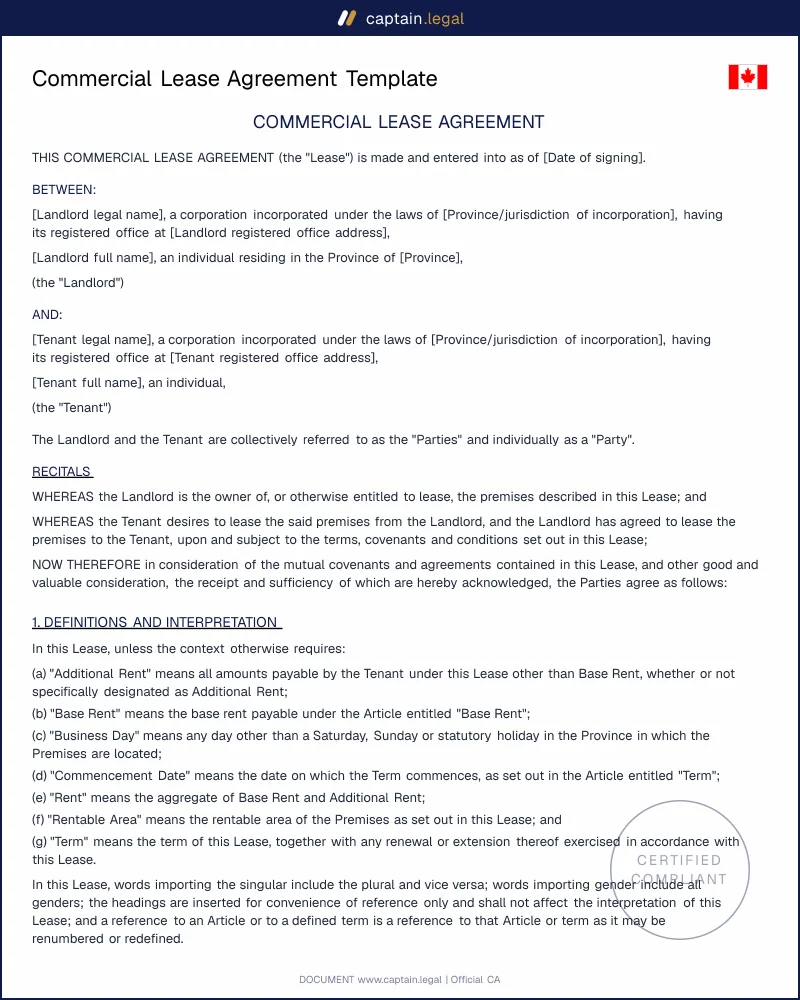
Commercial Lease Agreement Canada | Commercial Tenancies Act

Commercial lease agreement drafted for Canadian common-law practice, aligned with the Commercial Tenancies Act and provincial rules. Word and PDF download.
4.8/524 reviews50 000+ downloadsInstant download
Share

A commercial lease agreement is the contract that governs how a business occupies office, retail or industrial space, setting the rent, the term, the permitted use and the division of operating costs between landlord and tenant. In Canadian common-law provinces, the written lease is the document that controls almost everything, because commercial tenants enjoy far fewer statutory protections than residential ones and courts hold parties to the bargain they signed. Whether you are leasing a storefront in Toronto, an industrial bay in Calgary or office floors in Vancouver, a properly drafted commercial lease agreement is what separates a clean tenancy from years of costly disputes. This template is built for Canadian commercial leasing practice across the common-law provinces.

Compliant

2026 Legislation

50,000+ clients

trust us

Affordable

From $4.90 / doc

Secure payment

Instant download

Commercial Lease Agreement Canada | Commercial Tenancies Act

Secure payment · No subscription

Fill in the template

What is a commercial lease agreement?

A commercial lease agreement is a binding contract under which a landlord grants a business tenant the right to occupy and use premises for a commercial purpose, in exchange for rent over a defined term. It applies to offices, retail units, warehouses, industrial bays and mixed-use commercial space, and it differs fundamentally from a residential tenancy. Residential leases are heavily regulated by provincial Residential Tenancies Acts that cap rent increases and dictate notice periods; a commercial lease is treated as an ordinary business contract between parties of roughly equal bargaining power, so the terms you negotiate are the terms you live with.

People often blur the line between a commercial lease and a commercial rental agreement, but in practice the distinction is one of duration and formality. A lease usually fixes a term of three, five or ten years with renewal options, while a month-to-month arrangement runs on an indefinite periodic basis terminable on short notice. The other common confusion is the type of lease. A gross lease bundles operating costs into a single rent figure, while a net lease (and especially a triple-net or NNN lease) passes property taxes, insurance and maintenance through to the tenant on top of base rent. Knowing which structure you are signing matters more than almost any other clause, because it determines what you actually pay each month once operating costs are added. If you also need to record the condition of the premises at handover, a structured set of real estate and rental documents for Canadian property practice keeps the supporting paperwork consistent with the lease.

2

When do you need this document?

The most frequent trigger is a business taking new premises for the first time, whether a founder opening a first retail location or a growing company moving into dedicated office space. A written lease fixes the rent, the term and the permitted use, and without it the tenant occupies on uncertain terms that a landlord can change with little notice. The second common scenario is a landlord putting vacant commercial space on the market and needing a document that protects the asset while remaining attractive to credit-worthy tenants. Renewals form a third category: when a fixed term nears its end, parties either exercise a negotiated renewal option or paper a fresh lease, and renewal is one of the clauses tenants most regret leaving vague.

Beyond these, the document covers expansions where a tenant takes additional adjacent space, relocations within the same building, and sale-of-business situations where a buyer needs the lease assigned to them. A solid lease pairs naturally with the incorporation and shareholder documents Canadian businesses rely on, since the tenant is usually a corporation rather than an individual. Two edge cases deserve attention. First, a sublease or assignment almost always requires the landlord's written consent, and a tenant who occupies under a head lease they have not read inherits obligations they may not expect. Second, leasing space inside a commercial strata or condominium building layers the strata corporation's bylaws on top of the lease, so the tenant must comply with both. Never assume a verbal understanding with a landlord survives; in commercial leasing, what is not written down generally does not exist.

3

Key clauses included in our template

  • The identification of the parties and premises names the landlord and the tenant in their exact legal form, including the corporation's registered name and any guarantor, then describes the leased area with a measured square footage and a floor plan reference. Vague descriptions invite disputes over what space the rent actually buys.
  • The term and renewal options fix the commencement date, the length of the fixed term and the mechanics of any renewal, including how renewal rent is set. A renewal option that says only "to be negotiated" is worth almost nothing, so the template ties renewal rent to a defined formula or market-rate process.
  • The rent and operating cost structure distinguishes base rent from additional rent, and specifies whether the lease is gross, net or triple-net. It sets out how common-area maintenance, property taxes and building insurance are allocated and reconciled, which is where most billing disputes originate.
  • The permitted use and exclusivity clause defines the business the tenant may carry on, and where relevant grants an exclusive use right preventing the landlord from leasing nearby units to direct competitors. Restricting use too narrowly can trap a tenant whose business model later shifts.
  • The maintenance and repair allocation divides responsibility between landlord structural obligations (roof, foundation, exterior walls) and tenant obligations (interior, HVAC servicing, fixtures), because the statutes are silent on this and the lease must supply the answer.
  • The assignment, subletting and default provisions govern transfer of the lease and the landlord's remedies on breach, alongside tenant improvement terms covering who funds and owns fit-out work. These provisions decide how easily a tenant can exit and what happens when rent is late.
4

Regional considerations

Ontario runs the most developed statutory framework through the Commercial Tenancies Act, R.S.O. 1990, c. L.7. Landlords hold strong self-help remedies: distress for unpaid rent and lock-changing eviction on the 16th day after default, though never both at once. The Act does not cap rent increases or require deposit interest, so those terms must be negotiated into the lease. Disputes about money or property under fifty thousand dollars go to Small Claims Court, with larger claims heading to the Superior Court of Justice. Overholding triggers the double-rent exposure under section 58, a clause tenants frequently overlook when planning a move-out.

British Columbia is governed by the Commercial Tenancy Act, R.S.B.C. 1996, c. 57, which applies to retail, office, industrial and commercial strata space but offers no dispute-resolution body equivalent to the residential Residential Tenancy Branch and no prescribed forms. Holdover under the Act can expose a tenant to double the yearly value of the premises, although a well-drafted lease usually overrides that default. Commercial rent in BC attracts five per cent GST, and tenant improvement allowances are a heavily negotiated feature of Greater Vancouver leases. A clean lease pairs well with the Canadian non-profit and association documents where a charity or society is the tenant.

Alberta has no dedicated commercial tenancy statute, so leases rest entirely on common-law contract and property principles. The leading authority on landlord remedies for tenant abandonment is Highway Properties Ltd. v. Kelly, Douglas & Co. Ltd., which confirmed a landlord can terminate and sue for prospective losses. Because there is no statutory safety net, the written lease carries the entire relationship in Alberta, which makes precise drafting even more important than in Ontario or BC. The same caution applies to other common-law provinces such as Nova Scotia, where no specific commercial tenancy legislation exists at all and contract law governs by default.

5

How to fill out this commercial lease agreement

You start by selecting the province where the premises are located, because that choice sets the governing law and adjusts the statutory references and default remedies that apply behind your negotiated terms. From there, the form asks you to identify the parties in their correct legal form, capturing the corporation's registered name, any guarantor, and the full description and measured area of the leased premises. Next you set the commercial terms: the commencement date, the length of the fixed term, any renewal options and the rent structure, choosing between a gross, net or triple-net arrangement and recording how operating costs are shared.

The guided fields then move through permitted use, maintenance allocation, insurance obligations and the assignment and subletting rules, prompting you at each step with the questions a leasing lawyer would ask. Once the substantive terms are in place, the document assembles into a clean, signature-ready file you can download in Word and PDF, ready to adapt or execute. If your tenant entity is being incorporated alongside the lease, the director resolutions and corporate authority documents sit naturally next to this template in the same workflow.

6

Common mistakes to avoid

The single most expensive error is treating the rent figure as the whole cost. Tenants who sign a triple-net lease without modelling the operating-cost reconciliation often discover that common-area charges, property taxes and insurance add a substantial sum on top of base rent, and the GST or HST on the full amount compounds the surprise. A close second is leaving the renewal option vague: a clause promising renewal "at a rent to be agreed" gives the tenant no enforceable right, because if the parties cannot agree there is nothing to enforce. Equally common is an over-narrow permitted-use clause that locks a business into a single activity, then strangles it when the model evolves and the landlord refuses to consent to a change.

On the landlord side, the recurring failure is poor drafting of the default and distress provisions, which can leave a landlord choosing the wrong remedy or acting outside the lease and the statute. Many parties also forget that assignment and subletting almost always need written landlord consent, so a tenant who quietly sublets risks breaching the lease. Finally, far too many businesses sign without recording the condition of the premises at handover or clarifying who owns tenant improvements at the end of the term. Document the state of the space before you take possession, because at move-out the burden of proving what changed falls on whoever cannot show the starting point. For the wider set of agreements a business signs alongside a lease, the Canadian personal and family legal documents cover the supporting instruments owners often need.

Key takeaways

Contract first

The written lease is the rulebook

In Canadian common-law provinces, a commercial lease is treated like an ordinary business contract, not a residential tenancy. That means the clauses you sign on rent, term, permitted use, renewals and operating costs will usually govern, with far fewer statutory guardrails than under provincial Residential Tenancies Acts. Courts generally hold parties to the bargain they made, so sloppy wording turns into expensive arguments later.

Cost structure

Gross vs net decides what you pay

The most practical financial issue is whether you are signing a gross lease or a net lease, especially a triple-net (NNN) deal. A gross lease rolls operating costs into one rent figure, while a net structure pushes items like property taxes, insurance and maintenance onto the tenant on top of base rent. The headline rent can look attractive, then monthly costs climb once pass-throughs land.

Provincial rules

Know your province and the remedies

Commercial leasing is provincial, and the legal backdrop changes by location. Ontario uses the Commercial Tenancies Act, R.S.O. 1990, c. L.7 and British Columbia has its Commercial Tenancy Act, while Alberta has no dedicated commercial tenancy statute and relies on common law, including Highway Properties on remedies after abandonment. Statutes are often a backstop, so default remedies matter when the lease is silent.

Frequently Asked Questions

Yes. A commercial lease is an ordinary business contract, and once both parties sign premises described with sufficient certainty, agree a term and a rent, and intend to create legal relations, the lease binds them. In every common-law province the written agreement controls the relationship and generally takes precedence over the statutory defaults in laws like Ontario's Commercial Tenancies Act or BC's Commercial Tenancy Act. The template is structured to meet these requirements and to be enforceable in the relevant province, though where a corporation signs you should confirm the signatory has authority to bind the company. For high-value or long-term leases, independent legal advice before execution remains a sensible step.

The document is available in both Microsoft Word and PDF. The Word file lets you adapt clauses, insert your negotiated terms and adjust language to fit an unusual arrangement, which matters in commercial leasing where almost every deal is bespoke. The PDF gives you a clean, fixed copy suitable for circulation and signature. Most users complete the guided fields, download the Word version to fine-tune the permitted use, rent structure and renewal mechanics, then produce a final PDF for execution. Both formats reflect the same province-specific drafting, so you can move between them without losing any of the legal content.

It depends on the type of tenancy. A fixed-term lease simply ends on its expiry date, so no notice is needed unless the lease itself requires one, which is why diarising the expiry and any renewal deadline matters. A month-to-month commercial tenancy generally requires at least one month's written notice from either party under the common-law and statutory defaults. Beyond those baselines, the lease can and usually does set its own notice requirements, and those negotiated terms govern. Watch the overholding provisions: a tenant who stays past the term without consent can face double rent under section 58 of Ontario's Act or the equivalent holdover exposure in BC.

In a gross lease, the tenant pays a single rent figure and the landlord absorbs operating costs such as property taxes, insurance and maintenance out of that rent. In a net lease, the tenant pays base rent plus a share of those operating costs, and a triple-net lease passes essentially all of property taxes, insurance and maintenance through to the tenant. The practical effect is large: two leases with identical base rent can cost very different amounts once additional rent is added. Always ask which structure applies and request the operating-cost history before signing, so the real monthly figure holds no surprises.

Generally yes. Commercial rent is a taxable supply, so GST or HST applies to base rent and to most additional rent, including common-area charges and recovered property taxes billed by the landlord. The rate depends on the province: five per cent GST in provinces like British Columbia and Alberta, and the combined HST rate in participating provinces such as Ontario. There are limited exceptions, including the small-supplier rules, but most commercial landlords are registered and must collect the tax. Confirm the tax treatment in the lease and factor it into your budget, because it adds a real and recurring cost on top of the rent you negotiate.

During a fixed term, no, unless the lease expressly provides for it, which is exactly why rent-escalation clauses matter. Unlike residential law, commercial tenancy statutes do not cap rent increases, so once a fixed term ends a landlord is generally free to set whatever rent the market will bear and is under no obligation to renew. This is the core reason a clearly drafted renewal option with a defined rent formula is so valuable to a tenant. Inside the term, your protection comes entirely from the lease: if it fixes the rent and the escalation schedule, the landlord is bound by those figures.

No, an individual can sign a commercial lease, but in practice most commercial tenants are corporations, because a corporate tenant limits the personal liability of the owners. When a corporation signs, landlords frequently require a personal guarantee from a director or owner, which exposes that individual to the lease obligations if the company defaults. Read any guarantee carefully before signing, since it can survive the company's insolvency. If you are setting up the tenant entity at the same time, handle the incorporation and the lease together so the corporate name on the lease matches the registered entity exactly.

4.8/5

24 verified reviews · 50 000+ downloads

Commercial Lease Agreement Canada | Commercial Tenancies Act
  • Immediate access to the document
  • PDF + Word download
  • Compliant with 2026 legislation
  • Reviewed by lawyers
Fill in the template
Secure payment · No subscription
Updated on June 18, 2026

You might also like

Roommate Agreement Template Canada
Rental Application Form Canada