Create my document
Login

Choose country

CanadaCanadaChoose country
Personal & Family

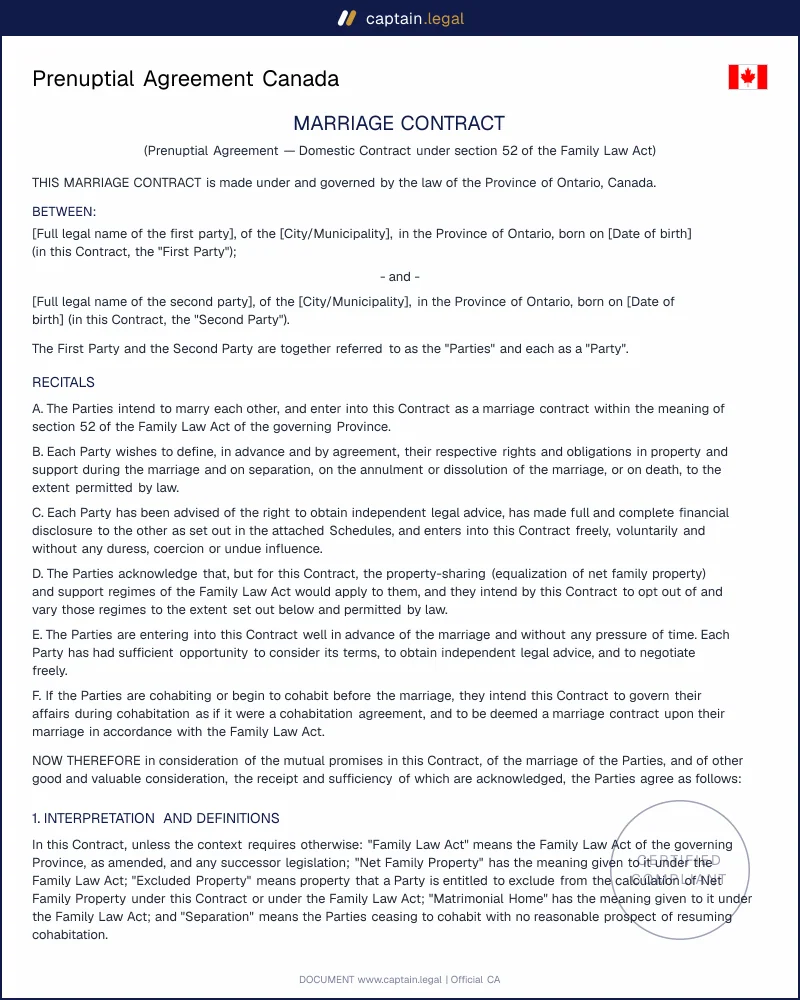
Prenuptial Agreement Canada | Family Law Act s.52

Prenuptial agreement drafted to Family Law Act s.52, with disclosure schedule and independent legal advice blocks courts require. Word and PDF download.
4.9/511 reviews50 000+ downloadsInstant download
Share

A prenuptial agreement in Canada's common-law provinces is a written domestic contract signed before marriage that lets a couple decide in advance how property, debts and spousal support will be handled if the relationship ends by separation, divorce or death. In Ontario it is legally called a marriage contract, and it is authorized by section 52 of the Family Law Act. The name changes across the country, but the purpose does not: the agreement replaces the province's default equalization or division rules with terms the couple negotiates for themselves. This template is built for the common-law provinces (Quebec's Civil Code regime is not covered), with the disclosure schedule and independent legal advice blocks that courts look for when an agreement is later challenged.

Couples reach for a prenuptial agreement when one partner owns a business, brings significant assets or debts into the marriage, expects an inheritance, or has children from a prior relationship whose interests need protecting. The document only holds up if it is executed correctly, which is why the drafting details below matter as much as the terms themselves.

Compliant

2026 Legislation

50,000+ clients

trust us

Affordable

From $4.90 / doc

Secure payment

Instant download

Prenuptial Agreement Canada | Family Law Act s.52

Secure payment

Fill in the template

What is a prenuptial agreement in Canada?

A prenuptial agreement is a contract between two people who intend to marry, setting out their respective rights and obligations during the marriage and on its breakdown. The everyday word is "prenup," but no Canadian statute uses that term. In Ontario the correct legal name is marriage contract under section 52 of the Family Law Act; in British Columbia the same instrument is a marriage agreement under sections 92 to 93 of the Family Law Act; in Alberta it is a family property agreement under the Family Property Act. Choosing the right label for the governing province is not cosmetic, because each statute attaches its own execution and enforceability rules to its own defined term.

The distinction that trips people up is prenup versus cohabitation agreement. A prenuptial agreement is signed by two people who intend to marry, while a cohabitation agreement is signed by an unmarried couple living together or planning to. In Ontario the two converge automatically: under section 53(2) of the Family Law Act, a cohabitation agreement is deemed to become a marriage contract once the parties marry, so a couple who signed before moving in together usually does not need to redraft on marriage. A prenuptial agreement is also different from a postnuptial agreement, which does the same job but is signed after the wedding rather than before. The terms a prenup can cover are broad, spanning property division, debt allocation and spousal support, but there are firm limits explained in the next section. A prenup can never fix child support or decide parenting time and decision-making responsibility, because those rights belong to the child and cannot be bargained away by the parents.

2

When do you need this document?

The clearest case is the entrepreneur or professional who owns a business and wants company shares, partnership interests or a practice kept out of the property pool on separation. Under most provincial regimes the growth in value of that business during the marriage is divisible by default, so without a prenup a founder can watch years of appreciation become a spousal claim. The second common trigger is the second marriage, where one or both partners have children from a prior relationship and want to ring-fence assets so an inheritance flows to those children rather than a new spouse. Blended families are the fastest-growing reason couples sign, and the agreement pairs naturally with an updated estate plan drawn from a last will and testament for Canada.

Significant pre-marriage assets or debts are the third scenario. A partner bringing an inherited property, a large investment portfolio, or conversely eighty thousand dollars of student debt into the marriage has a strong reason to record who keeps what and who carries which liability. Expected inheritances and family gifts round out the standard list, since a prenup can confirm that gifts and inheritances (and any income or growth from them) stay the separate property of the recipient.

Two edge cases legitimize careful drafting. First, the matrimonial home in Ontario is treated differently from every other asset: its full value at separation is normally shared even if one spouse owned it before marriage, and while a marriage contract can adjust how that value is split, section 52(2) of the Family Law Act means it cannot strip the other spouse of the right to possess the home or the requirement of consent before it is sold or mortgaged. Second, common-law entitlement varies wildly by province. In Ontario common-law partners have no automatic property division rights at all, so an unmarried couple needs a cohabitation agreement rather than a prenup, while in BC and Alberta cohabiting partners gain rights after two and three years respectively.

3

Key clauses included in our template

  • The property division clause identifies what each party owns going into the marriage and states how family property and pre-marriage property will be treated on separation. It attaches a schedule of assets and liabilities for each spouse, which is the single most important defence against a later section 56(4) disclosure challenge.
  • The separate property and exclusion clause ring-fences business interests, inheritances, gifts and pre-marriage assets, including their appreciation during the marriage. This is the clause business owners and second-marriage spouses rely on most, and it is drafted to the exclusion language each province recognizes.
  • The spousal support provision records whether support will be paid, waived, capped or calculated by a formula. It is written with the Miglin two-stage test in mind, because a bare waiver with no reasoning is the term a court is most likely to scrutinize and set aside.
  • The debt allocation clause assigns responsibility for debts brought into the marriage and incurred during it, so a student loan or business liability does not become a shared obligation by default.
  • The full financial disclosure schedule is a sworn statement of each party's assets, debts and income, supported by documentation. In Ontario, practitioners typically attach a Form 13 Financial Statement; missing or thin disclosure is the leading reason agreements collapse.
  • The independent legal advice certificates give each party's separate lawyer a block to confirm advice was given and the agreement signed voluntarily. In Alberta these certificates are mandatory under section 38; everywhere else they are the strongest protection against an unconscionability or duress argument.
4

Regional considerations

Ontario governs prenups as marriage contracts under section 52 of the Family Law Act, with formal validity set by section 55 (writing, signature, one witness) and the setting-aside grounds in section 56(4). The province's defining quirk is the matrimonial home: its full value at separation is shared regardless of who owned it before marriage, and section 52(2) forbids a contract from removing possession rights or the consent-before-disposition rule. A well-drafted Ontario agreement adjusts the split of the home's value without pretending it can eliminate those protected rights. Independent legal advice is not strictly mandatory but is treated as close to essential in practice.

British Columbia calls the document a marriage agreement under sections 92 to 93 of the Family Law Act. Execution needs writing and at least one witness. What sets BC apart is the "significantly unfair" test in section 93(5): a court can set aside an agreement that was fairly made if its effect has become significantly unfair by the time it is challenged, weighing the time elapsed, the couple's intention to achieve certainty, and their reliance on the terms. That lower threshold makes thorough disclosure and ILA more valuable in BC than the bare statute suggests.

Alberta is the outlier. Prenups are family property agreements under the Family Property Act, and section 38 makes independent legal advice and lawyer-signed acknowledgment certificates a hard requirement, not a best practice. Without a certificate from each party's separate lawyer, the property terms are unenforceable and the default fifty-fifty division applies. Alberta courts are otherwise deferential to properly certified agreements, so the certificate is genuinely the linchpin.

The Atlantic and Prairie provinces each have their own statute and term. Nova Scotia and New Brunswick authorize marriage contracts under the Matrimonial Property Act and Marital Property Act respectively, and other provinces follow similar patterns. Across all of them, the Divorce Act and the Miglin framework apply to spousal support, and the Federal Child Support Guidelines override any contractual attempt to cut child support. Wherever the couple lives, the template should be finalized against the specific governing statute of that province rather than a generic national form, which is why province selection drives the clauses you see.

5

How to fill out this prenuptial agreement

You start by selecting the province that will govern the agreement, because that single choice sets the statutory references, the execution formalities and the name the document carries. From there the template asks for the full legal names of both parties and the intended marriage date, then moves into the financial disclosure schedule where each partner lists assets, debts and income with supporting figures. This schedule is not a formality to rush; it is the evidentiary backbone that keeps the agreement standing if it is ever questioned, so the form prompts for enough detail to satisfy the section 56(4) disclosure standard.

Next you choose how property will be divided and which assets stay separate, and the form adapts its language to the exclusion rules of the province you selected. You then set the spousal support term, whether that is a waiver, a cap or a formula, with the Miglin considerations flagged so the choice is a deliberate one. The final stage generates the independent legal advice certificate blocks and the witnessing section. You download the finished agreement in Word and PDF, take it to your own lawyer for advice, and sign only after both parties have had that advice. For the reverse situation, a couple already married can use a postnuptial agreement for Canada instead.

6

Common mistakes to avoid

The most damaging error is thin or absent financial disclosure. An agreement that hides or undervalues a pension, a business or a property invites a section 56(4) application, and courts have set aside contracts where a pension listed at twenty-four thousand dollars turned out to be worth four times that. Full and frank disclosure, backed by documents and a sworn schedule, is the difference between an agreement that binds and one that evaporates. The second frequent mistake is skipping independent legal advice to save time or money. In Alberta that omission is fatal by statute, and everywhere else it hands the other side a ready-made argument that a spouse did not understand what they signed. Each party genuinely needs their own lawyer from a different firm, not a shared one.

Timing is the third trap. An agreement pushed in front of a partner days before the wedding looks like duress, and a signature extracted under that pressure is vulnerable no matter how fair the terms read. Practitioners recommend finalizing well in advance, ideally one to two months before the date. The fourth mistake is overreaching into forbidden territory, such as trying to waive child support or dictate parenting arrangements, which are void and can taint the surrounding clauses. Finally, couples forget that a prenup is not frozen in time: a waiver that was fair at signing can become unconscionable decades later, so pairing the agreement with periodic review and a current cohabitation agreement or separation agreement for Canada where circumstances change keeps the whole arrangement defensible.

Key takeaways

Governing law

Use the right agreement for your province

A prenup is a domestic contract, but the legal label and rules change by province: in Ontario it is a marriage contract under Family Law Act s.52, in B.C. a marriage agreement (ss.92-93), and in Alberta a family property agreement under the Family Property Act. Use the statute that matches where you live, not where you marry, because execution and enforceability tests attach to that defined term.

Formalities

Execution details can make it fail

Courts focus on whether the agreement was executed the way the statute requires. Ontario’s Family Law Act s.55 requires a written agreement, signed by both parties, with a witness. B.C. similarly requires written form and at least one witness. Alberta is stricter: independent legal advice is mandatory, and each party must sign a lawyer’s acknowledgment certificate or the property terms may be unenforceable and default division rules apply.

Limits

You cannot contract out of children’s rights

A prenup can set rules for property, debts, and spousal support, but it has hard boundaries. It cannot fix child support or decide parenting time or decision-making responsibility, because those rights belong to the child and are not something parents can bargain away in a domestic contract. If you try to include child terms, expect them to be ignored or to create leverage issues in a later separation.

Frequently Asked Questions

Yes, when it is properly made. A prenuptial agreement is enforceable in every common-law province provided it meets the formal rules of the governing statute, which generally means it is in writing, signed and witnessed. In Ontario that is section 55 of the Family Law Act; in BC, section 93; in Alberta, section 38 of the Family Property Act, which also demands independent legal advice certificates. Beyond form, the agreement must rest on full financial disclosure and a genuine understanding by both parties. Courts apply the Miglin test to spousal support terms and can set an agreement aside under provisions like Ontario's section 56(4), but an agreement negotiated fairly with disclosure and separate legal advice is routinely enforced as written.

In Alberta, yes, without exception: section 38 of the Family Property Act requires each party to have a separate lawyer sign an acknowledgment certificate, and without it the property terms are unenforceable. In Ontario, British Columbia and the other common-law provinces, independent legal advice is not strictly mandatory, but it is close to essential in practice. When each spouse has advice from their own lawyer at a different firm, the other side loses the argument that a party did not understand the agreement or signed under pressure. Agreements without independent legal advice face far higher challenge rates, so the modest step of separate counsel is the best single protection you can build in.

No. A prenuptial agreement can address the couple's own financial affairs, but it cannot fix child support below the Federal Child Support Guidelines amount, and it cannot decide parenting time or decision-making responsibility. Those rights belong to the child, not the parents, and a court will disregard any clause that tries to bargain them away. Ontario's section 52(1)(c) of the Family Law Act is explicit that a marriage contract cannot determine parenting arrangements. A prenup can note a couple's intention on a child's education and moral upbringing, but even that yields to the child's best interests if a judge later reviews it. Keep the agreement to property, debt and spousal support to keep it enforceable.

You download the prenuptial agreement in both Microsoft Word and PDF. The Word file lets you and your lawyer make final adjustments to names, schedules and province-specific clauses before signing, while the PDF gives you a clean, print-ready version for execution. Having both matters here, because a prenup almost always needs a round of review by each party's independent lawyer, and an editable Word document makes that process smooth rather than forcing you to rebuild the agreement from scratch.

Sign as early as you reasonably can, and ideally one to two months before the wedding. An agreement presented at the last minute, when one partner feels they cannot back out without cancelling the ceremony, looks like duress and becomes vulnerable to challenge on exactly that ground. Giving both parties unhurried time to obtain independent legal advice, review the disclosure and negotiate terms is what makes the agreement stand up later. Rushing the process is one of the most common reasons courts question whether a spouse truly agreed freely, so build in a comfortable margin before the date.

You can include a spousal support waiver, but it is the term courts scrutinize most closely. Under the Miglin framework a waiver is generally upheld if both parties had full disclosure, independent legal advice and were financially independent when they signed. The catch is the second stage: if enforcing the waiver decades later would leave one spouse in poverty or reliant on public assistance after a long marriage, a court retains discretion under the Divorce Act to override it. Complete waivers hold up best in shorter marriages between two financially independent people. Where one partner gave up a career, expect closer judicial review.

Without an agreement, the default rules of your province apply on separation or divorce. In Ontario that means the equalization of net family property, with the matrimonial home shared at full value regardless of who owned it. In BC and Alberta it means the statutory division of family property, generally an equal split. Spousal support follows the Divorce Act and the Spousal Support Advisory Guidelines. Those defaults work well for many couples, but they take the decision out of your hands, which is precisely why business owners, people entering second marriages and partners with unequal assets choose to set their own terms in advance through a family and divorce document from our Canadian library.

4.9/5

11 verified reviews · 50 000+ downloads

Prenuptial Agreement Canada | Family Law Act s.52
  • Immediate access to the document
  • PDF + Word download
  • Compliant with 2026 legislation
  • Reviewed by lawyers
Fill in the template
Secure payment
Updated on July 12, 2026

You might also like

Codicil to a Will Canada
Power of Attorney Canada