Create my document
Login

Choose country

CanadaCanadaChoose country
Employment

Independent Contractor Agreement Canada | CRA Compliant

Contractor agreement aligned with the Wiebe Door test and Copyright Act s.13. Covers status, IP assignment, GST and termination across Canadian provinces.
4.7/522 reviews50 000+ downloadsInstant download
Share

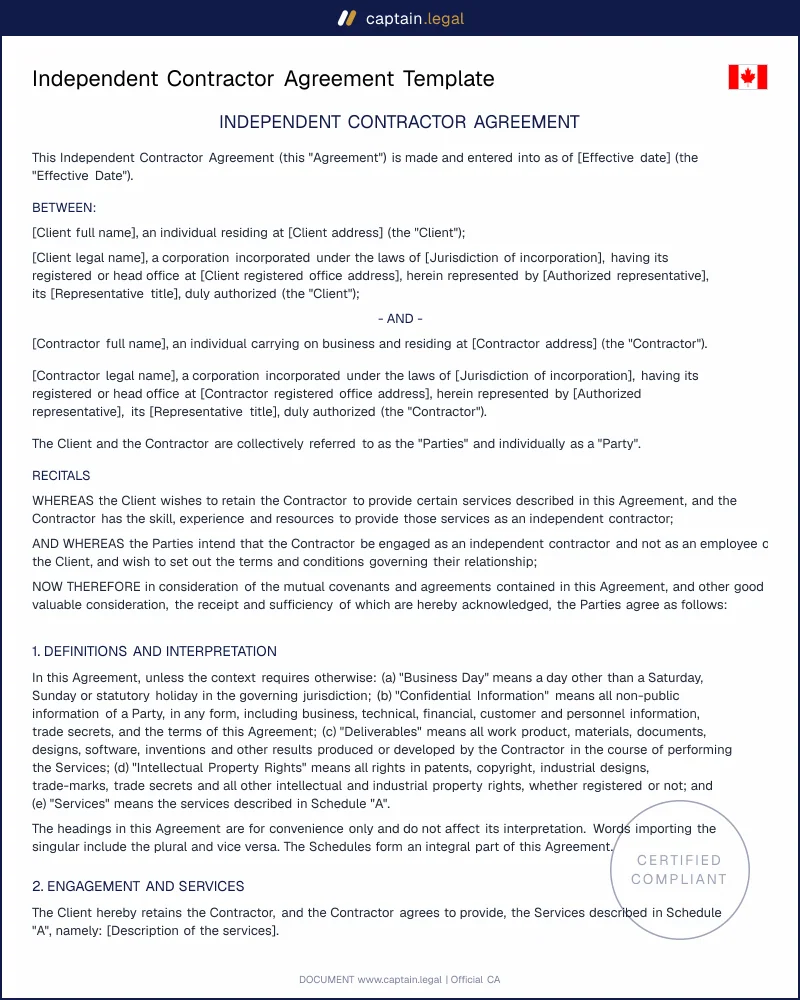
An independent contractor agreement is the contract a Canadian business signs with a self-employed worker to set out the scope of work, the fee, the deliverables, ownership of intellectual property, the worker's independent status, and how either side can end the engagement. It is the single document that separates a genuine contract for services from a disguised employment relationship, and that distinction drives everything that follows: who remits CPP and EI, who issues a T4A instead of a T4, and who carries the risk if the Canada Revenue Agency reclassifies the worker years later. Whether you are a startup hiring a developer, an agency retaining a freelance designer, or a consultant formalising your own terms, a properly drafted independent contractor agreement protects the relationship from the first invoice to the last.

This page explains how Canadian common law and the CRA treat contractor relationships, the clauses that actually hold up, and the provincial wrinkles that catch businesses out. The aim is a contract a Canadian law firm would recognise as its own work.

Compliant

2026 Legislation

50,000+ clients

trust us

Affordable

From $4.90 / doc

Secure payment

Instant download

Independent Contractor Agreement Canada | CRA Compliant

Secure payment · No subscription

Fill in the template

What is an independent contractor agreement?

An independent contractor agreement is a written contract for services between a payer and a self-employed worker who runs their own business. It contrasts directly with a contract of service, which is the legal name for an employment relationship. The difference is not cosmetic. A contractor invoices for results, controls how the work gets done, supplies their own tools, takes on profit and loss, and is free to work for other clients. An employee is integrated into the payer's organisation, follows direction on how and when to work, and receives statutory protections such as vacation pay, overtime and termination notice.

People often confuse this document with a few neighbours. A consulting agreement is simply an independent contractor agreement aimed at advisory or professional services rather than physical deliverables. A statement of work is usually a schedule attached to the master agreement that itemises one specific project. And a non-disclosure agreement is a narrower instrument that protects confidential information but says nothing about fees, status or IP. The independent contractor agreement is the umbrella that should sit above all of them. Labelling someone a "contractor" in the title does nothing on its own: Canadian courts and the CRA look at the substance of the relationship, not the heading on the page.

2

When do you need this document?

The most common trigger is hiring any worker you do not intend to put on payroll. A growing company that brings on a freelance developer, a marketing agency that retains a copywriter, or a manufacturer that engages a maintenance specialist all need the relationship documented before the first piece of work is delivered. The contract is what proves, later, that both sides genuinely intended a contract for services.

Project-based engagements are the next big category. When you commission a logo, a software build, a website or a research report, the agreement fixes the scope, the milestones and the acceptance criteria, and it is the only place where copyright in the finished work can be assigned to you. A handshake leaves the contractor owning the deliverable you paid for. The document also matters when you bring back a former employee as a consultant, a situation the CRA scrutinises closely because the facts often still look like employment.

Two edge cases deserve attention. The first is the dependent contractor, a worker who is technically self-employed but economically reliant on a single client. Canadian courts have created this intermediate category, and a dependent contractor is owed reasonable notice of termination even though they are not an employee. A well-drafted agreement with a clear term and termination clause is your best defence against an unexpected notice claim. The second is the contractor who subcontracts the work or uses their own team, which strengthens the independent characterisation and should be expressly permitted. If you also engage employees, compare the terms against a standard Canadian employment contract so the two documents do not blur the line you are trying to draw.

3

Key clauses included in our template

  • The scope of work and deliverables clause defines exactly what the contractor will produce, the milestones, and the acceptance standard. Vague scope is the leading source of fee disputes, so the template ties payment to defined outputs rather than to hours of presence, which also reinforces the independent characterisation.
  • The fees and payment terms clause sets the rate, the invoicing schedule, and who bears expenses. It records that the contractor is responsible for their own GST/HST registration and income tax, and that no source deductions for CPP or EI will be made, language that supports the contract for services analysis if the CRA ever asks.
  • The independent status clause states plainly that the worker is not an employee, controls their own method and hours, may work for others, and supplies their own tools. This is the clause that speaks directly to the Wiebe Door factors, though it works only if the actual conduct matches the words.
  • The intellectual property assignment clause is critical under Canadian law. Because section 13(1) of the Copyright Act makes the contractor the first owner, the template includes an express written assignment of all IP to the client and a waiver of moral rights, since moral rights cannot be assigned and otherwise stay with the author.
  • The confidentiality and non-solicitation clause protects your trade secrets and client relationships, scoped to a legitimate business interest so it survives the common-law presumption against restraint of trade.
  • The term and termination clause sets a defined end date or project completion point and the notice each side must give, which limits exposure to a dependent-contractor reasonable-notice claim.
4

Regional considerations

Ontario is the province where contractor agreements demand the most care. Under the Working for Workers Act, 2021, Ontario prohibits most non-compete clauses in employment, and although that ban targets employees, a misclassified contractor could invoke it, so a non-compete against a contractor should be drafted narrowly and paired with a strong non-solicitation clause instead. Ontario's Employment Standards Act, 2000 also expressly captures misclassification, and the Ministry can investigate workers labelled as contractors who are functioning as employees.

British Columbia applies its own Employment Standards Act, and the BC courts have been active in developing the dependent contractor doctrine. A contractor in BC who works almost exclusively for one client over a long period is a prime candidate for a reasonable-notice claim, so the term and termination language matters even more here.

Alberta tends to give greater weight to the parties' written intention than some other provinces, which makes a carefully drafted independent status clause genuinely useful, though never decisive on its own. Alberta's Employment Standards Code still governs anyone found to be an employee in substance.

Quebec is the outlier. Worker status there is decided under the Civil Code of Québec rather than the common-law Wiebe Door test, and the Act respecting labour standards uses its own concept of who counts as a salaried employee. A contract drafted for the common-law provinces should be reviewed before use in Quebec, and the language of the agreement may need to be in French to comply with the Charter of the French Language. For the corporate side of engaging contractors through a company, our Canadian business and corporate templates cover the related incorporation and shareholder documents.

5

How to fill out this independent contractor agreement

You start by identifying the two parties, naming the contractor's legal business name or sole proprietorship and the engaging company exactly as it is registered. From there the form asks you to describe the scope of work and the deliverables in concrete terms, because the more specific the output, the stronger the contractor characterisation and the cleaner any future dispute. You then set the fee structure, choosing between a fixed project price, an hourly or daily rate, or milestone payments, and you confirm that the contractor handles their own tax and GST/HST.

Next you address intellectual property, deciding whether all work product is assigned to your business with a moral rights waiver, or whether the contractor retains certain background materials and grants you a licence. The form then guides you through confidentiality, non-solicitation and the term, where you fix either a completion date or a fixed period and the notice required to end early. Throughout, plain-language prompts explain the Wiebe Door implications of each choice so you draft a relationship that holds up. Once complete, you download the agreement in Word and PDF, ready to sign. If you also need a separate confidentiality instrument, browse the full catalogue of Canadian legal templates.

6

Common mistakes to avoid

The mistake that costs the most is treating the contract as decoration while running the relationship like employment. Setting the contractor's hours, giving them a company email and a desk, forbidding other clients, and supplying all their equipment will override even the most carefully worded independent status clause, because the CRA and the courts look at conduct over labels. Businesses also routinely forget that paying for work does not buy the copyright. Without an express written assignment, section 13(1) of the Copyright Act leaves the contractor owning the logo, the code or the report you commissioned, and an oral promise will not transfer it.

A third error is ignoring the dependent contractor risk. A long-term contractor who relies on your business for most of their income can claim reasonable notice on termination, and a contract with no defined term or notice provision hands them the argument. Many businesses also draft restrictive covenants far too broadly, which invites a court to strike them out entirely under the presumption against restraint of trade, and in Ontario a non-compete may be void outright. Finally, sloppy invoicing undermines everything: a contractor who is paid a fixed salary every two weeks with no invoice looks exactly like an employee. For documents touching personal property and estates rather than business engagements, see our personal and family legal templates.

Key takeaways

CRA status

The relationship, not the label, decides

Calling someone a contractor in the heading does not make it true. In common law provinces, the CRA and courts apply the Wiebe Door multi-factor test and look past the paperwork to the day-to-day facts: control, tools, chance of profit and risk of loss, and integration into your business. If the reality looks like employment, the contract can be disregarded.

Tax & filings

Classification drives CPP, EI and slips

Status determines who carries payroll and reporting obligations. A genuine contractor generally handles their own income tax, may need to register and charge GST/HST once they pass the small-supplier threshold, and manages their Canada Pension Plan contributions as self-employed. On the payer side, documentation and reporting differ too, including issuing a T4A rather than a T4 when the person is truly a contractor.

IP ownership

Put IP assignment in writing

Do not assume you automatically own what a contractor creates. The agreement should spell out who owns the deliverables and how intellectual property is assigned, because contractor work is not treated the same way as employee-created work. Tying ownership to clear deliverables and payment milestones reduces disputes later, especially when a developer or designer is producing copyrightable materials.

Frequently Asked Questions

Yes. Once both parties sign, it is a binding contract for services enforceable under Canadian common law in every province outside Quebec, where the Civil Code of Québec governs instead. What it cannot do is override the substance of the relationship. If you call someone a contractor but treat them as an employee, the CRA and the courts will apply the Wiebe Door factors and reclassify them, regardless of what the contract says. The agreement is strong evidence of the parties' intention, which is the first step of the legal test, but the actual working conditions decide the outcome. A binding contract that matches reality is exactly what protects you.

By default, the contractor does. Under section 13(1) of the federal Copyright Act, the author of a work is the first owner of copyright, and unlike the United States, Canada has no work-for-hire doctrine that automatically transfers ownership to the paying client. Hiring and paying a contractor gives you only an implied licence to use the deliverable, not the right to own, modify or resell it. To own the work outright, the agreement must contain an express written assignment of copyright signed by the contractor, plus a waiver of moral rights, since moral rights cannot be assigned and otherwise remain with the creator. Our template includes both.

An independent contractor runs their own business and serves multiple clients. A dependent contractor is technically self-employed but economically reliant on a single client for most or all of their income, often over a long period. Canadian courts recognise this intermediate category, and the key consequence is termination: a dependent contractor is entitled to reasonable notice of termination even though they receive none of the other statutory employment protections. The practical defence is a written agreement with a defined term and a clear notice clause, so the parties' expectations are documented before any dispute arises. Without it, a long-serving contractor can claim months of notice.

You can, but tread carefully. Canadian law presumes a restraint of trade is void and enforces it only where it is reasonable in scope, duration and geography and protects a legitimate business interest. In Ontario, the Working for Workers Act, 2021 bans most non-compete clauses for employees, and a misclassified contractor could try to rely on that. The safer and more enforceable approach for most engagements is a well-drafted non-solicitation clause that stops the contractor from poaching your clients and staff, combined with confidentiality protection. The template scopes these covenants to survive judicial scrutiny rather than gamble on an overbroad non-compete.

The independent contractor agreement is available in both Word and PDF. The Word version lets you make final edits, adjust the scope schedule, or add a project-specific statement of work before signing, while the PDF is ready to print and execute as is. Both versions are generated from the same guided form, so the clauses stay consistent whichever format you choose. You can complete and download the document in a few minutes without a lawyer drafting it from scratch, then have both parties sign electronically or by hand depending on your preference.

It depends on the contract and on whether the worker is a genuine independent contractor or a dependent one. A true independent contractor can be terminated according to the notice clause in the agreement, which is exactly why fixing that clause matters. A dependent contractor, by contrast, is owed reasonable notice at common law, which the courts calculate from the length of the relationship, the degree of exclusivity and the difficulty of replacing the income, and it can run to several months. Drafting a defined term and a clear termination provision is the single most effective way to control this exposure rather than leave it to a judge.

No, provided the worker is a genuine independent contractor. A true contractor handles their own income tax, pays both portions of Canada Pension Plan contributions through self-employment, and is not covered by Employment Insurance. You issue a T4A rather than a T4 and make no source deductions. The catch is misclassification: if the CRA later decides the worker was really an employee, it can assess your business for years of unremitted CPP and EI plus penalties and interest. Either party can ask the CRA for a binding ruling on status if there is genuine doubt, which is worth doing before a long or high-value engagement.

4.7/5

22 verified reviews · 50 000+ downloads

Independent Contractor Agreement Canada | CRA Compliant
  • Immediate access to the document
  • PDF + Word download
  • Compliant with 2026 legislation
  • Reviewed by lawyers
Fill in the template
Secure payment · No subscription
Updated on June 19, 2026

You might also like

Non-Disclosure Agreement Canada
Employment Agreement Template Canada