Create my document
Login

Choose country

CanadaCanadaChoose country
Family & Divorce

Postnuptial Agreement Canada | Family Law Act s.52

Postnuptial agreement template meeting Family Law Act s.55(1) requirements: written, signed, witnessed. Full disclosure structure for enforceability.
4.8/525 reviews50 000+ downloadsInstant download
Share

A postnuptial agreement is a domestic contract signed by spouses after they are already married, setting out how property, debts, and spousal support will be handled if the relationship ends. It does the same job as a prenuptial agreement, only the timing is different: the wedding has already happened and circumstances have shifted, maybe a business took off, an inheritance landed, one spouse left the workforce, or an earlier prenup no longer reflects reality. Across Canada's common-law provinces these documents are formally called marriage contracts when signed by married couples, and they are governed by provincial family legislation rather than a single federal statute. Used properly, a postnup replaces the default property-sharing rules the law would otherwise impose, and it gives both partners a clear, written record of what they agreed while things were still calm.

Most couples reach for one when something material changes mid-marriage and the existing arrangement stops making sense. The value is predictability: instead of leaving asset division to a judge applying statutory defaults years from now, you decide the terms yourselves while you can still talk.

Compliant

2026 Legislation

50,000+ clients

trust us

Affordable

From $4.90 / doc

Secure payment

Instant download

Postnuptial Agreement Canada | Family Law Act s.52

Secure payment · No subscription

Fill in the template

What is a postnuptial agreement in Canada?

A postnuptial agreement is a private contract between married spouses that defines their financial rights and obligations during the marriage and on separation, divorce, annulment, or death. In every Canadian common-law province it falls under the broader statutory category of the domestic contract, the same family of agreements that includes cohabitation agreements and separation agreements. The defining feature is timing. A prenuptial agreement (a marriage contract signed before the wedding) and a postnuptial agreement are functionally identical in content; the postnup is simply executed once the couple is already legally married.

That timing distinction carries real legal weight, which is the point most people miss. Before marriage, spouses owe each other no special statutory obligations. The moment they marry, both acquire automatic rights to property division and spousal support under provincial law. A postnup almost always involves one spouse agreeing to give up some of those vested rights, so courts scrutinize postnuptial agreements more closely than prenups even when the wording is word-for-word the same. A postnuptial agreement is also the standard fix when a couple wants to amend or replace an earlier prenup that no longer matches their intentions, or when a prenup was signed under time pressure too close to the wedding and the parties want a cleaner, pressure-free version. It is not a separation agreement: a postnup is signed by a couple who intend to stay together, whereas a separation agreement documents the terms of a couple who have already decided to part.

2

When do you need this agreement?

The most common trigger is a significant change in financial circumstances after the wedding. A spouse launches or sells a business, receives a large inheritance, or comes into property, and the couple wants to define how that asset will be treated rather than letting the provincial equalization regime decide by default. A postnup signed early, while the relationship is stable and neither party feels cornered, is far more likely to survive a later challenge than one negotiated in the middle of a crisis. The earlier in the marriage it is signed, the more weight it tends to carry.

A second scenario is repairing or replacing an earlier agreement. Many couples sign a prenup in the rushed weeks before a wedding, sometimes close enough to the date that a court could later question whether real consent existed. A postnuptial agreement lets them redo the deal properly, with time, disclosure, and independent advice, so the terms reflect genuine agreement instead of last-minute pressure. It is also the right tool when an existing prenup has simply gone stale because the couple's assets, careers, or family structure no longer resemble what they were on the wedding day.

Blended families and second marriages are another frequent driver. A spouse who wants to preserve an asset or an anticipated inheritance for children from a previous relationship uses a postnup to ring-fence those interests. Couples building a shareholder or business ownership structure often pair it with a marriage contract so the company is shielded from a future equalization claim. One edge case worth flagging: a cohabitation agreement signed before marriage automatically converts into a marriage contract once the couple weds, unless it says otherwise, so partners moving from common-law to married status should review whether their existing family and divorce paperwork still does what they intended.

3

Key clauses included in our template

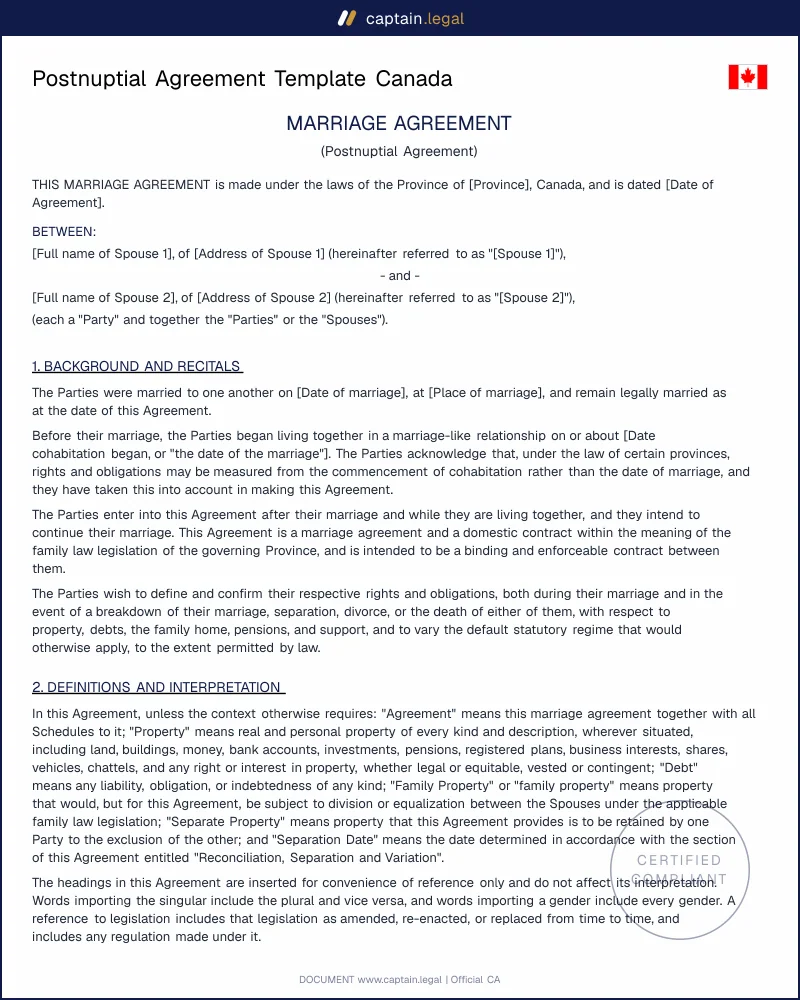
  • The identification of the parties and recital of marriage confirms both spouses by full legal name, states the date and place of marriage, and records that the agreement is a marriage contract under the relevant provincial statute. This framing matters because the document's enforceability depends on it being recognized as a domestic contract, not a loose memorandum.
  • The full financial disclosure schedule is the backbone of any enforceable postnup. Each spouse lists assets, debts, income, and significant financial interests, attached as schedules both parties acknowledge reviewing. Because section 56(4) lets a court set aside an agreement where disclosure was incomplete, this clause is what protects the deal years down the line.
  • The property division terms define what counts as separate property, how jointly acquired assets are treated, and how the value of the home is shared on separation, while respecting that matrimonial home possession rights cannot be limited under section 52(2).
  • The spousal support provision records whether support is preserved, structured, limited, or addressed at all, with the understanding that courts retain discretion under the Divorce Act to revisit support despite the contract.
  • The independent legal advice acknowledgment documents that each spouse had the chance to consult separate counsel, the factor courts weigh most heavily when deciding whether consent was genuine and the agreement fair.
  • The execution and witnessing block is built to satisfy section 55(1): signatures of both spouses plus a witness who also signs, the formality without which the entire agreement is void.
4

Regional considerations

Ontario treats the postnup as a marriage contract under section 52 of the Family Law Act and applies an equalization of net family property system. The formal rule in section 55(1) is non-negotiable: in writing, signed, and witnessed, or it is unenforceable. Ontario courts have repeatedly voided agreements over a missing witness signature alone, and section 52(2) blocks any clause that tries to limit a spouse's rights to the matrimonial home. Independent legal advice is not strictly mandatory, but agreements limiting property or home rights are realistically unenforceable without it.

British Columbia governs postnuptial agreements through section 93 of its Family Law Act, which gives courts a structured test for setting aside agreements that were procured through non-disclosure, exploitation of a vulnerability, or a failure to understand the terms. BC's regime distinguishes family property from excluded property, and a postnup is the usual instrument for keeping pre-marriage assets or inheritances on the excluded side of the ledger.

Alberta applies the Family Property Act to married spouses and, in many cases, to adult interdependent partners. A postnup there must be in writing and signed, and Alberta places real importance on each party having received independent legal advice before signing, often documented by a lawyer's certificate, before the agreement will be treated as binding.

Nova Scotia recognizes marriage contracts under the Matrimonial Property Act, with the familiar requirements of writing, signatures, and disclosure. Quebec stands apart entirely: it operates under civil law, calls the document a contrat de mariage, and requires notarization under the Civil Code of Québec, so a common-law-style postnup signed privately will not carry the same effect there. Couples should always confirm which provincial statute applies to them before relying on any marriage contract or prenup template as their final word.

5

How to fill out this postnuptial agreement

You start by confirming the province where you live, because that single choice determines which statute, formalities, and property regime apply to your agreement. From there you enter both spouses' full legal names and the details of your marriage, then move into the financial disclosure stage, where each of you sets out assets, debts, income, and any business or property interests. This part feels tedious, but it is the section that keeps the agreement standing if it is ever challenged, so honesty and completeness here are worth more than careful wording anywhere else.

Next you define how property and the value of the home are divided, and whether spousal support is preserved, structured, or addressed separately. The document prompts you toward the terms courts expect to see and steers you away from clauses that are simply unenforceable, like anything purporting to limit matrimonial home possession. Once the terms are set, you download the agreement in Word and PDF, then complete the execution properly: both spouses sign in front of a witness who also signs. Before signing, each of you should take the chance to get personal and family legal documents reviewed by independent counsel, which is the step courts look for when judging whether the agreement was entered freely.

6

Common mistakes to avoid

The mistake that sinks more postnups than any other is incomplete financial disclosure. A spouse who hides a business interest, understates debts, or glosses over an asset hands the other side a ready-made argument to set the whole agreement aside under section 56(4), sometimes years later when memories and documents are gone. Closely related is skipping independent legal advice. It is rarely a strict legal requirement, but a court reading an agreement where one spouse gave up substantial rights with no separate lawyer will read that as a red flag for pressure or misunderstanding, and a one-sided deal signed without advice routinely collapses. Couples also underestimate the formalities, treating signatures as a formality when the absence of a witness signature under section 55(1) renders the document legally void no matter how fair its terms.

People also try to contract over things the law will not allow. Clauses purporting to limit a spouse's possession of the matrimonial home are dead on arrival under section 52(2), and any attempt to waive or pre-fix child support fails because that right belongs to the child, not the parents. The last common error is timing and tone: signing under pressure, presenting the agreement as an ultimatum, or rushing it without giving the other spouse time to think invites a later argument that consent was never genuine. Treat the process as a negotiation between equals, document every step, and keep the signed original somewhere safe alongside your other Canadian legal documents.

Key takeaways

Purpose

A postnup sets rules before conflict

A postnuptial agreement (often called a marriage contract) is signed after you are already married and sets out how property, debts, and spousal support will be handled if the relationship ends. It is commonly used when circumstances change mid-marriage, such as a business growing, an inheritance, or one spouse leaving the workforce. The goal is predictability instead of relying on statutory default outcomes later.

Scrutiny

Courts review postnups more closely

Timing matters. Once you are married, provincial family law can give each spouse automatic rights to property division and spousal support. A postnup often has one spouse giving up some of those vested rights, which is why courts tend to scrutinize postnuptial agreements more than prenups even if the clauses look identical. A postnup is also a common way to replace or clean up an earlier prenup.

Formalities

If not witnessed, it can fail

The signing rules are strict. Under Ontario's Family Law Act, section 55(1), a domestic contract is unenforceable unless it is in writing, signed by both spouses, and properly witnessed, with the witness signing too. That means informal emails, verbal promises, or a document signed without a witness can leave you back under the default provincial property-sharing regime you were trying to avoid.

Frequently Asked Questions

Yes, provided it meets the formal and substantive requirements of your province. In Ontario, section 55(1) of the Family Law Act requires the agreement to be in writing, signed by both parties, and witnessed; an oral or unwitnessed postnup is unenforceable. Beyond the formalities, courts will only uphold an agreement entered into voluntarily, with full financial disclosure and genuine understanding of its consequences. The Supreme Court's decision in Miglin v. Miglin confirmed that properly drafted, fairly negotiated agreements are routinely enforced as written, while a court may set one aside under section 56(4) for non-disclosure, lack of understanding, or unconscionability.

The only real difference is timing. A prenuptial agreement, called a marriage contract in common-law provinces, is signed before the wedding; a postnuptial agreement is signed after the couple is already married. The content can be word-for-word identical. The legal consequence differs, though, because once spouses marry they acquire automatic rights to property and support, and a postnup usually involves giving some of those rights up. For that reason courts apply closer scrutiny to a postnup than to a prenup with the same wording, which makes full disclosure and independent advice even more important when signing after the wedding.

It can address spousal support, but a waiver is never guaranteed to hold. Once married, both spouses have rights and obligations regarding support under provincial law, and the Divorce Act gives courts broad discretion to order support despite a valid contract. A court is more likely to respect a support term where there was full disclosure, independent legal advice, and a result that is not unconscionable when the marriage ends. A blanket "support waived forever" clause signed without advice or disclosure is among the most fragile provisions you can write and is frequently overridden.

No. Courts across Canada retain jurisdiction over both. Child support is the child's right, not the parents', so it cannot be waived or pre-set in a way that binds a court, which applies the Federal Child Support Guidelines at the time of separation. Custody and parenting arrangements are decided on the child's best interests when the relationship actually ends, not by a contract signed years earlier. A postnup is the right instrument for property and spousal financial matters between the adults; parenting issues belong in a separate parenting plan or are left to the court.

The postnuptial agreement is provided in both Word and PDF formats. The Word version lets you edit names, financial schedules, property terms, and support provisions to match your circumstances and your province, while the PDF gives you a clean, print-ready copy for signing. Because section 55(1) requires a witnessed signature, you will print the final version and sign it in front of a witness who signs as well. Keeping the editable Word file means you can update the agreement later if your finances change, which is a common reason couples sign a postnup in the first place.

The drafting itself is quick once you have your financial information ready; completing the template typically takes well under an hour. The honest answer is that the disclosure and review stages are what take time and matter most. Each spouse should gather a complete picture of assets, debts, and income, and ideally each should have the agreement reviewed by independent counsel before signing. Rushing the process, or presenting it as a take-it-or-leave-it demand, undermines enforceability, so giving the other spouse genuine time to read, question, and seek advice is part of making the document hold up.

Independent legal advice is not strictly mandatory in most common-law provinces, but it is strongly recommended and sometimes practically essential. Where one spouse is giving up significant property or support rights, an agreement signed without separate advice is far more likely to be challenged and set aside, because a court may infer the party did not fully understand what they were surrendering. In Alberta, advice is often documented by a lawyer's certificate. Even where the law does not require it, getting each spouse's own review is the cheapest insurance available against the agreement falling apart when it is needed most.

4.8/5

25 verified reviews · 50 000+ downloads

Postnuptial Agreement Canada | Family Law Act s.52
  • Immediate access to the document
  • PDF + Word download
  • Compliant with 2026 legislation
  • Reviewed by lawyers
Fill in the template
Secure payment · No subscription
Updated on June 19, 2026

You might also like

Marriage Contract Template Canada
Spousal Support Agreement Template Canada