Create my document
Login

Choose country

CanadaCanadaChoose country
Personal & Family

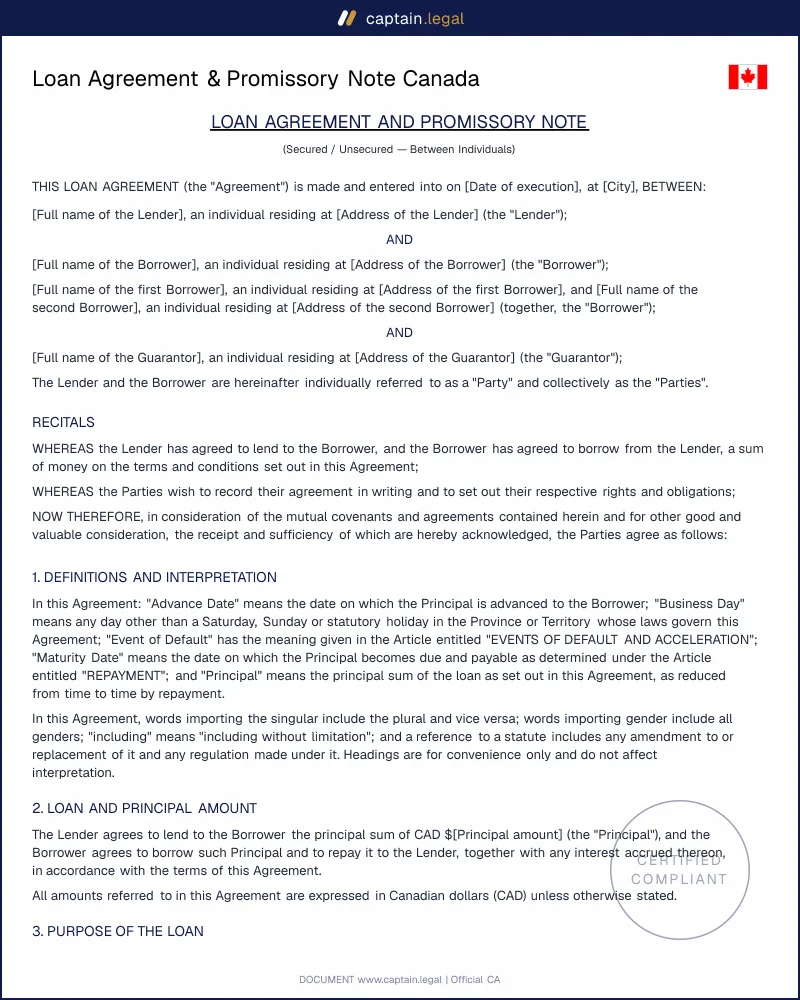
Loan Agreement & Promissory Note Canada | s.176 BEA

Loan agreement and promissory note built on the Bills of Exchange Act s.176, Interest Act s.4 and Criminal Code s.347. Download in Word and PDF.
4.8/516 reviews50 000+ downloadsInstant download
Share

A loan agreement or promissory note is the written record that turns a private loan between two people into a debt a court will recognise and enforce. It sets out who lent the money, how much, what interest applies, when repayment is due, and what happens on default. Canadians lend to family, friends and business partners every day, often on a handshake, and the handshake is exactly what fails when memory or goodwill runs out. A signed instrument fixes the terms before anyone disagrees about them, creates a paper trail the Canada Revenue Agency can accept, and gives the lender a clear claim if the borrower stops paying. This template is built for the common-law provinces and works for both interest-bearing and interest-free loans.

Compliant

2026 Legislation

50,000+ clients

trust us

Affordable

From $4.90 / doc

Secure payment

Instant download

Loan Agreement & Promissory Note Canada | s.176 BEA

Secure payment · No subscription

Fill in the template

What is a loan agreement or promissory note?

The two documents do the same basic job, recording a debt, but they are not interchangeable. A promissory note is a negotiable instrument: an unconditional promise in writing made by one person to another, signed by the maker, engaging to pay a sum certain in money on demand or at a fixed or determinable future time. That definition comes straight from section 176 of the Bills of Exchange Act, and the wording matters. A note is short, it stands on its own, and it can in principle be transferred to a third party who can then enforce it. It suits smaller, simpler loans between people who trust each other but still want a record.

A loan agreement is a fuller contract. It covers the same core promise to repay but adds the surrounding terms a longer or larger arrangement needs: representations, security, events of default, governing law, what counts as a breach and how disputes get resolved. Lenders reach for an agreement when the sum is significant, when the loan is secured against property, or when the repayment structure is complex. In everyday practice the choice is one of scale. A parent advancing a few thousand dollars to a child for a car deposit wants a note; two business partners formalising a six-figure advance want an agreement. Our template gives you both registers in one guided form so you pick the depth the situation actually calls for.

2

When do you need this document?

The classic case is the family loan that everyone treats as informal until it stops being friendly. A parent helps with a down payment, a sibling covers a tax bill, a friend floats a few months of rent, and the money is advanced with nothing written down. Months later the borrower remembers a gift and the lender remembers a loan, and there is no instrument to settle which it was. A signed note ends that argument before it starts, and it also signals to the CRA that the transfer was a loan rather than a disguised gift or undeclared income, which matters when either side is audited.

The second common trigger is a loan tied to an asset or a relationship that the parties want to protect. Money advanced between unmarried partners pooling funds for a home is far cleaner when it sits alongside a cohabitation agreement for Canadian couples, so the loan is not later recharacterised as a contribution to shared property. Capital injected into a venture belongs in writing for the same reason, often beside a partnership agreement built for Canadian businesses that records each partner's stake. A loan funding a real estate purchase should be documented before closing, not after, and lenders often pair it with the agreement of purchase and sale used in Canadian property deals. One edge case worth flagging: a loan repayable purely "when the borrower can afford it" risks being treated as too uncertain to enforce, so even an indulgent lender should fix a demand mechanism or a longstop date.

3

Key clauses included in our template

  • The identification of the parties and the principal names the lender (payee) and borrower (maker) in full and states the exact amount advanced as a sum certain in money, which the Bills of Exchange Act requires for the instrument to be valid. The clause separates the principal from any fees so there is no later argument about what was actually borrowed.
  • The interest clause states the rate as an annual percentage, which is what keeps the note clear of the five percent default penalty under section 4 of the Interest Act. It lets you choose simple or compound interest, set the compounding frequency, and confirm that the total cost including penalties stays below the section 347 criminal ceiling. An interest-free loan is recorded as such in plain words rather than left silent.
  • The repayment schedule defines whether the loan is payable on demand, in a single lump sum at a fixed maturity date, or by instalments, and it sets the dates and amounts precisely. Vague timing is the single most litigated feature of private loans, so the template forces a definite structure.
  • The acceleration and default clause lets the lender call the entire balance due on a missed instalment or other defined breach. Canadian courts have upheld optional acceleration on default as consistent with the "sum certain" requirement, so a properly drafted clause gives the lender real leverage without invalidating the note.
  • The late payment and security provisions record any penalty for missed payments and, where the loan is secured, identify the collateral. The Act expressly allows a note to carry a pledge of collateral with a power of sale without losing its character as a note.
  • The governing law and signature block fixes the province whose law applies and provides for dated signatures, with space for a witness. An undated or unsigned note is the easiest kind to challenge, so execution is treated as a formal step rather than an afterthought.
4

Regional considerations

Although the Bills of Exchange Act, the Interest Act and the Criminal Code are federal and apply uniformly across the country, the province you choose as governing law shapes how the debt is collected and how long you have to act. Ontario loans are enforced through the Superior Court of Justice or, for smaller amounts, the Small Claims Court, whose monetary ceiling makes it the practical venue for most family loans. The province's Limitations Act, 2002 sets a basic two-year window, and the clock generally runs from the day the loan was discoverable as due, which for a demand note means the date demand is made.

British Columbia applies its own Limitation Act with a comparable two-year basic period, and its courts have developed a careful body of law on when a loan is a loan rather than a gift, so the written instrument carries real weight in BC family disputes. Alberta runs on the Limitations Act as well, again with a two-year limitation measured from discoverability, and the Court of King's Bench and Provincial Court handle enforcement by amount.

A point that catches lenders across every common-law province is that a part payment or a written acknowledgement of the debt by the borrower can reset the limitation clock, giving the lender a fresh period to sue. Conversely, a lender who sits on a demand note for years without demanding may find the claim is statute-barred. The two-year limitation is the deadline that quietly destroys more private loans than any default ever does, so a lender should diarise it. Quebec is deliberately outside the scope of this template, since its Civil Code regime treats loans and prescription periods differently from the common-law provinces.

5

How to fill out this loan agreement or promissory note

You start by choosing whether you need a concise promissory note or a fuller loan agreement, and the form adjusts the depth of the clauses accordingly. From there you enter the lender and borrower details and the exact principal advanced, then you tell the form whether the loan carries interest. If it does, you state the rate as an annual percentage and pick simple or compound interest, and the template reminds you to keep the all-in cost under the criminal rate. Next you set the repayment structure, on demand, a single maturity date, or scheduled instalments, with the dates and amounts you have agreed.

The form then lets you add an acceleration clause, a late payment penalty and, if the loan is secured, a description of the collateral. You select the province whose law will govern, which is usually where the borrower lives or where the asset sits. Finally you generate the document as Word or PDF, review every figure once more, and have both parties sign and date it, ideally before a witness. Keep the signed original safe, because the original instrument, not a photocopy, is what a court expects to see. If you need a different document partway through, you can browse the full catalogue of Canadian legal templates without losing your work.

6

Common mistakes to avoid

The error that surfaces most in litigation is expressing interest on a monthly or per-period basis without stating the annual equivalent. Lenders write "two percent a month" thinking they have agreed twenty-four percent, and discover that section 4 of the Interest Act has quietly capped them at five percent for their trouble. Close behind it is leaving the loan repayable on impossibly vague terms, "whenever you can," which invites a court to find the obligation too uncertain to enforce and leaves the lender with a moral claim and no legal one. A third recurring failure is treating the document as optional between family members, then trying to reconstruct the terms from text messages once the relationship sours.

Lenders also routinely miss the two-year limitation, assuming a debt stays collectable indefinitely, and let an enforceable loan lapse into a statute-barred one. Others sign nothing more than a name with no date, no witness and no stated principal, producing an instrument so easy to dispute that it offers little protection. The cleanest practice is the opposite of all of these: a dated, signed, witnessed document that states an exact principal, expresses any interest as an annual rate, fixes a definite repayment trigger, and is kept as an original. For loans bound up with other arrangements, building the file out with the related agreements in the Canadian business document collection avoids gaps that surface later.

Key takeaways

Purpose

Put the loan in writing early

A private loan is easier to enforce when the terms are signed and written down: who the lender and borrower are, the amount, the interest (if any), the repayment date, and what counts as default. Handshake deals often fall apart when memories differ. A written instrument also creates a paper trail the Canada Revenue Agency can accept if questions come up later.

Instrument choice

Promissory note or full loan agreement

A promissory note is a negotiable instrument under section 176 of the Bills of Exchange Act: an unconditional, written, signed promise to pay a sum certain, on demand or at a fixed or determinable time. It is typically shorter and can, in principle, be transferred to someone else to enforce. A loan agreement is longer and adds surrounding terms like security and dispute handling for larger or more complex loans.

Interest rules

State annual interest and stay under limits

Two federal rules can quietly cap or jeopardize your interest. Under section 4 of the Interest Act, if you quote interest on a period shorter than a year (for example, a monthly rate) but do not also state the equivalent annual rate, the lender cannot recover more than five percent per year. Separately, Criminal Code section 347 makes it an offence to charge above the criminal rate, updated as of 1 January 2025 to a 35% APR ceiling.

Frequently Asked Questions

Yes. A promissory note that meets the requirements of section 176 of the Bills of Exchange Act, an unconditional written promise, signed by the borrower, for a sum certain payable on demand or at a fixed time, is a legally binding instrument enforceable in court. If the borrower defaults, the lender can sue on the note, and a clean instrument is generally easier to prove than a loose contract because the promise and the amount appear on its face. The same applies to a properly executed loan agreement. What undermines enforceability is not the format but missing essentials: no signature, no defined amount, or a promise made conditional on some uncertain event.

Both record a debt, but they differ in scale and complexity. A promissory note is a short negotiable instrument containing the borrower's bare promise to repay, suited to smaller or simpler loans between people who know each other. A loan agreement is a fuller contract that adds representations, security, default provisions, governing law and dispute resolution, and it suits larger sums, secured lending or complex repayment structures. The note can be transferred to a third party; the agreement is usually a private contract between the two original parties. Our template offers both, so you choose the depth the loan actually needs rather than over-documenting a modest advance or under-documenting a major one.

Since 1 January 2025, section 347 of the Criminal Code caps interest on most loans at an annual percentage rate of thirty-five percent, down from the previous sixty percent effective annual rate. The cap counts not just the headline rate but most fees, penalties and charges loaded onto the borrower, so the all-in cost is what must stay below the line. Separately, the Interest Act requires that any rate be stated as an annual percentage; if you express it monthly or weekly without the yearly equivalent, you are limited to five percent regardless of what you intended. Charging above the criminal rate is an offence, not merely an unenforceable term.

In the common-law provinces a lender generally has two years to start a claim, measured from the date the debt was discoverable as due. For a loan with a fixed maturity date the clock runs from that date; for a demand note it usually runs from the date you demand repayment. A part payment or a written acknowledgement of the debt by the borrower can reset that clock and give you a fresh two-year window. A lender who waits too long can find an otherwise valid loan has become statute-barred, so note the deadline when you sign and act before it passes rather than relying on the borrower's goodwill.

Yes. The template generates in both Word and PDF so you can use whichever suits you. The Word version is convenient if you want to make small edits before signing, while the PDF is the clean, fixed format most people print for signature. Whichever you choose, the document is ready to sign and witness without further drafting. Keep the signed original in a safe place, because when a note is enforced a court generally expects the original signed instrument rather than a copy, and the lender holding the original is in the strongest position to prove the debt.

A promissory note or loan agreement does not strictly require a witness or a notary to be valid in the common-law provinces; the borrower's signature is the essential element. That said, having an independent witness sign and date the document is a sensible precaution, because it makes the borrower's signature far harder to dispute later and costs nothing. Notarisation is rarely required for an ordinary private loan, though it adds an extra layer of proof for a large or secured advance. The practical priority is a clear, dated signature by the borrower, an exact stated principal and an annual interest rate, since those are the features a court actually looks for.

Not retroactively in a way that binds the borrower without their consent. Interest is a term of the loan, so it has to be agreed between the parties and recorded in the instrument; you cannot unilaterally impose a rate after the money has changed hands. If the original loan was silent on interest and both sides now want to add it, the proper route is a written variation or a fresh note that both parties sign, stating the new rate as an annual percentage. Any rate you add still has to respect the Interest Act disclosure rule and stay under the Criminal Code ceiling. Recording the change in writing, alongside your other personal and family legal documents, keeps the loan file coherent.

4.8/5

16 verified reviews · 50 000+ downloads

Loan Agreement & Promissory Note Canada | s.176 BEA
  • Immediate access to the document
  • PDF + Word download
  • Compliant with 2026 legislation
  • Reviewed by lawyers
Fill in the template
Secure payment · No subscription
Updated on June 20, 2026

You might also like

Affidavit Template Canada
Last Wishes Letter Template