Create my document
Login

Choose country

CanadaCanadaChoose country
Personal & Family

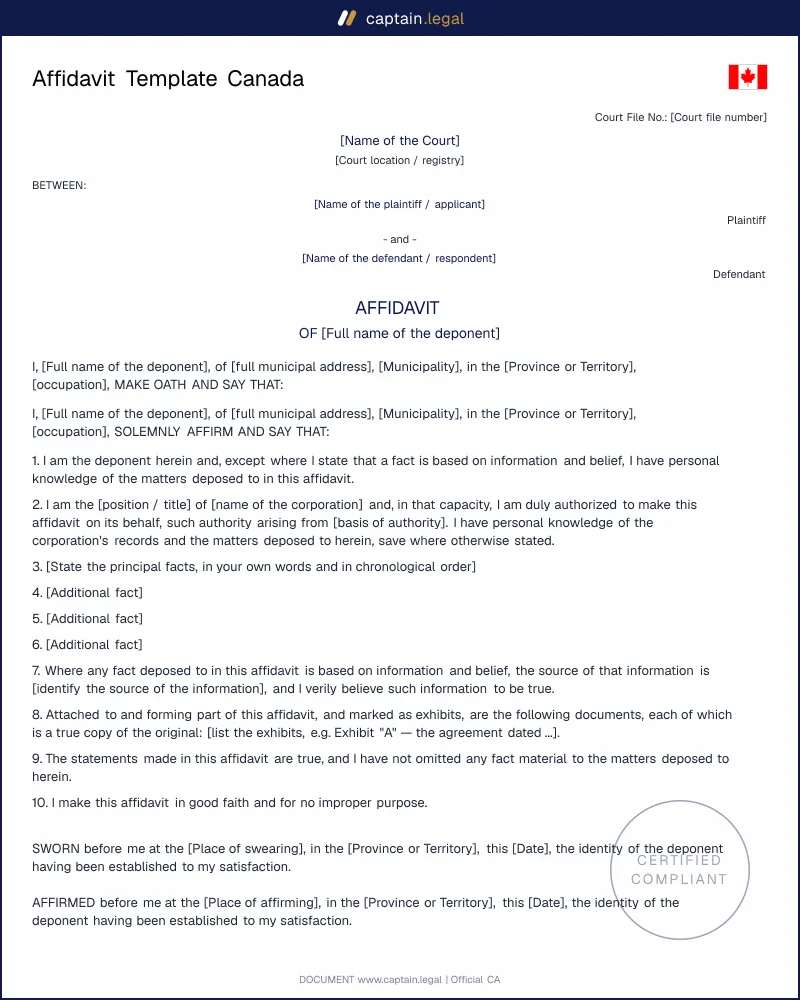
Affidavit Template Canada | Evidence Act Compliant

Affidavit drafted to section 41 Canada Evidence Act and provincial rules like Ontario Rule 4.06. Correct jurat, exhibits and execution. Word and PDF.
4.7/518 reviews50 000+ downloadsInstant download
Share

An affidavit is a written statement of facts that the person making it swears or affirms to be true before a notary public, a commissioner for taking affidavits, or a lawyer. It carries the same weight as testimony given in a courtroom, which is why courts, land registries, banks and immigration officers across Canada accept it as proof. People reach for an affidavit when they need to confirm their identity, account for a lost document, support a family law motion, or attest to a fact that no other paper can establish. The form looks plain, yet a missing jurat or an unsworn signature is enough to have it thrown out. This template is drafted for the common-law provinces and gives you a clean, court-ready structure you can complete, swear and file the same day.

Compliant

2026 Legislation

50,000+ clients

trust us

Affordable

From $4.90 / doc

Secure payment

Instant download

Affidavit Template Canada | Evidence Act Compliant

Secure payment · No subscription

Fill in the template

What is an affidavit?

An affidavit is a sworn or affirmed written statement of fact, made voluntarily by a person known as the deponent (sometimes called the affiant), and witnessed by an official authorised to administer oaths. The statement ends with a jurat, the clause recording where, when and before whom the oath was taken. That jurat is what separates an affidavit from an ordinary letter or a signed declaration: it converts your words into sworn evidence, and swearing a false affidavit exposes you to a perjury charge under the Criminal Code.

People often confuse an affidavit with a statutory declaration, and the distinction matters. Both are solemn statements of truth, but an affidavit is typically used inside or in support of a court proceeding, while a statutory declaration is used for administrative and non-litigious purposes, such as confirming a name or declaring a fact to a government office. The wording differs too. A declaration uses the formula set out in section 41 of the Canada Evidence Act, in which the declarant states that the facts are true and that the declaration has the same force as if made under oath. An affidavit, by contrast, is sworn or affirmed outright. Choosing the wrong instrument for the wrong purpose is one of the fastest ways to have a document rejected at the counter. When you need a flexible statement for an official body rather than a court, a statutory declaration template within the personal and family library is usually the better fit.

2

When do you need an affidavit?

The most common trigger is litigation support. When you bring or respond to a motion in civil or family court, your evidence usually goes in by affidavit rather than live testimony, so the affidavit becomes the vehicle that carries your facts to the judge. Family proceedings lean heavily on them: a parent swearing to a child's schedule, a spouse attesting to income, or a party confirming service of documents all rely on the sworn statement. If you are assembling a family law record, the affidavit frequently travels alongside the agreements found in the family and divorce documents collection.

A second recurring scenario is proof of a fact to a non-court body. Banks ask for an affidavit when an account holder dies and the estate is small, land registries require one to correct a title or prove identity, and insurers request a sworn statement of loss after a theft or fire. The third frequent use is the lost, destroyed or unavailable document, where you swear to the contents and circumstances of a paper that can no longer be produced, from a missing share certificate to a destroyed marriage record.

Two edge cases reward attention. The first is the affidavit of a corporation or partnership, which under provincial rules must be sworn by an officer, director, employee or member rather than by the entity itself, and the jurat should name that individual and their capacity. The second is the multi-deponent affidavit: where two people swear the same document, each ordinarily needs a separate jurat unless they swear before the same official at the same moment. Overlooking either point invites a rejection that a fresh swearing would have avoided.

3

Key clauses included in our template

  • The commencement and deponent identification opens the affidavit by naming you in full, stating your municipality and province of residence and your occupation, and identifying the proceeding or purpose. This is the block courts scan first, and an incomplete heading is a common reason a registry clerk hands the document back.
  • The statement of facts is the substance of the affidavit, organised into short numbered paragraphs that each contain a single fact within your personal knowledge. Where you rely on information from someone else, the clause prompts you to disclose the source and state your belief, the wording required to keep information-and-belief evidence from being struck.
  • The exhibit references allow you to attach supporting documents and mark each one as Exhibit "A", "B" and so on. The template tracks the marking language the commissioner must add, because an exhibit that is mentioned but not properly identified is treated as no evidence at all.
  • The jurat is the sworn or affirmed conclusion, recording the place, the date, the deponent's signature and the official's signature and title. The template carries both the "sworn" and "affirmed" wording so you select the one that matches how the oath was actually taken.
  • The interpreter and alteration provisions cover the practical realities the rules anticipate: a certification clause where the affidavit was interpreted for a deponent who does not read the language, and a reminder that any change to the text must be initialled by both the deponent and the official.
4

Regional considerations

Ontario governs affidavits through Rule 4.06 of the Rules of Civil Procedure, which insists that the statement stay within the deponent's personal knowledge and that exhibits be marked by the person taking the affidavit. The standard jurat follows the form set in the rules, and the Commissioners for Taking Affidavits Act makes every lawyer and paralegal a commissioner while authorising the Attorney General to appoint others. Ontario also permits remote commissioning under O. Reg. 431/20. The province's courts reject more affidavits over jurat defects, a wrong date, a missing place, an unsigned commissioner, than over the contents themselves, so the closing block deserves your closest attention.

British Columbia relies on its Evidence Act, RSBC 1996, c. 124, under which section 60 deems lawyers, registrars and a list of officials to be commissioners by virtue of office, while section 56 lets the Attorney General appoint others. The Interpretation Act treats an oath as including an affirmation, so a deponent with a conscientious objection to swearing may affirm with identical effect. Affidavits sworn outside the province before a recognised official are valid for use in BC under the Act.

Alberta, Saskatchewan and Manitoba each maintain their own evidence and commissioners-for-oaths legislation that mirrors this structure: a defined class of officials who may administer the oath, a jurat requirement, and a personal-knowledge rule for the contents. The practical advice is the same across all common-law provinces. Confirm that your commissioner's appointment is current, because an affidavit witnessed by a commissioner whose appointment has lapsed is invalid from the moment it was signed, and a lapsed jurat cannot be cured after the fact.

Quebec stands apart. Its sworn statements operate under the Civil Code of Québec and a distinct notarial tradition, so this common-law template is not drafted for use there.

5

How to fill out this affidavit

You begin by telling the template what the affidavit is for and which province it will be used in, so the heading and jurat wording line up with local practice. From there you enter your full legal name, your city and province of residence and your occupation, which populates the commencement clause that identifies you as the deponent. The form then opens the body, where you set out your facts one paragraph at a time, keeping each paragraph to a single point and flagging anything you know only through someone else so the source can be named. If you have documents to attach, the template prompts you to label them as exhibits in the order they appear and reminds you of the marking the commissioner will add.

Once the statement is complete, you choose between the sworn and the affirmed jurat depending on whether you intend to take an oath or make an affirmation, and you leave the date, place and signatures blank. You do not sign until you are in front of the official. The template generates a clean copy in Word and PDF so you can review the wording, make any corrections before printing, and bring it to a notary, lawyer or commissioner to complete the jurat. The same guided approach runs through the wider Canadian legal document catalogue, so the workflow will feel familiar if you have prepared other instruments on the platform.

6

Common mistakes to avoid

The single most frequent error is signing before you reach the commissioner. An affidavit is sworn evidence, and the law treats the oath as the act that gives it force, so a document signed at the kitchen table and merely shown to an official is worthless no matter how accurate its contents. Closely related is the defective jurat: a blank date, a missing place, "sworn" wording used where the deponent in fact affirmed, or a commissioner who signs without recording their name and capacity. Registry clerks and court officers reject far more affidavits over these closing-block technicalities than over anything in the body, and a defect that would have taken thirty seconds to fix at the counter often means a second appointment and a missed deadline.

The other cluster of mistakes lives in the facts. Deponents drift into argument, opinion or hearsay instead of stating what they personally know, and contested paragraphs that fail to name the source of information and belief get struck. Exhibits cause their own trouble when they are referred to in the text but not marked, initialled or attached as the rules require. White-out and uninitialled corrections are a quiet killer, because any alteration the official has not initialled can render the affidavit unusable without a judge's leave. Treat the document as evidence from the first paragraph, and most of these problems never arise.

Key takeaways

Sworn evidence

An affidavit is courtroom-level proof

An affidavit is a written statement of facts that you swear or affirm before an authorised official (notary public, commissioner for taking affidavits, or a lawyer). Once properly sworn, it carries the same weight as oral testimony, which is why courts, land registries, banks, and immigration officers across Canada accept it. If the facts are false, you may face a perjury charge under the Criminal Code.

Formality

No jurat, no usable affidavit

The jurat is not filler: it records where and when you swore or affirmed the document and who took it. A missing jurat or an unsworn signature can get your affidavit rejected on filing or refused at the counter, even if the facts are correct. Use a court-ready structure, swear it in front of the proper official, and attach exhibits in the expected format.

Fit for purpose

Do not mix up affidavits and declarations

Affidavits and statutory declarations are both solemn statements, but they are used differently. An affidavit is typically used in or to support a court proceeding; a statutory declaration is often for administrative, non-litigious uses like confirming a name or a fact to a government office. Section 41 of the Canada Evidence Act provides the declaration wording. Choosing the wrong instrument is a fast route to rejection.

Frequently Asked Questions

Yes. An affidavit becomes legally effective the moment it is sworn or affirmed before a notary public, a lawyer or a commissioner for taking affidavits who signs the jurat. From that point it carries the same evidentiary weight as testimony given under oath in court, and swearing a statement you know to be false is an offence under the Criminal Code. The template supplies the structure and the correct jurat wording, but the legal force comes from the swearing itself, so the document is only binding once the official has completed and signed the jurat in your presence. An unsworn affidavit, however well drafted, has no legal effect.

You receive the affidavit in both Microsoft Word and PDF. The Word version lets you edit every field, add or remove numbered fact paragraphs, and adjust the heading to match your province or proceeding before you print. The PDF gives you a clean, fixed copy suitable for printing and bringing to your commissioner. Most people draft and refine in Word, then either print the Word file or generate the PDF for the final swearing. Because the jurat must be completed by hand in front of the official, you print the document, sign it before the commissioner, and have them complete the closing block at the appointment.

An affidavit must be sworn before a person authorised to administer oaths in the relevant province. That includes notaries public, practising lawyers, and commissioners for taking affidavits, the last appointed under provincial statutes such as the Commissioners for Taking Affidavits Act in Ontario or the Evidence Act in British Columbia. In Ontario and several other provinces, every lawyer and paralegal is automatically a commissioner. Justices of the peace and certain government officials also qualify. The official cannot have an interest in the matter, and they must watch you sign. Confirm that the person's appointment is current before your appointment, because an affidavit taken by a lapsed commissioner is invalid.

An affidavit does not expire on its own. The facts it records are sworn as true on the date in the jurat, and the document remains a valid sworn statement indefinitely. What changes is its usefulness. A court, bank or registry may require a recent affidavit because circumstances change, and a statement of income or address sworn two years ago may no longer reflect reality. Some proceedings and institutions set their own currency requirements, often asking for an affidavit sworn within a set number of days. Check the rule or the requesting body's policy, and swear a fresh affidavit if the underlying facts have moved on.

Yes, and the template is built for it. You refer to each supporting document in the body of the affidavit, label them as Exhibit "A", "B" and so on in the order they appear, and the commissioner marks each exhibit with an identifying endorsement when the affidavit is sworn. Many officials also initial every page of an exhibit so it is clear nothing was added afterward. Where a rule says an exhibit is "produced and shown" rather than attached, it may be left with the court registrar instead of stapled to the affidavit. An exhibit that is mentioned but never properly marked is treated as if it were not evidence at all.

Swearing involves taking an oath, traditionally on a religious text, while affirming is a solemn promise to tell the truth made without religious content. The two have exactly the same legal effect, and the choice is yours. Provincial interpretation legislation expressly treats an oath as including an affirmation, so a deponent who objects to swearing on conscientious or religious grounds may affirm with no loss of validity. The only practical consequence is the jurat wording: it must read "affirmed" where you affirmed and "sworn" where you swore. Using the wrong word creates a procedural defect, so tell your commissioner which one you intend before the jurat is completed.

No. You are entitled to prepare your own affidavit, and a well-structured template lets you set out your facts, organise your exhibits and produce a court-ready document without legal drafting fees. What you cannot do yourself is administer your own oath, so you will still need to swear the finished affidavit before a notary, lawyer or commissioner. A lawyer's help is worth considering where the affidavit supports contested litigation, involves complex facts, or carries serious consequences if a paragraph is struck. For straightforward statements of fact, identity confirmations and supporting documents, a careful self-prepared affidavit is both common and entirely proper. Many people also pair it with related instruments such as a shareholder agreement for Canadian corporations when the affidavit supports a business matter, and review the broader employment document templates when the sworn statement relates to a workplace dispute.

4.7/5

18 verified reviews · 50 000+ downloads

Affidavit Template Canada | Evidence Act Compliant
  • Immediate access to the document
  • PDF + Word download
  • Compliant with 2026 legislation
  • Reviewed by lawyers
Fill in the template
Secure payment · No subscription
Updated on June 20, 2026

You might also like

Power of Attorney Personal Care
Last Will and Testament Canada