Create my document
Login

Choose country

CanadaCanadaChoose country
Personal & Family

Power of Attorney Canada | Substitute Decisions Act

Continuing power of attorney drafted to provincial law (Substitute Decisions Act, Power of Attorney Act). Correct witnessing, Word and PDF download.
4.8/529 reviews50 000+ downloadsInstant download
Share

A Power of Attorney is a written authorization that lets you appoint a trusted person, your attorney, to manage financial, legal, and property matters on your behalf. In Canada the document comes in two broad shapes: a general power of attorney, which gives wide authority but collapses the moment you lose mental capacity, and a continuing or enduring power of attorney, which survives incapacity and is the document most people actually need. You can also grant a limited (specific) power of attorney for a single transaction, such as closing a house sale while you are abroad. Whichever form you choose, the authority is only as good as the wording and the witnessing behind it, and both are set by the province where you live.

Powers of attorney are governed entirely at the provincial level in Canada, so the rules on who may witness, when the authority begins, and how broad it runs change as you cross a provincial border. This template is built for the common-law provinces and lets you tailor the scope, the trigger for activation, and the safeguards to your own situation.

Compliant

2026 Legislation

50,000+ clients

trust us

Affordable

From $4.90 / doc

Secure payment

Instant download

Power of Attorney Canada | Substitute Decisions Act

Secure payment · No subscription

Fill in the template

What is a power of attorney in Canada?

A power of attorney is a legal instrument by which a competent adult, the grantor (also called the donor or principal), gives another person authority to act in financial and property affairs. The person appointed is the attorney, a term that in Canada means an authorized agent, not a lawyer. The authority can be sweeping, covering banking, investments, real estate, pensions, tax filings, and business interests, or it can be confined to a single named task. What it never covers is the power to make a will for you, and a property power of attorney does not by itself authorize health or personal-care decisions.

The distinction that trips people up is the difference between a general and a continuing (enduring) power of attorney. A general power of attorney is convenient for a defined window, say a six-month posting overseas, but it ends automatically if the grantor becomes mentally incapable. That is the opposite of what most families want, because incapacity is precisely the moment the document needs to work. A continuing power of attorney for property contains express wording stating that it remains valid during subsequent incapacity, and that single clause is what separates a useful estate-planning tool from a document that fails when it matters. If you are organizing your wider affairs at the same time, it sits naturally alongside other personal and family legal documents for Canadian common-law provinces such as wills and statutory declarations.

2

When do you need this document?

The clearest case is incapacity planning. If you lose mental capacity without a valid continuing or enduring power of attorney in place, no one, not a spouse and not an adult child, automatically inherits the right to manage your money. Your family would have to apply to court to be named guardian or committee of your property, a process that is slow, expensive, and intrusive at exactly the wrong moment. A signed power of attorney is what avoids that court application entirely.

A second trigger is convenience during absence or illness. People posted abroad, hospitalized for an extended period, or simply finding day-to-day banking difficult often appoint an attorney to handle bills, deposits, and correspondence while they remain fully capable. Here a general power of attorney can be the right tool, since it is meant to end if incapacity arrives. A third scenario is the single-transaction mandate, where you authorize someone to sign a specific real-estate closing or a vehicle transfer on your behalf, and nothing more. This kind of property mandate sits close to the documents you would use to buy or sell a home in Canada under the Statute of Frauds, and the two are frequently signed together.

Edge cases matter. Business owners sometimes grant a limited power to a partner so the company can keep transacting if they are unreachable, an arrangement that overlaps with the protections you would build into a shareholder agreement under CBCA section 146. And anyone whose attorney will deal with land must check whether the province requires the document to be registered at the land title office before any property transfer can complete. An unregistered power of attorney can stall a real-estate deal at the worst possible moment.

3

Key clauses included in our template

  • The appointment and identification of the attorney names the person you trust, with full legal name and address, and lets you appoint a substitute or alternate attorney who steps in if your first choice dies, resigns, or becomes unable to act. A document that names only one attorney with no backup can fail entirely if that single person is unavailable when needed.
  • The scope of authority defines exactly what your attorney may do, from operating bank accounts and paying debts to managing investments and dealing with real property. You can grant broad authority or carve it down to named assets, and the template flags that the power to make a will can never be delegated.
  • The continuing (enduring) clause is the heart of an incapacity-planning document. It states in express statutory language that the authority survives your loss of mental capacity, the precise wording that provincial acts such as the Substitute Decisions Act, 1992 require for the document to keep working when you can no longer decide for yourself.
  • The activation trigger lets you choose whether the power takes effect immediately on signing or only on a documented finding of incapacity, often called a springing power. Each choice has consequences, and the template explains why an immediate power suits convenience while a springing power suits pure incapacity protection.
  • The execution and witnessing block is drafted to the requirements of your province, with the correct number of witnesses, the disqualification of the attorney and the attorney's spouse where the law demands it, and dated signatures in the presence of the witnesses.
4

Regional considerations

Ontario runs everything through the Substitute Decisions Act, 1992. The province does not force you to use a government form, but the document must meet the Act's requirements, and a continuing power of attorney for property needs the express continuing-authority wording to survive incapacity. Two witnesses are required, and neither the attorney nor the attorney's spouse, nor a person under eighteen, may witness. Property and personal care are kept in separate documents, so a single instrument covering both is not how Ontario law is structured.

British Columbia separates the two worlds even more sharply. Financial authority comes from an enduring power of attorney under the Power of Attorney Act, while health and personal decisions require a representation agreement under the Representation Agreement Act. Two witnesses are normally required, reduced to one where that witness is a lawyer or BC notary public, and the attorney's close relatives are disqualified. Notarization is not needed for validity, but the Land Title Act requires a notarized enduring power of attorney before your attorney can register a real-estate transfer.

Alberta uses the Powers of Attorney Act, R.S.A. 2000, c. P-20. An enduring power of attorney must be signed and dated by the grantor and a witness in each other's presence, and the document must state clearly that the authority continues, or springs into effect, on the grantor's incapacity. If a physical disability prevents the grantor from signing, another person may sign on their behalf, but that signer cannot be the attorney or the attorney's spouse or partner.

Manitoba sets a notably specific witness list under section 11 of its Powers of Attorney Act, allowing a lawyer, a notary public, a medical practitioner, a justice of the peace, an RCMP member, and certain others to witness an enduring power of attorney. The lesson across all four provinces is the same: the witnessing rule is local, and a power of attorney that is perfectly valid in one province can be rejected in another if it was not witnessed to that province's standard.

5

How to fill out this power of attorney

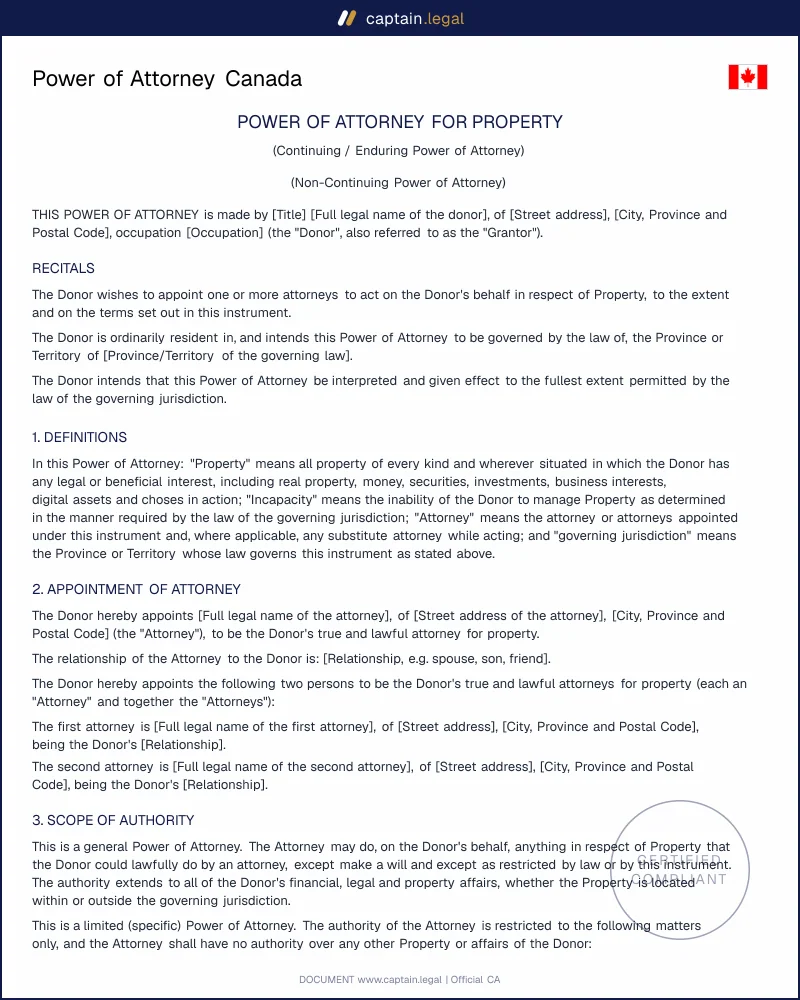
You begin by selecting the province where you live, because that single choice drives the witnessing rules, the available document types, and the statutory wording the form will use. From there you identify yourself as the grantor and name your attorney, with the option to add an alternate who takes over if your first choice cannot act. The form then asks you to set the scope of the authority, letting you grant broad financial control or restrict it to specific accounts, properties, or a single transaction.

Next you choose the activation model, deciding whether the power is general and effective immediately, or continuing and built to survive incapacity, or springing so that it only takes effect once incapacity is documented. The template inserts the correct continuing-authority language for your province when you select an enduring power. You finish at the execution block, where the form lays out the signature and witnessing requirements for your province so that you sign in front of the right number of qualified witnesses. Once complete, you download the document in Word and PDF, ready to sign and, where your province requires it for land dealings, to take for notarization.

6

Common mistakes to avoid

The single most damaging error is treating a general power of attorney as if it were a continuing one. A general power ends the instant the grantor loses capacity, so families who relied on it discover, at the worst possible moment, that the document is worthless and a court guardianship application is now the only path. The fix is the express continuing or enduring clause, and a surprising number of homemade documents simply omit it. A close second is botched witnessing: using the attorney or the attorney's spouse as a witness, using only one witness where the province demands two, or signing without the witness physically present. Each of these defects can void the entire instrument.

People also confuse property authority with personal-care authority, assuming a financial power of attorney lets the attorney make medical or housing decisions. It does not, and a separate personal-care document or representation agreement is required. Others forget to appoint a substitute attorney, so the plan collapses if the sole named attorney predeceases them or declines to act. Finally, many grantors never tell their attorney where the original is kept, or never register it for land dealings, leaving a valid document that cannot actually be used when the need arrives. Reviewing the appointment every few years, and after any major life change, keeps it current.

Key takeaways

Type of POA

Choose continuing if incapacity is the risk

In Canada, a general power of attorney can give broad authority, but it stops the moment you lose mental capacity. A continuing or enduring power of attorney is drafted to stay valid during later incapacity, which is when families usually need it. If you only need help for one deal, use a limited power of attorney tied to that single transaction.

Scope limits

Property authority is not personal care

A power of attorney for property covers financial, legal, and property matters like banking, investments, real estate, pensions, tax filings, and even business interests, depending on your wording. It does not let your attorney make a will for you. It also does not, by itself, authorize health or personal-care decisions, which typically require a separate document under provincial law.

Provincial rules

Execution and witnessing must match your province

There is no federal power of attorney statute, so the rules depend on where you live. Ontario uses the Substitute Decisions Act, 1992 and recognizes separate documents for property and personal care. British Columbia uses the Power of Attorney Act for financial matters and a representation agreement for personal and health decisions. Alberta requires an enduring power of attorney to be signed and dated with grantor and witness present together.

Frequently Asked Questions

Yes, provided you complete it correctly for your province and execute it according to that province's rules. A power of attorney is a creature of provincial statute, so the document becomes legally binding when a competent adult signs it before the number of qualified witnesses the local act requires, such as two witnesses under Ontario's Substitute Decisions Act, 1992. The template is drafted to carry the correct statutory wording and witnessing block once you select your province. What gives it force is not the paper itself but compliant execution, which is why the witnessing instructions are built into the form rather than left to chance.

A general power of attorney grants authority while you are capable and ends automatically the moment you lose mental capacity. A continuing or enduring power of attorney contains express wording stating that the authority survives incapacity, which is what makes it the right tool for estate and incapacity planning. The practical consequence is large: if you want someone to manage your finances precisely because you can no longer do so yourself, only the continuing form works. A general power suits a defined absence, such as travel, where you expect to resume control yourself.

Not for general validity in most provinces, where correct witnessing is what counts rather than notarization. The exception is real estate. British Columbia, New Brunswick, and Nova Scotia require a notarized enduring power of attorney before your attorney can register a property transfer at the land title office. If your attorney will buy, sell, or mortgage land on your behalf, plan to have the document notarized regardless of province, since institutions often insist on it. For purely financial day-to-day authority, qualified witnessing under your provincial act is usually sufficient.

No, not under a property power of attorney alone. A financial power of attorney covers money, property, and legal affairs, but it does not authorize health-care, housing, or other personal decisions. Those require a separate instrument, called a power of attorney for personal care in Ontario or a representation agreement in British Columbia. If you want one trusted person to handle both your finances and your care, you generally need two documents, executed to the standards each provincial statute sets, rather than a single combined form.

That depends on how you draft the activation trigger. An immediate power takes effect the moment you sign, letting your attorney assist while you are still capable. A springing power only begins once your incapacity is documented, often by a medical or capacity assessment. The authority ends when you revoke it while capable, when you die, when a sole attorney with no named substitute can no longer act, or, for a general power, when you lose capacity. A continuing power, by contrast, deliberately survives incapacity until death or revocation.

Yes. You can appoint attorneys to act jointly, meaning they must agree on every decision, or jointly and severally, meaning each can act alone. Joint appointment adds a safeguard against misuse but can stall if one attorney is unavailable, while joint and several is more flexible but relies on full trust in each person. Naming a substitute or alternate attorney is strongly advisable in either case, so the plan does not collapse if your first choice dies, resigns, or becomes unable to act when you most need the document to work.

The template is available in both Word and PDF. The Word version lets you make final adjustments, add province-specific instructions, or insert details before printing, while the PDF is formatted and ready to sign and witness as is. Having both means you can edit where you need flexibility and then produce a clean, signable copy for execution. For documents your attorney may need to register for land dealings, a clean PDF original is what most land title offices and notaries expect to see.

While you remain mentally capable, you can revoke a power of attorney at any time by signing a written revocation and notifying your attorney and any institution relying on the document, such as your bank. It is good practice to destroy or retrieve all signed copies of the old document, because a third party who has no notice of the revocation may still act on a copy in good faith. A later valid power of attorney can also revoke an earlier one, but only if it says so clearly, so spelling out the revocation in writing remains the safer course.

4.8/5

29 verified reviews · 50 000+ downloads

Power of Attorney Canada | Substitute Decisions Act
  • Immediate access to the document
  • PDF + Word download
  • Compliant with 2026 legislation
  • Reviewed by lawyers
Fill in the template
Secure payment · No subscription
Updated on June 20, 2026

You might also like

Last Wishes Letter Template
Power of Attorney Personal Care