Create my document
Login

Choose country

CanadaCanadaChoose country
Personal & Family

Letter of Invitation Canada | IRPA and IRPR Compliant

Invitation letter drafted to IRPA s.11(1) and IRPR s.179, with the full IRCC host information set and a notarial block. Word and PDF download.
4.7/517 reviews50 000+ downloadsInstant download
Share

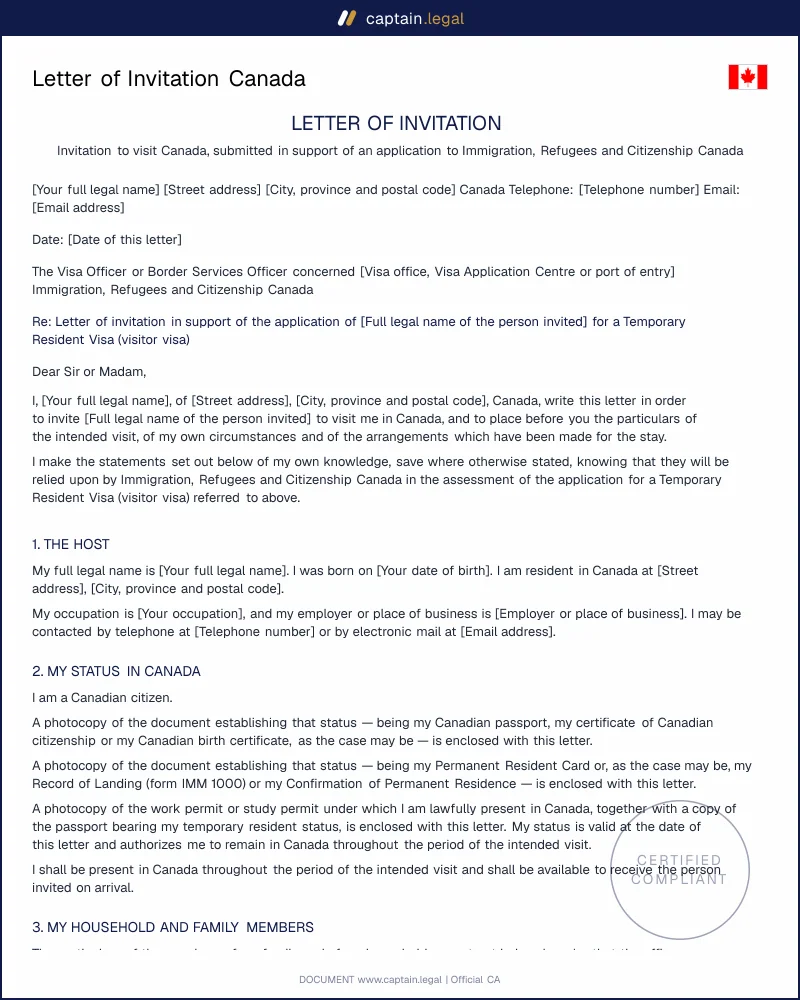
A letter of invitation is the signed statement a Canadian host sends to a relative or friend abroad so that it can be filed with their temporary resident visa application to Immigration, Refugees and Citizenship Canada. It confirms who is coming, why, where they will sleep, and who is paying for what. IRCC publishes no official form for it, which is exactly why so many are written badly and rejected as unpersuasive. This letter of invitation for a Canada visa is drafted to the information set IRCC asks hosts to provide, formatted for notarization when a visa office requires it, and structured so that every promise in the letter can be matched against a supporting document behind it.

Compliant

2026 Legislation

50,000+ clients

trust us

Affordable

From $4.90 / doc

Secure payment

Instant download

Letter of Invitation Canada | IRPA and IRPR Compliant

Secure payment

Fill in the template

What is a letter of invitation for a Canada visa?

The letter is private correspondence, not a government form, and it carries no file number of its own. Its job is narrow: corroborate the purpose of the trip declared on the IMM 5257 application form and show a visa officer that accommodation and financial support in Canada are real rather than aspirational. The host writes it, signs it, and sends it to the applicant abroad, who uploads it with the rest of the application package. The letter is addressed either to Immigration, Refugees and Citizenship Canada or to the visa office processing the file, and it never travels on its own: a copy of the host's citizenship certificate, PR card or status card goes with it.

Two confusions cost applicants their visas. The first is treating an invitation as sponsorship. Family class sponsorship creates a binding undertaking to repay social assistance for a fixed period; a letter of invitation creates no such liability, and IRCC states plainly that writing one does not make the host legally responsible for the visitor after arrival. The second is confusing this personal letter with the business invitation letter a Canadian company issues to a business visitor, which follows a separate information set and is signed by an officer of the company on corporate letterhead. A super visa letter is a third variant, with a promise of financial support and a family size calculation that the ordinary visitor letter does not need. Where a child under 18 is travelling without both parents, the invitation is a different instrument again and pairs with a consent to travel letter for a minor rather than replacing it.

2

When do you need this document?

The ordinary case is a parent, sibling or close friend applying for a visitor visa from a country whose nationals are not visa exempt. IRCC's own tourist and family visit instructions list a letter from the person inviting you as a document to include, and its absence in a family visit file reads as a gap rather than a neutral omission. Weddings, graduations and religious festivals produce the same need on a fixed calendar, and here the letter earns its keep by anchoring the trip to a dated event that ends. Compassionate visits work differently: a hospitalisation or a funeral compresses the timeline, and the letter has to explain the urgency in the first paragraph because that is what supports a request for expedited processing.

Super visa files need the letter as a formal eligibility condition, not merely as supporting evidence. IRCC requires the host to write and sign an invitation, meet the minimum necessary income for the family size, and produce proof that the applicant holds private health insurance valid for at least a year from entry. Two edge cases deserve flagging. Visa-exempt travellers who fly to Canada on an electronic travel authorization are not asked for a letter by IRCC, yet a border services officer conducting an examination on arrival can and does ask what the traveller is doing here; a printed invitation answers that question in seconds. And where the host is a study or work permit holder rather than a citizen or permanent resident, the letter still helps, but it must say so honestly and attach the permit, because a host who overstates their status contaminates the file. In every version, the officer will cross-check the address in the letter against the host's own paperwork, so a copy of the residential tenancy agreement for the common-law provinces or a mortgage statement belongs in the bundle.

3

Key clauses included in our template

  • The recipient block places the correct addressee at the top left, whether that is Immigration, Refugees and Citizenship Canada, a named Canadian embassy or consulate immigration section, or the Canada Border Services Agency. Visa offices sort thousands of letters, and one addressed to nobody in particular reads as a form letter recycled from the internet.
  • The applicant identification clause records the complete legal name as it appears in the passport, the date of birth, the residential address and telephone number abroad, and the passport number. Officers verify these against the IMM 5257 form, and a single mismatched spelling is enough to trigger a request for clarification and weeks of delay.
  • The relationship and evidence clause states how host and visitor are related and names the document that proves it, such as a birth certificate, a marriage certificate or a statutory declaration of common-law union. Vague phrasing like "a close family friend" carries almost no evidentiary weight and should be replaced by a factual history of the relationship.
  • The purpose and itinerary clause sets out the reason for the trip, the intended arrival and departure dates, and the events the visitor will attend. It keeps the proposed stay inside the six-month default unless a super visa is being sought, and it ties the departure date to something verifiable, such as a return flight or an employment obligation abroad.
  • The support and accommodation clause states precisely what the host will cover: lodging in the host's home, meals, internal travel, or airfare. It also states what the host will not cover, which sounds counterintuitive but is far more credible than a blanket promise, and it should match the bank statements filed with the application.
  • The host status and household clause gives the host's full name, date of birth, Canadian address and telephone number, job title, immigration status, and the names and dates of birth of the spouse and dependants. For a super visa it adds the family size calculation and the promise of financial support that IRCC requires. Attaching a Canadian employment agreement setting out job title and salary alongside a recent notice of assessment turns an assertion into evidence.
4

Provincial and visa office considerations

Ontario hosts who need the letter sworn will usually go to a lawyer or licensed paralegal, both of whom are commissioners for taking affidavits by virtue of office under the Commissioners for Taking Affidavits Act, R.S.O. 1990, c. C.17. A notary public appointed under the Notaries Act, R.S.O. 1990, c. N.6, can also notarize the signature. The practical difference matters: commissioning attests that the deponent swore the contents, while notarization attests to the identity of the signatory and the authenticity of the signature. Visa offices that ask for a "notarized" letter generally accept either, but the safer route is a notarial certificate.

British Columbia is the outlier, because it maintains a separate profession of notaries public regulated under the Notaries Act, R.S.B.C. 1996, c. 334. BC notaries handle invitation letters as routine work and their seals are recognised abroad without difficulty. Alberta consolidated both functions in the Notaries and Commissioners Act, S.A. 2013, c. N-5.5, so an Alberta host will often find that a single appointment covers both the oath and the seal.

Quebec hosts are on identical federal footing, since immigration selection for temporary residents remains a federal matter and the Certificat d'acceptation du Québec applies to permanent and certain long-stay categories rather than ordinary visitors. Where a Quebec host wants a sworn version, the letter goes before a notary who is a member of the Chambre des notaires du Québec or before a commissioner for oaths, and the resulting notarial act carries strong evidentiary weight. Hosts elsewhere who need the same formality can pair the invitation with a sworn affidavit carrying a properly drafted jurat.

Visa office practice is the variable nobody controls. Offices covering India, Nigeria, Pakistan and the Philippines apply visible scrutiny to family visit files and frequently expect notarization, while several European offices never mention it. Check the visa office instructions for the applicant's country before deciding whether to notarize, because sending an unnotarized letter to an office that expects one wastes a full processing cycle.

5

How to fill out this letter of invitation

You begin by identifying yourself as the host and confirming your status in Canada, since the template branches from there: a citizen, a permanent resident, a registered Indian and a temporary resident each attach different proof. Next you enter the visitor's identity exactly as it appears in their passport, then the relationship and the document that establishes it. The form then asks what kind of visit this is. Choosing a super visa opens the financial support undertaking and the family size fields; choosing an ordinary visit keeps the stay inside six months and prompts you for the intended arrival and departure dates.

The support section is where most hosts rush and where you should slow down. You state what you are covering, in plain terms, and the template converts that into a paragraph an officer can read against the bank statements in the file. You then list your household members with their dates of birth. The finished letter arrives ready to sign, with a notarial block at the foot for the jurisdictions that ask for one and a clean signature line for those that do not. Anyone building a wider application bundle can work through the rest of the personal and family templates for Canada from the same account.

6

Common mistakes to avoid

The letter that fails is almost always the emotional one. A host writes four paragraphs about how much the family has missed their mother and supplies no dates, no address, no household composition and no statement of who is paying. An officer reading it learns nothing verifiable and treats the file as if no letter had been filed at all. The second recurring failure is contradiction: the letter says the visit lasts three weeks, the application says two months, and the flight booking says something else again. Officers cross-reference these fields as a matter of routine, and an inconsistency reads as either carelessness or invention. A third is promising support the bank statements cannot sustain, which converts a helpful letter into evidence against the applicant.

Hosts also underestimate the status documents. Sending a letter without a copy of the citizenship certificate, PR card or status card leaves the officer unable to confirm that the writer is who they claim to be, and the letter loses most of its weight. Never sign a letter containing a fact you have not verified. Guessing at a passport number, rounding an income figure upward or describing a friend as a cousin are all misrepresentations within the meaning of section 40 of the Immigration and Refugee Protection Act, and the person who pays for it is the applicant, not the host. Finally, avoid stale letters: one written many months before filing suggests the plan has changed, and officers notice.

Key takeaways

Purpose

It supports the TRV, nothing more

A letter of invitation is private correspondence that backs up what the applicant states in the IMM 5257 visitor visa (TRV) application. It should spell out who is visiting, why, where they will stay, and who pays for what, then be uploaded with the rest of the IRCC package. It also needs the host’s status proof (citizenship certificate, PR card, or permit).

IRPA rules

The real test is leaving Canada

Under IRPA s. 11(1) and IRPR s. 179, a visa officer issues a TRV only if satisfied the applicant has a valid passport, has means of support, is not inadmissible, and will leave Canada at the end of the authorized stay. Most refusals turn on that last point. IRPA s. 20(1)(b) puts the burden on the applicant, and the letter helps by making the trip finite and verifiable.

Misrepresentation

A sloppy lie can trigger a five-year bar

Accuracy is not optional. IRPA s. 16(1) requires truthful answers and relevant evidence, and IRPA s. 40(1)(a) can make the applicant inadmissible for misrepresentation, with a five-year bar under s. 40(2)(a). The host has exposure too: IRPA s. 127 applies to anyone who knowingly misrepresents or withholds material facts, and s. 128 makes it an indictable offence punishable by up to five years in prison.

Frequently Asked Questions

Not in every case. IRCC does not list it among the documents every applicant must provide, and a well-documented tourist file can succeed without one. In practice the picture is different. For a family visit, IRCC's own instructions direct applicants to include a letter from the person inviting them along with proof of the relationship, and a missing letter in that context reads as an unexplained gap. For a super visa it is a hard eligibility condition: the host must write and sign one. Where the applicant is from a country with historically lower approval rates, treat the letter as effectively required rather than optional.

No. IRCC states expressly that writing a letter of invitation does not make the host legally responsible for the visitor once they enter Canada. There is no undertaking, no repayment obligation and no financial guarantee comparable to family class sponsorship. That said, the letter must be written in good faith and the promises in it must be ones you intend to keep. If you promise accommodation and support, an officer will expect the bank statements to bear that out, and a promise you cannot fund undermines the whole application.

IRCC does not impose notarization as a general requirement, but individual visa offices do, and some visa application centres will refuse a bundle without a notarial seal. Check the visa office instructions for the applicant's country before signing. Notarization is inexpensive, takes minutes, and adds credibility even where it is not demanded, because it confirms that a regulated professional verified the signatory's identity. Our template includes a notarial block at the foot of the letter, so the same document works whether you sign it privately or before a notary public or commissioner for oaths.

The letter is not a contract and does not create enforceable obligations toward the visitor or toward the Crown. It is a signed statement of fact and intention, and its legal weight comes from the truthfulness duty in the Immigration and Refugee Protection Act rather than from contract law. That distinction cuts both ways. You cannot be sued on the promise of support, but you can be prosecuted under section 127 of the Act for knowingly misrepresenting a material fact, and the applicant faces a five-year inadmissibility under section 40. Drafted honestly, the letter is a strong evidentiary document.

Yes. The completed letter downloads in both Microsoft Word and PDF. The Word version is there for the details you may need to adjust at the last moment, such as a shifted arrival date or an added household member, and the PDF is the version you sign, scan and send to the applicant for upload to the IRCC portal. Hosts preparing several documents at once, for a wedding or a multi-generation visit, often work through the catalogue of Canadian legal documents and download the whole bundle in one session.

Send it early enough that the applicant can include it in the original submission rather than adding it later. Visitor visa processing times vary substantially by visa office, and a file that arrives incomplete goes back into the queue when the missing document appears. Date the letter close to the filing date, ideally within a few weeks, because a letter written many months earlier suggests the plan may have changed. If the applicant needs biometrics, factor in the appointment and the travel to the collection point, since the clock on processing effectively starts once biometrics are given.

A super visa letter carries two elements the ordinary version does not. It must contain an explicit promise of financial support for the entire duration of the parent's or grandparent's visit, and it must list the people counted in the family size calculation, because the host has to meet or exceed the minimum necessary income for that household size. The visitor also has to hold private health insurance valid for at least one year from the date of entry, purchased from a Canadian insurer or from a foreign insurer approved by the minister. Buy and pay for the insurance before filing, since a quotation is not accepted as proof.

4.7/5

17 verified reviews · 50 000+ downloads

Letter of Invitation Canada | IRPA and IRPR Compliant
  • Immediate access to the document
  • PDF + Word download
  • Compliant with 2026 legislation
  • Reviewed by lawyers
Fill in the template
Secure payment
Updated on July 28, 2026

You might also like

Statutory Declaration Canada
Gift Deed Canada