Create my document
Login

Choose country

CanadaCanadaChoose country
Personal & Family

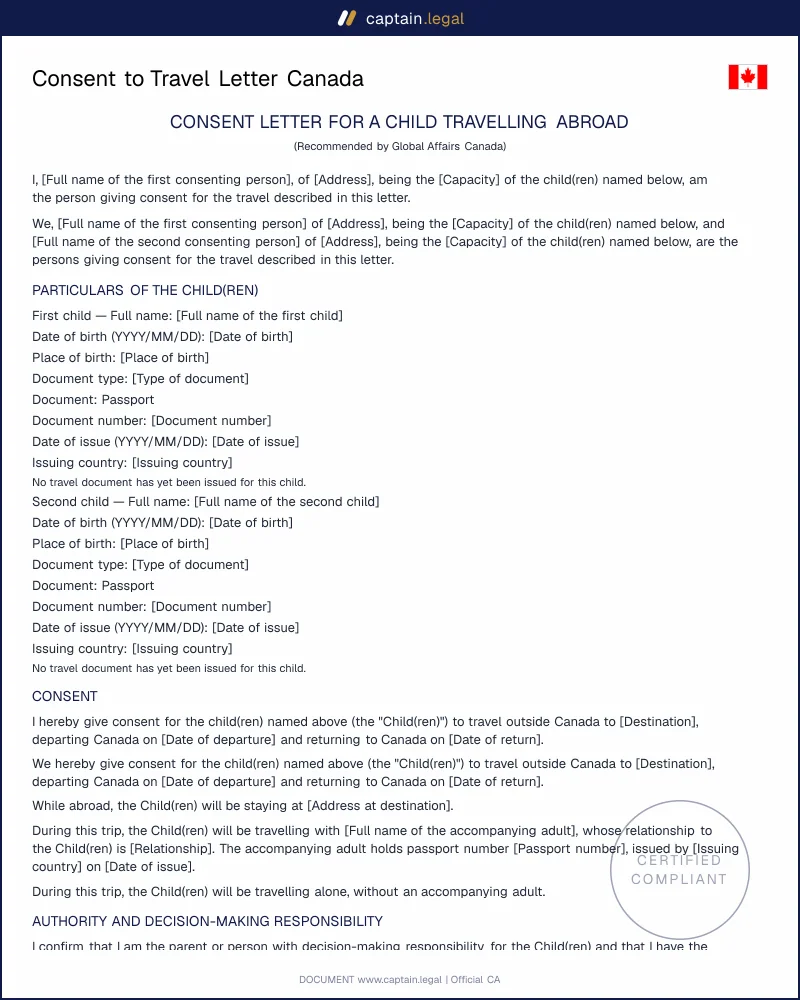
Consent to Travel Letter Canada | Global Affairs Format

Consent letter for children travelling abroad, drafted to Global Affairs Canada guidance and notary-ready. Covers siblings on one form. Word and PDF download.
4.6/532 reviews50 000+ downloadsInstant download
Share

A consent to travel letter is the signed statement a parent or guardian who stays home uses to show that a child has permission to leave Canada with someone else. Border officers, airlines and foreign immigration authorities may ask to see it whenever a minor crosses an international border without both parents, and a missing or improvised letter is one of the most common reasons a family gets pulled aside at departure. This template follows the format recommended by the Government of Canada, is drafted for the common-law provinces and territories, and downloads in Word and PDF so the non-travelling parent can sign it in front of a notary public before the trip.

Compliant

2026 Legislation

50,000+ clients

trust us

Affordable

From $4.90 / doc

Secure payment

Instant download

Consent to Travel Letter Canada | Global Affairs Format

Secure payment

Fill in the template
2

When do you need this document?

The most common trigger is a single parent travelling with the children while the other parent stays home, whether the couple is married, separated or divorced. Border officers cannot infer consent from a shared surname, so a mother taking her kids to Florida for March break should carry a letter signed by the father even if the marriage is intact. The next scenario involves children travelling with grandparents, aunts, uncles or family friends, where both parents ordinarily sign because neither is present to vouch for the trip. School, sports and religious group trips fall into the same category, and organizers usually collect a signed letter from each family before departure.

Unaccompanied minors flying alone present the clearest case: both parents sign, and the airline's own unaccompanied-minor policy layers additional paperwork on top. Two edge cases deserve attention. A parent with sole custody should carry the court order granting it, since that document can stand in for the other parent's signature, though a letter remains useful. Where the other parent has died, a copy of the death certificate travels with the child instead of a second signature. One overlooked situation catches families off guard: a child may be a deemed citizen of the destination country through a parent's nationality, which can subject the child to that country's own exit rules on top of the Canadian recommendation. Families sorting out cross-border authority often pair this letter with a power of attorney for personal care so a caregiver can make health decisions while abroad.

3

Key clauses included in our template

  • The identification of every consenting parent or guardian opens the letter, listing the full legal name of each person with decision-making responsibility who is not travelling. The template mirrors the Global Affairs Canada wording so an officer recognizes the format instantly, and it accommodates one signatory or two depending on the family's custody arrangement.
  • The child's identifying details follow, capturing full name, date and place of birth, and passport number with its issue date and issuing country. One letter can name several siblings from the same parents, which spares a family from preparing a separate document for each child on the same trip.
  • The accompanying person's information records who is actually travelling with the child, their passport details and their relationship to the child, or a clear statement that the child is travelling alone. This is the field border officers cross-check against the adult presenting the child.
  • The travel particulars set out the destination, the departure and return dates and the address where the child will stay. Because the letter is trip-specific, these fields are what make it valid for one journey and not a blanket authorization.
  • The signature and witnessing block provides space for the consenting parent to sign before a notary public, commissioner for oaths or lawyer, with the notarial jurat that persuades foreign officials the signature is genuine. A statutory declaration or affidavit can support the letter where a parent needs to swear to sole custody or another fact.
4

Regional considerations

Ontario and the 18 provinces. In Alberta, Manitoba, Ontario, Prince Edward Island and Saskatchewan the age of majority is 18, so a person is legally an adult on their eighteenth birthday and, strictly, no longer needs a consent letter. The practical advice still runs the other way. The Canadian government recommends carrying a letter for any traveller under 19, because foreign border officers apply their own thresholds and a 17 or 18 year old is routinely asked for one. An Ontario notary, commissioner for oaths or lawyer can witness the signature, and Ontario families should note that a single letter may list all siblings who share the same two parents.

British Columbia and the 19 provinces. British Columbia, New Brunswick, Newfoundland and Labrador, Nova Scotia and the three territories set majority at 19 under each jurisdiction's Age of Majority Act. A child of 18 in these provinces is still a minor for provincial purposes, which reinforces the standing recommendation to prepare a letter for anyone under 19. Witnessing options are the same, and a notary public is the usual choice for cross-border documents.

Blended and separated families anywhere. The sharpest regional variable is not geography but custody. Where parents have separated, the parent who is not travelling and who holds parenting time or decision-making responsibility should sign, and the letter travels with the separation agreement or court order that defines those responsibilities. This template is drafted for the common-law provinces and territories; Quebec's Civil Code regime, with its own rules on parental authority and tutorship, is not covered here.

6

Common mistakes to avoid

The error that grounds the most trips is treating the letter as optional because it is not legally required in Canada. The recommendation comes from Global Affairs Canada, but the people who enforce it are foreign immigration officers and airline staff, and they turn families back at the gate without hesitation. A second frequent failure is signing the letter in advance without a witness. An unwitnessed note is easy to forge and border officers are trained to spot one, which is exactly why notarization is urged even though the law does not compel it. Families also reuse an old letter with stale dates, forgetting that the document is trip-specific and that a return date in the past reads as an obvious problem.

Detail errors do the rest of the damage. Parents transpose a passport number or shorten a child's legal name to a nickname, and the mismatch between the letter and the passport triggers questioning. Separated parents sometimes assume the travelling parent's signature is enough, when the whole point is the absent parent's consent. Carrying only a photocopy or a phone photo is another trap, since officers frequently insist on the original. Where one parent has sole custody or the other has died, families forget to pack the court order or death certificate that proves sole authority, leaving them unable to explain the single signature.

Key takeaways

When needed

Carry it whenever one parent stays home

A consent to travel letter is the written permission the non-travelling parent or guardian gives when a child leaves Canada with someone else. Airlines, the Canada Border Services Agency, and foreign immigration officials may ask for it at departure or arrival, and a missing or last-minute note is a common reason families get pulled aside. The template follows Global Affairs Canada guidance and is designed to be signed before travel.

What it is

It proves permission, not custody

This letter does not change custody, guardianship, or decision-making responsibility. It only evidences consent for a specific trip by naming the child, the accompanying adult, the destination, and the dates. That distinction matters at the border: a passport alone does not show whether the absent parent agreed. If you have a separation or parenting arrangements, the consent letter sits alongside those documents rather than replacing them.

Risk

Treat it as trip-specific and minor-focused

There is no federal statute that forces you to carry a consent letter, but Global Affairs Canada strongly recommends one for each trip because carriers and foreign authorities may delay travel or refuse exit or entry if you cannot produce it. A child is under the age of majority (18 or 19 depending on the province), and government advice leans toward preparing the letter for anyone under 19 as a safer default.

Frequently Asked Questions

The letter is not legally required and does not by itself carry the force of a court order, but it is a genuine legal instrument that evidences a parent's consent to a specific trip. Its authority comes from how border and immigration authorities treat it: a properly completed and notarized letter is accepted as reliable proof of permission, while its absence can justify refusing a child entry or exit. A notary public or commissioner for oaths witnessing the signature is what officials look for. The letter does not override a custody order, so where a court has restricted travel, that order governs and the letter cannot authorize a trip the order forbids.

No Canadian law makes notarization mandatory, and a letter signed before any adult who has reached the age of majority is technically acceptable under Global Affairs Canada guidance. In practice notarization is strongly recommended and close to essential for higher-risk destinations. Border officers and the Canada Border Services Agency both advise it because they are far less likely to question a document witnessed by a notary public. The consenting parent attends the notary in person with government photo identification, and only the parent staying behind needs to appear; the travelling parent does not.

Yes, provided the children share the same two parents. Global Affairs Canada allows several siblings from the same family to be named on a single consent letter, so a parent travelling with two children of the same relationship prepares one document. The situation changes with blended families. If you travel with two children from a first relationship and one child from a second, you need two separate letters: one signed by the other parent of the first two children, and one signed by the parent of the third. The template accommodates multiple children in the child-details section for this reason.

The letter records each child's full legal name, date and place of birth, and passport number with its date and country of issue, entered to match the passport exactly. For the accompanying adult it captures name, passport details and relationship to the child. These fields let a border officer cross-check the letter against the people and documents in front of them. You should also carry the child's passport and, where relevant, a long-form birth certificate showing the parents' names, since that document supports the identity claims the letter makes.

Prepare the letter well before departure, ideally a week or two ahead, so there is time to reach a notary and correct any error. The document has no fixed statutory validity period, but it is trip-specific and is generally treated as valid only for the dates it names. A letter is not a standing authorization, so a new one is completed for each journey with current destination and dates. Leaving notarization to the last day is the main scheduling risk, because a notary appointment plus the original signature cannot be rushed at the airport.

The letter downloads in both Word and PDF. The Word version lets you adjust wording for an unusual family situation before printing, while the PDF gives you a clean, ready-to-sign copy. Because border officers may decline a photocopy or a digital image, you print the original and have the non-travelling parent sign that printed copy in front of the notary. The child then carries the wet-ink original across the border. Keeping a scanned backup on a phone is sensible, but it does not replace the signed original that officers expect to see.

A refusal cannot be worked around by signing the letter yourself, and travelling without the other parent's consent where they hold custody or decision-making responsibility can amount to wrongful removal under the Hague Convention. Where the other parent objects, the travelling parent may apply to the provincial superior court for authorization to travel over the objection, with the child's best interests as the governing standard. These applications take time, so legal advice early is important; a planned departure date can be jeopardized if the application is left too late. A family legal document suited to your custody arrangement can help clarify each parent's authority before a dispute reaches court.

4.6/5

32 verified reviews · 50 000+ downloads

Consent to Travel Letter Canada | Global Affairs Format
  • Immediate access to the document
  • PDF + Word download
  • Compliant with 2026 legislation
  • Reviewed by lawyers
Fill in the template
Secure payment
Updated on July 13, 2026

You might also like

Power of Attorney Personal Care
Affidavit Template Canada