Employment

Full and Final Release Canada | ESA s.5 & Titus Test

Employment release built on ESA s.5, the Titus unconscionability test and CCQ art. 2631. Covers retiring allowance tax and EI repayment. Word and PDF.
4.8/5— 18 reviews50 000+ downloadsInstant download
Share

A full and final release is the agreement an employer and a departing employee sign to close every claim arising from the employment relationship, in exchange for a severance payment that goes beyond what the law already requires. Employers, HR teams and employment counsel use it across the common-law provinces, Quebec and the federally regulated sector. A well-drafted release turns a contested dismissal into a settled file. A poorly drafted one becomes evidence against the employer in the very lawsuit it was meant to prevent.

Our template is built around the three questions a Canadian court asks before enforcing a release: was there fresh consideration, did the employee sign voluntarily and with understanding, and does the wording actually cover the claim now being raised.

Compliant

2026 Legislation

50,000+ clients

trust us

Affordable

From $4.90 / doc

Secure payment

Instant download

Full and Final Release Canada | ESA s.5 & Titus Test

Secure payment

Fill in the template

What is a full and final release agreement?

A full and final release agreement is a contract by which the employee (the releasor) gives up the right to sue or file complaints against the employer and its related parties (the releasees) for any matter connected to the employment and its termination. In return, the employer pays an amount or provides a benefit the employee was not otherwise entitled to receive. That condition is the heart of the document. A release supported only by statutory termination pay is supported by nothing, because those sums were owed anyway, and courts treat it as void for want of consideration.

The document is often confused with its neighbours. A termination letter announces the end of employment and states the statutory entitlements; it releases nothing. Minutes of settlement are usually signed once litigation or a tribunal complaint is already underway. The full and final release sits between the two: it is signed at or shortly after termination, before any proceeding exists, and it pairs the payment terms with a release of claims, an acknowledgment of independent legal advice and the covenants (confidentiality, non-disparagement, return of property) that make the exit final. In Quebec, the same agreement is analyzed as a transaction under the Civil Code of Québec, which gives it the authority of res judicata between the parties.

When do you need this document?

The classic case is a without-cause dismissal of a non-unionized employee with several years of service. Absent a valid termination clause, that employee is owed common-law reasonable notice, which in senior roles runs well past the statutory minimum. The employer offers a sum between the two figures, and the full and final release is the price of that premium. It is served alongside a termination letter that sets out notice and pay in lieu, never in place of it.

Restructurings come next, where a uniform full and final release prevents a wave of parallel wrongful dismissal actions. Negotiated executive departures follow: there, the release settles bonus and equity entitlements, incentive vesting and benefits continuation, items otherwise argued line by line in court. Releases also close earlier disputes, such as a harassment complaint or an overtime claim, if named expressly.

Two edge cases deserve attention. After a business sale, the vendor often terminates staff the purchaser does not retain, and the business purchase agreement for an asset or share sale will usually require signed releases at closing. For a unionized employee, the collective agreement governs, and an individual release that bypasses the union and the grievance procedure is unlikely to hold.

Key clauses included in our template

  • The release and discharge clause identifies the releasees (the employer, its affiliates, directors, officers and employees) and the claims released, from wrongful dismissal to statutory complaints. It names the main heads of claim expressly, because Biancaniello reads general language narrowly.
  • The consideration clause states the severance amount, the payment schedule and the benefits continuation period, kept separate from the statutory minimums already paid. That separation is what proves fresh consideration if the full and final release is challenged.
  • The tax allocation and indemnity clause characterizes the payment as a retiring allowance, salary continuance or both, and records any direct RRSP transfer. The employee indemnifies the employer against a later reassessment of the agreed characterization.
  • The statutory compliance acknowledgment confirms that every employment standards entitlement has been received, including benefits continued during the statutory notice period. It also records how any EI overpayment was handled under s. 46.
  • The independent legal advice clause confirms that the employee had reasonable time to review the document and to consult a lawyer of their choosing. A separate certificate, signed by the employee or by counsel, is the evidence a court will look for first.
  • The ancillary covenants cover confidentiality of the settlement terms, mutual non-disparagement, return of company property and continuing duties already set out in a standalone non-disclosure agreement for employees. In Ontario, s. 67.2 of the Employment Standards Act, 2000 bars most non-compete covenants, so the template limits restraints to non-solicitation unless the executive or sale-of-business exception applies.
  • The no admission of liability, governing law and entire agreement clauses fix the applicable provincial law and stop earlier drafts or emails from reopening the deal. The no-admission wording also keeps the payment from being read as an acknowledgment of just cause, or of its absence.

Regional considerations

Ontario produces most of the reported case law. The Employment Standards Act, 2000 adds statutory severance pay under s. 64 for employees with five or more years of service, where the employer meets the payroll threshold or severs 50 or more employees within six months because part of the business closes. It is calculated under s. 65 at one week per year of service, up to 26 weeks. Benefit plan contributions must also continue through the statutory notice period under s. 61(1)(b). Ontario employees must choose between an ESA complaint and a civil action for the same termination (ss. 97 and 98), so the release should confirm that no complaint is pending.

British Columbia relies on s. 4 of its Employment Standards Act, which voids any waiver of statutory requirements, and on s. 63 for compensation for length of service, which starts after three consecutive months of employment and is capped at eight weeks. Those weeks are paid before, and independently of, any release. A private settlement does not automatically bar a complaint before the BC Human Rights Tribunal, so employers should name the Human Rights Code specifically and document the legal advice offered.

Alberta applies s. 4 of the Employment Standards Code, which treats any agreement to opt out of the Code as void. Statutory termination notice under s. 56 ranges from one to eight weeks depending on length of employment, and vacation pay owed under the Code must be paid on termination, not traded for the release. Claims under the Alberta Human Rights Act should be named expressly, as in the other provinces.

Quebec follows a civil law model. A release is a transaction under arts. 2631 and 2633 of the Civil Code of Québec; it binds the parties as res judicata, but it must be homologated by the court before it can be enforced. Article 2092 prevents an employee from renouncing in advance an indemnity for insufficient notice, yet a transaction signed after termination is valid. The Act respecting labour standards is of public order (s. 93), and an employee with two years of uninterrupted service may complain to the CNESST under s. 124. That complaint must be filed within 45 days of dismissal, and the transaction should address the remedy expressly.

Federally regulated employees fall under the Canada Labour Code, which grants statutory severance under s. 235. Non-unionized employees other than managers, with twelve months of continuous service, may file an unjust dismissal complaint under s. 240. That complaint must be filed within 90 days, and a release signed with fresh consideration is the employer's main defence.

How to fill out this full and final release

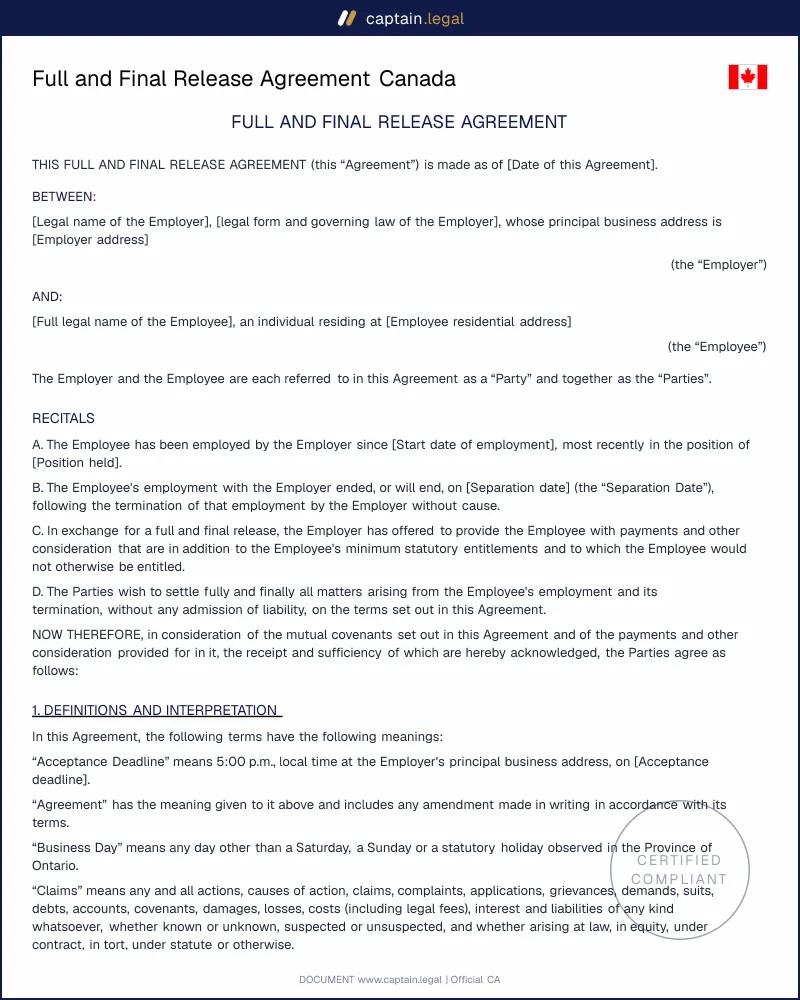
You begin by choosing the governing jurisdiction: a common-law province, Quebec or the federal sector. That choice drives the statutory references, the Quebec transaction wording and the tribunal complaints the full and final release addresses. The form then asks for the parties' details, the employee's position, start date and termination date, which together determine the statutory entitlements the document acknowledges as already paid.

The payment section follows. You enter the statutory amounts separately from the additional severance, then specify a lump sum or salary continuance, the benefits continuation period and any RRSP transfer. If the employee has received Employment Insurance benefits, the form adds the s. 46 deduction language.

Finally, you select the covenants that fit (confidentiality, non-disparagement, return of property, a reference letter, cooperation in pending matters), set the review period granted to the employee and generate the legal advice certificate. The same guided approach runs through our Canadian employment and HR templates.

Common mistakes to avoid

The most frequent error is making statutory pay conditional on the release. An employer who withholds termination pay until the employee signs breaches the statute and hands the employee a ready argument that the release lacks consideration. The second is a "sign today" deadline. Canadian law imposes no fixed review period, but a release extracted within hours from an employee refused time to call a lawyer meets most branches of the Titus test. Seven to fourteen days is the usual practice.

Drafting errors cost just as much. Generic wording that releases "all claims" without naming human rights, statutory or benefits claims invites a narrow reading, and an employee on disability leave may still pursue long-term disability benefits if the insurer's position was never addressed. Employers also forget the tax treatment: paying a retiring allowance as ordinary salary triggers the wrong source deductions and a T4 correction. Others ignore EI repayment and end up liable under s. 46 for money already paid out. A full and final release is only as strong as the evidence of how it was signed, so keep the dated cover email, the review period granted and the signed legal advice certificate in the personnel file.

Key takeaways

STATUTORY FLOOR

Minimum entitlements stay off the table

A release cannot trade away employment standards minimums. Under Ontario ESA s. 5(1), and similar provincial Employment Standards Acts or Canada Labour Code rules, statutory termination and severance pay remain payable whether or not the employee signs. Ontario also requires payment by the later of seven days after termination or the next regular pay date.

ENFORCEABILITY

Fresh consideration makes the release stick

Courts look for something new given in exchange for the waiver, usually a severance amount above what the law already owed. The Titus test also examines unfairness, legal advice, bargaining imbalance and employer pressure. Broad wording is not a cure-all: under Biancaniello, a claim outside the parties' contemplation may still survive.

PAYMENT TERMS

Tax and EI treatment need care

The settlement amount is not just a cheque number. A full and final release should identify the payment, how it will be treated as a retiring allowance or other taxable amount, and any EI repayment issue. Getting this wrong can turn a closed dismissal into a payroll, tax or benefits dispute after signature.

Frequently Asked Questions

Yes, provided three conditions are met. The employee must receive fresh consideration, a benefit above what employment standards legislation already guarantees. The employee must sign voluntarily, with a reasonable opportunity to understand the document and obtain legal advice. And the claim later raised must fall within the wording of the release, read in light of what the parties had in mind. A release meeting these conditions is routinely enforced and leads to the dismissal of a later wrongful dismissal action. In Quebec, the transaction binds the parties once signed but needs homologation to be enforced.

Only the portion above the statutory minimum. Termination pay, statutory severance pay and benefits continuation during the statutory notice period are owed regardless of any signature, and in Ontario they must be paid within the timeline of s. 11(5) of the Employment Standards Act, 2000. The additional amount offered in lieu of common-law reasonable notice can legitimately depend on the release. The offer letter should show the two figures separately, so that nobody can later argue the employee signed away a statutory right.

No Canadian statute fixes a review period for employment releases. Practice settles on seven to fourteen days, longer for senior employees or packages involving equity and pensions. The test is reasonableness: the employee must have had enough time to consult a lawyer. Statutory clocks keep running during negotiations, including the 90-day window under the Canada Labour Code and the 45-day window under Quebec's Act respecting labour standards.

It can, but human rights tribunals keep the power to examine whether the release was fair. They look at whether human rights claims were named expressly, whether the employee understood what was given up, whether legal advice was available and whether the consideration was meaningful. A generic release that never mentions the applicable human rights statute leaves room for the complaint, which is why the template names the provincial Human Rights Code or the federal Canadian Human Rights Act.

Yes. Once completed, your full and final release is available in Word, so you or the employee's lawyer can negotiate and revise it, and in PDF for signature. Electronic signatures are generally accepted under provincial electronic commerce legislation, such as Ontario's Electronic Commerce Act, 2000. Other exit documents are in our full catalogue of Canadian legal documents.

Severance paid in exchange for a full and final release is generally a retiring allowance under the Income Tax Act. It is subject to income tax withholding at the lump sum rates published by the Canada Revenue Agency, but not to CPP contributions or EI premiums, and it is reported on the T4 slip. Employees with service before 1996 may transfer an eligible portion directly to an RRSP without withholding under s. 60(j.1). The release should record the characterization the parties agreed on.

4.8/5

18 verified reviews · 50 000+ downloads

Full and Final Release Canada | ESA s.5 & Titus Test
  • Immediate access to the document
  • PDF + Word download
  • Compliant with 2026 legislation
  • Reviewed by lawyers
Fill in the template
Secure payment
Updated on October 12, 2026

You might also like

Termination Letter Template Canada
Employee Offer Letter Template Canada