Non-Profit

Gift Acceptance Policy Canada | ITA s.248 & CRA Rules

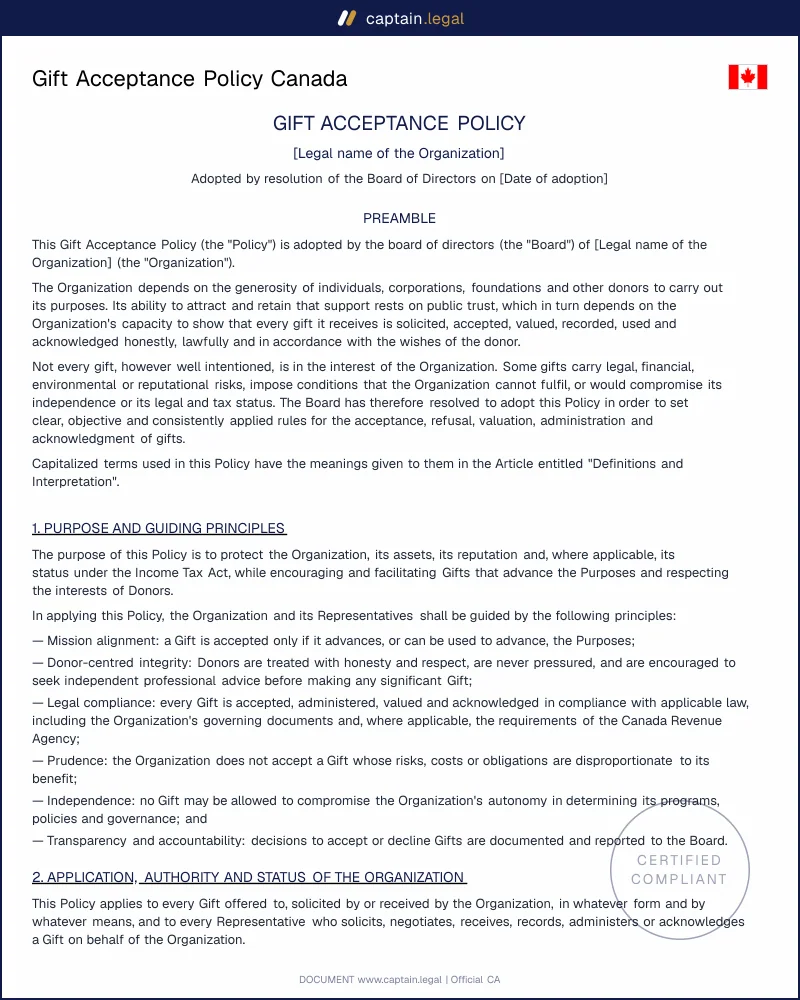
Gift acceptance policy drafted to Income Tax Act s.248, NFP Act s.148 and CRA receipting rules. Valuation, refusal and restricted gift clauses.
4.7/5— 16 reviews50 000+ downloadsInstant download
Share

A gift acceptance policy is the board-approved document that tells a Canadian charity or non-profit which donations it will take, which it will turn down, and how it will value, receipt and record everything in between. It covers cash, publicly listed securities, real estate, life insurance and other gifts in kind, and it gives staff a written basis for declining a gift that carries more risk than value. Registered charities and other qualified donees rely on it to stay within the Canada Revenue Agency's receipting rules. Non-profit corporations use it to show how the directors exercised their duty of care when an unusual donation arrived. Our template is drafted to the Income Tax Act, the Canada Not-for-profit Corporations Act and the main provincial charity statutes.

Compliant

2026 Legislation

50,000+ clients

trust us

Affordable

From $4.90 / doc

Secure payment

Instant download

Gift Acceptance Policy Canada | ITA s.248 & CRA Rules

Secure payment

Fill in the template

What is a gift acceptance policy?

In Canadian practice, a gift acceptance policy is an internal governance instrument adopted by resolution of the board. It is not a contract with any donor. It sets the standing rules applied to every offer: who has authority to accept, which categories of property are welcome, which need committee or board review, and which are refused outright. It also fixes the valuation and receipting procedure, so that an official donation receipt is never issued on a guess. Many charities publish their gift acceptance policy so donors know the rules before they call.

The document is often confused with two neighbours. A donation agreement drafted to CRA receipting rules is a bilateral contract recording the terms of one specific gift: amount, restrictions, payment schedule, recognition and what happens if the purpose fails. The gift acceptance policy sits one level above and decides whether that agreement should be signed at all. A fundraising policy governs solicitation, and an investment policy governs funds once received.

When do you need this document?

The most common trigger is the first non-cash offer. A donor calls about a cottage, shares in a family company or a collection of paintings, and the executive director realizes nobody knows who can say yes. Planned giving comes next: once a charity encourages bequests, it needs rules for residual gifts under a last will and testament compliant with the SLRA and WESA, for life insurance and for RRSP or TFSA beneficiary designations, which arrive months after the donor's death.

Naming rights, endowed scholarships and program-specific gifts create obligations that outlive the people who negotiated them, so the gift acceptance policy sets the minimum term and exit clause before the plaque goes up. Many organizations adopt one only during a CRA audit, when they find that inconsistent receipting is the first thing examiners check.

One edge case deserves attention. Shares of a private corporation that does not deal at arm's length with the donor are non-qualifying securities under subsection 118.1(13) of the Income Tax Act. The donor's credit is deferred and arises only if the charity disposes of the shares within 60 months, for no more than the proceeds received, which turns acceptance into a liquidity plan.

Key clauses included in our template

  • The statement of purpose and mission alignment ties every acceptance decision to the charitable purposes in your articles or letters patent. It gives staff a principled ground for declining a gift that would pull the organization away from its objects.
  • The authority and approval thresholds allocate decisions between staff, the gift acceptance committee and the board. Cash and listed securities are delegated, while real estate, private shares and endowments go to the board, recorded in a board of directors resolution under NFP Act section 140.
  • The categories of acceptable gifts treat separately cash, listed securities (eligible for the zero capital gains inclusion in paragraph 38(a.1)), real property, life insurance, gifts in kind, cultural property and ecological gifts. Life insurance premiums are receiptable only where the charity is both owner and beneficiary of the policy, and donated services are never receiptable.
  • The grounds for refusal cover an illegal or unverifiable source, unacceptable conditions, excessive carrying costs, conflict with mission, or a requested benefit above the 80 per cent threshold.
  • The valuation and receipting procedure sets when an independent appraisal is required, who pays for it, how the deemed fair market value rule is checked and which officer signs receipts.
  • The restricted gifts and variation clause requires every restriction in writing and reserves the right to redirect funds to the closest charitable purpose if the original one becomes impossible.
  • The recognition, privacy and anonymity provisions govern naming rights, donor lists and personal information under PIPEDA or provincial privacy law.

Provincial considerations

Federal corporations under the Canada Not-for-profit Corporations Act apply its director duties everywhere, and receipting is federal, so the tax sections of a gift acceptance policy do not change between provinces. Land transfers, trusts and charitable property supervision remain provincial, which is why the template adapts those references to your province.

Ontario gives the Public Guardian and Trustee a supervisory role over charitable property under the Charities Accounting Act, and investment of donated funds follows the prudent investor standard in section 27 of the Trustee Act. The Charitable Gifts Act, which once forced charities to sell controlling business interests, was repealed in 2010. Ontario charities may therefore hold gifted private shares, although private foundations remain subject to the federal excess business holdings rules in section 149.2 of the Income Tax Act. Before accepting, review any shareholder agreement under CBCA section 146 or its provincial equivalent for transfer restrictions, rights of first refusal and buy-sell triggers.

Quebec applies civil law. Under article 1824 of the Civil Code of Québec, a gift must be made by notarial act en minute and published, unless it concerns movable property delivered at once. A gift of an immovable made without a notarial act is absolutely null. A promise of a future gift is not itself a gift under article 1812, so a multi-year pledge gives the charity only a limited claim in damages if the donor stops paying. A Quebec gift acceptance policy routes real estate gifts through a notary and treats pledges as unsecured until paid.

British Columbia charities must account for the Charitable Purposes Preservation Act, which deems property received for a charitable purpose to be held on trust for that purpose. Societies under the Societies Act should align the policy with their bylaws on restricted funds.

Alberta regulates solicitation through the Charitable Fund-raising Act, which gives donors a right to information about how contributions are used. The gift acceptance policy states how those requests are answered.

How to fill out this gift acceptance policy

You start by choosing the province where the organization is incorporated or principally operates, and whether it is a registered charity, a non-profit corporation or both. That choice switches the statutory references, adds the notarial requirements for Quebec and adjusts the trust language for British Columbia. The questionnaire then asks which gift categories you accept: a small community group may limit itself to cash and listed securities, while a hospital foundation will open the door to real estate, life insurance and cultural property.

Next you set the approval thresholds and name the officers authorized to sign receipts and the person responsible for appraisals. You then choose how anonymity, naming rights and restricted gifts are handled. The document is generated in Word and PDF, ready for adoption at the next board meeting.

Common mistakes to avoid

The mistake seen most often is a gift acceptance policy that exists on paper but is never followed. Staff accept a donated vehicle because the donor is a friend of the chair, the receipt goes out at the donor's estimate, and the policy only surfaces when the CRA asks for the appraisal file. A second error is copying an American gift acceptance policy that refers to IRS Form 8283 and section 501(c)(3) and ignores split receipting. A policy that cites the wrong country's tax law offers no protection in a Canadian audit.

Restrictions cause the third set of problems. Boards accept conditions such as "for the new wing" without a deadline or fallback purpose, then discover the wing will never be built and the money cannot move without the estate or a court. The fourth mistake is ignoring carrying costs: land and collections bring taxes, insurance and sometimes environmental liability exceeding the gift's value. The last is skipping the conflict check when the donor sits on the board. Any gift involving a director should be approved without that director in the room.

Key takeaways

CRA receipting

Receipt only the eligible amount

A registered charity cannot receipt a donation on a rough estimate. Under Income Tax Act subsection 248(31), the eligible amount is fair market value minus any advantage to the donor. If the advantage exceeds 80 per cent of value, paragraph 248(30)(b) creates an added intent problem. Gifts in kind also need the details required by Income Tax Regulations section 3501.

Board authority

Set acceptance rules before gifts arrive

The policy is an internal governance document approved by the board, not a contract with a donor. It tells staff who may accept cash, publicly listed securities, real estate, life insurance and other gifts in kind, and which offers need committee or board review. That advance structure avoids rushed decisions when an unusual or restricted donation lands.

Director protection

Refusal clauses protect the organization

Some donations cost more to manage than they are worth, especially restricted gifts or property with valuation concerns. A written refusal process helps directors show care under Canada Not-for-profit Corporations Act section 148 and similar provincial rules, including Ontario's section 43. A wrong receipt remains a compliance problem for the charity, not just a donor issue.

Frequently Asked Questions

It binds the organization and its staff once the board adopts it by resolution, like any governance policy. It creates no obligations for donors, who are bound only by a signed donation agreement or, in Quebec, a notarial act. The CRA and the courts can rely on an adopted policy as evidence of how directors discharged their duty of care, and departing from it without a recorded reason can be used against the board in an audit or a claim by a donor's estate.

The Income Tax Act does not require it, and the T3010 annual return does not ask for a copy. In practice, CRA auditors expect a charity receiving non-cash gifts to show a consistent valuation and receipting method, and a written gift acceptance policy is the simplest proof.

Yes. No charity has to accept a gift, and a refusal clause protects it when conditions are unacceptable, the source cannot be verified or the property would cost more to hold than it is worth. Returning a receipted gift is more delicate: under subsections 118.1(25) to (27) of the Income Tax Act, the original gift is treated as never made and the charity must give the donor a written statement. The policy therefore requires the review before any receipt goes out.

No statute sets a deadline, so the policy fixes one. Routine cash and listed securities are usually processed within a few business days, while real estate or private shares may need 30 to 90 days for appraisal, title search and environmental review. The gift is dated on the day ownership transfers. Under section 5800 of the Income Tax Regulations, duplicate receipts must be kept for at least two years after the end of the calendar year to which they relate.

Only within limits. A restricted gift is generally held on trust, so the organization cannot reallocate it when priorities change. Our gift acceptance policy template includes a variation clause, agreed with the donor at the outset, allowing funds to move to the closest related charitable purpose if the original one becomes impossible. Without it, you need the donor's written consent, the estate's consent or a court order under the cy-près doctrine.

The completed policy is delivered in Word, so you can adapt wording to your bylaws, and in PDF for board packages and website publication. Related governance templates are listed in the full catalogue of Canadian legal templates.

4.7/5

16 verified reviews · 50 000+ downloads

Gift Acceptance Policy Canada | ITA s.248 & CRA Rules
  • Immediate access to the document
  • PDF + Word download
  • Compliant with 2026 legislation
  • Reviewed by lawyers
Fill in the template
Secure payment
Updated on October 11, 2026

You might also like

Board Resolution Template
Donation Agreement Template