Non-Profit

AGM Notice and Minutes Canada | NFP Act s.160 & ONCA

AGM notice and minutes drafted to NFP Act ss.160-182, ONCA s.55 and the BC Societies Act: statutory notice periods, auditor, director elections. Word and PDF.
4.7/5— 15 reviews50 000+ downloadsInstant download
Share

An annual general meeting notice and minutes package is the paper trail every Canadian not-for-profit corporation produces once a year: the formal call to members, the agenda of mandatory business and the signed record of what the members decided. Federal corporations governed by the Canada Not-for-profit Corporations Act (the NFP Act) need it, and so do Ontario corporations under the Not-for-Profit Corporations Act, 2010 (the ONCA) and societies in British Columbia and Alberta. Our template covers the full AGM cycle, from the notice of meeting and proxy wording to minutes recording the financial statements, the election of directors and the appointment of the public accountant. It is written for corporate secretaries and volunteer board members who want minute book records that hold up when a member, a funder or the CRA starts asking questions.

Compliant

2026 Legislation

50,000+ clients

trust us

Affordable

From $4.90 / doc

Secure payment

Instant download

AGM Notice and Minutes Canada | NFP Act s.160 & ONCA

Secure payment

Fill in the template

What is an annual general meeting notice and minutes template?

The annual meeting is the one gathering the statute imposes on the members of a non-profit corporation, and it rests on two documents. The notice of meeting is sent by the directors under section 162 of the NFP Act; it fixes the date, the time and the place or electronic platform, and it describes the business. Everything beyond the financial statements, the public accountant's report, the election of directors and the reappointment of the incumbent accountant counts as special business. For those items, the notice must state their nature in enough detail for members to form a reasoned judgment and reproduce the text of any special resolution. The minutes are the permanent record the corporation must keep under section 20.

Members' minutes are not board minutes. The directors meet beforehand to approve the financial statements and call the AGM, usually through a formal board of directors resolution under section 140, and the members' minutes record only what the membership itself decided. The template is also distinct from a shareholders' meeting under the CBCA, where votes attach to shares; owners of for-profit companies will find those records among our Canadian business and CBCA corporate templates. Quebec non-profits incorporated under Part III of the Companies Act (CQLR, c. C-38) follow a separate civil law regime that this template does not cover.

When do you need this document?

The obvious trigger is the regular annual meeting, held once the accountant has signed off on the year. Most boards work backwards from the six-month deadline: with a March 31 year-end, the meeting must take place by September 30, so the federal notice has to leave by early September at the latest. A newly incorporated corporation runs on a different clock, since its first meeting falls within 18 months of incorporation, and that inaugural meeting is usually where members confirm the founding by-laws under section 152. Many boards also combine the regular agenda with special business in an annual and special meeting, typically to confirm a by-law amendment adopted during the year, change the number of directors or amend the articles. Each of these items needs the special-business wording in the notice.

Two edge cases deserve attention. When members holding 5% of the votes requisition a meeting under section 167, the directors have 21 days to call it, failing which any signatory may call it and the corporation reimburses reasonable expenses. And a registered charity filing its annual information return (T3010) with the CRA sometimes believes members must approve that return. They do not: the board approves and files it, and minutes suggesting otherwise blur who is accountable for the filing.

Key clauses included in our template

  • The notice header identifies the corporation by its exact legal name and corporation number, the type of meeting and the date, time and place or electronic platform. It also states the record date for determining members entitled to notice and to vote.
  • The statement of business separates ordinary items (financial statements, public accountant, election of directors) from special business. Every special resolution appears in full text with the threshold required by the governing statute, two-thirds of votes cast under the NFP Act, the ONCA and the BC Societies Act, and 75% in Alberta, because a vague reference to "by-law changes" can invalidate the vote.
  • The participation and voting clause sets out electronic attendance, proxy or absentee ballot procedures and the deadline to deposit proxies. It tracks section 171 and only offers the options your by-laws actually authorize.
  • The opening of the meeting section of the minutes records the chair, the secretary, the number of voting members present and the confirmation that notice was properly given and quorum was reached. These four facts are the first thing examined when a resolution is challenged.
  • The resolutions block records each motion, its mover and seconder, the method of voting and the result, with exact counts for ballots. Declarations of interest made under the corporation's conflict of interest policy based on NFP Act section 141 are minuted at the item concerned, together with the director's abstention.
  • The closing and certification section carries the time of adjournment, the signatures of the chair and secretary and a certification line for the minute book.

Regional considerations

Ontario. Corporations incorporated or continued under the ONCA work with different numbers. Section 52 imposes the same 15-month and six-month rhythm, but section 55 fixes notice at 10 to 50 days, and section 84 requires the financial statements, or a summary, to reach members at least five days before the meeting. Audit obligations depend on whether the corporation is a public benefit corporation and on its annual revenue. Under section 76, members may opt for a review engagement, or in some cases neither audit nor review, by extraordinary resolution (80% of votes cast), valid only until the next annual meeting. Since the ONCA transition period closed, provisions of old letters patent and by-laws that conflict with the Act are deemed amended, so the notice should follow the statute rather than legacy wording.

British Columbia. The Societies Act counts in calendar years: section 71 requires an annual general meeting in each calendar year. Under section 77, notice defaults to 14 days, and bylaws may set a different period between 7 and 60 days. Section 35 requires the financial statements presented at the AGM to cover a period ending no more than six months before the meeting. Since the 2023 amendments, a society with at least 101 members may give notice by email combined with posting, if its bylaws allow, and the notice of an electronic meeting must explain how members participate. The annual report must be filed with the registrar within 30 days after the AGM under section 73, and a society that stops filing risks being dissolved.

Alberta. Under the Societies Act, RSA 2000, c S-14, the bylaws fix the timing of the annual general meeting and the notice for ordinary business. A poorly drafted bylaw therefore leaves the board with no statutory fallback. Special resolutions follow the statute: at least 21 days' notice specifying the resolution, then a vote of 75% of the members voting in person or, where the bylaws allow it, by proxy. The annual return filed with Corporate Registry includes the financial statement presented at the last AGM and the list of directors, so the minutes must identify precisely which statement members received.

How to fill out this annual general meeting notice and minutes

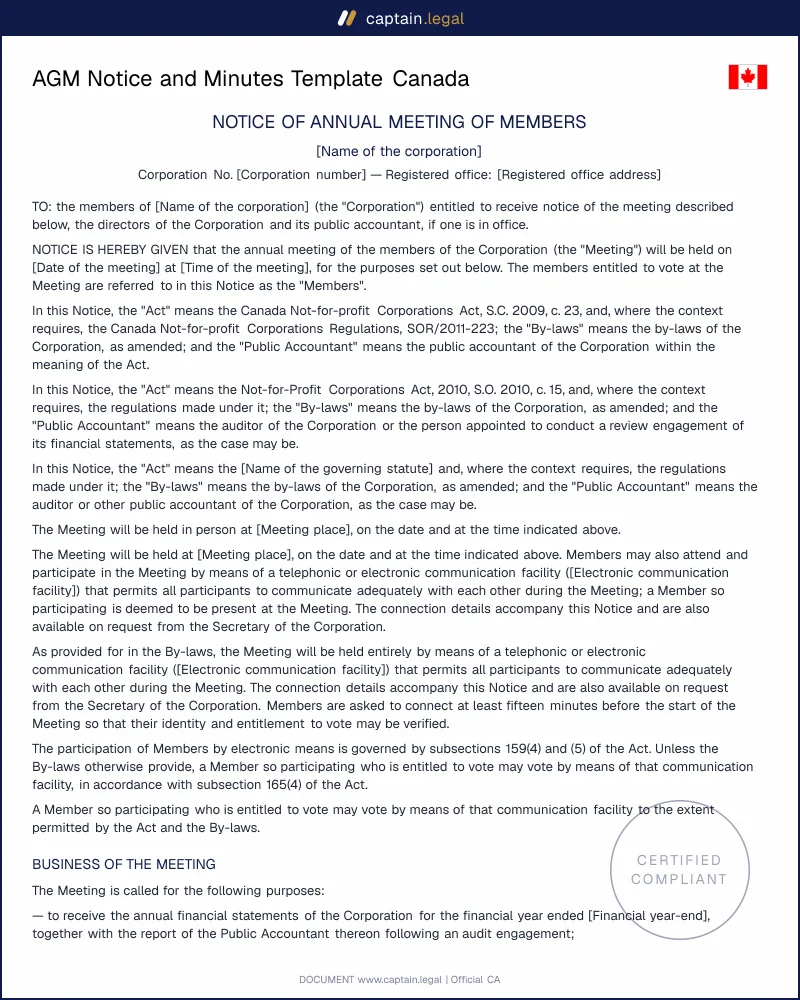
You start by choosing the governing statute (NFP Act, ONCA, BC Societies Act or Alberta Societies Act), and the form adapts the notice window and the section references throughout both documents. You then enter the corporation's legal name, its corporation or society number and the financial year-end, the data point that tells you the latest date on which the meeting can lawfully be held. The agenda comes next: mandatory items are pre-loaded, and you add special business by choosing the type of resolution so that its full text and voting threshold appear in the notice. If your by-laws allow virtual or hybrid meetings, you indicate the platform and the voting method; if they provide for proxies, you set the deposit deadline.

After the meeting, you return to the same document to complete the minutes: attendance and quorum, chair and secretary, nominations and election results, the public accountant appointed and the outcome of each vote. The finished file downloads in Word and PDF, ready for signature and filing next to your other governance documents for Canadian non-profits. Director changes still require a separate filing, within 15 days for federal corporations under section 134.

Common mistakes to avoid

The most frequent error is a notice sent outside the statutory window. Secretaries used to the ONCA's 10-day minimum apply it to a federal corporation and send 14 days' notice, which exposes every resolution to challenge unless the members waive the defect. Counting is the second trap: under section 27 of the Interpretation Act, a minimum notice period runs in clear days, excluding both the day of sending and the day of the meeting. The third is treating the financial statements as an approval item. "Moved and seconded that the financial statements be approved" appears in countless minute books and misstates the law, since members only receive the statements. A fourth mistake is skipping the appointment of the public accountant, or recording a waiver that was not unanimous where section 182 demands unanimity.

Election records cause the next layer of trouble. Minutes that announce "the slate was elected" without stating each director's term make it impossible to know when a seat expires. Equally common is the fully virtual meeting held when the by-laws say nothing about it; at the federal level, a meeting held entirely by electronic means needs express by-law authority under subsection 159(5). Finally, many organizations never sign their minutes. Unsigned minutes carry little weight, and a missing signature is often the first thing a dissatisfied member or a funder's due diligence spots.

Key takeaways

AGM TIMING

Meet the statutory meeting window

Federal not-for-profit corporations must call the first AGM within 18 months of incorporation. Later AGMs must occur within 15 months of the last meeting and no more than six months after financial year-end under NFP Act section 160. If that window cannot be met, the corporation may apply to the Director under subsection 160(2) if members are not prejudiced.

NOTICE

Give members enough notice to decide

The notice under NFP Act section 162 sets the date, time, location or electronic platform, and meeting business. Federal notice periods run 21 to 60 days for mail, courier or personal delivery, and 21 to 35 days electronically. Any special business needs enough detail for a reasoned judgment, including the text of any special resolution.

MINUTES

Record only member decisions

Members' minutes are the permanent record kept under NFP Act section 20, not a rewrite of board minutes. They should show the financial statements were placed before members, director elections occurred and the public accountant was appointed under section 181. Clean minutes help when a member, funder or the CRA asks how the AGM was handled.

Frequently Asked Questions

Yes, provided the notice goes out within the statutory window and the meeting follows the corporation's by-laws. No statute imposes a mandatory form for notices or minutes. A court examines whether the right members received the required content on time, whether quorum existed and whether each resolution reached its threshold. Minutes signed by the chair and secretary and kept in the minute book under section 20 of the NFP Act are the corporation's best evidence of what was decided.

It depends on the governing statute. Federal corporations give 21 to 60 days by mail, courier or personal delivery, or 21 to 35 days by electronic means. Ontario corporations under the ONCA give 10 to 50 days. BC societies give 14 days unless their bylaws set another period between 7 and 60 days, and Alberta societies follow their bylaws for ordinary business but need 21 days for any special resolution. Count clear days: exclude both the day the notice is sent and the day of the meeting.

At the federal level, members may join an in-person meeting electronically if the corporation offers the facility, under subsection 159(4) of the NFP Act. A meeting held entirely by electronic means is a different matter: it needs express authorization in the by-laws. Ontario and British Columbia also provide for electronic meetings, subject to the articles or bylaws. In every case, the notice should explain how to connect and vote, and the minutes should record who attended remotely.

No. Under section 172 of the NFP Act, the directors approve the financial statements and place them before the members, who receive them and may ask questions. The same logic applies under the ONCA and the BC Societies Act. What members actually vote on is the appointment of the public accountant, or its waiver where the statute allows it. Minutes recording an "approval" misstate the legal effect of the meeting.

Directors who fail to call the AGM on time breach the statute, and members can requisition a meeting or ask a court to order one. Incumbent directors stay in office until successors are elected. For federal corporations, the better course is an application to the Director under subsection 160(2) before the deadline passes, showing that members are not prejudiced and keeping them informed financially. Corporations Canada may also dissolve a corporation that stops filing its annual returns.

Both documents download in editable Word and in PDF. Your secretary adjusts the wording to match by-law terminology in Word, then circulates and archives the PDF. Many corporations prepare a membership application, a proxy form and directors' resolutions at the same time, all available in our complete catalogue of Canadian legal documents. Keep the signed PDF in the minute book with the list of members entitled to vote and any proxies received.

4.7/5

15 verified reviews · 50 000+ downloads

AGM Notice and Minutes Canada | NFP Act s.160 & ONCA
  • Immediate access to the document
  • PDF + Word download
  • Compliant with 2026 legislation
  • Reviewed by lawyers
Fill in the template
Secure payment
Updated on October 11, 2026

You might also like

Gift Acceptance Policy Canada
Official Donation Receipt Template Canada