Ontario corporations are governed by the Business Corporations Act, R.S.O. 1990, c. B.16, whose section 116 reproduces the federal mechanism: directors make the by-law, shareholders confirm it at the next meeting. Ontario repealed its resident director requirement in section 118(3) on July 5, 2021, so an Ontario company may have an entirely non-resident board. The same amendments let a non-offering corporation pass a written ordinary resolution by a majority of voting shares, with notice to the shareholders who did not sign. Notice of meetings under section 96 runs from 10 to 50 days for a non-offering corporation.
Alberta corporations follow the Business Corporations Act, R.S.A. 2000, c. B-9, where the board adopts by-laws and submits them to shareholders under section 102. Alberta removed its director residency requirement in 2021, which makes it a common choice for private companies with directors abroad. Annual returns go to the Alberta Corporate Registry rather than to Corporations Canada.
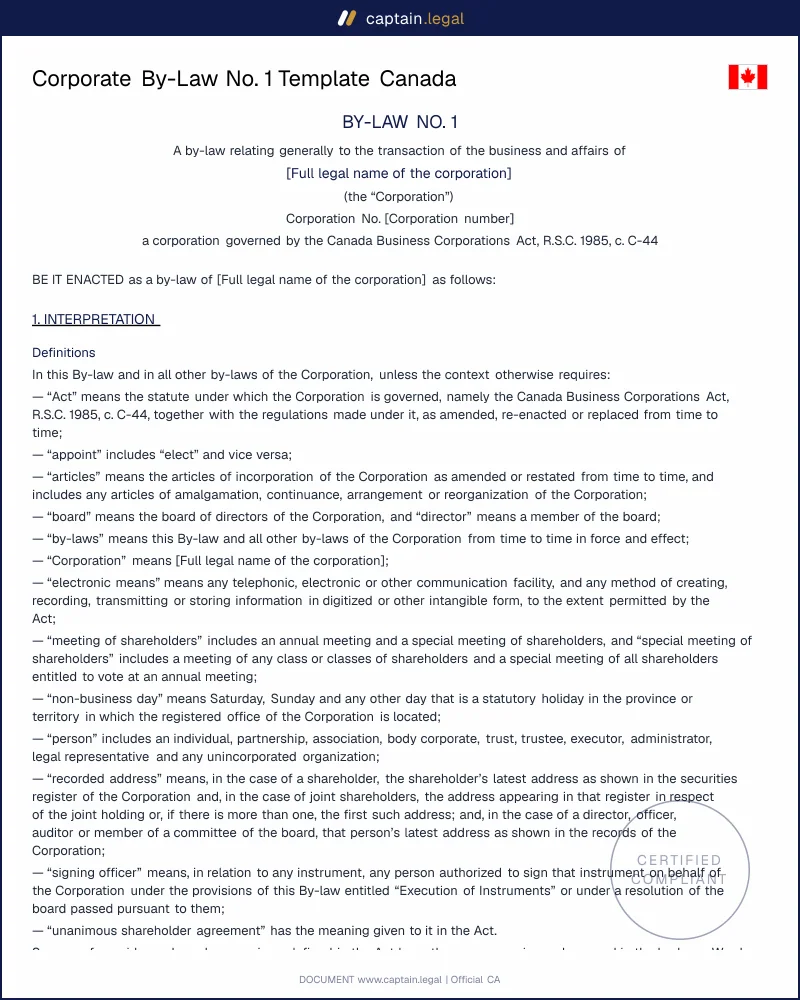
British Columbia is the exception every practitioner flags. The Business Corporations Act, S.B.C. 2002, c. 57, has no by-laws: governance rules sit in the company's Articles, alongside a Notice of Articles filed with the registry. A BC company cannot adopt a By-Law No. 1 as such; its governance provisions must be written into its Articles. Our template still works as a drafting base, adopted by the resolution those Articles require.
Quebec corporations are governed by the Business Corporations Act, CQLR c. S-31.1, which follows the CBCA model: by-laws adopted by the board take effect immediately and go to shareholders at the next meeting. The Act states that the articles prevail over the by-laws in case of conflict. There is no residency requirement, but changes to directors must be declared to the Registraire des entreprises.