Employment

Contract Amendment Letter Canada | Hobbs & Quach Rules

Amendment letter drafted to Hobbs v. TDI, Quach v. Mitrux and provincial ESA minimums. Fresh consideration clause and savings provision. Word and PDF.
4.7/5— 22 reviews50 000+ downloadsInstant download
Share

An employment contract amendment letter is the written instrument a Canadian employer uses to change the salary, hours, title or duties of an employee who is already on the payroll. Done properly, it turns a proposed change into a binding variation of the existing contract, signed by both parties and supported by the fresh consideration that courts in Ontario, British Columbia and Alberta still require. Done casually, it can hand the employee a constructive dismissal claim or leave the old terms quietly in force. This template is written for HR managers, business owners and in-house counsel in the common-law provinces and federally regulated workplaces who need a variation that will hold up when it is tested.

Compliant

2026 Legislation

50,000+ clients

trust us

Affordable

From $4.90 / doc

Secure payment

Instant download

Contract Amendment Letter Canada | Hobbs & Quach Rules

Secure payment

Fill in the template

What is an employment contract amendment letter?

An employment contract amendment letter is a short bilateral agreement that identifies the original contract, sets out the terms being changed, states what the employee receives in exchange, fixes an effective date and confirms that every other term continues unchanged. It is not a new contract. The original offer letter or written employment agreement for Canadian employees remains the governing document, and the letter operates as a targeted edit to it. Courts read the two documents together, and any genuine ambiguity is resolved against the drafter under the contra proferentem rule, which in employment cases almost always means against the employer.

The letter also differs from a policy notice. A policy notice informs staff of a rule the employer may already set under its management rights, such as a dress code or an expense approval process. An amendment letter changes a term of the contract itself, which the employer cannot impose alone. Salary, commission structure, hours of work, job title, reporting line, work location and termination entitlements are treated as contractual terms in nearly every Canadian case. The letter exists to record the employee's agreement in a form that is clear, voluntary and supported by something of value.

When do you need this document?

The most common trigger is a change in compensation. A raise is simple, since the increase is itself the consideration, but a restructured commission plan or a reduction during a downturn needs a signed variation that states the new formula precisely. Bonus language deserves extra care after Matthews v. Ocean Nutrition Canada Ltd., 2020 SCC 26, which requires clear and unambiguous wording before an employee loses incentive pay. A change in hours or schedule comes next: moving a full-time employee to four days or introducing an averaging arrangement alters a core term, and several provinces require written agreement for averaging. Promotions and demotions follow, since a new title usually carries new duties and a new reporting line that belong in one signed document.

Employers also use the letter to add protective covenants mid-employment, typically confidentiality or non-solicitation obligations once an employee gains access to key accounts. Those clauses fail for want of consideration more often than any other term, so they are best drafted alongside a dedicated non-compete and non-solicitation agreement for Canada and paired with a signing payment or a genuine promotion. The sale of a business is a frequent edge case. An asset buyer that keeps staff often wants to harmonize terms quickly, and those changes should be planned in the business purchase agreement for Canadian asset and share deals before being documented employee by employee. Finally, the letter has no place for unionized employees whose terms are fixed by a collective agreement, since individual bargaining over those terms is not permitted.

Key clauses included in our template

  • The reference to the original contract identifies the agreement being varied by date and title, along with any earlier amendments. Without that anchor, a court may read the letter as a stand-alone contract with its own gaps.
  • The description of the changed terms sets out each variation in full, quoting the old wording and the replacement where precision matters. Salary is stated as an annual figure and hours as a weekly schedule.
  • The consideration clause names the specific benefit the employee receives: a signing payment, a salary increase, additional vacation, an improved severance entitlement or a promotion. A clause that cites only "continued employment" will not survive scrutiny in Ontario or British Columbia.
  • The effective date is set far enough ahead to give the employee real time to consider the change and obtain advice, which supports the finding that consent was voluntary.
  • The employment standards savings provision confirms that nothing in the amendment reduces any entitlement below the statutory minimum. After Waksdale v. Swegon North America Inc., 2020 ONCA 391, any termination language touched by the amendment must be read against the whole contract, since one non-compliant provision can void the entire termination scheme.
  • The continuation and entire agreement clause states that every term not expressly amended continues unchanged, and that the letter and the original contract together form the whole agreement.
  • The independent legal advice acknowledgment and signature block records that the employee could seek independent advice, signed voluntarily and received a copy.

Provincial and federal considerations

Ontario has the largest body of appellate case law on consideration for mid-employment changes, and employers there should treat Francis and Hobbs as settled. Section 5 of the Employment Standards Act, 2000 voids any term below the statutory floor, and section 13 requires written authorization for wage deductions. Hours above 48 per week need a written excess hours agreement under section 17, and overtime averaging a separate written agreement under section 22. Since the Working for Workers Act, 2021, section 67.2 prohibits most new non-compete clauses, subject to narrow exceptions for executives and business sales. On a sale of business, section 9 preserves the employee's prior service with the buyer.

British Columbia adds a statutory remedy to the common-law rule. Under section 66 of the Employment Standards Act, the Director may find that employment has been terminated where a condition of employment is substantially altered, which triggers compensation for length of service under section 63 without any court action. Section 4 prevents waiver of the minimum requirements, averaging agreements must meet section 37, and section 97 deals with continuity on a business sale. After Quach, assume fresh consideration is required for any significant amendment.

Alberta applies the same consideration rule, confirmed for mid-employment restrictive covenants in Globex Foreign Exchange Corporation v. Kelcher, 2011 ABCA 240. Under section 4 of the Employment Standards Code, an agreement that the Code does not apply is void, and averaging arrangements carry their own documentary requirements. A mid-year cut to commission eligibility deserves the same care as a change to base salary.

Federally regulated employers in banking, telecommunications and interprovincial transportation apply Part III of the Canada Labour Code. Section 168 makes the Code's standards prevail over less favourable contract terms. A modified work schedule under section 170 needs approval by at least 70 per cent of affected employees where no collective agreement applies. Non-managerial employees with 12 consecutive months of service can also challenge an imposed change as an unjust dismissal under section 240.

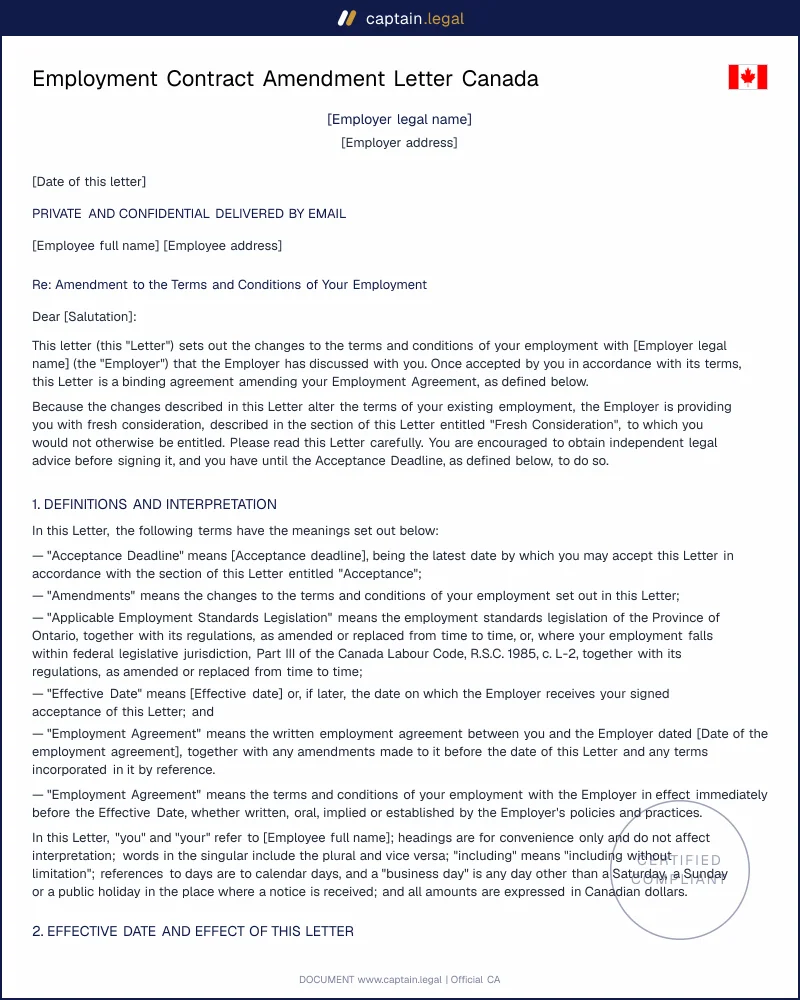
How to fill out this employment contract amendment letter

You start by selecting the province or the federal regime that governs the employment relationship. That choice drives the statutory references and the savings provision in the final document. From there, you enter the parties' names, the employee's current title and the date of the original contract, along with any earlier amendments the letter needs to reference.

The questionnaire then asks which terms are changing (salary, hours, title, duties or location) and collects the current and replacement wording for each. The consideration section comes next, where you identify the specific benefit the employee receives in exchange for the change. Take the time to make it concrete and new, because this is the clause a court will examine first.

You then set the effective date and the period the employee has to review the letter. A later effective date, with an express invitation to obtain independent legal advice, strengthens the evidence of voluntary consent if the amendment is later challenged. Once the fields are complete, the document is generated in Word and PDF, ready for both signatures. Keep a signed copy in the personnel file and give the employee one as well.

Common mistakes to avoid

The most frequent error is treating the employee's continued attendance as acceptance. An employer announces a pay cut by email, the employee keeps working while objecting, and the employer assumes the matter is closed. Under Wronko, that employee has accepted nothing and the old terms still apply. The second mistake is offering consideration with no real value, or a benefit the employee was already entitled to, such as a raise promised at the last review. A recycled benefit is no benefit at all, and courts look at substance rather than labels.

Never present the letter on the day the change takes effect, and never pair the request for a signature with a threat of dismissal; both facts point toward duress. A related error is amending one clause while ignoring its effect on the rest of the contract. Changing compensation without updating the definition of earnings in the termination clause can push the severance formula below the statutory minimum and, under Machtinger, expose the employer to full common-law notice. When agreement proves impossible, the safer route is reasonable working notice of the change, or ending the existing contract with a properly drafted termination letter that complies with Canadian employment standards and offering re-engagement on the new terms.

Key takeaways

Fresh consideration

Continued work will not carry the deal

An amendment is a new bargain, not a memo. Under Hobbs v. TDI and Quach v. Mitrux, asking an employee to sign after starting work requires something new of value, such as a benefit tied to the change. Mere continued employment usually leaves the variation exposed and the original term may remain in force.

ESA floor

Minimum standards set the lower limit

The letter cannot reduce statutory employment standards. In Ontario, section 5 of the Employment Standards Act, 2000 bars contracting out; the same floor concept applies across provincial employment standards regimes and federally regulated workplaces. If a termination clause dips below minimums, Machtinger can make it void and push the employer into common-law reasonable notice.

Unilateral changes

Imposed changes can become dismissal

Salary, hours, duties, title, reporting line, work location and termination entitlements are contractual terms, not casual policy updates. Farber and Potter treat a unilateral, substantial change to an essential term as constructive dismissal. A clear written amendment, signed by both sides and tied to an effective date, helps avoid a dispute over whether the old terms still govern.

Frequently Asked Questions

Yes, provided three conditions are met. Both parties must sign it, the employee must receive fresh consideration for agreeing to the change, and the amended terms must respect the governing employment standards legislation. Courts in Ontario, British Columbia and Alberta have set aside variations that failed any one of those tests, most often the consideration requirement. The template builds each condition into the document through a consideration clause, a statutory savings provision and a signature block recording voluntary acceptance. A letter signed under pressure, or with nothing new offered, remains open to challenge whatever its wording.

Generally no. An existing employee is already entitled to keep working until dismissed with reasonable notice, so a promise of continued employment gives nothing new. Hobbs v. TDI Canada Ltd. in Ontario and Quach v. Mitrux Services Ltd. in British Columbia both rejected the argument. Continued employment counts only where the employer genuinely intended to terminate and held back in exchange for the signature, which is hard to prove after the fact. Offer something concrete instead: a signing payment, a pay increase, extra vacation days or an improved termination entitlement.

Not lawfully, if the change is significant. A unilateral pay cut or a substantial change in hours breaches an essential term, and under Potter v. New Brunswick Legal Aid Services Commission the employee may treat it as a constructive dismissal and claim reasonable notice. The employee can also object in writing, keep working and hold the employer to the original terms. Staying silent is risky, because a court may find that a long period without protest amounts to acceptance of the new terms.

No statute fixes a review period for a voluntary amendment, but courts look closely at the time allowed. In practice, at least one to two weeks before signature, with a later effective date, supports a finding of informed and voluntary consent. Larger changes, such as a pay reduction or a new restrictive covenant, justify a longer period and an express invitation to seek independent legal advice. If the employer decides to impose the change after a refusal, the working notice should match the employee's common-law reasonable notice, which can run to many months.

Yes. The completed letter is generated in both Word and PDF. The Word version lets you add a letterhead or attach a revised job description before signature, while the PDF suits electronic signature platforms and the personnel file. Electronic signatures are generally accepted for employment documents in the common-law provinces under their electronic commerce statutes, provided the method reliably identifies the signatory. Related forms for hiring, discipline and termination are available in our range of Canadian employment and HR templates.

No. Quebec employment relationships are governed by the Civil Code of Québec, notably articles 2085 and following, and by the Act respecting labour standards. Those rules follow civil law principles rather than the common-law doctrine of consideration, and the Charter of the French language imposes its own requirements on written employment documents. This template is drafted for the common-law provinces and for federally regulated employers outside Quebec. For other Canadian forms, browse the complete catalogue of Captain.Legal documents for Canada.

4.7/5

22 verified reviews · 50 000+ downloads

Contract Amendment Letter Canada | Hobbs & Quach Rules
  • Immediate access to the document
  • PDF + Word download
  • Compliant with 2026 legislation
  • Reviewed by lawyers
Fill in the template
Secure payment
Updated on October 12, 2026

You might also like

Employment Verification Letter Canada
Full and Final Release Agreement Canada