Family & Divorce

Financial Disclosure Statement | Support Guidelines s.21

Disclosure schedule built to Divorce Act s.7.4, Child Support Guidelines s.21 and provincial rules (ON Form 13.1, BC F8, AB FL-17). Word and PDF.
4.8/5— 17 reviews50 000+ downloadsInstant download
Share

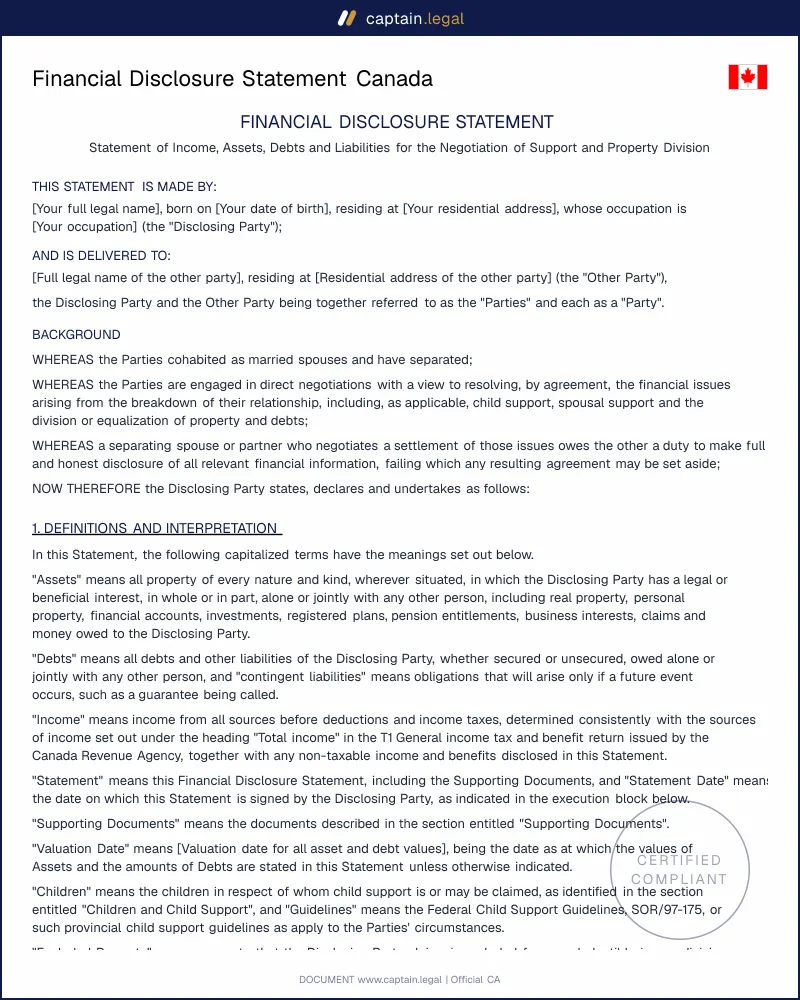
A financial disclosure statement is the signed schedule in which a separating spouse or common-law partner lists every source of income, every asset and every debt, with a value attached to each line. In Canadian family law, nothing serious gets negotiated without it: no lawyer, mediator or judge will approve child support, spousal support or a division of property until both sides have put their numbers on paper. Our template is built for spouses and partners in the common law provinces who want to exchange full and frank disclosure before negotiating, whether at the kitchen table, in mediation or through counsel.

Compliant

2026 Legislation

50,000+ clients

trust us

Affordable

From $4.90 / doc

Secure payment

Instant download

Financial Disclosure Statement | Support Guidelines s.21

Secure payment

Fill in the template

What is a financial disclosure statement in Canada?

In court practice the document goes by several names. Ontario calls it a financial statement (Form 13 or Form 13.1), British Columbia uses Form F8, and Alberta attaches a statement of income, assets and liabilities to its Notice to Disclose. The content is the same in every version: income for the last three tax years, a monthly budget, the value of everything you own and owe, and an index of the documents proving each figure. The valuation dates depend on the province. Ontario values property at the date of separation and deducts what each spouse brought in at the date of marriage, while British Columbia and Alberta generally work from current values, with dates of acquisition used to support excluded or exempt property.

The statement is the evidence, not the deal. A separation agreement drafted to the Divorce Act records what the parties decided; the financial disclosure statement shows what they knew when they decided it. If a bonus lands or a property sells before settlement, the statement must be updated.

When do you need this document?

The most common trigger is a negotiated separation. The first practical step is an exchange of statements. Most family mediators ask for it before the first joint session, and collaborative family law makes it a condition of the process. A lawyer giving independent legal advice on a draft settlement will want to see both financial disclosure statements before signing the certificate.

Disclosure also comes before marriage. Anyone signing a marriage contract with a disclosure schedule or a cohabitation agreement faces the same risk of having the contract set aside under section 56(4)(a), so the annexed schedule should be as complete as one prepared at separation. Support variation is the third scenario: a payor whose income has dropped, or a recipient who believes it has risen, needs an updated financial disclosure statement to bring or answer a variation application under section 17 of the Divorce Act.

Two edge cases deserve attention. The self-employed spouse or business owner is the first, because personal returns tell only part of the story; section 18 of the Guidelines lets a court attribute pre-tax corporate income to a shareholder. The second is a disputed separation date, where values at both candidate dates should be disclosed, since a few months can move a pension or portfolio considerably.

Key clauses included in our template

  • The identification and dates block names both parties, their province and their status as married spouses, common-law partners or adult interdependent partners. It also records every valuation date relevant to the claim, since status and dates decide which property regime applies.
  • The income schedule reports line 15000 of the T1 return for three years, then applies the Schedule III adjustments for items such as union dues and carrying charges. Each figure is tied to a notice of assessment or pay statement in the document index.
  • The monthly budget separates housing, transportation, child-related expenses and debt service. Spousal support ranges under the Spousal Support Advisory Guidelines and section 7 special expense claims both rely on it, so it is drafted line by line.
  • The asset schedule covers real property, bank and investment accounts, RRSPs, TFSAs, pensions at their family law value, vehicles and business interests. Shareholders in a private corporation are prompted for the share register and any shareholder agreement under the CBCA, since buy-sell formulas affect value.
  • The debts and liabilities schedule lists mortgages, credit lines, loans and guarantees. It also records contingent tax on RRSP withdrawals or capital gains on a cottage, which courts deduct when the disposition is likely.
  • The excluded property section identifies gifts, inheritances and injury awards from third parties, with a tracing note showing where the funds went. Exclusions that are not traced are routinely lost.
  • The certification and undertaking closes with a declaration of completeness. It also commits the signatory to disclose any material change before the matter is resolved.

Regional considerations

Ontario sets out disclosure in Rule 13 of the Family Law Rules, O. Reg. 114/99. A party claiming only support serves Form 13; once property is in issue, the longer Form 13.1 is required, backed by the listed documents and a Form 13A certificate of financial disclosure. Married spouses then complete a net family property statement (Form 13B) to calculate the equalization payment under section 5 of the Family Law Act, and defined benefit pensions enter that calculation at the family law value set by the plan administrator under the Pension Benefits Act. Unmarried partners do not share in the equalization regime, but they can claim spousal support under section 29 after three years of cohabitation, or sooner with a child.

British Columbia writes the duty into the statute itself. Section 5 of the Family Law Act requires full and true information to resolve a family law dispute, whether or not anyone has gone to court. In the Supreme Court, Rule 5-1 of the Supreme Court Family Rules requires a sworn Form F8 with attached income documents, generally within 30 days of service; the Provincial Court uses Form 4. Partners in a marriage-like relationship of at least two years are spouses for property purposes. Interests held through a trust should be disclosed along with the family trust deed and its beneficiary terms.

Alberta applies the Family Property Act to married spouses and, since 2020, to adult interdependent partners. Disclosure is often exchanged voluntarily, but the formal tool is the Notice to Disclose (Form FL-17) under Rule 12.41 of the Alberta Rules of Court. A party served has one month to provide the listed information or object, after which the court can sanction non-compliance. Partners claiming child support outside a divorce rely on the Alberta Child Support Guidelines, which mirror the federal disclosure model.

Quebec follows a civil law system built on the family patrimony (articles 414 and following of the Civil Code of Québec) and applies its own child support rules, even in divorce proceedings. Our template is drafted for the common law provinces, and Quebec residents should adapt it with local counsel.

How to fill out this financial disclosure statement

You start by selecting your province and legal status, because those answers decide which valuation dates appear and whether the property schedules follow equalization, family property or support only. From there, the income section walks through three years of returns and flags the adjustments the Guidelines allow.

The asset and debt screens work from documents you already hold. Keep your latest bank, investment, pension and mortgage statements at hand and enter each balance at each valuation date. Business owners are asked for three years of financial statements and any shareholder loan balance. The excluded property screen asks for the source of each gift or inheritance and the account it went into, which is what a lawyer needs to defend the exclusion.

Before downloading your financial disclosure statement, check the generated document index against the files you will attach. Once disclosure is exchanged, the same figures carry into the other family law agreements for separating couples in Canada.

Common mistakes to avoid

The most frequent error is valuing assets at the wrong date. An Ontario spouse who lists today's RRSP balance instead of its separation date value has produced a financial disclosure statement that cannot support an equalization calculation. Close behind is the gross value trap: listing registered accounts and investment property at face value without the tax payable on withdrawal or sale. Pensions are another weak point, since the family law value of a defined benefit plan comes from the administrator, and requests can take months.

Business owners have their own pitfalls. Reporting only the salary drawn while retained earnings accumulate invites a section 18 analysis and an adverse inference. Never omit an asset because you believe it is excluded; disclose it, then claim the exclusion. The same goes for accounts outside Canada, cryptocurrency and debts owed to relatives. Finally, many spouses treat disclosure as a one-time exercise. A bonus, severance or sale before settlement must be reported, and silence on that kind of change is exactly what cost the husband his agreement in Rick v. Brandsema.

Key takeaways

Full disclosure

Full numbers come before any deal

A financial disclosure statement is the signed schedule that puts every income source, asset and debt on paper with a value attached. In a separation, it is the evidence behind child support, spousal support and property division. Without full and frank disclosure, a lawyer, mediator or judge has no reliable basis to assess the proposed outcome.

Income proof

Three years of income records matter

Under Divorce Act section 7.4 and section 21 of the Federal Child Support Guidelines, disclosure must be complete, accurate and up to date. The income package usually includes tax returns and notices of assessment for the three most recent taxation years, current pay statements, and corporate or partnership financial statements where a spouse is self-employed or controls a corporation.

Settlement risk

Incomplete disclosure can undo a settlement

The statement is not just paperwork. Courts can draw an adverse inference and impute income under section 23 of the Federal Child Support Guidelines when a spouse does not comply. Agreements may also be set aside for hidden assets or debts, as reflected in Rick v. Brandsema and provincial rules in Ontario and British Columbia.

Frequently Asked Questions

The statement is evidence rather than a contract, but it carries real weight. Sworn or affirmed before a commissioner for taking affidavits, a knowingly false entry exposes you to perjury and to adverse findings of fact. Even an unsworn statement becomes the factual basis of any agreement that follows, and under Rick v. Brandsema and section 56(4)(a) of Ontario's Family Law Act, an agreement signed on inaccurate disclosure can be set aside years later.

Yes, both formats are available as soon as you finish the questionnaire. Word suits the negotiation phase, since balances change and you will likely update the schedules more than once before settlement. PDF is better for the version you sign, swear or send to the other party's lawyer, because it preserves the layout and the page references in the document index. Both versions include the full document index, so supporting records can be matched to each line.

Under section 21(3) of the Federal Child Support Guidelines, a spouse served with a child support application must provide the required income documents within 30 days if living in Canada or the United States, and within 60 days elsewhere. Provincial deadlines are similar: generally 30 days for a Form F8 in British Columbia and one month to answer an Alberta Notice to Disclose. Outside litigation no statutory clock applies, but most lawyers propose a 30-day timetable in their first letter.

Yes, and this is where amicable separations often go wrong. Agreeing on the outcome does not protect a deal reached without the information needed to evaluate it. Courts across the common law provinces have set aside separation agreements and marriage contracts where significant assets or debts were later shown to be missing, even when both spouses signed willingly. A complete exchange now costs far less than defending an application to reopen the settlement.

Under sections 19 and 23 of the Guidelines, a judge can impute income to a spouse who withholds required information, inferring that the missing figures would not have helped them. Under section 24, the court can also strike pleadings, award costs or, in serious cases, find a party in contempt. In Alberta the first step is usually a Notice to Disclose; in Ontario and British Columbia, a disclosure motion under the provincial rules does the same work.

Once statements are exchanged, the usual next steps are a separation agreement, a parenting plan and stand-alone support terms. The full Captain.Legal catalogue of Canadian legal documents groups them by category and practice area, so you can pick the agreements that match your status as married spouses, common-law partners or adult interdependent partners. Carry the same valuation dates and income figures from your financial disclosure statement into every document to avoid inconsistencies.

4.8/5

17 verified reviews · 50 000+ downloads

Financial Disclosure Statement | Support Guidelines s.21
  • Immediate access to the document
  • PDF + Word download
  • Compliant with 2026 legislation
  • Reviewed by lawyers
Fill in the template
Secure payment
Updated on October 7, 2026

You might also like

Postnuptial Agreement Template Canada
Cohabitation Agreement Canada