Business

Organizational Resolutions | CBCA s.104, s.117 & s.142

Directors' and shareholders' resolutions under CBCA s.104, s.117 and s.142: By-law No. 1, fully paid shares (s.25), s.21.1 ISC register. OBCA and BCBCA.
4.8/5— 13 reviews50 000+ downloadsInstant download
Share

An organizational resolutions pack is the set of written decisions a newly incorporated Canadian corporation signs to complete its own set-up: the first directors' resolutions, the first shareholders' resolutions, the issuance of founder shares, the appointment of officers and the opening of the corporate registers. The certificate of incorporation creates the legal person. It does not say who owns the shares, who may sign a cheque or which by-law governs board meetings. Those answers live in the minute book. This template is drafted for founders, holding company owners, accountants and corporate clerks working under the Canada Business Corporations Act or a provincial business corporations statute who want a complete, signable minute book in one sitting.

Compliant

2026 Legislation

50,000+ clients

trust us

Affordable

From $4.90 / doc

Secure payment

Instant download

Organizational Resolutions | CBCA s.104, s.117 & s.142

Secure payment

Fill in the template

What is an organizational resolutions pack?

When Corporations Canada issues a certificate of incorporation, the corporation has articles, a registered office and first directors, but no shareholders, no officers and no internal rules. Section 104 of the CBCA fills that gap with an organizational meeting at which the directors may make by-laws, adopt forms of security certificates and corporate records, authorize the issue of securities, appoint officers, appoint an auditor until the first annual meeting and make banking arrangements. In practice, closely held corporations rarely hold that meeting. The directors sign the same decisions as written resolutions under s. 117(1), and the shareholders do likewise under s. 142(1). A complete set of organizational resolutions therefore holds two layers of decisions, the documents that make them effective (subscriptions, consents to act, share certificates) and the registers that record the result.

Articles fix the authorized share structure, by-laws are the internal rulebook, and organizational resolutions are the decisions that put both into operation. They are also distinct from a unanimous shareholder agreement under CBCA section 146, which restricts the directors' powers by contract and sits beside the resolutions rather than replacing them. Corporations without share capital follow a different statute, so a society or charity should begin with not-for-profit by-laws drafted under the NFP Act. For the contracts that usually follow the minute book, see our Canadian business and incorporation templates.

When do you need this document?

The obvious moment is the week after incorporation. An online filing produces a certificate, articles and a corporation number, and nothing else. The bank wants a certified banking resolution, and the accountant wants to know who owns the shares. Without signed organizational resolutions, neither question has a legal answer.

The second scenario is corrective. Accountants regularly take over corporations that have traded for two or three years with an empty minute book, and the fix is a set of resolutions that ratifies past acts and issues the shares properly. The third is a holding company set-up, where the shareholder may be another corporation or a discretionary trust; if a family trust subscribes for growth shares, the family trust deed with ITA s. 104(4) provisions must be settled before the subscription is accepted, not after.

Two edge cases deserve attention. Founders who transfer an existing sole proprietorship to the corporation in exchange for shares need a directors' resolution valuing the property under s. 25(3) and (4), and the tax side usually runs through a section 85 election under the Income Tax Act. Foreign founders incorporating federally must also confirm the resident Canadian quota before the first board resolution is signed.

Key clauses included in our template

  • The directors' resolution adopting By-law No. 1 brings into force a general by-law covering quorum, notice of meetings, signing authority and the fiscal year end. The resolution also directs that the by-law be submitted to shareholders, so it does not lapse under s. 103.
  • The acceptance of subscriptions and issuance of shares names each subscriber, the class and number of shares, and the consideration received. The board declares the shares fully paid, values any non-cash consideration and directs the amount to the stated capital account of that class.
  • The appointment of officers designates the president, secretary and any other officers under s. 121. Where an officer is also a salaried employee, pair the resolution with a written employment agreement for the officers you appoint.
  • The banking resolution names the financial institution, the authorized signatories and the signing rule, in a form the secretary can certify for the bank.
  • The shareholders' resolution confirms By-law No. 1, ratifies the election of the first directors and, for a non-distributing corporation, records the consent of all shareholders, voting or not, to dispense with an auditor under s. 163, a consent that lapses at the next annual meeting.
  • The consents to act as director satisfy s. 106(9) and include a residency declaration for the s. 105(3) count.
  • The share certificates and registers cover the securities register, transfers, directors, officers and individuals with significant control. Certificates are optional under s. 49, and a corporate seal is optional under s. 23.

Regional considerations

Ontario corporations follow the Business Corporations Act (Ontario), which tracks the federal model closely. Directors may act by written resolution under s. 129(1) and shareholders under s. 104(1). The 25 per cent resident Canadian rule was repealed effective July 5, 2021, so a board of non-residents is now acceptable. Since January 1, 2023, s. 140.2 requires a register of individuals with significant control, kept with the corporate records rather than filed. An initial return under the Corporations Information Act is due within 60 days of incorporation.

British Columbia works differently. Under the Business Corporations Act (British Columbia), each incorporator subscribes for at least one share in the incorporation agreement, and the articles adopted at that time contain the internal rules, so there is no separate By-law No. 1. A directors' consent resolution must be signed by every director, while an ordinary resolution of shareholders can be passed in writing by holders of at least two thirds of the votes. Private companies have kept a transparency register of significant individuals since October 1, 2020, and BC has had no director residency requirement for more than two decades.

Alberta corporations are governed by the Business Corporations Act (Alberta), modelled on the CBCA, so the organizational sequence and the written resolution mechanisms follow the federal pattern almost section for section. The former director residency requirement in s. 105(3) was repealed effective March 29, 2021, removing the main reason Alberta founders once incorporated elsewhere and registered back extra-provincially. The pack therefore applies with Alberta citations and without the residency declaration.

Quebec is a civil law jurisdiction. Corporations formed under the Business Corporations Act (Quebec) have no resident director rule, and since March 31, 2023 they must declare their ultimate beneficiaries to the Registraire des entreprises under the Act respecting the legal publicity of enterprises. The corporate name must also comply with the Charter of the French language. Drafting conventions differ enough that a Quebec minute book deserves local review.

How to fill out this organizational resolutions pack

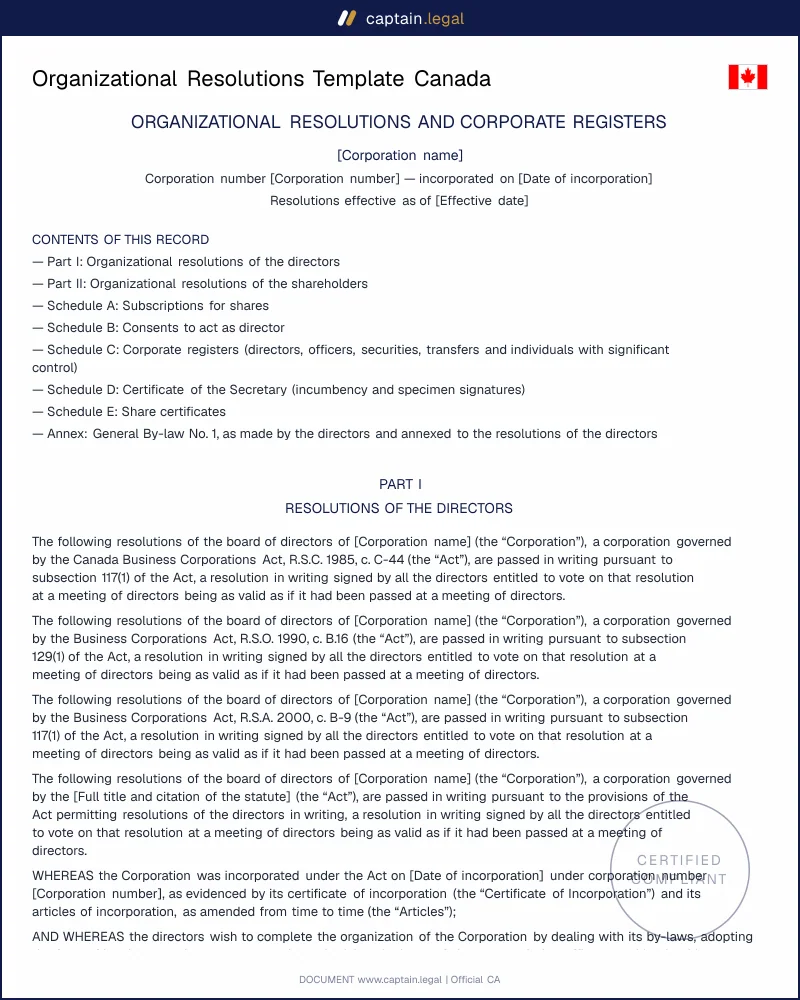
You start by choosing the governing statute: federal, Ontario, British Columbia, Alberta or Quebec. That answer sets the citations, the residency questions and whether a by-law is produced. Next, you enter the legal name, corporation number, date of incorporation and registered office exactly as they appear on the certificate, since banks check for any mismatch with the registry.

The form then asks for the share structure set out in your articles. You list each subscriber, the class, the number of shares and the consideration, and the template calculates the stated capital entries and generates matching share certificates. From there you name the directors, the officers, the bank and the signing rule, and indicate whether shareholders waive the audit. The last screen collects the details for the register of individuals with significant control, including citizenship and tax residence. Once you validate, your organizational resolutions are assembled in signing order: consents to act, directors' resolutions, subscriptions, shareholders' resolutions and registers, each with a signature block for every person required to sign.

Common mistakes to avoid

The most frequent error is assuming that the person who filed the articles owns the company. Under the CBCA, incorporation creates no shareholder; until the directors issue shares by resolution, the corporation has none. The second error is issuing shares for consideration that does not qualify. A promissory note means the shares are not validly issued at all, while an inflated value placed on "know-how" or equipment exposes the directors who voted for the issue to personal liability for the shortfall under s. 118(1). Third, many minute books list directors who never signed a consent to act, so their election never took effect.

By-laws adopted by the board but never confirmed by shareholders quietly lapse, and decisions made under them become contestable. The ISC register is often left blank because founders believe it only concerns large companies, yet failing to file that information exposes a federal corporation to fines and even dissolution. Never backdate organizational resolutions to the incorporation date. Corrective resolutions carry the actual signing date and ratify earlier acts expressly. Finally, check that every class you issue is authorized by the articles: shares of a class the articles do not create cannot be validly issued until articles of amendment are filed.

Key takeaways

Minute book

Incorporation is only the starting point

The certificate creates the corporation, but the organizational resolutions make it workable. They record the first directors' and shareholders' decisions: By-law No. 1, officers, banking authority, share subscriptions and corporate registers. Without that minute book trail, a founder may own shares in practice but lack the clean records a bank, accountant or buyer will ask to see.

CBCA process

Written resolutions can replace the first meeting

CBCA s. 104 allows an organizational meeting on at least five days' notice, but closely held corporations usually use written directors' resolutions under s. 117(1) and written shareholders' resolutions under s. 142(1). Every director entitled to vote must sign the directors' resolutions. Board-made by-laws take effect right away, but must still be submitted to shareholders as required by s. 103.

Founder shares

Shares must be fully paid before issue

Directors authorize who receives shares, when, and for what consideration under CBCA s. 25(1). The shares have no par value, and the consideration goes to stated capital. A share cannot be issued until fully paid in money, property or past services; a promissory note does not count. Non-cash consideration should be valued by directors' resolution.

Frequently Asked Questions

Yes. Under s. 117(1) of the CBCA, a resolution in writing signed by all directors entitled to vote is as valid as if it had been passed at a meeting, and s. 142(1) gives the same effect to shareholder resolutions signed by all voting shareholders. Ontario and Alberta apply the same unanimity rule, while British Columbia allows an ordinary shareholders' resolution with written consent of two thirds of the votes. If one director refuses to sign, the board must meet. Signatures can be handwritten or electronic, and separately signed counterparts form one resolution.

No federal provision sets a deadline for the organizational meeting itself, but several clocks start on the date of incorporation. Federal corporations file ISC information with Corporations Canada at incorporation, Ontario corporations owe an initial return within 60 days, and the first annual meeting of shareholders must be held within 18 months under s. 133 of the CBCA. In practice, sign the pack within the first two weeks, before the corporation issues an invoice, signs a lease or receives founder funds.

Yes. The completed pack is delivered as an editable Word file and a print-ready PDF. The Word version lets your accountant or lawyer adjust a recital or add a resolution before signing, while the PDF is the version most people print, sign and scan into a digital minute book. Related documents for the same corporation can be generated from the full Canadian legal document catalogue using the same corporate details.

No statute requires a lawyer to prepare organizational resolutions, and many owner-managed corporations keep their own minute books. The template follows the statutory requirements and walks you through each decision your governing act requires. A lawyer adds value when the structure is unusual: several share classes with different dividend rights, an estate freeze, a section 85 rollover, foreign shareholders or a corporation that has operated for years without records. Even then, a completed draft shortens the review.

Yes. The same individual often holds every role, but the statute treats director, officer and shareholder as separate capacities. The sole director signs the directors' resolutions, then signs the shareholders' resolutions as sole shareholder, and each document states the capacity in which it is signed. That separation shows the corporation, not the individual, received the capital, which matters for limited liability and for the Canada Revenue Agency.

The corporation still exists, but its internal affairs are undocumented: nobody holds issued shares on paper, officers have no recorded authority and by-laws may not exist. The fix is a set of rectifying resolutions dated on the day they are signed. They ratify the directors' acts since incorporation, issue shares to the people who funded the company and appoint officers going forward. Where several founders were promised different stakes, document that agreement first.

4.8/5

13 verified reviews · 50 000+ downloads

Organizational Resolutions | CBCA s.104, s.117 & s.142
  • Immediate access to the document
  • PDF + Word download
  • Compliant with 2026 legislation
  • Reviewed by lawyers
Fill in the template
Secure payment
Updated on October 12, 2026

You might also like

Non-Disclosure Agreement Canada
Partnership Agreement Template