Non-Profit

Sponsorship Agreement Canada | ITA s.248(30) & ETA s.135

Sponsorship agreement drafted to ITA split-receipting rules, ETA s.135 and Trademarks Act s.50. Covers benefits, exclusivity and Quebec rules.
4.8/5— 16 reviews50 000+ downloadsInstant download
Share

A sponsorship agreement is the contract under which a business pays cash, or supplies goods and services, to a Canadian non-profit or registered charity in exchange for defined recognition: logo placement, naming rights, booth space or digital visibility. It fixes what the sponsor receives, when each instalment is due, how both parties may use each other's marks, and whether the sponsor holds category exclusivity. For a registered charity, it also settles the question every finance committee asks: can we issue an official donation receipt, or is this a business expense for the sponsor? Our corporate sponsorship contract is written for not-for-profit corporations, event organizers and their business partners who expect the standard of a charity law practice.

Compliant

2026 Legislation

50,000+ clients

trust us

Affordable

From $4.90 / doc

Secure payment

Instant download

Sponsorship Agreement Canada | ITA s.248(30) & ETA s.135

Secure payment

Fill in the template

What is a sponsorship agreement?

Under Canadian law, a sponsorship agreement is a bilateral commercial contract. The sponsor pays and the organization performs, whether by displaying a logo, naming a program after the sponsor or providing hospitality. That exchange of value is what separates sponsorship from a gift. Since Friedberg v. Canada, 92 DTC 6031 (FCA), a gift for tax purposes has meant a voluntary transfer of property with no benefit flowing back to the donor, a rule the split-receipting provisions later relaxed only for advantages that can be valued. Once the sponsor bargains for promotion, the payment becomes consideration, and the ordinary rules of formation and breach apply in the common law provinces as under the Civil Code of Québec.

Practitioners keep three neighbouring instruments apart. A donation agreement drafted around CRA receipting rules documents a true gift, with recognition kept modest so that a receipt can issue. A cause-related marketing arrangement ties the contribution to a share of the sponsor's sales, and the CRA treats the resulting publicity as an advantage that usually cannot be valued. The sponsorship agreement sits between them: commercial in substance, but performed by an organization whose purposes, tax status and by-laws limit what it can promise. A marketing contract borrowed from the private sector ignores those constraints.

When do you need this document?

The classic trigger is a title or presenting sponsor for a gala, run or conference, where one partner pays for visibility across every channel the event touches. Multi-year naming rights for a program, scholarship or room need more care, because the agreement has to say what happens to signage if the relationship ends early. Sports and arts organizations rely on the same contract for season packages sold in tiers. If the event also involves raffles or a venue contract, pair the sponsorship agreement with a fundraising event agreement covering raffle and venue terms.

In-kind sponsorship deserves its own paper trail. A printer supplying materials or a media outlet donating airtime expects recognition, and each raises a valuation question first. Two edge cases come up often. The first is a sponsor asking for the attendee or donor list, and PIPEDA expressly treats selling, bartering or leasing donor or membership lists as commercial activity requiring consent. The second is a sponsor controlled by a director, which triggers the disclosure duties in section 141 of the Canada Not-for-profit Corporations Act and the non-arm's-length rules in subsection 248(32) of the Income Tax Act.

Key clauses included in our template

  • The schedule of sponsor benefits lists every deliverable with its format, channel, quantity and date, from logo size to hospitality tickets. A benefit missing from the schedule is not owed.
  • The payment schedule sets instalments against milestones, typically a deposit on signature and the balance pre-event. It states whether amounts include GST/HST or rely on section 135 of the Excise Tax Act.
  • The reciprocal logo licence grants each party a limited, revocable right to use the other's marks, subject to written approval of each use. That approval mechanism preserves control under section 50 of the Trademarks Act.
  • The exclusivity clause defines the protected category precisely ("retail banking" rather than "financial services") and carves out existing partners, government funders and individual donors.
  • The receipting and tax clause records whether the payment is pure sponsorship with no receipt, or a split arrangement in which the charity values and discloses the advantage. Any split receipt follows section 3501 of the Income Tax Regulations, and the receipting decision stays with the charity alone.
  • The indemnity and insurance clause makes each party answer for its own negligence and for claims arising from its marks, and requires a sponsor running an on-site activation to carry liability insurance naming the organization as additional insured.
  • The reputation and termination clause lets either party exit if the other's conduct damages its name, with a pro-rated refund and a deadline for removing logos.
  • The authority clause confirms that the organization signs under a valid board of directors resolution under section 140 of the NFP Act, which matters for any multi-year commitment.

Provincial considerations

Ontario. Not-for-profit corporations operate under the Not-for-Profit Corporations Act, 2010, in force since October 19, 2021. Charities also answer to the Charities Accounting Act and the Public Guardian and Trustee. That layer matters when a sponsorship agreement earmarks funds for one program, because wording that reads like a restricted gift invites the argument that the money is held for a specific charitable purpose. Safer drafting names the program only as the sponsored activity.

Quebec. The contract is innominate and governed by the Civil Code of Québec (articles 1378 and following), and a tiered package the sponsor cannot negotiate may be a contract of adhesion under article 1379, exposing abusive clauses to annulment under article 1437. Since June 1, 2023, section 55 of the Charter of the French Language requires a French version of a contract of adhesion to be provided before the parties may choose to be bound by an English one. Event signage must respect the commercial publicity rules in section 58, and attendee data shared with a sponsor falls under the Act respecting the protection of personal information in the private sector.

British Columbia. Societies incorporate under the Societies Act (S.B.C. 2015, c. 18). Transferring member or attendee information to a sponsor falls under the provincial Personal Information Protection Act, which requires consent for disclosure to a third party. The agreement should also allocate responsibility for any special event liquor permit.

Alberta. Societies are governed by the Societies Act (R.S.A. 2000, c. S-14), and organizations soliciting the public also face the Charitable Fund-raising Act (R.S.A. 2000, c. C-9). When sponsorship is bundled with a public donation appeal, that Act's registration and disclosure duties can apply, and the agreement should assign them. Raffles need a licence from Alberta Gaming, Liquor and Cannabis.

How to fill out this sponsorship agreement

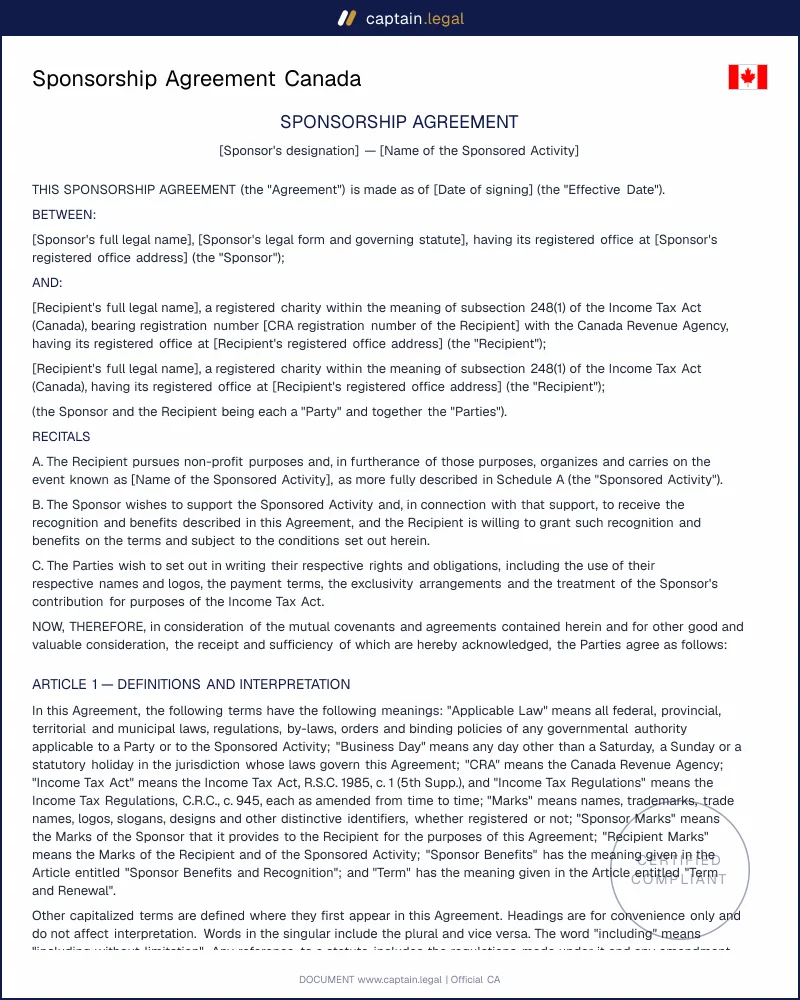
You start by identifying both parties with their exact legal names, their governing statute (NFP Act, ONCA, a provincial Societies Act or a business corporations statute) and, for a charity, its registration number. The form then asks for the governing province, which adjusts the language provisions for Quebec and the sales tax wording elsewhere. Next comes the sponsored activity, its term and any renewal option.

The benefits schedule is the longest step. Each deliverable becomes a dated, measurable obligation rather than a promise of "visibility". You then set the payment milestones and choose the tax treatment, either pure sponsorship or a split arrangement where the charity values the advantage. Finally, you choose the termination triggers and the authorized signatory, and the finished sponsorship agreement is ready for review by the board and the sponsor's counsel.

Common mistakes to avoid

The most expensive error is receipting a sponsorship as if it were a gift. A finance volunteer issues a full receipt to a company whose logo sat on every banner, the CRA audits, and the receipts are reversed. The opposite error is refusing any receipt to a business that only received a line in the annual report. Organizations also forget that the advantage is valued at fair market value, hospitality tickets included.

Drafting failures follow a pattern too. Exclusivity is promised for "the sector" without a definition, and the charity then loses a second sponsor. Logo use is granted without an approval right, so the sponsor's agency prints the charity's name on a product launch it never saw. And many relationships start with a letter of intent that may turn out to be binding, signed with firm exclusivity terms before any board has approved the deal. Never let a term sheet commit the organization to exclusivity or naming rights before the final agreement is signed.

Key takeaways

Tax receipts

Receipt only the eligible gift amount

A registered charity cannot treat every sponsorship dollar as a donation. Under Income Tax Act subsections 248(30) to 248(32), the receiptable amount is the payment minus the fair market value of benefits such as promotion or hospitality. If the advantage is over 80% of the payment, CRA generally will not recognize a gift.

GST/HST

Sponsorship tax is a separate analysis

GST/HST does not always attach to sponsorship benefits. Excise Tax Act section 135 can deem a public sector body's service or trademark licence for sponsor publicity not to be a supply. The carve-out has limits: it does not cover consideration mainly paid for advertising in periodicals, on radio or on television.

Brand control

Spell out benefits, marks and exclusivity

Set out every benefit: each cash or in-kind contribution, instalment date, logo placement, naming right, booth space and digital mention. Mark use needs written permission and control consistent with Trademarks Act section 50, and category exclusivity should say exactly who is blocked. Otherwise, a competing sponsor or off-brand logo use can quickly become a breach claim.

Frequently Asked Questions

Yes. A sponsorship agreement is an ordinary commercial contract, binding once there is offer, acceptance, consideration and an intention to create legal relations, or in Quebec the exchange of consents between capable parties under article 1385 of the Civil Code of Québec. No notarization or registration is required, and electronic signatures are valid. What matters in practice is that the non-profit's signatory acts under a board resolution or a signing authority in the by-laws.

Only for the part of the payment that is a true gift. If the sponsor receives advertising or promotional benefits whose value cannot be calculated, the charity cannot issue any official donation receipt. Where the advantage can be valued and stays at or below 80% of the payment, the charity may issue a split receipt showing the amount received, the value of the advantage and the eligible amount. Otherwise, the sponsor deducts the cost as a business expense.

Usually not. Section 135 of the Excise Tax Act deems that services or trademark licences supplied by a public sector body, charities and non-profits included, to a sponsor for use exclusively in publicizing its business are not supplies. The exception covers payments that are primarily for advertising in a periodical or on radio or television. Elements such as exhibition space can raise separate questions depending on the organization's status, so the template treats each benefit separately.

The template sets the deposit on signature and the balance a fixed number of days before the event, so the organization never finances the sponsor's visibility. For artwork, each party has a set number of business days to approve a proposed use of its logo, and silence counts as refusal, which preserves trademark control. If the sponsor misses an artwork deadline, the organization is released from that benefit without refund.

It can negotiate it. The clause must define the category narrowly and exclude government funders, individual donors and partners already under contract. A charity should not agree to refuse gifts from a competitor, because its directors must act in the best interests of the organization and its charitable purposes. Browse the Canadian non-profit and charity templates for the conflict of interest policy and related governance documents.

The force majeure clause suspends obligations for events beyond either party's control, such as public health orders or loss of the venue. If the event cannot be rescheduled within an agreed window, the sponsor chooses between a pro-rated refund of undelivered benefits and a credit toward the next edition.

You receive the completed document as an editable Word file and a PDF ready to sign, with the benefits schedule as an appendix. Every other template for Canadian organizations appears in the complete catalogue of Canadian legal documents.

4.8/5

16 verified reviews · 50 000+ downloads

Sponsorship Agreement Canada | ITA s.248(30) & ETA s.135
  • Immediate access to the document
  • PDF + Word download
  • Compliant with 2026 legislation
  • Reviewed by lawyers
Fill in the template
Secure payment
Updated on October 11, 2026

You might also like

Donation Agreement Template
Official Donation Receipt Template Canada