Non-Profit

Official Donation Receipt Canada | ITA Regulation 3501

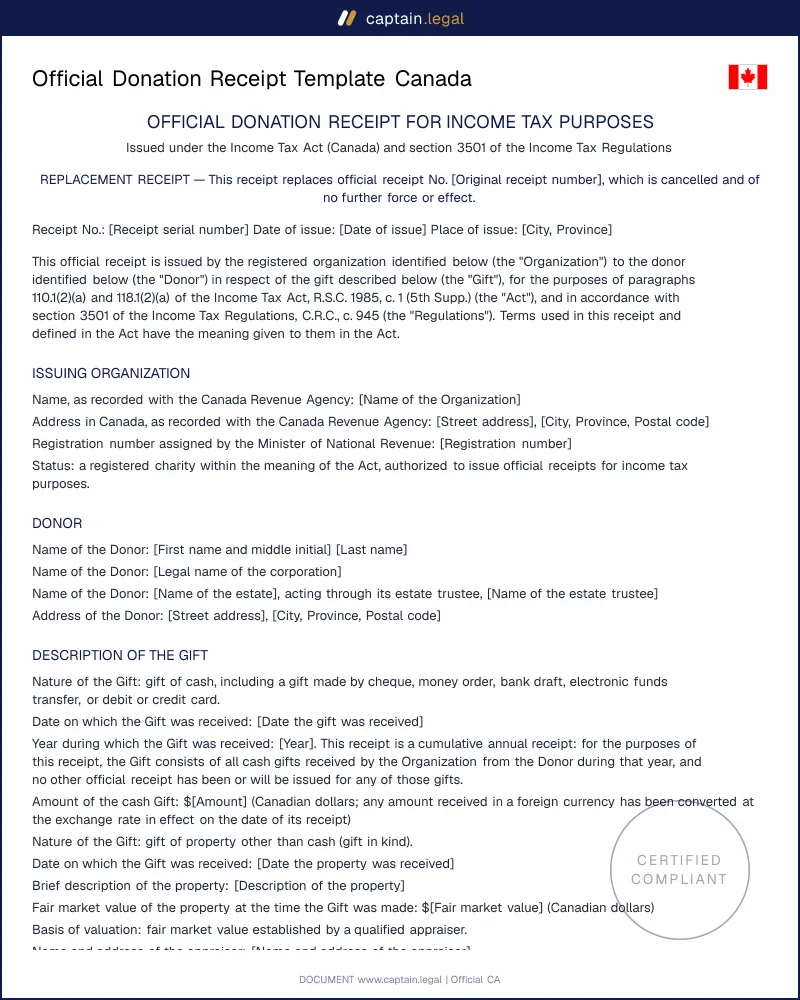
Drafted to Regulation 3501 and the ITA split-receipting rules: registration number, serial number, advantage, eligible amount, CRA reference. Word and PDF.
4.6/5— 12 reviews50 000+ downloadsInstant download
Share

An official donation receipt is the document a registered charity issues to confirm a gift and to let the donor claim the federal and provincial tax credit attached to it. Canadian tax law is strict on this point: the credit is available only on proof by a receipt containing the prescribed information, and the CRA routinely denies claims supported by an incomplete one. This CRA compliant donation receipt template is built for registered charities, registered Canadian amateur athletic associations and other qualified donees that want each receipt to carry every item an auditor checks, from the registration number to the eligible amount. Treasurers use it to issue charitable tax receipts for cash gifts, gifts in kind and gala tickets.

Compliant

2026 Legislation

50,000+ clients

trust us

Affordable

From $4.90 / doc

Secure payment

Instant download

Official Donation Receipt Canada | ITA Regulation 3501

Secure payment

Fill in the template

What is an official donation receipt?

In Canadian practice the term is technical. It means a receipt containing the information prescribed by section 3501 of the Income Tax Regulations, issued by a qualified donee as defined in subsection 149.1(1) of the Income Tax Act, for a transfer of property that qualifies as a gift at law. Only that receipt supports the charitable donation tax credit under subsection 118.1(2) for individuals, or the deduction under subsection 110.1(2) for corporations. A thank-you letter, a payment platform's confirmation email or a bank statement does not count, however detailed. The CRA denies the claim on reassessment.

The official receipt is also distinct from the acknowledgement letter a non-profit sends when it is not a qualified donee. A corporation under the Canada Not-for-profit Corporations Act can accept money and thank its supporters, but it cannot issue a tax receipt until the CRA registers it as a charity. Likewise, a registered charity may never issue receipts on behalf of another organization, and lending its number puts its own registration at risk. Nor is the receipt a contract. A donation agreement setting the donor's conditions and restrictions records what the donor promised; the receipt records what the charity actually received, on which date, and for what eligible amount.

When do you need this document?

The most frequent trigger is the year-end receipting run: monthly donors and December givers expect an official donation receipt before tax season, and a charity issuing hundreds of them needs numbering that cannot produce gaps or duplicates. Gifts in kind come next. Artwork, equipment or listed securities each require a receipt at fair market value on the date of transfer; the capital gain on listed shares has a zero inclusion rate under paragraph 38(a.1).

A gala ticket or golf tournament entry involves an advantage, so the receipt shows the reduced eligible amount, never the full ticket price. A bequest is deemed made by the estate under subsection 118.1(5), so the receipt is issued to the estate, which can allocate the credit to the deceased's final returns if it qualifies as a graduated rate estate. A clear last will and testament naming the charity as beneficiary simplifies that allocation.

Corporate giving catches even experienced treasurers. A company that writes a cheque and receives only a public thank-you has made a gift, since simple recognition of a donor's name or logo is generally not an advantage. A company that obtains genuine promotion, such as advertising space or product placement, has usually made a business expense rather than a gift, a distinction to settle in the Canadian business contract templates used for sponsorship deals. Services, such as a lawyer's pro bono hours, are never receiptable because they are not property.

Key clauses included in our template

  • The statutory header identifies the document as an official receipt for income tax purposes. The regulation requires a statement to that effect rather than a fixed formula, but our wording mirrors the CRA samples so no auditor has to wonder.
  • The issuer block reproduces the charity's legal name and Canadian address exactly as they appear on the CRA Charities Listings, followed by the registration number in its full format (nine-digit business number, the letters RR, then a four-digit reference).
  • The serial number and duplicate control assigns each receipt a unique number and generates a matching duplicate for the charity's records. Spoiled receipts are marked as cancelled and kept, never destroyed.
  • The donor identification captures the full name, including middle initial, and the complete address of the person or corporation that actually made the gift. Spouses can claim each other's receipts, so a joint cheque needs only one named donor.
  • The gift and advantage section separates the amount received, the value and description of any advantage, and the resulting eligible amount. It follows the same logic as our fundraising event agreement with CRA split-receipting clauses, so the event contract and the receipt never contradict each other.
  • The gift-in-kind schedule records the date of transfer, a brief description of the property, the fair market value and the appraiser's details. A prompt flags the three-year cost rule.
  • The signature and CRA reference block carries the authorized signatory's name and signature, the place and date of issue, and the line "Canada Revenue Agency: canada.ca/charities-giving".

Provincial considerations

Ontario charities deal with two regulators. The CRA controls receipting, while the Charities Accounting Act (R.S.O. 1990, c. C.10) gives the Public Guardian and Trustee supervisory authority over property held for charitable purposes. Under that Act, a corporation receiving property for a charitable purpose is deemed a trustee of it. A gift made for a restricted purpose is therefore held on a charitable purpose trust, and the receipt reference should match the restriction recorded in the gift documents and the internal ledger. The donor claims the Ontario credit with the same federal receipt.

Quebec applies its own Taxation Act (CQLR, c. I-3), and Revenu Québec administers the provincial credit. Since January 1, 2016, a charity registered with the CRA is deemed registered in Quebec under section 985.5R1 of the Regulation respecting the Taxation Act, although Revenu Québec keeps its power to refuse or revoke that status. A charity carrying on activities in Quebec must still file the provincial information return TP-985.22 within six months after its taxation year ends, in addition to the federal T3010. Many Quebec charities issue bilingual receipts.

Alberta adds a fundraising layer through the Charitable Fund-raising Act (RSA 2000, c. C-9). A charitable organization whose solicitations of Albertans reach the statutory gross-contribution threshold in a financial year must register with the province within 45 days. Registered or not, a soliciting charity must give donors a receipt when they ask for one, and it must keep records of its Alberta solicitations available to provincial inspectors. Our template meets that obligation.

British Columbia has no separate charity registry, so receipting is entirely federal. Societies incorporated under the Societies Act (S.B.C. 2015, c. 18) must keep their accounting records at their address and make them available for inspection, which makes an orderly duplicate file as important there as anywhere else.

How to fill out this official donation receipt

You start by selecting the type of qualified donee issuing the receipt, since registered charities and other donees do not carry identical mandatory items. For the issuer block, copy the name, address and registration number from the CRA Charities Listings rather than the letterhead, which often lags after a move.

From there, the form asks whether the gift is cash or property. For a cash gift you enter the amount and the date or year it was received; for a gift in kind the form opens the property description, the exact transfer date and the appraisal fields. If the donor received anything in return, you describe the advantage and its value, and the template computes the eligible amount automatically, flagging any advantage above 80% of the gift's value.

The serial number follows your sequence, and the signatory field should name a person the board has actually authorized; a short board resolution appointing the charity's signing officers settles that question for the auditor. You then download the receipt in Word or PDF, send the original to the donor and file the duplicate.

Common mistakes to avoid

The first mistake is receipting things that are not gifts. Membership fees carrying real benefits, raffle tickets, auction purchases at market value and volunteer time all fall outside the definition, and receipting them exposes the charity to the 5% penalty on every affected receipt. Directed gifts are a close cousin: a donation earmarked for a named individual, such as a specific family in need, is generally not a gift to the charity at all. Another is valuing gifts in kind at the donor's word. A painting bought eighteen months ago and declared well above its price runs straight into the three-year cost rule, and the charity, not the donor, signs the receipt that states the value.

Administrative errors are just as costly. Charities replace lost receipts with a fresh one that never mentions the original, when the replacement should carry a new serial number and state that it cancels and replaces the earlier receipt. They keep using stock printed with an old address or CRA website. They issue a gala receipt for the full ticket price because the event budget was never broken down. Each of these mistakes is visible on the face of the receipt, which is exactly where a CRA auditor looks first.

Key takeaways

Regulation 3501

The receipt must carry every prescribed detail

A tax receipt works only if it includes the information required by section 3501 of the Income Tax Regulations. That means the charity's CRA registration number, unique serial number, issue place and date, gift date or year, donor name and address, gift amount, any advantage, eligible amount, authorized signature, and the CRA name and website.

Qualified donees

Only registered bodies can issue receipts

An acknowledgement letter is not an official donation receipt. Only a qualified donee, such as a registered charity or registered Canadian amateur athletic association, can issue one for tax purposes. A Canada Not-for-profit Corporations Act corporation may thank donors, but cannot issue tax receipts until registered by the CRA. A charity also cannot lend its number to another organization.

Split receipting

Advantages reduce the eligible amount

Under the Income Tax Act split-receipting rules, the eligible amount is the fair market value of the gift minus any advantage received by the donor. Gala tickets, gifts in kind, and donor benefits need careful treatment. If an advantage exceeds 80% of the value, the transfer is presumed not to be a gift unless the donor proves an intention to give.

Frequently Asked Questions

Yes, provided the issuer is a qualified donee and the payment is a gift at law. The template contains every item listed in Regulation 3501. Validity still depends on the facts you enter: a perfect layout cannot rescue a receipt for a payment that is not a gift, or a gift in kind recorded at an inflated value. Every province, Quebec included, relies on the same receipt for its own credit.

No. A not-for-profit corporation can accept donations and send a thank-you letter, but only a qualified donee may issue official receipts. Qualified donees include registered charities, registered Canadian amateur athletic associations, registered journalism organizations, municipalities and the other categories listed in subsection 149.1(1). Receipts issued without that status expose donors to reassessment. An organization planning to apply for charitable status should put its by-laws and governance documents in order before filing.

The Act sets no fixed deadline, but the receipt must reach the donor before the return on which the credit is claimed, so most charities send annual receipts by the end of February for the April 30 filing date. For mailed gifts the CRA generally treats the postmark as the date of the gift, so a cheque postmarked December 31 belongs to that year. Donors can carry unused gifts forward for five years, within the annual limit of 75% of net income.

Yes. Word suits charities that merge the layout with their letterhead, while a locked PDF is the right choice for email, since the CRA accepts electronic receipts only if they cannot be easily altered. An electronic signature is acceptable, and the charity keeps an electronic copy as its duplicate. Browse the full catalogue of Canadian legal document templates for the governance documents that support a receipting system.

Issue a replacement with a new serial number that states it cancels and replaces the original, identified by its own number, and keep a copy of both. Without the cancellation statement, the file shows two gifts. The same approach corrects an error on a receipt already sent.

No. A charity is not legally required to receipt each gift, and anonymous cash, such as coins in a donation box, is usually not receipted. Without a receipt, however, the donor cannot claim the credit, so any identified donor who asks should get one. A single consolidated official donation receipt per year for regular donors keeps the duplicate file manageable.

4.6/5

12 verified reviews · 50 000+ downloads

Official Donation Receipt Canada | ITA Regulation 3501
  • Immediate access to the document
  • PDF + Word download
  • Compliant with 2026 legislation
  • Reviewed by lawyers
Fill in the template
Secure payment
Updated on October 11, 2026

You might also like

Sponsorship Agreement Canada
Conflict of Interest Policy Canada