Real Estate

Sublease Agreement Canada | RTA s.97, s.34 & s.22 Rules

Sublease drafted to Ontario RTA s.97, BC RTA s.34 and Alberta RTA s.22: written consent, 14-day deemed approval, legal deposit caps. Word and PDF.
4.8/5— 18 reviews50 000+ downloadsInstant download
Share

A sublease agreement is the contract a tenant signs when another person will occupy all or part of the rental unit for a fixed period while the original tenancy stays in force. The tenant becomes the landlord of the subtenant, collects the rent and remains answerable to the head landlord for every obligation in the original lease. The document suits tenants in Canada's common-law provinces who leave for a work contract or a semester abroad, and landlords who want the arrangement on paper before giving written consent. It sets the rent, the term, the deposit and the allocation of liability for damage, and it records the landlord's approval so the sublet holds up before the provincial tenancy tribunal.

Compliant

2026 Legislation

50,000+ clients

trust us

Affordable

From $4.90 / doc

Secure payment

Instant download

Sublease Agreement Canada | RTA s.97, s.34 & s.22 Rules

Secure payment

Fill in the template

What is a sublease agreement?

In Canadian tenancy law, a sublease is a transfer of possession for less than the tenant's full remaining interest. The original tenant keeps what lawyers call the reversion: a slice of the term, sometimes a single day, that returns to them before the head lease ends. That retained interest separates a sublet from an assignment. With an assignment, the tenant hands over the whole remaining term and leaves; with a sublet, the tenant intends to come back. The subtenant has no contract with the head landlord; their rights run against the tenant alone. A sublease agreement that covers every remaining day of the term is therefore treated as an assignment, with very different consequences for liability.

Two neighbouring documents are often confused with it. The residential tenancy agreement for Canadian provinces is the head lease itself, signed directly between owner and tenant. A roommate agreement between co-tenants governs people who share a unit and are all on the lease, and it is enforced as an ordinary contract rather than under tenancy legislation. A partial sublease, where the tenant rents out one bedroom while still living in the unit, raises its own questions, because tribunals often treat the newcomer as a roommate or occupant rather than a true subtenant.

When do you need this document?

The textbook case is the temporary relocation. A tenant in Toronto takes an eight-month contract in Calgary and does not want to give up a unit at a rent impossible to find again. Students form the second large group, with a wave of summer sublets every spring in university towns. In both cases the tenant stays liable for rent and damage, so the subtenant has to be chosen and documented carefully.

On the commercial side, businesses with more space than they need often sublease part of their premises to another company after a downsizing or a shift to hybrid work. Those arrangements usually sit alongside other Canadian business contract templates, such as service or confidentiality agreements between the two companies.

Two edge cases deserve a mention. A tenant in rent-geared-to-income housing often cannot sublet at all: British Columbia expressly exempts certain public housing bodies from the duty to consider sublet requests reasonably. And a tenant planning to list the unit on a short-term rental platform is subletting in law, which brings the landlord's consent rules and municipal bylaws into play; in British Columbia, the Short-Term Rental Accommodations Act adds a principal residence requirement in many communities.

Key clauses included in our template

  • The identification of the parties and the head lease names the tenant as sublandlord, each adult subtenant and the head landlord, and refers to the original lease by date and address. Every occupancy term of the head lease, from pet rules to condominium bylaws, binds the subtenant.
  • The sublease term sets a fixed start date and an end date that falls before the head lease expires. That gap protects the tenant's reversion and keeps the arrangement from being recharacterized as an assignment.
  • The rent and deposit clause fixes the monthly amount, the due date and the payment method, and it caps any deposit at the provincial limit. In practice that means a rent deposit only in Ontario under section 106, since the province does not allow damage deposits, and no more than half a month's rent as a security deposit in British Columbia under section 19 of the Residential Tenancy Act.
  • The landlord consent clause records the head landlord's approval, signed and dated, on an annexed consent page. The sublease is expressly conditional on that consent.
  • The damage and liability allocation makes the subtenant answerable to the tenant for damage beyond normal wear and tear, backed by a condition inspection at move-in and move-out signed by both. It also deals with tenant insurance, since the tenant's own policy rarely covers a subtenant's belongings or liability.
  • The termination and holdover provision covers the end of the term, early termination for non-payment and the method for serving notices. If the relationship breaks down, the tenant can follow up with a notice to end a tenancy drafted to provincial rules instead of improvising one.

Provincial considerations

Ontario gives tenants the strongest statutory footing. Under section 97(1) of the Residential Tenancies Act, 2006, a tenant may sublet with the landlord's consent, and section 97(2) bars any arbitrary or unreasonable refusal. The landlord may recover only reasonable out-of-pocket expenses under section 97(3), such as a credit check, never an administration fee. Under section 97(5), the subtenant has no right to remain once the subtenancy ends. An unreasonable refusal can be challenged under section 98 with Form A2 before the Landlord and Tenant Board. The 60-day window is strict: if a subtenant overholds, the landlord or the tenant must apply under section 101 within 60 days after the subtenancy ends, failing which section 104 can turn the occupant into an assignee of the tenancy.

British Columbia offers narrower protection. Section 34(1) of the Residential Tenancy Act bars any sublet without written consent, and the duty not to refuse unreasonably under section 34(2) applies only to fixed-term tenancies with six months or more remaining. Section 34(3) forbids any charge for considering or granting consent, and an unreasonable refusal can be overridden by the Residential Tenancy Branch under section 65(1)(g). Policy Guideline 19 requires the sublease to end before the tenant's own tenancy, even by a single day. As sublandlord, the tenant must also complete the condition inspection reports required by sections 23 and 35, or lose the right to claim against the deposit for damage under sections 24 and 36.

Alberta places its rule in section 22 of the Residential Tenancies Act. Under section 22(1), no sublease is valid without the landlord's written consent, and section 22(2) requires reasonable grounds for any refusal. Section 22(4) adds a rule many tenants overlook: a landlord who does not answer a request within 14 days of receiving it is deemed to have consented. A landlord who refuses must give written reasons under section 22(5). Disputes go to the Residential Tenancy Dispute Resolution Service, and the security deposit taken from the subtenant cannot exceed one month's rent.

Quebec follows the Civil Code of Québec. Under article 1870, the tenant must notify the landlord of the proposed sublet with the sublessee's name and address, and article 1871 allows a refusal only for a serious reason, given within fifteen days, failing which consent is deemed given. A Quebec sublet therefore calls for a civil-law document, with disputes heard by the Tribunal administratif du logement.

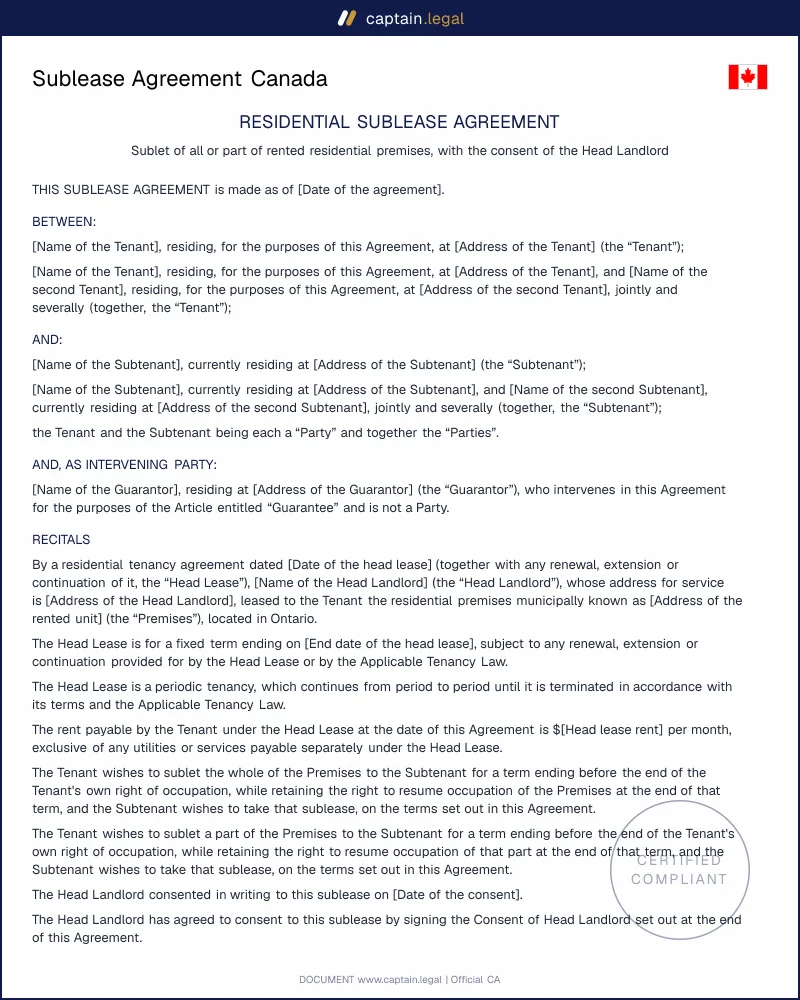
How to fill out this sublease agreement

You start by selecting the province where the rental unit is located, which sets the consent wording, the deposit limits and the statutory references used throughout the document. Next you enter the details of the head lease: the landlord's name, the address of the unit, the date of the original agreement and the date it ends. The sublet term you choose must finish before that date, even by a single day, so that you keep the reversion.

The following screens cover the subtenant, the rent, the payment method and the deposit. For a partial sublet, you describe the room and the shared areas. You then decide how damage is handled, whether the subtenant must carry tenant insurance, and which furniture or appliances are included.

The final step produces the agreement and the landlord consent page. Send the consent page to the landlord first, collect the signature, and only then sign with the subtenant. In Alberta, keep proof of the date your request was received, since the 14-day clock runs from it.

Common mistakes to avoid

The most frequent mistake is signing with the subtenant before the landlord has approved anything. In Alberta the sublease is then invalid, and in every province an unauthorized sublet gives the landlord a ground to end the head tenancy. The second is setting a sublet end date identical to the expiry of the head lease, which turns the deal into an assignment and can strip the tenant of the right to return. The third is overcharging: Ontario's section 134(3) bars a tenant from charging a subtenant more than the lawful rent, and landlords elsewhere routinely cite a profit motive when refusing consent.

The remaining errors concern evidence and money. Tenants carry deposit habits from one province to another and collect a damage deposit in Ontario, where the law allows none, or more than half a month's rent in British Columbia. Others skip the condition inspection and cannot later prove what the subtenant damaged. Insurance is the last blind spot. Check both policies before the keys change hands, because a water leak during a sublet ends up argued over by three parties and two insurers.

Key takeaways

Consent

Get landlord approval in writing

Residential subletting is provincial, but the shared rule is landlord consent. B.C. RTA s.34 and Alberta RTA s.22 require written consent, and Ontario RTA s.97 makes refusal subject to the statutory scheme. A head lease clause that bans all sublets cannot displace protected statutory rights. If approval is deemed after 14 days, keep proof of the request and timing.

Structure

A sublet is not an assignment

A sublease works only if the tenant keeps a remaining slice of the term, even one day, and plans to return. If the agreement gives the subtenant the entire rest of the lease, it may be treated as an assignment instead. That difference changes who stays liable and whether the original tenant has truly stepped out of the tenancy.

Liability

The tenant stays on the hook

The original tenant becomes the subtenant's landlord, collects rent, and remains answerable to the head landlord under the original lease. The agreement should spell out rent, term, deposits, damage responsibility, and any inspection rules that apply under provincial tenancy law. Without clear paperwork, a dispute can land before the tribunal with the tenant carrying both sides of the risk.

Frequently Asked Questions

Yes. A sublease is an enforceable contract between tenant and subtenant, recognized by provincial tenancy legislation. Its effect against the head landlord depends on consent: Alberta's section 22(1) makes a sublease invalid without the landlord's written consent, and British Columbia applies the same writing rule. Our template follows the statutory wording of each common-law province and binds the parties once both have signed and the landlord's consent is on file. No notarization or registration is required for a residential sublet.

In every province, yes. What varies is how freely the landlord can say no. Ontario bars any arbitrary or unreasonable refusal, Alberta requires reasonable grounds and written reasons, and British Columbia protects you only on a fixed-term tenancy with six months or more remaining. Valid grounds usually concern the subtenant, such as a poor credit history, not a wish to sign a new lease at a higher rent.

It depends on the province. Alberta sets the clearest rule: under section 22(4) of the Residential Tenancies Act, a landlord who does not respond within 14 days of receiving the request is deemed to have consented. Quebec gives the landlord fifteen days under article 1871 of the Civil Code of Québec, with the same effect. Ontario and British Columbia set no fixed period for sublets, so send your written request well before move-in. If the landlord stays silent or refuses without valid grounds, Ontario tenants can file Form A2 and British Columbia tenants can apply to the Residential Tenancy Branch.

You are, as far as the landlord is concerned. The head lease stays in force, so the landlord can claim unpaid rent and repairs from you, a liability Ontario spells out in section 97(4). Your recourse lies against the subtenant under the sublease agreement, which is why the template pairs a damage clause with signed inspection reports and a deposit capped at the provincial limit. You enforce those terms before the tenancy tribunal or in Small Claims Court.

With a sublet, you keep part of your interest, plan to return and stay liable to the landlord. With an assignment, the entire remaining term passes to a new tenant who deals directly with the landlord, and you leave for good. In Ontario, section 95(4) lets a tenant end the tenancy by notice under section 96 if the landlord refuses an assignment or fails to answer within seven days. If an assignment or a fresh lease suits you better, browse our real estate and rental documents for Canada.

Yes. The sublease and the landlord consent page are generated in both formats as soon as the questionnaire is complete. The Word file lets you adjust wording before signing, while the PDF is fixed for printing or electronic signature. Both stay in your account, alongside the full catalogue of Canadian legal templates.

4.8/5

18 verified reviews · 50 000+ downloads

Sublease Agreement Canada | RTA s.97, s.34 & s.22 Rules
  • Immediate access to the document
  • PDF + Word download
  • Compliant with 2026 legislation
  • Reviewed by lawyers
Fill in the template
Secure payment
Updated on October 9, 2026

You might also like

Notice to Terminate Tenancy Canada
Rent Receipt Template Canada