Real Estate

Rent Receipt Canada | Ontario RTA s.109 & BC RTA s.26

Rent receipt drafted to Ontario RTA s.109 and BC RTA s.26: free on request, cash receipts, former tenants within 12 months. Province-aware. Word and PDF.
4.7/5— 24 reviews50 000+ downloadsInstant download
Share

A rent receipt is a short written acknowledgment, signed by the landlord or an authorized agent, confirming that a named tenant paid a stated amount for a defined rental period at an identified unit. Canadian tenants rely on it to claim provincial tax credits, to show a payment history to a lender or a new landlord, and to answer an arrears claim before a tenancy tribunal. Landlords use the same paper trail as their record of rental income when the Canada Revenue Agency asks questions. Our template is drafted for the common-law provinces and records the amount, the period, the payment method and the unit, with separate treatment for deposits, partial payments and arrears.

Compliant

2026 Legislation

50,000+ clients

trust us

Affordable

From $4.90 / doc

Secure payment

Instant download

Rent Receipt Canada | Ontario RTA s.109 & BC RTA s.26

Secure payment

Fill in the template

What is a rent receipt?

In law, a rent receipt is an acknowledgment of payment, not a contract. It creates no new obligation. It records that an existing one, the tenant's duty to pay rent for a given period, has been discharged in whole or in part. A signed receipt is prima facie evidence of payment: once the tenant produces it, the landlord carries the burden of proving that the money was never received or was applied to something else. That evidentiary weight sets it apart from the residential tenancy agreement for Canadian landlords that fixes the rent, from the private ledger a landlord keeps, and from an e-transfer confirmation, which proves that money moved but says nothing about what it paid for.

A well drafted rent receipt answers five questions: who paid, who received, how much, for which unit, and for which period. The refinement that matters most is the allocation of the payment, because Canadian tenancies generate more than rent. Depending on the province, a tenant may also hand over a rent deposit in Ontario or a security and pet damage deposit in British Columbia, along with a refundable key deposit, parking or storage fees, or a charge for a returned cheque. A slip that reads "received, thank you" leaves every one of those questions open, and open questions are what tenancy hearings are made of.

When do you need this document?

The obvious case is the tenant who pays in cash. Without a receipt that tenant has no evidence at all, and in British Columbia a landlord who refuses one for a cash payment is in breach of the Act. The next trigger arrives every spring, when Ontario tenants claiming the Ontario Energy and Property Tax Credit and Manitoba tenants claiming the renters' tax credit need a clean record of the year's rent. A single annual rent receipt answers a CRA review letter in one page, and the same proof supports a mortgage or rental application.

Disputes are where receipts earn their keep. When a landlord files an arrears application, the tenant holding signed receipts for every disputed month usually ends the argument at the first hearing. Payments made after a termination notice need particular care. In Ontario, section 59(3) voids a notice for non-payment if the tenant pays all arrears, plus the rent that has since fallen due, before the landlord applies to the Board. A tenant who pays after receiving a notice to end a tenancy drafted to provincial rules therefore needs a receipt showing exactly what was paid and when, and a landlord who accepts only part of the arrears should record that the balance remains outstanding.

Two edge cases come up often. Rent paid by a third party (a parent, an employer, a social assistance program) should be receipted to the tenant with the payer named separately, otherwise the payer can appear to be a tenant. Co-tenants who pay their shares separately should each receive their own receipt, with the total rent for the unit shown for reference.

Key clauses included in our template

Each rent receipt generated by the template contains the following provisions, so the document can stand alone as evidence.

  • A sequential receipt number and an issue date run across the whole tenancy. The series supports the record keeping required by section 230 of the Income Tax Act and makes a missing or altered receipt obvious.
  • Both parties are identified by their full legal names, exactly as they appear on the lease. Where the property is held by a corporation or by co-owners under a partnership agreement for Canadian co-investors, the receipt names the entity that is the legal landlord, not the person who collected the money.
  • The unit is described by its civic address and unit number, together with any parking space or locker billed separately. Without that detail, a receipt is weak evidence in a building where one landlord holds several tenancies.
  • The amount and the rental period appear in figures and in words, with start and end dates. Prepaid rent covering several months is broken down month by month instead of lumped into one figure.
  • An allocation clause separates rent, deposits, arrears and other charges. For a partial payment it records the balance still owing; otherwise it confirms that the account is paid in full.
  • The payment method is recorded (cash, cheque number, e-transfer reference or pre-authorized debit), with the payer's identity where it differs from the tenant.
  • The signature block identifies the landlord or the authorized agent and states the agent's capacity, with an optional reservation of rights for payments accepted while a notice of termination is pending.

Provincial considerations

Ontario gives tenants the broadest receipt right in Canada. The section 109 duty covers every payment method, every payment connected with the tenancy, and former tenants for 12 months after move-out. Under section 106, a rent deposit cannot exceed the lesser of one rent period and one month's rent, and the landlord owes annual interest on it at the rent increase guideline rate, or may apply that interest to top up the deposit to the current rent. Section 134 prohibits key money and most charges beyond lawful rent, so the template treats any "other amount" with caution unless it is a deposit or charge the regulations allow, such as a refundable key deposit. Most private tenancies now use the provincial standard form of lease, and the receipt should mirror the rent figure stated in it.

British Columbia limits the mandatory duty to cash under section 26, but receipts matter well beyond that. Security and pet damage deposits are each capped at half a month's rent under section 19, and recording them separately from rent prevents the most common deposit dispute heard by the Residential Tenancy Branch. Where the tenant has handed over post-dated cheques, listing each cheque number on the receipt makes the return of unused cheques at move-out easy to verify. A tenant may deduct from rent only where the Act or an arbitrator allows it, and a receipt showing the lawful deduction protects both sides.

Alberta has no statutory receipt rule, which shifts the risk onto whoever cannot prove the payment, usually the tenant who paid cash. The Residential Tenancies Act requires the landlord to give the tenant a written notice with a name and an address in Canada within seven days after the tenant takes possession, and the receipt should use the same identity. Security deposits are capped at one month's rent and must be placed in a trust account, so a receipt for the deposit is as valuable as one for the rent. Before the Residential Tenancy Dispute Resolution Service, a numbered series carries real weight.

Manitoba approaches the issue mainly through tax and housing benefits. Under The Residential Tenancies Act, C.C.S.M. c. R119, the security deposit is generally limited to half of the first month's rent. Tenants claiming the provincial renters' tax credit or applying for Rent Assist routinely need proof of rent paid, and an annual summary covers both. Quebec, governed by the Civil Code of Québec rather than the common law, has its own mechanism: landlords issue the RL-31 slip used for the solidarity tax credit, and our receipt does not replace it.

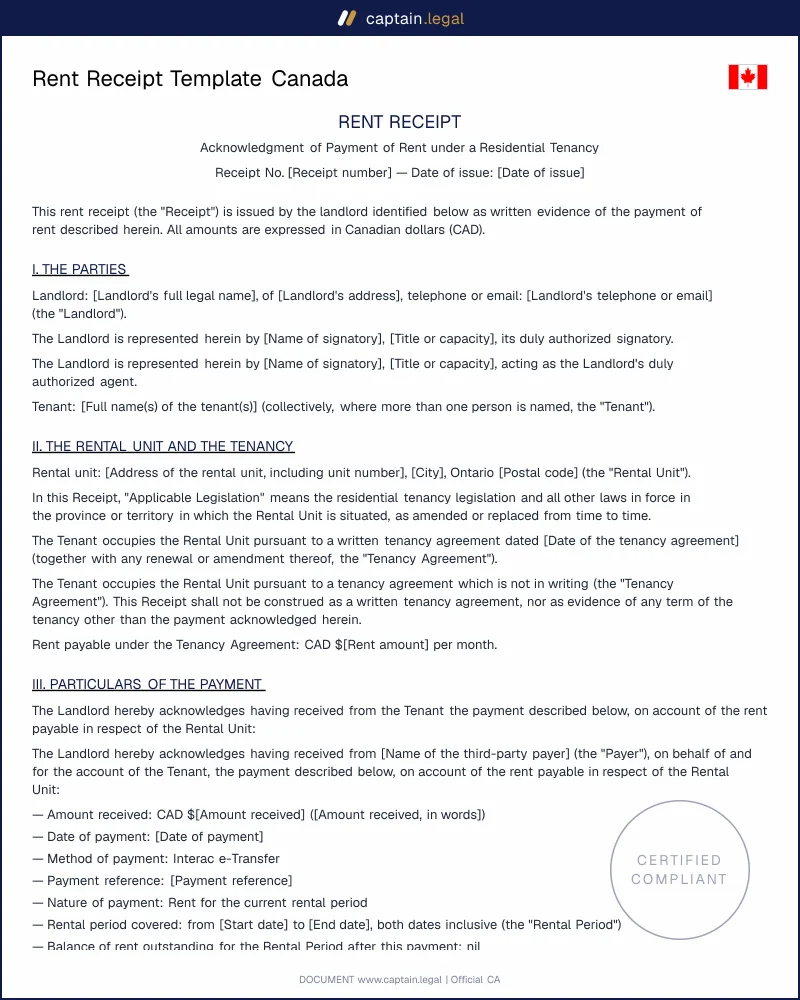
How to fill out this rent receipt

You start by choosing the province where the unit is located, because the form adapts its wording to the governing statute: Ontario receipts reference section 109, and BC receipts reference section 26 whenever cash is selected. You then enter the landlord's details exactly as they appear on the lease, each tenant named on the tenancy, and the unit address with any parking or storage billed separately.

Next comes the payment. You enter the amount, the date received and the period covered, then allocate the money between rent, deposit, arrears and other charges. For a partial payment the form asks for the balance still owing; if the payment settles the account, the receipt says so expressly. When someone other than the tenant paid, you name that payer in a dedicated field. If a property manager collects rent under a property management agreement covering rent collection and trust accounting, you add the agent's name and capacity so the signature binds the landlord.

Finally, you choose between a single receipt for one payment and an annual summary for tax purposes. The document downloads in Word and PDF. Sign it by hand or electronically, give the original to the tenant, and keep an identical copy.

Common mistakes to avoid

The most frequent error is the pre-signed blank receipt. Some landlords leave a superintendent a pad of signed forms to save time, and the first one that goes missing costs them control of the evidence. Close behind is the receipt issued for a cheque before it clears. If the cheque bounces, the tenant still holds a document saying the rent was paid, so mark any receipt for a cheque or pre-authorized debit as subject to clearance. Vague periods cause the next set of problems: "January rent" without a year is useless in a dispute spanning several years, and a receipt that labels a deposit as rent lets the tenant argue later that no deposit was ever paid.

The second group of mistakes is legal. Charging for a receipt is unlawful in Ontario, and refusing a former tenant inside the 12-month window carries the same enforcement risk as refusing a current one. Landlords also discard copies too early, although the six-year retention rule under the Income Tax Act applies to receipts like any other record. A vague receipt for money paid after a termination notice is the most common way landlords hand a tenant an argument they never needed to give. If you accept arrears while a notice is pending, state the amount applied and the balance still owing, and keep the receipt consistent with the notice served.

Key takeaways

Ontario and BC

Receipt duties vary by province

Ontario landlords must give receipts free of charge on request under RTA section 109, covering rent, deposits, arrears and other amounts paid. Former tenants can still ask within 12 months after the tenancy ends. In British Columbia, RTA section 26 is narrower: the statutory duty is tied to rent paid in cash.

Proof of payment

A receipt is evidence, not a lease

A rent receipt acknowledges that money was received for a defined rental period; it does not create new tenancy terms. Its value is evidentiary. Once produced, it can shift the burden onto the landlord to explain why the payment was not received or was applied elsewhere, such as to arrears, a deposit, parking or storage.

Records and tax

Keep receipts ready for CRA questions

Receipts help both sides answer later questions. Tenants may need proof of rent to support a provincial tax credit, while landlords need records of rental income if the Canada Revenue Agency asks. Under Income Tax Act section 230, rental income records are generally kept for six years after the tax year they relate to.

Frequently Asked Questions

It depends on the province. Ontario has the broadest rule: under section 109 of the Residential Tenancies Act, 2006, the landlord must give a receipt free of charge for any rent, deposit or other payment whenever the tenant asks, and a former tenant can ask for 12 months after moving out. British Columbia requires one for rent paid in cash under section 26 of the Residential Tenancy Act. Alberta has no general statutory duty. Everywhere, the receipt remains the best evidence either side can produce.

Yes. A signed receipt identifying the parties, the unit, the amount, the period and the payment method is prima facie evidence of payment before the Landlord and Tenant Board, the Residential Tenancy Branch, the courts and the CRA. No notarization or witness is needed, and an electronic signature is acceptable under the provincial electronic commerce statutes when both parties agree to deal electronically. It does not change the lease; it records what was paid under it.

Both formats are included. The Word version suits landlords who issue receipts every month and want a numbered series in one file, while the PDF is better for email because the layout stays fixed and the document is harder to alter. If the same tenancy also needs a lease, a notice or another form, our complete catalogue of Canadian legal templates covers the rest of the paperwork.

Ontario's statute requires the receipt "on request" but sets no fixed deadline, so the safe reading is a reasonable time, measured in days rather than weeks. For cash payments in British Columbia, the receipt should be handed over when the money changes hands. A former Ontario tenant must ask within 12 months after the tenancy ends. Make the request by email or text: a dated written request is your evidence if the landlord does not respond.

Yes. For the Ontario Energy and Property Tax Credit, paid through the Ontario Trillium Benefit, 20 per cent of the rent you paid during the year counts as occupancy cost, and the CRA can ask for proof after you file. An annual summary signed by the landlord, showing the address and the total rent for the calendar year, answers that request in one document. Manitoba tenants use the same type of summary for the renters' tax credit, while Quebec tenants rely on the RL-31 slip.

An e-transfer confirmation proves that money left your account and reached the landlord. It does not prove which period it covered, or whether the landlord applied it to rent, a deposit or arrears, and that allocation is where most disputes start. In Ontario you remain entitled to a formal receipt, free of charge, even when you pay electronically. Keep both: the bank record proves the transfer, and the signed receipt proves how it was applied. Lease, application and notice forms are in our Canadian rental and property documents.

4.7/5

24 verified reviews · 50 000+ downloads

Rent Receipt Canada | Ontario RTA s.109 & BC RTA s.26
  • Immediate access to the document
  • PDF + Word download
  • Compliant with 2026 legislation
  • Reviewed by lawyers
Fill in the template
Secure payment
Updated on October 10, 2026

You might also like

Property Management Agreement
Residential Lease Agreement Canada