Employment

Employment Verification Letter | PIPEDA & PIPA Compliant

Employment verification letter drafted to PIPEDA, Alberta and BC PIPA and Quebec Law 25 consent rules. Confirms salary, hours and status. Word and PDF.
4.8/5— 15 reviews50 000+ downloadsInstant download
Share

An employment verification letter is a signed statement in which an employer confirms that a named person works for the organization, in what position, since when, on what schedule and at what pay. Landlords ask for one before approving a tenancy, mortgage lenders before advancing funds, and Immigration, Refugees and Citizenship Canada (IRCC) before crediting work experience. Our template is drafted for employers, HR teams and payroll administrators in the common-law provinces, in Quebec and in federally regulated workplaces, and it produces a proof of employment built around what landlords, underwriters and immigration officers actually check.

Compliant

2026 Legislation

50,000+ clients

trust us

Affordable

From $4.90 / doc

Secure payment

Instant download

Employment Verification Letter | PIPEDA & PIPA Compliant

Secure payment

Fill in the template

What is an employment verification letter?

In Canadian practice, the employment verification letter (also called a letter of employment or confirmation of employment) is a factual attestation issued on company letterhead and signed by someone with authority to speak for the employer, usually HR, payroll or an owner. It states the employee's legal name, job title, start date, employment status (permanent, fixed term, casual or on probation), weekly hours and compensation. It confirms an existing relationship, which separates it from an employee offer letter for Canadian hires that sets the terms before work begins. The letter creates no new contractual right, but it is not neutral either: a signed statement of salary or start date can later be produced as an admission in a wrongful dismissal claim, where length of service and total compensation drive the reasonable notice award.

Three neighbouring documents are often confused with it. A reference letter gives an opinion on performance, which a verification letter deliberately avoids. The Record of Employment, issued under the Employment Insurance Regulations, serves benefit claims, not landlords. In Quebec, the certificat de travail under section 84 of the Act respecting labour standards is issued when employment ends. The verification letter speaks to the present.

When do you need this document?

The most frequent request comes from a landlord. In Ontario, O. Reg. 290/98 under the Human Rights Code allows landlords to request income information, but only together with credit references, rental history or a credit check, and income may not be used on its own to screen out an applicant. Property managers usually attach the letter to a rental application form for Canadian landlords. Mortgage and loan underwriting comes next: lenders want the letter recent and consistent with pay stubs and the Notice of Assessment, and many hesitate when it discloses probation.

Immigration is the most demanding use. For Express Entry, IRCC expects letterhead, the signatory's contact details, dates of employment, weekly hours, salary and benefits, and duties that track the National Occupational Classification code claimed. Family law adds a fourth category, since support claims test income declarations and the letter often accompanies a financial disclosure statement under the Child Support Guidelines.

Two edge cases recur. An employee on parental leave remains employed, and the letter should note the approved leave and the right to reinstatement rather than calling the person inactive. An employee serving working notice of termination is still on payroll, but a letter describing the position as ongoing without the end date misleads the reader.

Key clauses included in our template

  • The employer identification block sets out the legal name of the entity, its address and a direct verification contact. Underwriters call that number, so it must reach someone able to confirm the letter.
  • The employee identification and consent reference records the employee's legal name as shown on government ID and states that the disclosure is made at the employee's written request, naming the recipient.
  • The position and duties clause gives the official title and, for IRCC, a factual description of main duties in the employer's own words, because duties copied verbatim from the NOC description draw an officer's attention.
  • The start date and employment status clause distinguishes permanent, fixed term, seasonal and casual engagements and states whether probation applies. If you use our Canadian employment agreement with an enforceable termination clause, the wording of both documents lines up.
  • The hours of work clause states regular paid hours per week. IRCC treats thirty hours as full time and counts part-time work toward the same 1,560-hour total, so the figure has to be exact.
  • The compensation clause separates guaranteed base pay from commissions, overtime and bonuses. Lenders weigh them differently.
  • The purpose and reliance clause names the recipient and confirms accuracy on the date of signature, which limits reuse of the letter for unrelated purposes.

Provincial considerations

Ontario has no general private-sector privacy statute covering employee information held by provincially regulated employers, and some employers conclude they can disclose freely. That is risky. The Court of Appeal recognized the tort of intrusion upon seclusion in Jones v. Tsige, 2012 ONCA 32, and listed financial records among the matters it protects. Ontario employers should obtain written consent anyway and reconcile figures with the records kept under section 15 of the Employment Standards Act, 2000.

British Columbia regulates the point directly. Section 19 of the Personal Information Protection Act permits disclosure of employee information without consent only for purposes reasonable to the employment relationship, and a third-party verification request does not qualify. Complaints go to the Office of the Information and Privacy Commissioner, and payroll records under section 28 of the Employment Standards Act remain the reference point for every figure.

Alberta follows the same model. Section 21 of the Personal Information Protection Act limits disclosure of personal employee information without consent to managing the employment relationship, and the Information and Privacy Commissioner of Alberta enforces it. The figures in the letter should match the payroll records required by section 14 of the Employment Standards Code.

Quebec works on a civil law foundation. Article 2096 of the Civil Code of Québec and section 84 of the Act respecting labour standards entitle a departing employee to a work certificate that may not comment on the quality of the work or the employee's conduct. That rule targets end-of-employment certificates, but applying the same restraint to a current employee's letter is sound practice. Consent must meet section 14 of the Act respecting the protection of personal information in the private sector, which means a separate, specific request for each recipient.

Federally regulated employers apply Part III of the Canada Labour Code for employment standards and PIPEDA for employee privacy. Banks and interprovincial carriers therefore work from one federal framework, whichever province the employee is in. Complaints go to the Office of the Privacy Commissioner of Canada.

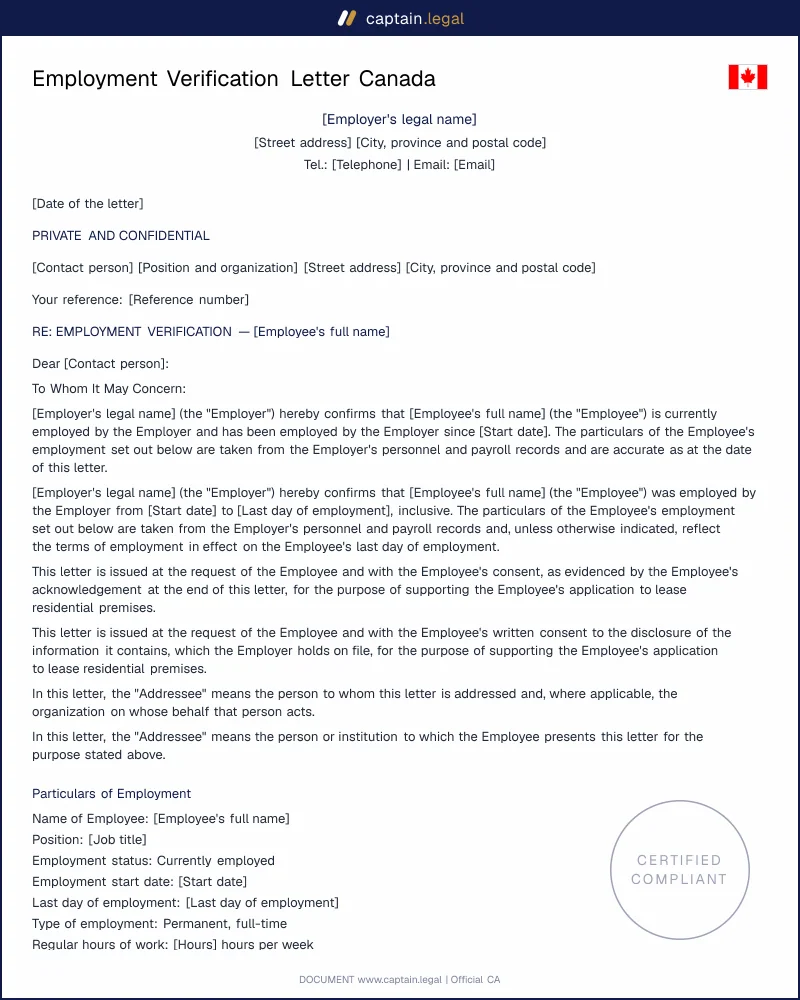
How to fill out this employment verification letter

You start by choosing the jurisdiction: the province where the employee works, or the federal regime if the business is federally regulated. You then enter the employer's legal name, address and the person who will sign and answer verification calls. The employee section asks for legal name, title, start date and status, with a prompt to flag probation, leave or notice of termination.

Compensation comes next. You record base pay and its frequency, then decide whether variable pay appears on a separate line, which lenders prefer. IRCC files open an extra field for duties. You finish by naming the recipient and purpose and confirming the employee's written request. The draft downloads in Word and PDF, ready to place on letterhead and sign.

Common mistakes to avoid

The error that comes up most often is inflated income. An employer trying to help adds an expected bonus or annualizes overtime from a busy quarter, and the underwriter compares the figure with the T4. The second classic error is a letter signed by a supervisor without authority, on plain paper with a personal cell number, which officers and underwriters treat as unverifiable. A third is oversharing: mentioning medical leave, an accommodation or a garnishment discloses information the employee never authorized.

Status errors cause the rest of the trouble. Calling a probationary hire "permanent" without qualification, or omitting a fixed end date, misleads as surely as a wrong salary. Stale letters are the last trap: many lenders and landlords will not accept a letter more than thirty days old. When the relationship is actually ending, use the dedicated documents among our Canadian employment and HR templates rather than stretching a verification letter to cover a departure.

Key takeaways

Scope

State facts, not opinions

An employment verification letter should confirm only the employee's legal name, job title, start date, status, weekly hours and compensation. It is not a reference letter and should avoid performance comments. That keeps the document useful for landlords, mortgage lenders or IRCC while reducing the chance that HR accidentally creates a broader statement than intended.

Consent

Get written permission before disclosure

Salary, hours and status are personal information. Under PIPEDA Schedule 1, clause 4.3, and Alberta and British Columbia PIPA rules, disclosure to a landlord or lender needs employee consent because it is not for managing the employment relationship. In Quebec, Law 25 requires consent that is clear, free, informed and tied to specific purposes.

Accuracy

Match payroll records line by line

The letter should mirror the employer's wage and hour records, including records required under section 15 of Ontario's Employment Standards Act, 2000 and similar provincial rules. A signed salary or start-date statement can later be used in a wrongful dismissal file. If a lender relies on inflated pay, negligent misrepresentation may also be alleged.

Frequently Asked Questions

It is not a contract, so it does not commit the employer to keep the employee or to pay a set amount in future. It is a statement of fact that third parties rely on, and Canadian courts hold signatories accountable when that reliance is foreseeable. An employer who states an incorrect salary to a lender can be liable in negligent misrepresentation, and the same letter can later be used as evidence of salary and length of service in an employment dispute.

Outside Quebec, no general statute obliges a current employer to issue one, although refusing a reasonable request is rare. In Quebec, section 84 of the Act respecting labour standards and article 2096 of the Civil Code entitle an employee to a work certificate on request at the end of employment, stating the nature of the job and its dates. Every employer should route requests through HR or payroll so each letter matches payroll records and rests on written consent.

For a third-party request, generally not. Employers covered by PIPEDA, by the Alberta or British Columbia Personal Information Protection Act, or by Quebec's private sector privacy law need consent before sending salary details to a landlord, lender or agency. In Ontario, the absence of a statute does not remove the risk of an intrusion upon seclusion claim. Our template records the employee's written request, naming the recipient and purpose, before any figure is released.

No Canadian statute sets a deadline for a current employee's letter. Most HR departments respond within a few business days, faster when a mortgage closing or IRCC deadline is close. Validity is set by the recipient, not by law: many lenders and landlords want a letter dated within the last thirty days, while IRCC assesses it against the period of experience claimed. If a file stalls, request a fresh, dated letter rather than resubmitting the old one.

The completed letter downloads instantly in Word and PDF. The Word file lets you place the text on your letterhead, adjust the signature block or add a logo, while the PDF is ready to sign and email to a lender or upload to an IRCC portal. Both versions keep the same clause structure. If the same transaction needs other paperwork, the full catalogue of Canadian legal templates uses identical formats.

Yes, once you activate the immigration option. IRCC expects letterhead, the signatory's name, title and contact details, exact dates, paid hours per week, salary and benefits, and main duties matching the NOC code claimed. The template collects each element and keeps duties in the employer's own words. If the employee held several positions with the same employer, list each separately with its own dates, because officers assess experience role by role.

4.8/5

15 verified reviews · 50 000+ downloads

Employment Verification Letter | PIPEDA & PIPA Compliant
  • Immediate access to the document
  • PDF + Word download
  • Compliant with 2026 legislation
  • Reviewed by lawyers
Fill in the template
Secure payment
Updated on October 12, 2026

You might also like

Independent Contractor Agreement Template
Employee Handbook Template Canada