Real Estate

Lease Assignment Agreement | RPL 226-b, Civ. Code 1995.260

Lease assignment drafted to statute: NY Real Property Law 226-b, Cal. Civ. Code 1995.260, Tex. Prop. Code 91.005. Consent, novation and deposit transfer.
4.8/524 reviews50 000+ downloadsInstant download
Share

A lease assignment agreement transfers the entire remaining interest in a lease from the current tenant to a new one, who then answers to the landlord directly. You sign it when you are leaving for good and someone else takes your place, not when you rent out a spare room. Landlords use it to vet an incoming tenant without tearing up the original lease. Outgoing tenants use it to hand over possession, the deposit and the rent obligation in one instrument. Business owners use it when a restaurant or office changes hands and the premises go with the goodwill. Our lease transfer template covers all 50 states and adjusts the consent, release and deposit wording to the governing statute.

Compliant

2026 Legislation

50,000+ clients

trust us

Affordable

From $4.90 / doc

Secure payment

Instant download

Lease Assignment Agreement | RPL 226-b, Civ. Code 1995.260

Secure payment

Fill in the template

What is a lease assignment agreement?

An assignment moves the whole balance of the term to the incoming tenant. The assignor keeps nothing back and gives up possession on the effective date. That structural fact drives every consequence that follows. Because the assignee takes the entire estate, the law puts that person in privity of estate with the landlord: rent covenants run with the land, and the landlord can sue the assignee directly. A sublease agreement drafted for state consent rules does the opposite. The subtenant pays the original tenant, who stays liable for everything, and the landlord has no direct claim against the person occupying the unit.

The vocabulary is inconsistent. People say lease takeover, lease transfer and lease reassignment for what is legally one transaction. None of those labels changes the outcome. What matters is whether the instrument conveys the full remaining term and whether the landlord signs a release. An assignment with a full release is a novation, and the outgoing tenant is genuinely finished.

2

When do you need this document?

The classic trigger is a job that moves someone across the country with eight months left on the term. Walking away invites a claim for the balance, so a landlord-approved replacement is usually the cheapest exit. The second is a business sale, where the lease is often the most valuable asset in the deal and the closing collapses if the landlord refuses consent. Careful buyers make consent a condition precedent in the business purchase agreement for asset and stock deals rather than discovering the problem at signing.

Co-tenancy breakups generate a steady stream of assignments. One roommate on a joint lease leaves, the remaining tenant finds a replacement, and the departing tenant assigns an undivided interest. That partial assignment is valid in most states, and it must say whether the departing tenant is released from joint and several liability or merely removed from the door. Two edge cases deserve a flag. Rent-stabilized apartments in New York are not freely assignable, and an attempted transfer can trigger a succession fight rather than a routine consent. In franchising, the franchisor's approval runs on its own timetable.

3

Key clauses included in our template

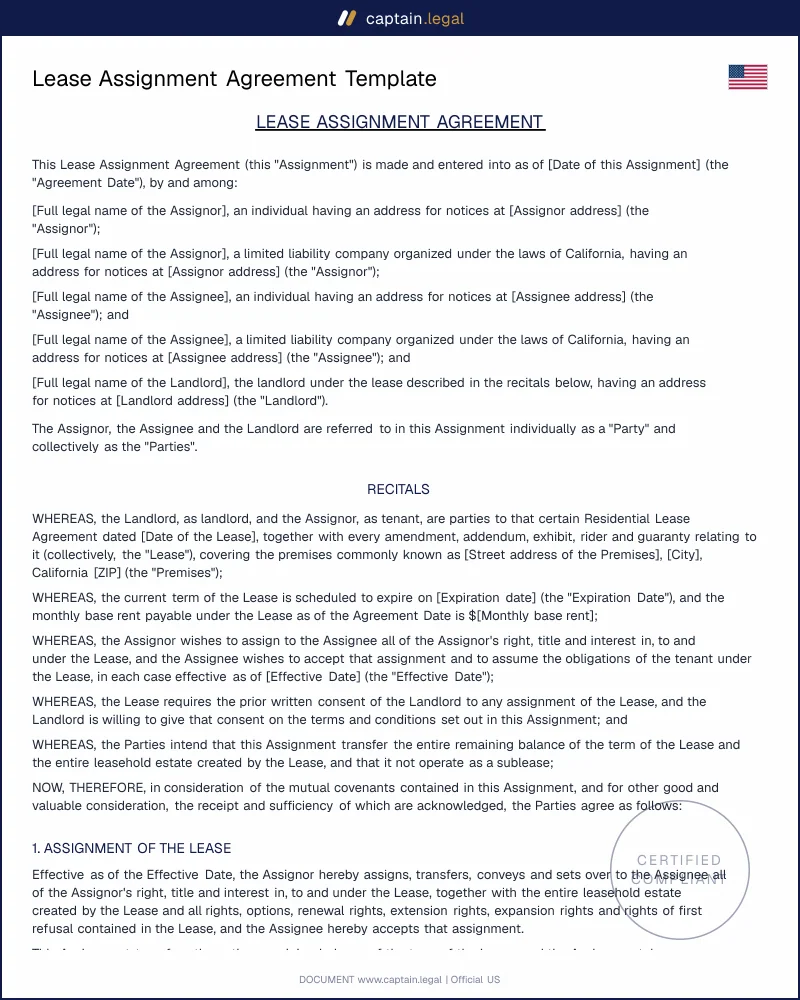
  • The recitals and party identification name the assignor, the assignee and the landlord, then attach the original lease and every amendment by date and title. Signing capacity is captured too, because consent given by a managing agent without authority has been challenged more than once.
  • The assignment and assumption language conveys the entire remaining term with no reversion and has the assignee expressly assume every obligation arising on and after the effective date. Both halves are needed: a conveyance without an assumption leaves the landlord on privity of estate alone, which misses covenants that do not run with the land.
  • The landlord consent and release block is drafted as two separate elections, because they are two distinct legal acts. The landlord consents, then chooses whether to release the assignor. If the release box is not checked, the outgoing tenant remains liable for the rest of the term.
  • The security deposit treatment states whether the deposit is refunded to the assignor and re-funded by the assignee, or credited across without money moving through the landlord. It records the amount held and who is entitled to it when the term ends.
  • The condition of the premises provision documents the unit at handover through a joint walkthrough and a signed schedule. Without it, damage from the assignor's occupancy is charged to whoever is there when the lease ends.
  • The arrears, proration and utilities clause allocates rent for the changeover month, confirms the balance on the effective date and lists the utility transfers each party must complete. Guarantor and holdover provisions carry forward where they exist.
4

State-specific considerations

California treats consent differently by property type. For commercial leases, Civil Code §1995.260 provides that where a lease requires consent but states no standard, consent may not be unreasonably withheld, the rule Kendall announced. Residential leases fall outside that chapter, so the lease language governs, and most California leases bar assignment without written approval. Deposits are the other flashpoint: Civil Code §1950.5 ties the accounting duty to whoever paid, so an assignment silent on the point leaves the assignor waiting on a refund that goes to somebody else.

Texas codifies the consent requirement. Property Code §91.005 provides that during the term of a lease a tenant may not rent the leasehold to another person without the landlord's prior consent, and Texas courts read that clause as written rather than importing a reasonableness gloss. Deposit timing is the practical issue: §92.103 gives the landlord 30 days to refund after the tenant surrenders and gives a forwarding address, and an assignor who never surrenders never starts that clock. Settle the deposit inside the assignment or you will chase it for months.

Florida removed the two-witness formality for leases from §689.01, so a signed writing suffices for an assignment of a term longer than a year. Residential deposits run on Fla. Stat. §83.49: a landlord claiming against a deposit must give written notice within 30 days of the tenant vacating, and the tenant has 15 days to object. Commercial tenants get the Fernandez standard where the lease requires consent without setting a test.

New York has the most explicit residential rule in the country, and it surprises people. Under Real Property Law §226-b(1), a residential tenant may not assign without the owner's written consent, and that consent may be unconditionally withheld without cause. The counterweight is that where the owner unreasonably withholds it, the tenant may demand release on 30 days notice, and that release is the sole remedy. Subletting is far more generous under §226-b(2), which is why New York tenants who want out often sublet instead. Related forms sit on the US real estate templates hub.

5

How to fill out this lease assignment agreement

You start by choosing the state where the property sits, because that selection drives the consent language, the deposit mechanics and the statutory citations printed in the document. Next you tell the form whether the premises are residential or commercial, since the standards diverge on consent. You then enter the lease details: commencement and expiration dates, current rent, the deposit on file and any amendments signed. The form asks for every co-tenant on the lease and whether the assignment is full or partial.

The decisive question comes next. You indicate whether the landlord is releasing the assignor or only consenting, and the document reshapes itself, adding either a release and novation recital or a survival clause that keeps the assignor secondarily liable. From there you set the effective date, allocate the changeover month's rent and record how the deposit moves. Signature blocks are generated for all three parties, with a notary block where the state calls for it.

6

Common mistakes to avoid

The mistake that costs the most money is treating a consent letter as a release. A landlord who writes back approving the new tenant has approved the new tenant, and nothing more. Absent express words of release, the assignor stays liable for rent, damage and legal fees for the rest of the term, and landlords enforce that liability when the assignee defaults. The second recurring error is silence on the security deposit. Two parties, one deposit, no written instruction: the money goes to whoever the landlord believes paid it, and the loser is left with a small claims case.

Skipping the walkthrough is close behind. Damage from the assignor's tenancy becomes the assignee's problem because nobody photographed the unit on handover day, and an itemized security deposit return letter later cites deductions no one can attribute. Assigning in breach of the lease is a fourth trap, since an unauthorized transfer is a default that gives the landlord grounds to terminate. Watch guarantors too: a parent who guaranteed the original lease is not released by an assignment they never signed.

Key takeaways

SCOPE

An assignment transfers the full term

A lease assignment is not a roommate arrangement or a partial handoff. It transfers the entire remaining lease term to the incoming tenant, and the outgoing tenant gives up possession on the effective date. Once assigned, the new tenant is in privity of estate with the landlord, meaning rent and other lease covenants can be enforced directly against the assignee.

CONSENT

Landlord approval rules change by state

Most leases require the landlord’s consent to any assignment, but the landlord’s ability to say no depends on state law and the lease wording. Some states require reasonableness in certain settings (for example, California’s rule reflected in Civil Code 1995.260), while other states may allow refusal without a stated reason unless the lease limits that discretion. Always start with the assignment clause in the existing lease.

LIABILITY

Consent is not the same as release

The biggest surprise is continuing liability. Even after the assignee takes over, the outgoing tenant can still be on the hook under privity of contract unless the landlord signs an express release. A signed consent only means the landlord approved the change; it does not wipe out the original tenant’s obligations. If the goal is to be done for good, the document needs a clear release (a novation).

Frequently Asked Questions

Yes, provided the right people sign it. An assignment binds the outgoing and incoming tenant immediately, but it does not bind the landlord unless the landlord consents where the lease demands it. One executed in breach of a no-assignment clause is usually not void; it is a lease default, letting the landlord terminate. For terms longer than a year the statute of frauds requires a signed writing.

Assignment transfers the entire remaining term, so the incoming tenant deals with the landlord directly and you keep no interest in the property. A sublet transfers only part of the term or the space, you keep a reversion, and the subtenant pays you rather than the landlord. The difference is exposure: after a sublet you are still the tenant and still fully liable.

Almost certainly. Nearly every residential and commercial lease conditions assignment on prior written consent, and several states legislate the point. Texas Property Code §91.005 bars transfer without consent, and New York Real Property Law §226-b requires written owner consent for a residential assignment. Whether refusal can be arbitrary depends on the state and the lease wording; California and Florida apply a reasonableness test to commercial premises where the clause sets no standard.

Yes, unless the landlord signs an express release. Assignment transfers the estate but does not extinguish the promises you made when you signed the lease, so you stay liable through privity of contract if the assignee stops paying. A release turns the transaction into a novation and ends that exposure. Ask for one during the consent negotiation, because asking afterward rarely works.

It depends on the state and the lease. New York sets a clear timetable for sublets under Real Property Law §226-b(2): the owner must answer within 30 days of the request or of any additional information sought, and silence counts as consent. Assignment requests under §226-b(1) carry no equivalent deadline, and most states have no statutory clock. Allow two to four weeks for a residential landlord and longer where a commercial landlord's lender must approve.

Both formats come with the document. Use the Word file when the landlord's attorney wants to redline the release language, since it stays editable without breaking the numbering. The PDF is print-ready, with signature and notary blocks laid out for execution. Regenerate it if the effective date moves. Other tenancy forms sit in the full catalogue of US legal templates.

4.8/5

24 verified reviews · 50 000+ downloads

Lease Assignment Agreement | RPL 226-b, Civ. Code 1995.260
  • Immediate access to the document
  • PDF + Word download
  • Compliant with 2026 legislation
  • Reviewed by lawyers
Fill in the template
Secure payment
Updated on September 5, 2026

You might also like

Late Rent Notice Template
Letter of Intent to Lease Template