Real Estate

Letter of Intent to Lease | Cal. Civ. 1624, NY GOL 5-703

Commercial letter of intent to lease drafted to state law: Cal. Civ. Code 1624, N.Y. Gen. Oblig. Law 5-703, Fla. Stat. 725.01. Binding carve-outs. Word, PDF.
4.6/515 reviews50 000+ downloadsInstant download
Share

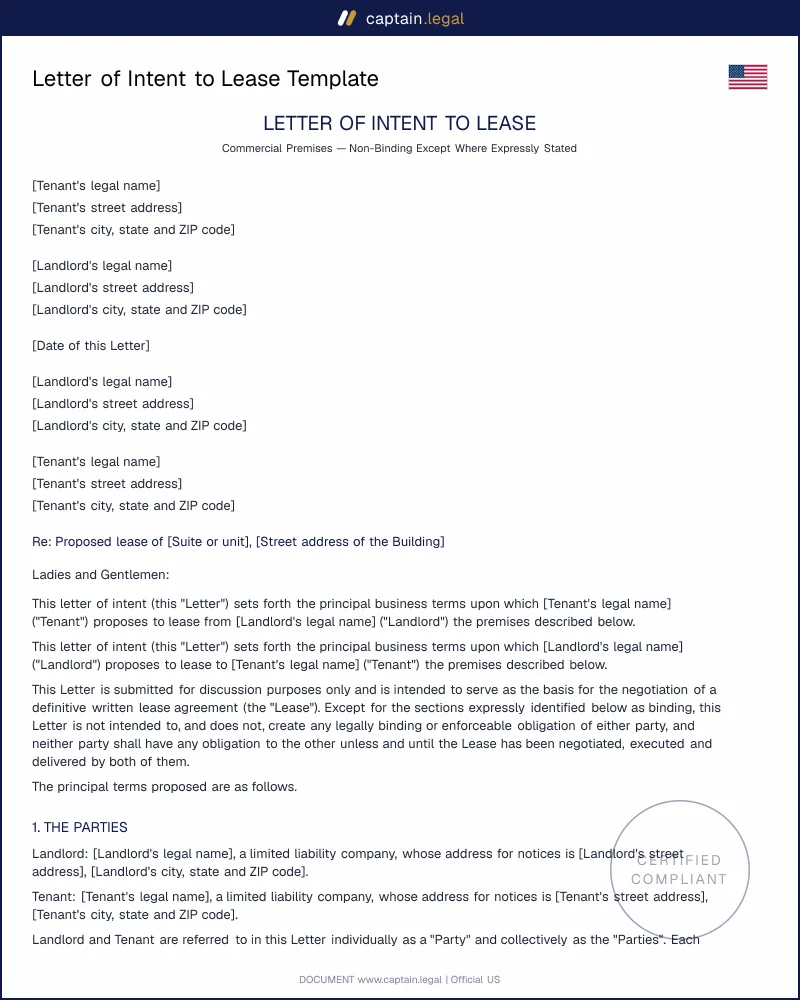
A letter of intent to lease is the short term sheet a commercial landlord and a prospective tenant sign before either side pays a lawyer to draft the lease. It fixes base rent, the length of the term, the tenant improvement allowance, renewal options and exclusive use, and it states in plain words which paragraphs bind the parties and which do not. Brokers call it an LOI, owners a proposal to lease. The label matters far less than the drafting, because a loose LOI can be enforced as a contract, while a careful one keeps both sides free to walk away and still protects the confidential financials exchanged along the way.

Compliant

2026 Legislation

50,000+ clients

trust us

Affordable

From $4.90 / doc

Secure payment

Instant download

Letter of Intent to Lease | Cal. Civ. 1624, NY GOL 5-703

Secure payment

Fill in the template

What is a letter of intent to lease?

A letter of intent to lease is a preliminary written agreement that records the deal points of a proposed tenancy and defers the legal machinery to a later document. It is not a lease. It conveys no leasehold estate and no obligation to pay rent. It forces both sides to settle the economics before anyone spends money on due diligence or lease review.

The document sits between a broker's marketing proposal, which no tenant signs, and the executed commercial lease agreement drafted for NNN and gross structures that governs possession for the whole term. Its value lies in being partly binding. Confidentiality, exclusivity, broker identification and governing law are usually enforceable from signature, while rent, term and build-out stay open until the lease is executed. Practitioners use memorandum of understanding and term sheet interchangeably with LOI, and courts ignore the heading. A court reads the operative language, not the title of the document. A letter headed as non-binding that recites every material term and omits a disclaimer has been enforced more than once.

2

When do you need this document?

The common trigger is a tenant who has toured a space and wants the economics locked before ordering a lease review. Landlord counsel routinely produces a fifty page lease, and a tenant who has not first agreed rent, escalations and allowance negotiates from the weaker position. The owner has the mirror interest: nobody pays for drafting before the tenant confirms its credit, its entity and its timeline.

Expansions and renewals come next. When a tenant takes adjacent suites or extends a term, the LOI captures the amended rent, the new expiration date and any refreshed allowance without reopening the lease. Investors use the same instrument in a lease with option to purchase structure, where occupancy terms and purchase mechanics are agreed together. Two edge cases justify extra care. A franchisee rarely obtains SBA financing or franchisor site approval without a signed LOI. A tenant applying for a conditional use permit or a liquor license often has to show site control to the municipality. An LOI filed with a public authority becomes a public record, reason enough to keep sensitive terms out of any version that leaves the table.

3

Key clauses included in our template

  • The premises and measurement paragraph identifies the suite, the building and the rentable area, and names the measurement standard applied. Office deals commonly reference BOMA standards and disclose the load factor added to usable area, which is what keeps the rentable figure from growing in the lease draft.
  • The base rent and escalation paragraph states the starting rate, the unit of measurement and how rent moves over the term. Fixed bumps and index linked increases produce very different totals across ten years, so the mechanism belongs here.
  • The operating expense structure paragraph fixes whether the deal is triple net, modified gross or full service, and names the base year for any gross structure. It is where a tenant asks for a cap on controllable common area costs.
  • The tenant improvement allowance paragraph sets the amount, the basis of calculation, who manages the work, what happens to unused funds and the delivery condition, whether warm shell, white box or as is.
  • The term, commencement and options paragraph defines the delivery date, the rent commencement date, any free rent period and the renewal options. Renewal rent is stated either as a fixed rate or as fair market value with an agreed appraisal mechanism.
  • The binding provisions paragraph is the heart of the document. It carves out confidentiality, the exclusivity window with its outside date, broker identification and governing law, then states that every other paragraph is non-binding until a lease is signed.
4

State-specific considerations

California now treats small commercial tenants differently from sophisticated ones. The Commercial Tenant Protection Act, enacted as SB 1103 and effective January 1, 2025, created a class of qualified commercial tenants covering microenterprises with five or fewer employees, restaurants with fewer than ten and nonprofits with fewer than twenty. Under Civ. Code 1950.9 a landlord cannot pass building operating costs to such a tenant unless they are allocated proportionately and documented on request. Civ. Code 1632 adds a translation duty when the lease is negotiated primarily in Spanish, Chinese, Tagalog, Vietnamese or Korean, and the tenant may rescind if it is ignored. An LOI promising a CAM structure the landlord cannot lawfully deliver to a qualified commercial tenant creates a problem before the lease is drafted.

Texas takes the opposite view of good faith. Under John Wood Group USA, Inc. v. ICO, Inc., 26 S.W.3d 12 (Tex. App. Houston 1st Dist. 2000, pet. denied), an agreement to negotiate in the future is unenforceable even when it expressly calls for a good faith effort. Texas exclusivity therefore has to read as a hard covenant not to market or negotiate with third parties for a defined period, with its own remedy. The same court warned that a letter lacking a clear non-binding statement can still bind on material terms.

Florida removed a long standing occupancy cost when the legislature repealed Fla. Stat. 212.031 effective October 1, 2025, ending state sales tax and county surtax on commercial rent. Older forms still carry a gross up line for a charge that no longer applies. Build-out terms deserve equal attention, because the construction lien statute at Chapter 713 gives contractors strong recording rights against the landlord's interest, so the letter should name who contracts for the work and who collects lien waivers.

New York applies the Tribune factors with unusual rigor, and the Court of Appeals confirmed the Type II analysis in IDT Corp. v. Tyco Group, S.A.R.L., 13 N.Y.3d 209 (2009). A New York LOI reciting full economics without a disclaimer is a real litigation risk. Any tenancy longer than a year must also satisfy Gen. Oblig. Law 5-703(2), and premises in Manhattan below 96th Street may attract the city commercial rent tax, which belongs in the occupancy cost discussion.

5

How to fill out this letter of intent to lease

You start by selecting the state where the property sits and the side you represent, because a landlord form and a tenant form allocate the same points very differently. The questionnaire asks for the parties, with exact entity names, then the premises description with rentable area and measurement standard. Rent follows, with fields for the starting rate, the escalation method and any abatement period. If the tenant entity does not exist yet, most users pair the letter with an LLC operating agreement for the new tenant entity so the signature block names a real party.

The expense section adapts to the structure you choose. Improvement fields cover the allowance, who performs the work and the delivery condition. You then set the exclusivity window, confirm the broker arrangement and choose the governing law. The last screen is the binding provisions selector. Download follows immediately in editable Word and signature ready PDF.

6

Common mistakes to avoid

The mistake that ends up in court is the detailed LOI with no disclaimer. Parties list rent, term, allowance, options and delivery date, add a line saying they intend to proceed promptly, and a judge later reads that as a complete agreement awaiting formalities. The reverse error is a letter so vague it gives the owner no reason to hold the space. Contradictory drafting sits between the two, where one paragraph declares the letter non-binding and another says the parties shall be bound by the terms above.

Open-ended exclusivity is the third trap. A no-shop covenant with no outside date is either void for indefiniteness or enforceable in a way the landlord never intended. Allowances are the fourth, often a bare figure with no basis, no manager and no answer on unused funds. Last, people copy residential language into commercial deals. Notice periods, deposit caps and habitability duties drawn from a residential lease agreement built to state specific rules have no place in an office or retail LOI, and they tell opposing counsel who drafted it.

Key takeaways

ENFORCEABILITY

The title does not control binding effect

Courts look at the operative language, not whether the document is labeled LOI, term sheet, or “non-binding.” If it reads like a complete deal and lacks a clear disclaimer, it can be treated as a contract. Under the Type I/Type II framework (Teachers v. Tribune), you may end up bound right away or at least bound to negotiate in good faith.

STATUTE OF FRAUDS

A signed LOI can satisfy writing rules

For leases longer than one year, state statute of frauds rules require a signed writing (see Cal. Civ. Code 1624(a)(3) and N.Y. Gen. Oblig. Law 5-703(2)). A signed LOI that identifies the parties, premises, rent, and term may check those boxes, even if you thought it was only a placeholder. If you want it non-binding, the non-binding legend must be explicit.

BINDING CARVE-OUTS

Some clauses are meant to bind now

A well-drafted LOI separates business terms that stay open (rent, term, build-out) from provisions that are enforceable at signature. Confidentiality typically binds because sensitive financials and deal terms get shared before the lease is drafted, and it can align with trade secret protection (Defend Trade Secrets Act, 18 U.S.C. 1836). Exclusivity and broker identification also commonly bind for a stated window.

Frequently Asked Questions

Partly, and that is the design. Economic terms stay non-binding until a lease is signed, while confidentiality, exclusivity, broker identification and governing law bind from signature. That split holds only if the document says so explicitly. Courts applying Teachers Insurance and Annuity Association v. Tribune Co. have enforced letters that recited full economics without one.

It depends on the state and on how the exclusivity clause was drafted. Where the letter contains a genuine covenant to withdraw the space from the market, the tenant may have a claim, as it did in Channel Home Centers v. Grossman. Recovery usually runs to reliance costs such as architect fees and lease review, not lost profits. In Texas the analysis is harsher, since an agreement to negotiate in good faith is unenforceable.

Yes. Every completed document arrives in editable Microsoft Word format and in PDF ready for signature. Word matters more than people expect on an LOI, because these letters are redlined two or three times before signature, and a landlord who receives a locked PDF will retype the terms into their own form.

Thirty to sixty days is the working range for most office and retail deals, measured from signature. Thirty suits a straightforward suite with no construction. Sixty or more is realistic where the tenant needs zoning confirmation, franchisor approval or a build-out estimate first. What matters more than the length is the outside date, because a covenant with no expiry leaves the owner unable to remarket cleanly.

Neither is legally required. Tenants regularly send an LOI directly, and small building owners do the same. What you need is drafting that separates binding from non-binding paragraphs and reflects the law of the state where the property sits. Where the deal involves a long term, heavy construction spend or a ground lease, counsel should read the letter first, because terms conceded here are hard to reclaim.

It belongs in the LOI. The allowance is often the largest concession in the deal, and a landlord who has already signed a letter fixing rent and term will resist adding construction money later. State the amount, the basis of calculation, who manages the work, the delivery condition and what happens to any unused portion. Related build-out and entity contracts sit in our catalogue of legal document templates.

4.6/5

15 verified reviews · 50 000+ downloads

Letter of Intent to Lease | Cal. Civ. 1624, NY GOL 5-703
  • Immediate access to the document
  • PDF + Word download
  • Compliant with 2026 legislation
  • Reviewed by lawyers
Fill in the template
Secure payment
Updated on September 4, 2026

You might also like

Commercial Lease Agreement
Co-Ownership Agreement Template