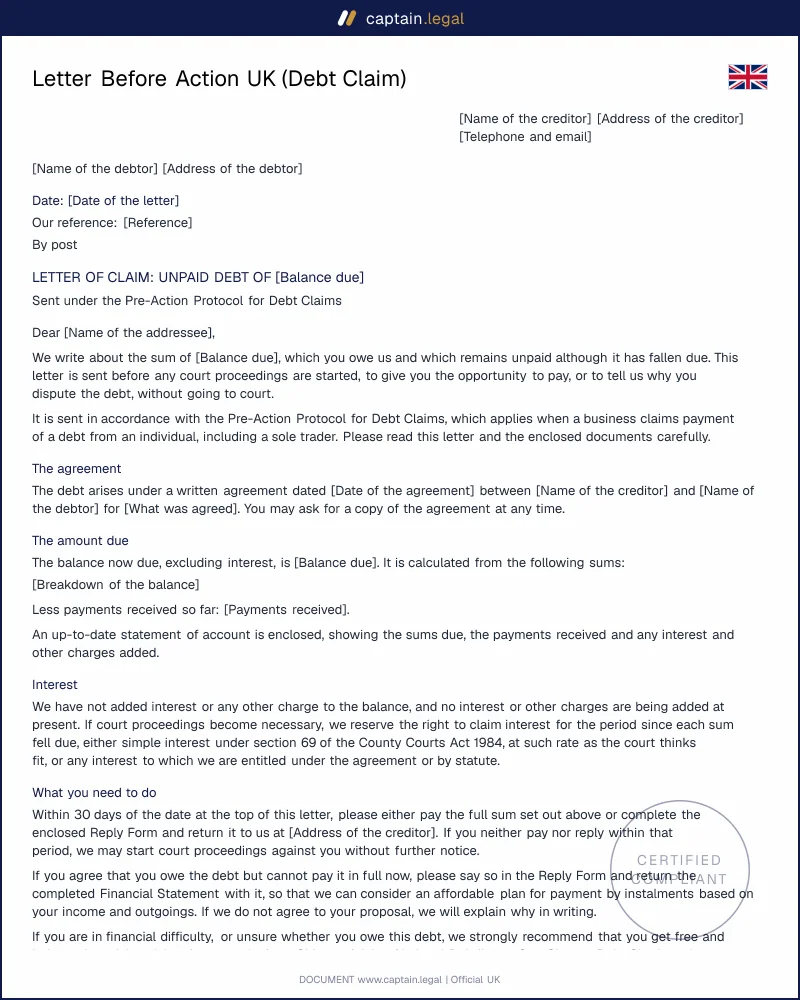
Two sets of pre-action rules govern debt claims in England and Wales. The Pre-Action Protocol for Debt Claims applies when a business, including a sole trader or a public body, claims a debt from an individual, including a sole trader (paragraph 1.1). Under paragraph 3.1, the letter must state the amount, whether interest or charges are still running, the date and parties of a written agreement or the details of an oral one, how to pay and where to send the Reply Form. It must enclose a statement of account, the Information Sheet and Reply Form from Annex 1, and a Financial Statement form. Paragraph 3.3 requires it to go by post unless the debtor has explicitly asked otherwise, and paragraph 3.4 gives the debtor 30 days from the date at the top of the letter before proceedings can start.
Every other debt falls under the Practice Direction on Pre-Action Conduct and Protocols: business to business, or a private individual claiming from anyone. Paragraph 6 expects concise details of the claim, how the amount is calculated, and a reply within a reasonable time, which is 14 days in a straightforward case. Since Churchill v Merthyr Tydfil County Borough Council [2023] EWCA Civ 1416, a court can order parties to engage in alternative dispute resolution. CPR 3.1(2)(o) now gives that power expressly, and CPR 44.2(5)(e) treats an unreasonable failure to engage as conduct relevant to costs.
Interest has its own rules. On a contract for goods or services between businesses, the Late Payment of Commercial Debts (Interest) Act 1998 implies simple interest at 8% above the Bank of England base rate in force on the previous 30 June or 31 December, plus fixed compensation per invoice under section 5A. Outside that Act, and absent a contractual rate, the court may award interest under section 69 of the County Courts Act 1984. The gov.uk guide to making a court claim for money explains how that interest is calculated once a claim is issued.