Business

Privacy Policy UK: Website Privacy Notice and Cookie Policy Template

Privacy notice and cookie policy for a UK business website under the UK GDPR, the Data Protection Act 2018 and PECR, updated for the Data (Use and Access) Act 2025: lawful bases, retention, rights, complaints, cookie table.
4.6/5— 14 reviews50 000+ downloadsInstant download
Share

A website privacy policy tells visitors who runs the site, what personal data it collects and why, on which lawful basis, who receives it, how long it is kept and what rights they have. This UK privacy policy template combines that notice with a cookie policy and a cookie table. It is written for small businesses, sole traders, consultants and online shops that decide for themselves how their website data is used. It follows the UK GDPR, the Data Protection Act 2018 and PECR, as amended by the Data (Use and Access) Act 2025.

Compliant

2026 Legislation

50,000+ clients

trust us

Affordable

From $4.90 / doc

Secure payment

Instant download

Privacy Policy UK: Website Privacy Notice and Cookie Policy Template

Secure payment

Fill in the template

What is a UK privacy policy?

Lawyers call it a privacy notice; most website owners call it a privacy policy. Both names describe a public statement giving individuals the information listed in Articles 13 and 14 of the UK GDPR when their data is collected. It is not a contract. Nobody signs it, and a tick box saying "I accept the privacy policy" adds nothing legally. Its job is transparency, and the regulator judges it on a simple test: can a visitor understand, in plain English, what happens to their name, email address, IP address or order history?

A privacy policy UK law expects is also different from your terms and conditions. The terms govern the sale; the notice explains the data processing behind it, and the terms simply point to it. The cookie policy is the third piece. It explains the files and tags your site places on a visitor's device, which fall under PECR rather than the UK GDPR alone.

Keeping the three topics in one document has a practical benefit. The classic contradiction is an old privacy page, a cookie banner configured later by a developer, and a newsletter tool that neither mentions. A single notice built from the same answers keeps purposes, cookies and retention periods aligned, with one dated version to update.

When do you need this document?

Almost every business website needs a UK privacy policy, even a brochure site, because the server logs IP addresses and the contact form captures names and emails. The clearest case is an online shop: orders, payments, deliveries and returns all involve personal data, and online shop terms and conditions for consumer sales refer customers to your privacy notice for exactly that reason. Consultants and service businesses need one as soon as an enquiry or quote form goes live.

A newsletter is another trigger. Once you collect email addresses for marketing, the notice has to explain consent, the soft opt-in if you use it, unsubscribing and the suppression list. Adding Google Analytics, a Meta Pixel or embedded YouTube videos brings in the cookie rules, and the cookie policy must then match what your banner actually does.

Two edge cases come up often. A careers page that accepts CVs makes you a controller of candidate data, sometimes including health information for reasonable adjustments, which needs its own condition and a policy document. And a business that switches tools, say to a new live chat widget, often gains a new processor and a new transfer abroad, so the notice must change before the tool goes live.

Key clauses included in our template

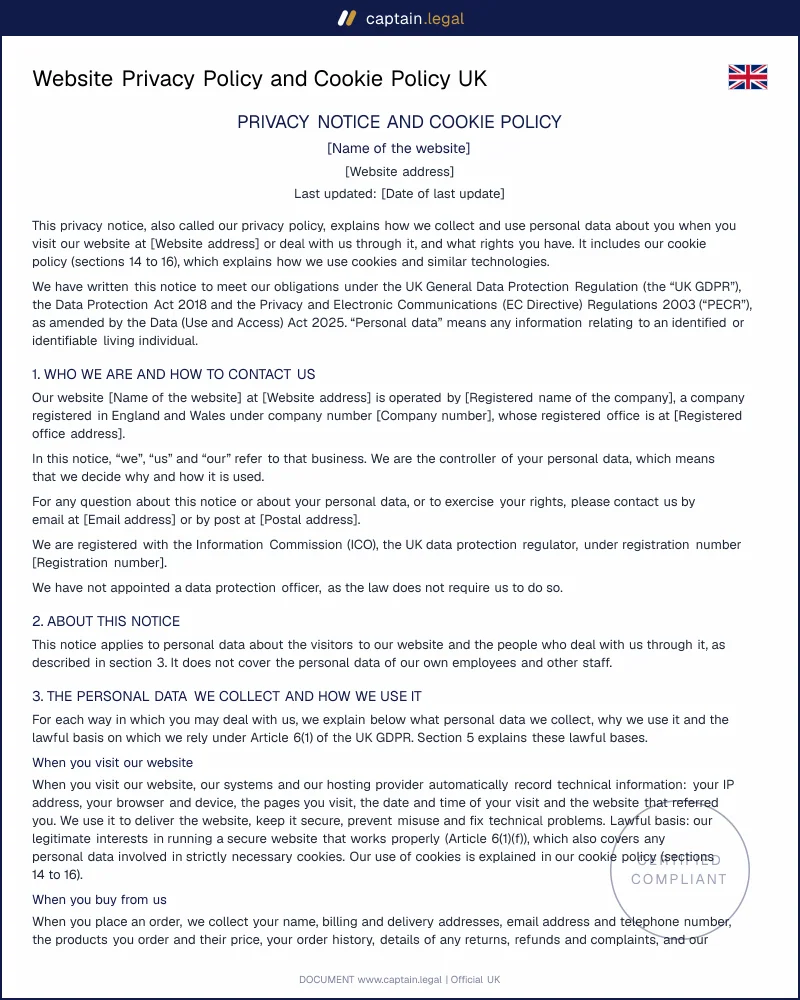
The notice opens with the identity of the controller, built from your answers for a limited company, an LLP, a sole trader or a partnership. Contact details for privacy requests follow, with your registration number with the Information Commission if you pay the fee, and either your data protection officer's details or a short statement that the law does not require one. Section 3 covers website visits and each activity you tick (orders, accounts, enquiries, newsletters, job applications, live chat, reviews and age checks) with the data, purpose and lawful basis for each, so the notice never describes processing your site does not carry out.

Next comes the part copied notices most often get wrong: data received from third parties, each lawful basis including recognised legitimate interests, recipients by category, transfers under Articles 45A and 46, and retention periods tied to real obligations such as the six-year accounting rule. Staff data is deliberately left out. Employees need their own privacy notice, and an employee handbook with workplace data protection policies sets the rules staff follow when they handle customer data.

Rights fill the following sections: access with a reasonable and proportionate search, erasure, portability, the separately presented right to object, automated decisions, the one-month deadline and the two complaint routes. The cookie policy then sets out the categories used, consent or exemption for analytics and functionality cookies, a table of up to eight named cookies and how to change choices. A short clause on future changes closes the document.

Common mistakes to avoid

The most frequent error is copying a UK privacy policy from another website. It lists tools you do not use, misses the ones you do, and often still names the old regulator or quotes the EU GDPR as if it applied. Cookie policies that contradict the banner come a close second, claiming analytics run only with consent while the script fires on page load. Under Schedule A1, analytics can run without consent only for statistics that improve your own site, shared with no one beyond the provider helping you. If that provider reuses the data for its own advertising, the exception does not apply and consent is required.

Vague retention is another weak spot: "as long as necessary" tells the reader nothing, and stated periods must match what your systems delete. Processors are the blind spot. Your developer, hosting company and email platform handle data for you and need a written contract with data protection terms; a UK contractor agreement for freelancers sets the working terms, and those data processing terms sit alongside it. Timing matters too: link the notice from every form, not just the footer, so people see it when their data is collected. If a prospective partner wants to see your customer list, sign a mutual or one-way NDA first and check that the disclosure itself has a lawful basis, because confidentiality does not replace data protection terms.

Key takeaways

TRANSPARENCY

Every purpose needs its own lawful basis

Articles 13 and 14 of the UK GDPR require the notice to state, for each use of personal data, its purpose and lawful basis, the legitimate interests relied on, the recipients, transfers outside the United Kingdom and how long the data is kept. A generic notice copied from another site rarely matches reality, and that gap is itself a breach of the transparency rules. The template only describes the activities your website actually carries out.

COMPLAINTS

Visitors can now complain to the business

Since 19 June 2026, section 164A of the Data Protection Act 2018 lets anyone who thinks their personal data has been mishandled complain to the business. You must make complaints easy, acknowledge each one within 30 days and deal with it without undue delay. The notice must also mention the right to complain to the Information Commission, which replaced the Information Commissioner on 30 September 2026 as the UK regulator.

COOKIES

Some analytics cookies no longer need consent

Since 5 February 2026, Schedule A1 to PECR allows cookies used only to collect statistics that improve your own website, or to adapt its appearance and functions, without prior consent, provided visitors are clearly informed and can object simply and free of charge. Advertising cookies, social media plugins and analytics data reused by the provider for its own purposes still need consent, and withdrawing it must be as easy as giving it.

Frequently Asked Questions

A privacy notice is not a contract, so it does not bind visitors the way terms of sale do. It binds you. Once published, it records what you have told people about your processing, and the Information Commission can treat any gap between the notice and your real practice as a breach of the transparency principle in Articles 5, 12 and 13 of the UK GDPR. That is why the template describes only the activities you tick and lists your real cookies.

Yes. When you click Finish, the completed notice is generated in both formats. The PDF is ready to send to your web developer or to keep as a record of the version in force, and the Word file lets you adapt wording, for example to add a ninth cookie. A stable address such as /privacy makes the notice easy to link from forms, the checkout and your cookie banner. Keep the dated versions on file, because you may need to show which notice applied when a complaint arrives.

One month, counted from the latest of three moments: receipt of the request, receipt of any information you asked for to confirm identity, or payment of a fee where one is allowed. Article 12A of the UK GDPR lets you extend by two further months for complex or numerous requests, if you tell the person within the first month and give reasons. For access requests, the clock also pauses while you wait for details you reasonably need to identify what the request covers. A late reply is itself a breach of Article 12, so diarise requests the day they arrive.

It depends on how you use them. Paragraph 5 of Schedule A1 to PECR allows cookies whose sole purpose is to produce statistics about how your website is used, with a view to improving it, without prior consent. You must give clear information, offer a simple and free way to object, and share the information only with a provider helping you make those improvements. If your analytics tool reuses the data for advertising or audience building, it falls outside the exception. When in doubt, choose consent in the questionnaire.

Either, and neither route is a precondition of the other. Under section 164A of the Data Protection Act 2018, anyone who thinks you have mishandled their personal data can complain to you, and you must make complaints easy, acknowledge them within 30 days and deal with them without undue delay, reporting progress and the outcome. The person can also complain to the Information Commission, which replaced the Information Commissioner on 30 September 2026. The template states both rights, as Article 13(2) requires.

Yes, as soon as the site collects personal data, which nearly every site does through server logs, contact forms or newsletter sign-ups. Being a sole trader changes the identification section, not the duty: you are personally the controller, so the notice names you and your trading name. You may also have to pay the annual data protection fee unless an exemption applies. For the rest of your paperwork, the full catalogue of UK legal documents lists the templates available for England and Wales.

You can rely on the soft opt-in in regulation 22(3) of PECR if three conditions are met: you obtained the email address during a sale or negotiations for a sale, you market only your own similar products or services, and you offered a simple, free way to refuse when you collected the address and in every message. People who have never bought or asked to buy from you, such as a visitor who only downloaded a guide, still need to give consent. The template adds the soft opt-in paragraph only if you select it.

4.6/5

14 verified reviews · 50 000+ downloads

Privacy Policy UK: Website Privacy Notice and Cookie Policy Template
  • Immediate access to the document
  • PDF + Word download
  • Compliant with 2026 legislation
  • Reviewed by lawyers
Fill in the template
Secure payment
Updated on November 8, 2026

You might also like

Statement of Capital UK
Online Shop Terms and Conditions UK