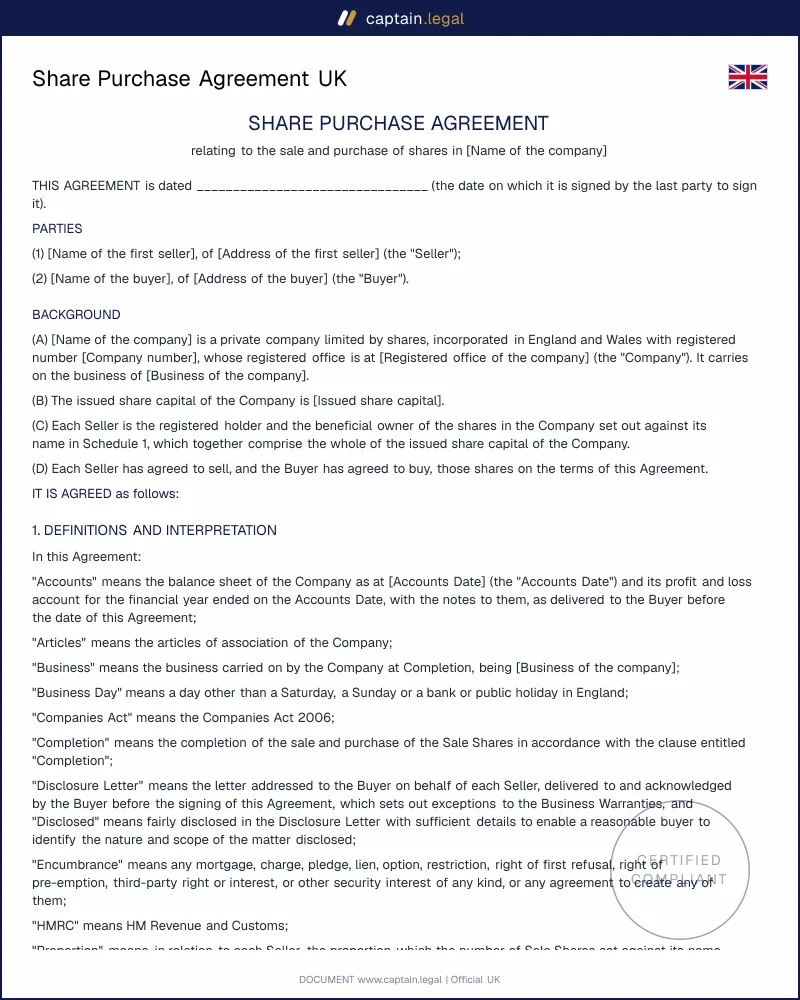
The opening clauses identify the sellers, the buyer and the company, list each seller's shares in Schedule 1 and set the price. You choose between payment in full at completion, payment by instalments with an acceleration clause if the buyer defaults or resells, and a fixed price plus a single earn-out sum payable if the company reaches a target that you define for a named financial year. The price is fixed, with no completion accounts mechanism, and payments are split between the sellers in proportion to their shares.
Schedule 4 carries the buyer's protection. Title and capacity warranties are always given: each seller owns its shares free from any charge and has the power to sell them. You can add nineteen business warranties covering the accounts, employees, property, contracts, data protection, disputes and tax, all qualified by a disclosure letter, and an optional tax covenant under which the sellers pay any pre-completion tax not provided for in the accounts. The limitations clause then sets a minimum claim, a threshold, a cap and a time limit of 12, 18 or 24 months, with seven years for tax. Where there are several sellers, you decide whether their liability is several (each pays its share) or joint and several. Fraud is never capped.
The sellers' personal commitments come next. Restrictive covenants of 12, 24 or 36 months stop the sellers from competing, poaching customers or hiring key staff, and must stay reasonable to be enforced, as our page on UK restrictive covenants and the Tillman test explains. Seller loans are repaid at completion, personal guarantees given to the bank or landlord are released or indemnified, and outgoing directors resign by deed.