Create my document
Login

Choose country

United KingdomUnited KingdomChoose country
Employment

Restrictive Covenants Agreement UK | Word & PDF Template

Protect your clients, team and trade secrets when staff leave. Enforceable post-termination restrictions calibrated to role seniority. Word and PDF download.
4.7/522 reviews50 000+ downloadsInstant download
Share

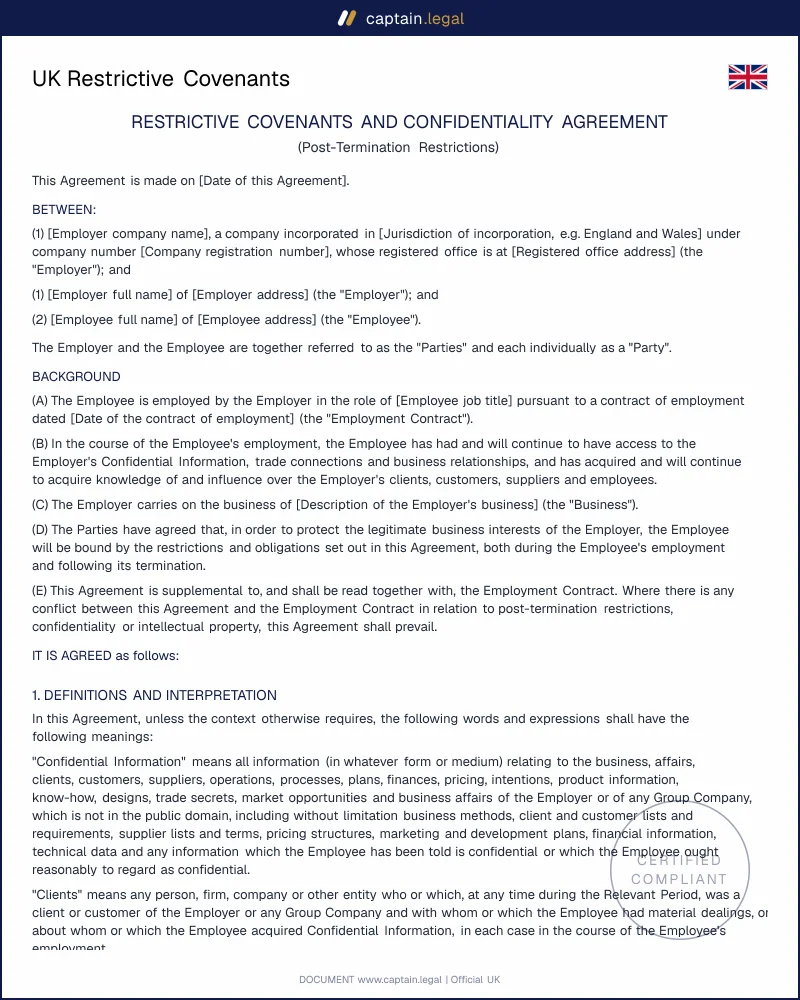
A Restrictive Covenants and Confidentiality Agreement is a standalone post-termination document that stops a departing employee from taking your clients, your team or your trade secrets to a competitor. It bundles the four protections that matter most when someone leaves: a non-compete covenant, a non-solicitation covenant, a non-dealing covenant, and a confidentiality undertaking that survives the end of the employment relationship. UK courts treat these clauses as an unlawful restraint of trade by default, enforceable only where they go no further than reasonably necessary to protect a legitimate business interest. That single principle governs everything in the document, which is why each covenant in our template is drafted with a defined duration, a defined geographic or client scope, and wording a judge can actually uphold.

This agreement is written for English and Welsh employers managing senior, client-facing or technical staff, and it works either as a fresh standalone deed or as a schedule bolted onto an existing contract.

Compliant

2026 Legislation

50,000+ clients

trust us

Affordable

From $4.90 / doc

Secure payment

Instant download

Restrictive Covenants Agreement UK | Word & PDF Template

Secure payment · No subscription

Fill in the template

What is a restrictive covenants and confidentiality agreement?

A restrictive covenants and confidentiality agreement is a contract that restricts what a former employee can do for a defined period after their employment ends. It sits in the family of post-termination restrictions, sometimes called PTRs, and it differs from the confidentiality clause buried in a standard employment contract in two ways: it is broader, and it is built to survive termination rather than lapse with it.

The distinction worth understanding is between the four instruments the document combines. A non-compete prevents the leaver from working for, or setting up, a competing business. A non-solicitation covenant stops them approaching your clients or staff to lure them away. A non-dealing covenant goes further than non-solicitation : it bars the leaver from doing business with your clients even when the client made the first approach. The confidentiality undertaking protects information that does not qualify as a trade secret but is still commercially sensitive, such as pricing models, supplier terms or pipeline data.

People often confuse a restrictive covenant with a simple garden leave clause. They are not the same. Garden leave keeps someone on the payroll and out of the market during their notice period; a restrictive covenant bites only after employment has ended. Most well-advised employers use both, because time spent on garden leave is usually set off against the covenant period, and a court will expect that overlap to be accounted for when judging whether the total restraint is reasonable. Our full-time UK employment contract template already contains a baseline set of these clauses, but a dedicated agreement gives you stronger, role-specific drafting.

2

When do you need this agreement?

The clearest trigger is a senior hire with access to your client book. When you bring in a sales director, an account lead or a practice head, the value they can walk out with is your customer relationships, and a non-solicitation and non-dealing package is the protection that actually holds in court. Reasonableness scales with seniority : a covenant a tribunal would strike down for a junior administrator may be entirely defensible for a board-level executive whose knowledge of the business is deep and current.

The second common scenario is the technical or product role. An engineer, a developer or a head of R&D holds confidential know-how that a confidentiality undertaking alone may not fully contain, which is why a short, tightly scoped non-compete is often the only effective shield. The third is the team-build risk : where one leaver could trigger a wave of resignations, a staff non-solicitation covenant protects workforce stability, one of the three interests the courts expressly recognise.

Two edge cases deserve a flag. First, covenants imposed mid-employment without fresh consideration are vulnerable; if you add restrictions to an existing employee, give something of value in return, such as a pay rise, a bonus or a promotion, and record it. Second, you cannot enforce a covenant against an employee you have wrongfully dismissed : a repudiatory breach by the employer releases the leaver from the restraints entirely. This is precisely why a clean, documented exit matters, and why pairing covenants with a proper UK disciplinary procedure and warning letter pack protects the enforceability of everything that follows.

3

Key clauses included in our template

  • The non-compete covenant is drafted with an express duration, a defined activity, and a carve-out permitting passive minority shareholdings. That carve-out is not optional padding; it is the precise drafting failure that nearly sank the employer in Tillman, where the word "interested" was read to bar even a single share in a listed rival.
  • The non-solicitation covenant is limited to clients with whom the employee personally dealt, and to a backstop period before termination (commonly the final twelve months). A covenant protecting clients the leaver never met is almost always struck down as wider than necessary.
  • The non-dealing covenant closes the gap left by non-solicitation by prohibiting business with protected clients regardless of who approached whom. Courts scrutinise these closely, so the template ties the restriction to clients the employee had material contact with rather than your entire customer base.
  • The staff non-solicitation covenant restrains the leaver from poaching colleagues, and is narrowed to employees of a defined seniority with whom they worked, not the whole payroll. Blanket "no poaching anyone" wording is a classic over-reach.
  • The confidentiality and trade secrets undertaking survives termination indefinitely for true trade secrets and for a defined period for merely confidential information, mirroring the dual protection under the common law duty of confidence and the Trade Secrets Regulations 2018.
  • The garden leave and set-off provision allows time spent on garden leave to count against the covenant period, the mechanism a court expects to see when assessing whether the total restraint is proportionate.
4

Regional considerations

This agreement is drafted for England and Wales, where the restraint of trade doctrine and the Tillman line of authority apply directly. The reasonableness test, the legitimate-interest categories, and the blue pencil approach to severance are all features of English common law as developed through the High Court, the Court of Appeal and the Supreme Court.

Scotland operates a separate legal system, and while the underlying principles of restraint of trade are broadly similar, Scottish courts apply their own procedure and their own body of case law. Enforcement is pursued through the Court of Session rather than the High Court, and a covenant litigated in Edinburgh will be tested against Scottish authority. Before relying on this template for a Scottish-based employee, take Scottish-qualified advice on the specific covenants.

Northern Ireland likewise has its own court structure and statutory framework, and although the common law on restrictive covenants tracks the English position closely, the governing-law and jurisdiction clauses need to reflect Northern Irish law where the employee is based there. In every case the template lets you set the governing law expressly, which is the single most important choice when staff are spread across the UK's three jurisdictions. For cross-border businesses managing standalone confidentiality alongside covenants, the UK NDA and business confidentiality templates in our business category complement this agreement well.

5

How to fill out this restrictive covenants and confidentiality agreement

You start by identifying the employer and the employee, then selecting whether the agreement is a fresh standalone deed or a schedule that varies an existing contract. From there the template asks you to set the role seniority, because that single choice calibrates how aggressive your covenants can reasonably be. You then choose which of the four covenants you actually need, since a court reads a kitchen-sink approach as evidence that none of the restraints was carefully considered.

Next you define the duration of each restriction, the client or geographic scope, and the backstop period for non-solicitation and non-dealing. The form prompts you to record any fresh consideration where covenants are being added mid-employment, and to align the covenant period with any garden leave so the set-off is documented. You finish by setting the governing law and jurisdiction to match where the employee is based. The document then generates in editable Word and clean PDF, ready to sign. If you are also resetting wider employment terms, our UK part-time employment contract template pairs naturally with a covenant schedule.

6

Common mistakes to avoid

The most expensive error is reaching for the widest possible drafting in the belief that a court will simply trim it back. It will not. A judge applies the blue pencil only to remove discrete offending words, never to rewrite a covenant into something reasonable, and a restraint that is plainly too broad falls in its entirety. Employers also routinely forget that reasonableness is fixed at the moment the covenant is signed, so the senior manager promoted three times since signing a junior contract may be bound by nothing at all. Refresh covenants on promotion, and give consideration each time you tighten them.

A second cluster of mistakes concerns scope. Protecting clients the employee never dealt with, restraining the poaching of staff they never worked alongside, or imposing a two-year non-compete where six months would protect the interest, each invites a finding that the covenant is punitive rather than protective. Length is the most over-reached variable of all : most enforceable non-competes run three to twelve months, and anything longer needs a genuine justification tied to how long your confidential information stays valuable. Finally, do not assume covenants survive a botched exit. Dismiss someone in repudiatory breach of their contract and you release them from every restraint, which is why a defensible termination process protects far more than the dismissal itself.

Key takeaways

SCOPE

Four clauses cover most exit risks

This agreement bundles the four main post-termination protections: non-compete (stops working for or setting up a competitor), non-solicitation (stops poaching clients or staff), non-dealing (blocks doing business with clients even if they approach first), and confidentiality that survives termination. It is aimed at senior, client-facing or technical roles where client relationships, team stability and commercially sensitive information are exposed.

ENFORCEABILITY

Reasonableness decides if it stands up

In England and Wales, post-termination restrictions are treated as restraint of trade by default, so they only work if they go no further than reasonably necessary to protect a legitimate business interest. The recognised interests are trade connections, confidential information, and workforce stability. Drafting needs clear limits, such as a defined duration and a defined geographic or client scope, or a judge may refuse to enforce it.

TIMING

Do not confuse covenants with garden leave

Garden leave and restrictive covenants operate at different times. Garden leave keeps the employee on payroll and out of the market during the notice period; restrictive covenants bite only after employment ends. Many employers use both, but the overlap matters: time spent on garden leave is usually set off against the covenant period. Courts will look at the total restraint when deciding whether it is reasonable.

Frequently Asked Questions

Yes, provided it is properly executed and the covenants are reasonable. A restrictive covenants and confidentiality agreement is enforceable in England and Wales where each restriction protects a legitimate business interest and goes no further than reasonably necessary, the test confirmed in Tillman v Egon Zehnder Ltd [2019] UKSC 32. The template is drafted to that standard, with defined durations and scope. It must be signed by both parties, and where added during employment it should be supported by fresh consideration. A binding document is only half the work, though : the covenants must also be reasonable for the specific role, which is why the form calibrates scope to seniority.

There is no fixed statutory limit at present. Enforceability turns on reasonableness, and in practice most non-compete covenants run between three and twelve months, with six months being the most common duration for senior staff. Anything longer must be justified by reference to how long your confidential information or client connections remain valuable. The previous government proposed a three-month statutory cap, and a fresh Department for Business and Trade consultation ran from November 2025 to February 2026, but no cap has become law. Until it does, the common law reasonableness test governs, and an over-long restriction risks being struck down in full.

A non-solicitation covenant stops a former employee approaching or enticing your clients away. A non-dealing covenant goes further : it bars the leaver from doing business with those clients at all, even where the client made the first approach. Non-dealing is the stronger protection because it removes the evidential headache of proving who solicited whom, but courts scrutinise it more closely precisely because it is broader. Both should be limited to clients the employee personally dealt with during a defined period before leaving. A restriction covering your whole client base, including customers the leaver never met, is the kind of over-reach a tribunal routinely refuses to enforce.

You receive the agreement in two formats: a fully editable Microsoft Word file and a clean, signature-ready PDF. The Word version lets you adjust durations, client scope and governing law to fit the specific role, while the PDF is formatted for signing and filing. Both download instantly once the document is generated. Because covenant drafting is so role-sensitive, the editable format matters more here than with most templates : you will often tailor the scope for each senior hire rather than reusing identical wording.

Yes, but you must give something of value in return, known as fresh consideration. Simply asking a current employee to sign new restrictions without offering anything, such as a pay rise, a bonus, a promotion or another genuine benefit, leaves the covenant vulnerable to challenge for want of consideration. Record what was given and when. It is also worth knowing that reasonableness is assessed at the date of signing, so the sensible moment to introduce or refresh covenants is at promotion or contract renewal, when fresh consideration is naturally present and the restrictions can be matched to the employee's expanded role.

Yes. Genuine trade secrets are protected indefinitely after termination, both under the common law duty of confidence and the Trade Secrets (Enforcement, etc.) Regulations 2018. Information that is merely confidential rather than a true trade secret receives a lower level of protection and is usually restricted for a defined post-termination period. The template distinguishes the two, because over-claiming that everything is a trade secret weakens your position. A well-drafted confidentiality undertaking remains one of the most durable protections an employer has, and it survives even where the wider government reform of non-competes eventually limits other covenants.

You may lose the protection of every covenant in the agreement. Where an employer commits a repudiatory breach of contract, such as a wrongful dismissal, the employee is released from their post-termination restraints entirely. This makes the manner of an employee's exit directly relevant to whether your covenants survive it. A clean, contractually sound termination is not just good practice for unfair dismissal purposes; it is what keeps your restrictive covenants alive. Following a documented, defensible process before ending the relationship protects the covenants as much as it protects against a tribunal claim.

In practice, yes. A single set of covenants applied uniformly across your workforce is a red flag to a court, because it signals that the restraints were not tailored to any individual's actual access to clients or confidential information. The reasonable scope for a board director differs sharply from that for a mid-level account manager. The better approach is to set covenant length and breadth role by role, lighter for junior staff and more robust for senior, client-facing or technical employees, so each restriction can be defended on its own facts if it is ever tested.

4.7/5

22 verified reviews · 50 000+ downloads

Restrictive Covenants Agreement UK | Word & PDF Template
  • Immediate access to the document
  • PDF + Word download
  • Compliant with 2026 legislation
  • Reviewed by lawyers
Fill in the template
Secure payment · No subscription
Updated on June 22, 2026

You might also like

Grievance Procedure & Response Letter Pack UK
Performance Improvement Plan Template UK